


 July 19, 2026
Why Oklahoma Businesses Are Investing in AI Software (2026 Guide)
The most valuable AI work in Oklahoma has nothing to do with chatbots.
It's happening on drilling pads in the Anadarko Basin, where AI models predict equipment failures days before they happen. It's in Oklahoma City insurance offices, where claims that took a week to process now clear in hours. It's in Tulsa hospital systems drowning in prior authorization paperwork, and in the aerospace maintenance operations around Tinker AFB, where predictive analytics are reshaping how aircraft get serviced.
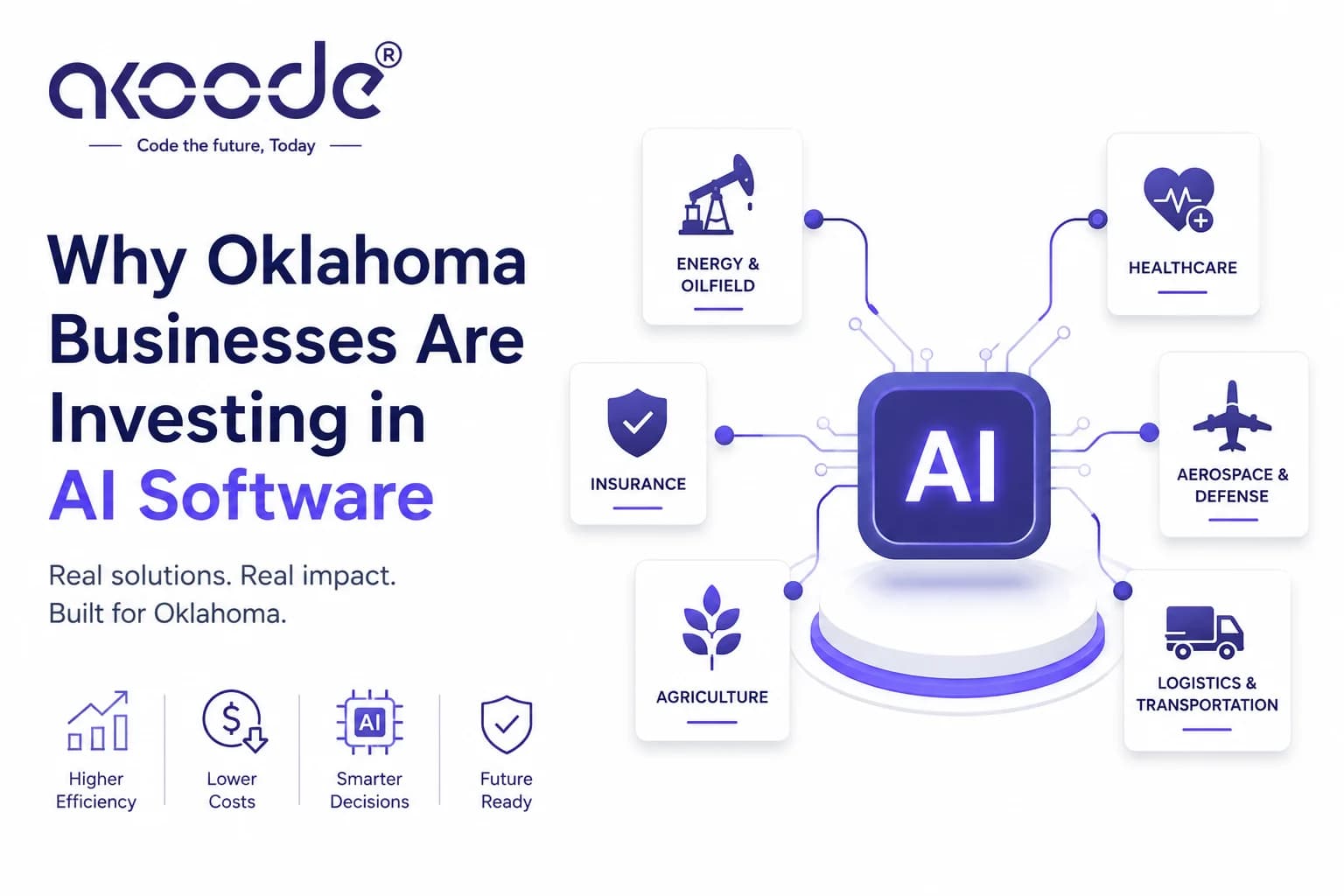
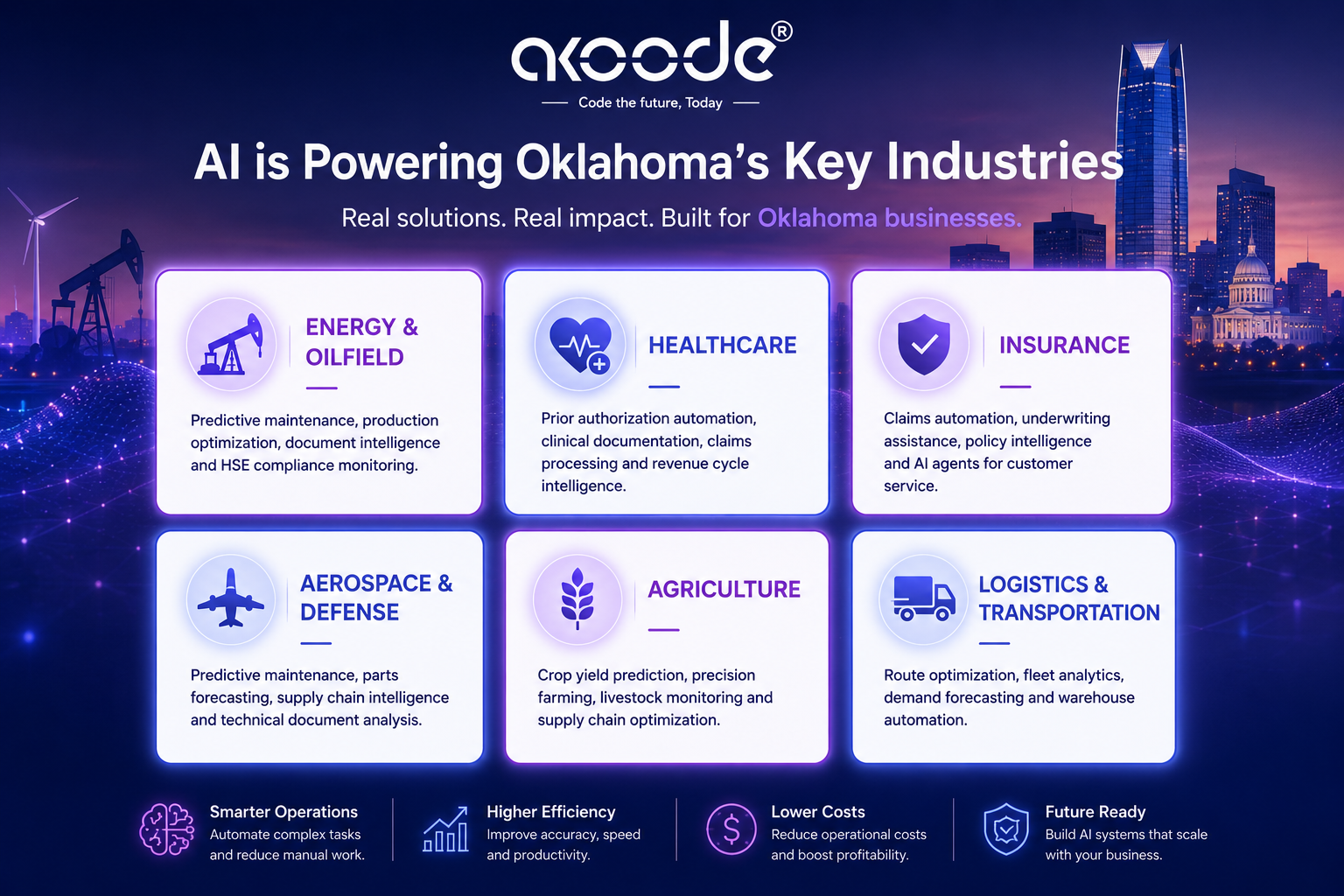
None of this is experimental. It's applied AI, pointed at the industries Oklahoma already runs on — energy, healthcare, insurance, aerospace, agriculture, and logistics.
And here's the part that matters for your business: the companies deploying it aren't tech giants. They're mid-market Oklahoma operators who realized that AI's economics finally work at their scale. A document-processing system that cost $500,000 to build in 2021 costs $60,000–$120,000 today. An AI agent that handles routine customer queries costs less than one full-time hire.
This guide covers why Oklahoma businesses are making the investment now, what's actually being built sector by sector, what it costs, and how to start without burning money on a science project.
Why Now: The Three Forces Driving Oklahoma AI Investment
Oklahoma businesses aren't adopting AI because it's fashionable. Three practical forces converged, and the math changed.
First, the cost of building AI collapsed. Five years ago, custom AI meant hiring ML PhDs and training models from scratch — a seven-figure commitment reserved for enterprises. Modern large language models (GPT-4o, Claude, Gemini) changed that completely. Today, AI development means connecting proven models to your business data through architectures like RAG (retrieval-augmented generation). The engineering is faster, cheaper, and dramatically more reliable. Projects that were enterprise-only in 2021 are mid-market accessible in 2026.
Second, the labor math got serious. Oklahoma's dominant industries are labor-intensive in exactly the ways AI compresses best: document review, data entry, scheduling, claims processing, compliance checks, dispatch coordination. When a claims processor costs $55,000/year fully loaded and an AI system handles 70% of routine claims for a fraction of that — permanently, without turnover — the ROI conversation gets short.
Third, the competition moved first. Texas energy operators, Kansas City insurers, and national healthcare systems are already deploying AI into the same markets Oklahoma companies compete in. For a Tulsa energy services firm bidding against a Houston competitor whose back office runs 40% leaner on AI, this stopped being optional strategy and became defensive necessity.
The result: AI went from "interesting" to "budgeted" across Oklahoma's mid-market in about eighteen months.
What Oklahoma Businesses Are Actually Building, Sector by Sector
Forget the generic AI use-case lists. Here's what's genuinely being deployed in Oklahoma's core industries.
Energy and Oilfield Operations
This is Oklahoma's deepest AI opportunity, and the use cases are concrete:
Predictive maintenance — models trained on sensor data flag pump, compressor, and rig equipment failures days before they happen, converting unplanned downtime into scheduled service
Production optimization — AI analyzing well performance data to recommend choke settings, artificial lift adjustments, and workover priorities
Land and lease document intelligence — extracting terms, obligations, and expiration dates from thousands of lease documents that currently get reviewed by hand
Royalty and JIB automation — AI-assisted division order processing and joint interest billing review, cutting error rates in the most dispute-prone paperwork in the industry
HSE compliance monitoring — automated review of safety documentation and incident reports against regulatory requirements
The economics here are unusually strong because the downside costs are enormous. One day of unplanned downtime on a producing well can exceed the annual cost of the AI system watching it.
Healthcare
Oklahoma's healthcare systems face the same administrative crush as everywhere else — with tighter margins. AI is being deployed for:
Prior authorization automation — the single most-requested use case we see from Oklahoma providers
Clinical documentation — AI drafting visit notes from recorded encounters, returning hours per day to physicians
Patient scheduling and no-show reduction — AI agents handling reminders, rescheduling, and intake
Claims processing and denial management — pattern analysis on denials plus automated appeal drafting
Revenue cycle intelligence — flagging coding issues before claims go out
Every one of these lives under HIPAA, which shapes the entire architecture — HIPAA-eligible infrastructure, BAAs with every vendor touching PHI (including your LLM provider), encryption, and audit logging. Our healthcare software development practice builds AI systems with that compliance designed in from Phase 1, because in healthcare, a system that can't pass an audit can't ship.
Insurance
Oklahoma City has a genuine insurance sector — American Fidelity is one of the metro's top developer employers — and insurance is arguably the single best-fit industry for current AI:
Claims triage and processing — routing, document extraction, fraud signal detection
Underwriting assistance — AI-assembled risk profiles from applications, records, and third-party data
Policy document intelligence — instant answers from policy language for both agents and customers
Customer service agents — handling routine policy queries, billing questions, and claims status (here's how AI support agents work in practice)
Insurance runs on documents and rules. That's precisely what modern AI handles best.
Aerospace and Defense
The ecosystem around Tinker AFB — one of the largest employers in the state — generates real AI demand: predictive maintenance for aircraft systems, supply chain and parts forecasting, technical documentation intelligence, and quality control via computer vision.
One critical caveat: defense-adjacent AI work frequently triggers CMMC and ITAR requirements that mandate US-persons-only engineering teams. If your project touches controlled data, confirm compliance requirements before shortlisting any vendor — it eliminates entire categories immediately. Our guide to choosing a software development company in Oklahoma covers exactly how to run that filter.
Agriculture
Oklahoma's ag economy is adopting AI faster than most people realize: yield prediction from satellite and weather data, livestock health monitoring via computer vision, equipment predictive maintenance, and commodity market intelligence. The tools that were Silicon Valley demos three years ago are working products on Oklahoma operations today.
Logistics and Distribution
Sitting at the crossroads of I-35 and I-40, Oklahoma moves freight. AI applications: route optimization, demand forecasting, warehouse automation, and document processing for bills of lading and customs paperwork.
What AI Software Development Costs in Oklahoma
Let's get concrete, because vague AI pricing is how businesses end up either overpaying or under-scoping.
AI engineers carry a 20–30% premium over general developers. In Oklahoma, senior AI/ML engineers bill $140–$185/hour locally — below coastal AI rates but above the state's standard development pricing. (Full context on general rates in our Oklahoma software development cost guide.)
Here's what complete AI projects run:
AI Project Type | Oklahoma Agency | Global Partner (Akoode) | Timeline |
|---|---|---|---|
AI chatbot / support agent | $40,000–$110,000 | $18,000–$55,000 | 6–14 weeks |
Document processing / extraction | $55,000–$150,000 | $25,000–$70,000 | 8–16 weeks |
LLM-powered internal tool (RAG) | $65,000–$170,000 | $30,000–$80,000 | 10–20 weeks |
Predictive maintenance system | $90,000–$250,000 | $45,000–$120,000 | 14–24 weeks |
Computer vision system | $90,000–$240,000 | $50,000–$120,000 | 12–24 weeks |
AI-integrated enterprise platform | $200,000–$550,000+ | $95,000–$250,000 | 6–18 months |
Two things to understand about these numbers.
The gap between local and global pricing isn't a quality gap. A senior AI engineer working with GPT-4o, LangChain, and Pinecone produces the same architecture whether they sit in Oklahoma City or Gurugram. What changes is the salary structure underneath.
Ongoing costs are separate and permanent. LLM API fees, vector database hosting, and infrastructure run $500–$15,000/month depending on volume. Model monitoring and retraining adds 15–20% of build cost annually. Any vendor who doesn't raise this in the first conversation is deferring the cost, not eliminating it.
Add the compliance layer where it applies: HIPAA adds 15–20% for healthcare AI. CMMC/ITAR reshapes defense-adjacent projects entirely. Energy projects touching pipeline or utility infrastructure face federal cybersecurity directives.
The ROI Math That's Driving the Investment
Abstract percentages don't move budgets. Worked examples do. Here are two patterns we see repeatedly in Oklahoma.
Example 1: Insurance claims processing (OKC mid-market carrier)
Current state: 4 claims processors handling routine claims at ~$55,000/year fully loaded each = $220,000/year
AI system handles 70% of routine claims volume; team reduces to 2 processors handling complex cases
Build cost: $65,000 | Ongoing: $2,500/month ($30,000/year)
Year 1: $110,000 labor savings – $95,000 total cost = modest positive
Year 2 onward: $110,000 savings – $30,000 ongoing = $80,000/year, recurring
Plus the unquantified gains: faster claims turnaround, fewer errors, no turnover risk on routine work
Example 2: Energy predictive maintenance (Tulsa-area operator)
Current state: reactive maintenance; 3–4 unplanned downtime events per year at $40,000–$150,000 each
AI system flags failures early, converting most unplanned events to scheduled service
Build cost: $110,000 | Ongoing: $3,000/month
Preventing just two mid-size downtime events per year covers the entire system cost
Everything after that is margin
The pattern across both: AI ROI in Oklahoma is strongest where the work is repetitive, document-heavy, or downtime-expensive. Which describes most of the state's economy.
How to Start Without Burning Money on a Science Project
Most failed AI projects fail the same way: a business buys "AI" as a category instead of solving a specific problem. Here's the sequence that works.
Step 1: Name the specific, expensive problem. Not "we want to use AI." Something like: "Our landmen spend 25 hours a week extracting terms from lease documents, and 80% follow standard formats." That sentence transforms every vendor conversation you'll have.
Step 2: Check your data before anything else. Is it accessible? Digitized? Structured enough for a model to learn from or retrieve against? Most AI projects that fail in Oklahoma fail on data, not models. If your leases are in filing cabinets, the first project is digitization — and that's fine, it just changes the sequence.
Step 3: Start with one workflow, not a platform. A focused $50,000 system that automates one painful process teaches you more — and returns more — than a $300,000 "AI transformation" that tries to do everything. Win once, then expand.
Step 4: Demand a paid discovery phase. $5,000–$15,000 for a proper discovery that assesses your data, defines success metrics, and produces a realistic scope. Vendors who skip discovery to quote fast are guessing with your money.
Step 5: Ask the questions that filter AI vendors. Show me an AI system in production for 12+ months. Walk me through your RAG architecture decisions. How do you prevent hallucination? What's your model evaluation process? Have you shipped under HIPAA or CMMC? Most vendors fail three of these five. The ones who pass are your shortlist.
Local vs. Global for Oklahoma AI Work: The Honest Answer
Factor | Local OK Agency | Global Partner (Akoode) |
|---|---|---|
Senior AI engineer rate | $140–$185/hr | $45–$75/hr |
AI project cost | Baseline | 45–60% lower |
AI/LLM specialist depth | Thin — small local pool | Deep bench |
Energy/sector domain knowledge | Often strong | Verify per vendor |
CMMC / ITAR eligibility | Yes, if certified | Generally no |
Time zone | Same (CT) | 3–4 hr overlap, async otherwise |
Production AI track record | Varies widely | Verify — demand proof either way |
The honest read: Oklahoma's local AI talent pool is genuinely thin. The state has excellent general developers, but production AI experience — real RAG systems, model evaluation frameworks, deployed LLM applications — is scarce locally. That's not a knock on Oklahoma; it's the reality of a specialization that concentrated in bigger markets.
Which means for most Oklahoma AI projects, the practical choice is between a local firm learning AI on your budget, or a global partner with production AI depth at half the rate. The exceptions are defense-adjacent work (where CMMC/ITAR mandates local) and projects where deep energy-domain knowledge outweighs AI-specific experience.
Akoode Technologies sits in a specific position here: global AI engineering depth — GPT-4o, Claude, LangChain, Pinecone, production deployments across healthcare, fintech, and e-commerce — with a US presence in Oklahoma. You get specialist AI capability at global economics, with local accountability and Central Time communication.
Frequently Asked Questions
Why are Oklahoma businesses investing in AI software now?
Three reasons converged: AI development costs collapsed (modern LLMs replaced seven-figure custom model builds with $50,000–$150,000 applied projects), the labor math turned decisive in Oklahoma's document-heavy industries, and competitors in Texas and nationally moved first. AI shifted from experimental to budgeted across the Oklahoma mid-market in roughly eighteen months.
How much does AI software development cost in Oklahoma?
Local Oklahoma agencies charge $40,000–$110,000 for an AI chatbot or support agent, $65,000–$170,000 for an LLM-powered internal tool with RAG, and $200,000–$550,000+ for enterprise AI platforms. Senior AI engineers bill $140–$185/hour locally. Global partners deliver equivalent scope 45–60% lower. Budget separately for ongoing costs of $500–$15,000/month plus 15–20% of build cost annually for model maintenance.
What industries in Oklahoma benefit most from AI?
Energy (predictive maintenance, lease document intelligence, production optimization), healthcare (prior authorization, clinical documentation), insurance (claims automation, underwriting assistance), aerospace (predictive maintenance around the Tinker AFB ecosystem), agriculture (yield prediction, livestock monitoring), and logistics (route optimization, freight documentation). The common thread: repetitive, document-heavy, or downtime-expensive work.
What is RAG and why does it matter for Oklahoma businesses?
Retrieval-Augmented Generation grounds AI responses in your actual business data — your leases, policies, maintenance manuals — rather than the model's training data. It retrieves relevant content at query time and answers from that, which prevents hallucination (the AI confidently inventing facts). For regulated Oklahoma industries like healthcare and insurance, RAG is a requirement, not a feature.
How long does it take to build an AI system for an Oklahoma business?
A focused AI agent takes 6–14 weeks. An LLM-powered tool with proper RAG architecture takes 10–20 weeks. A predictive maintenance system takes 14–24 weeks. Enterprise AI platforms run 6–18 months. These assume your data is accessible and reasonably clean — data preparation frequently adds weeks that first-time buyers don't anticipate.
Does my Oklahoma business have enough data for AI?
Probably more than you think — but format matters more than volume. Modern RAG systems work well with hundreds of documents, not millions. The real questions: is your data digitized, accessible, and reasonably structured? If your critical documents live in filing cabinets or scattered spreadsheets, the first project is data organization. A proper discovery phase answers this in two weeks for $5,000–$15,000.
What compliance issues affect AI projects in Oklahoma?
HIPAA for healthcare AI adds 15–20% to build costs and requires BAAs with every vendor touching patient data, including your LLM provider. Defense-adjacent work around Tinker AFB can trigger CMMC and ITAR requirements mandating US-persons-only teams. Energy projects touching pipeline or grid infrastructure face federal cybersecurity directives. Compliance belongs in Phase 1 architecture, not Phase 3 patching.
Should I use a local Oklahoma AI company or a global partner?
Oklahoma's local production-AI talent pool is thin — excellent general developers, but scarce hands-on LLM and RAG deployment experience. For most AI projects, the practical choice is a global partner with real production depth at 45–60% lower cost. The exceptions: CMMC/ITAR-restricted defense work (local mandatory) and projects where deep energy-domain knowledge outweighs AI specialization. Vet either type the same way — demand proof of AI in production for 12+ months.
Can a small Oklahoma business afford AI?
Yes — this is the biggest change since 2021. A focused AI agent handling customer queries or document processing starts around $18,000–$55,000 with a global partner, less than one full-time hire. The key is starting with one workflow, not a platform. Small businesses that win with a $30,000 focused system expand from there; ones that attempt $300,000 transformations usually don't finish them.
What's the first step for an Oklahoma business considering AI?
Write one sentence naming the specific, expensive problem: "Our team spends X hours a week on Y, and Z% of it follows predictable patterns." Then check whether the relevant data is digitized and accessible. Then talk to two or three vendors — including at least one who will tell you honestly whether your project is worth doing at all.
The Bottom Line
Oklahoma's AI moment isn't about chasing technology. It's about arithmetic that finally works.
The state's economy runs on exactly the workflows modern AI compresses best — lease documents, claims files, maintenance logs, prior authorizations, freight paperwork. The build costs dropped into mid-market range. And the competitors who moved first are already operating leaner.
The businesses getting this right share one habit: they started with a specific problem, checked their data, built one focused system, and expanded from the win. The ones getting it wrong bought "AI" as a category and funded science projects.
If you're weighing where your business fits, that's a conversation worth having before you commit to anything — and it's the conversation we offer.
Book a free 45-minute AI consultation → calendly.com/akhil-akoode/ak
We'll review your workflow, assess your data, surface the compliance requirements you'll hit, and give you a straight answer on scope, cost, and whether AI is even the right tool. Sometimes the answer is a $30,000 focused system. Sometimes it's a SaaS tool. Sometimes it's "not yet — digitize first." We'll tell you which.
Explore: Software Development Company in Oklahoma | AI development services | Oklahoma software costs | how to choose a vendor | akoode.com | contact us
Get In Touch Now
View More Our Blog