


 July 19, 2026
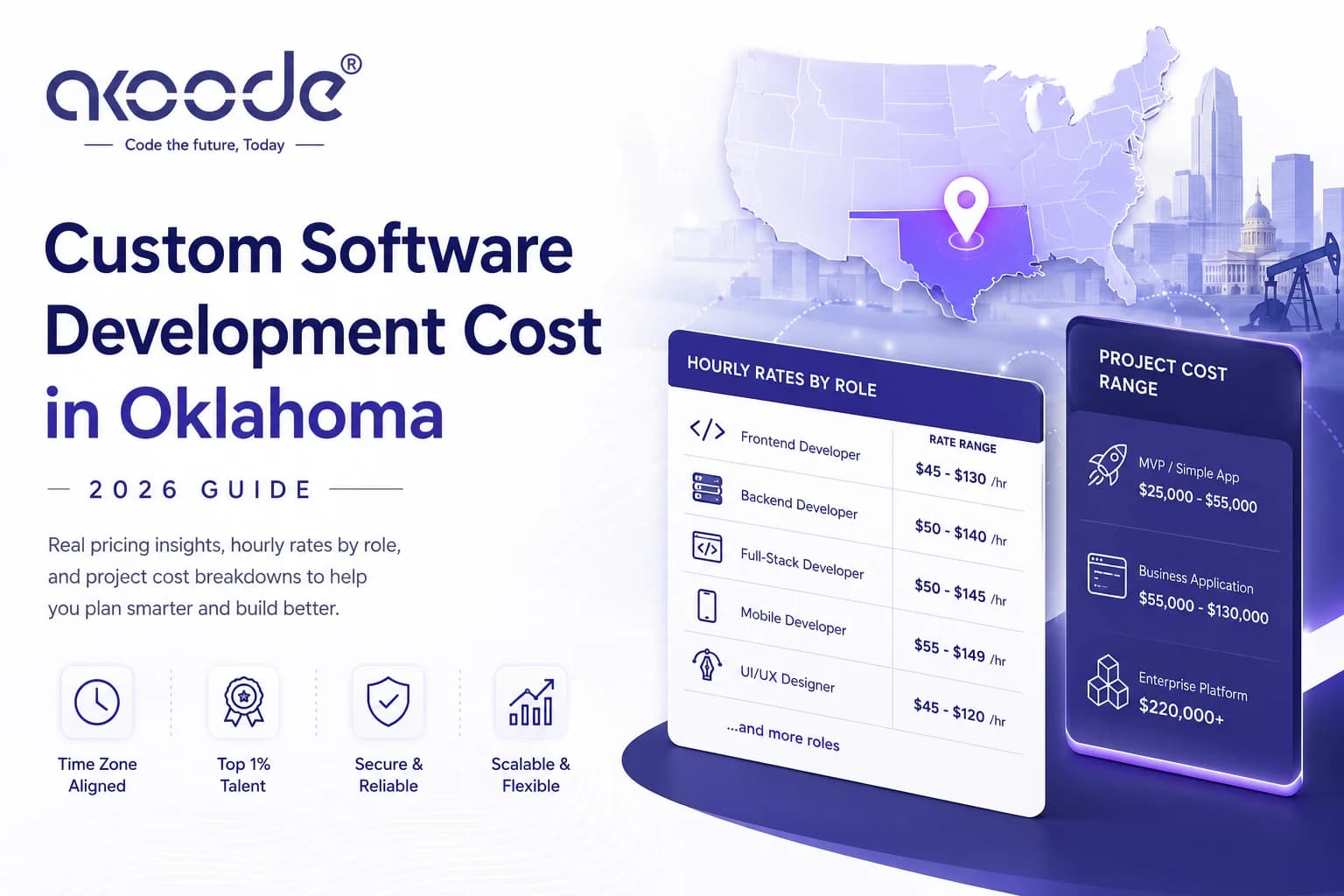
Custom Software Development Cost in Oklahoma (2026 Guide)
Oklahoma might be the best-kept secret in American software development.
While businesses in New York pay $130–$220 per hour and San Francisco companies swallow $250/hour rates, Oklahoma software development runs $50–$149 per hour — competitive rates that come in 10–20% below coastal metros without sacrificing North American time-zone alignment or English-language communication.
That's not a consolation prize. For companies headquartered in the Plains states, an Oklahoma team delivers genuine cultural fit and logistical ease at a price point that changes what's financially possible.
But "cheaper than the coasts" still doesn't tell you what your specific project will cost. A custom software build in Oklahoma can run anywhere from $25,000 for a simple MVP to $500,000+ for a complex enterprise platform — and understanding where your project lands in that range is exactly what this guide is for.
If you're an Oklahoma business planning a software project — in Oklahoma City, Tulsa, or anywhere across the state — here are the real numbers before you talk to a single vendor.
Why Oklahoma Software Costs What It Does
Every quote you'll receive is built on one foundation: what developers actually earn here. So let's start there.
The data varies slightly by source, which itself tells you something about the market:
Glassdoor puts the average Oklahoma software developer at $109,254/year ($53/hour) — 11% below the national average
Salary.com reports $119,544/year ($57/hour) statewide
Oklahoma City specifically: $107,921/year average, with top earners at $174,129
Tulsa: $108,185/year average, ranging up to $167,672 for the 90th percentile
Entry-level developers (Software Developer I) in Oklahoma average $75,590/year — roughly $36/hour in salary terms.
That 11–12% discount versus the national average is the structural advantage that flows through everything. Oklahoma's cost of living is among the lowest in the country, so developers here earn a comfortable living at salaries that would be untenable in Austin, Denver, or Dallas — let alone the coasts.
Now here's the part that surprises first-time software buyers: what you pay an agency is very different from what the developer earns. When a $110,000 developer joins an agency, the firm adds roughly 30–40% in benefits and employer costs, plus office space, project management, sales overhead, and margin. That's how a $53/hour salary becomes a $100–$149/hour billing rate.
It's not a markup scheme. It's how the economics of every services business work — in Oklahoma and everywhere else.
Oklahoma Developer Hourly Rates: The Full Breakdown
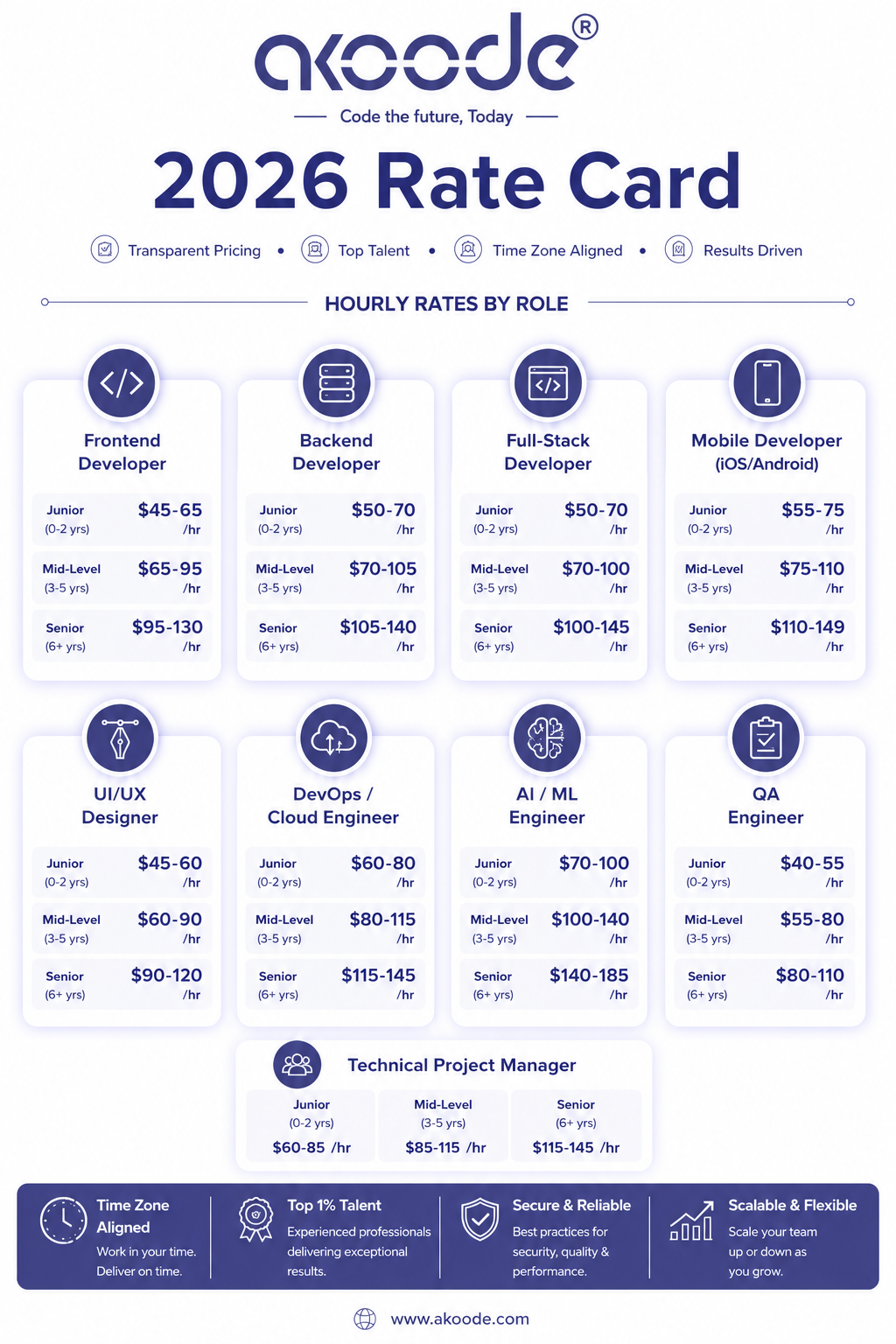
Clutch's verified data on Oklahoma City development firms puts the market at $50–$100/hour for mid-level talent and $100–$149/hour for senior engineers. Here's the fuller picture by role:
Role | Junior (0–2 yrs) | Mid-Level (3–5 yrs) | Senior (6+ yrs) |
|---|---|---|---|
Frontend Developer | $45–$65/hr | $65–$95/hr | $95–$130/hr |
Backend Developer | $50–$70/hr | $70–$105/hr | $105–$140/hr |
Full-Stack Developer | $50–$70/hr | $70–$100/hr | $100–$145/hr |
Mobile Developer (iOS/Android) | $55–$75/hr | $75–$110/hr | $110–$149/hr |
UI/UX Designer | $45–$60/hr | $60–$90/hr | $90–$120/hr |
DevOps / Cloud Engineer | $60–$80/hr | $80–$115/hr | $115–$145/hr |
AI / ML Engineer | $70–$100/hr | $100–$140/hr | $140–$185/hr |
QA Engineer | $40–$55/hr | $55–$80/hr | $80–$110/hr |
Technical Project Manager | $60–$85/hr | $85–$115/hr | $115–$145/hr |
Two observations worth making.
AI talent carries a premium here like everywhere else — roughly 20–30% above general development rates. And it's scarcer in Oklahoma than in bigger markets, which matters if your project has serious ML requirements. (We cover Oklahoma's growing AI scene in detail in our companion guide on AI software development in Oklahoma.)
The market has depth in specific sectors. The top-paying industries for Oklahoma developers are Information Technology (Paycom, Oracle), Insurance (American Fidelity), Aerospace & Defense (CACI International, Tinker AFB ecosystem), and Energy. If your project sits in one of those verticals, Oklahoma has genuine domain expertise. Outside them, the specialist pool thins quickly.
What Complete Projects Cost in Oklahoma
Hourly rates are inputs. Total project cost is what you actually budget for. Here's what complete builds run with Oklahoma-based teams in 2026:
Web Application Development
Project Type | Complexity | Oklahoma Cost | Timeline |
|---|---|---|---|
Marketing website / landing pages | Simple | $6,000–$18,000 | 3–6 weeks |
MVP / proof of concept web app | Simple-Medium | $25,000–$55,000 | 2–4 months |
Business web application | Medium | $55,000–$130,000 | 4–7 months |
SaaS platform | Medium-High | $100,000–$250,000 | 5–10 months |
Enterprise web platform | Complex | $220,000–$500,000+ | 9–18 months |
Mobile App Development
App Type | Oklahoma Cost | Notes |
|---|---|---|
Simple MVP (cross-platform) | $35,000–$70,000 | Flutter/React Native, iOS + Android |
Mid-complexity app | $70,000–$150,000 | Integrations, custom UI, backend |
Complex / enterprise app | $150,000–$350,000+ | Real-time data, security, multi-role |
Custom Software and Enterprise Systems
Project Type | Oklahoma Cost |
|---|---|
CRM or internal operations tool | $30,000–$100,000 |
Custom ERP system | $120,000–$400,000+ |
Healthcare platform (HIPAA-compliant) | $90,000–$320,000 |
Energy / oilfield management software | $80,000–$300,000 |
AI-integrated business application | $60,000–$250,000 |
Timeline benchmarks are consistent nationally: a simple MVP takes 2–4 months, a mid-complexity app 4–9 months, and enterprise platforms 9–18 months. Oklahoma teams don't build faster or slower than anyone else — geography changes cost, not physics.
One Oklahoma-specific note: energy sector software is a genuine local specialty. Oilfield operations, land management, royalty accounting, SCADA integrations — Oklahoma teams have domain knowledge here that coastal firms simply don't. If your project touches the energy vertical, that expertise is worth real money in avoided mistakes.
Where Your Budget Actually Goes
Most first-time buyers assume the budget goes to "coding." Here's how a $120,000 Oklahoma project actually distributes:
Phase | Share | Amount | What It Covers |
|---|---|---|---|
Discovery & strategy | 8–12% | $10K–$14K | Requirements, architecture, user research |
UI/UX design | 18–25% | $22K–$30K | Wireframes, prototypes, design system |
Frontend development | 25–35% | $30K–$42K | UI build, responsive design |
Backend & APIs | 20–30% | $24K–$36K | Server, database, auth, integrations |
QA & testing | 8–12% | $10K–$14K | Functional, performance, security |
Deployment & PM | 10–15% | $12K–$18K | DevOps, cloud, project management |
Notice that design and backend infrastructure together consume $46,000–$66,000 of a $120,000 budget — before a single user-facing screen ships. These aren't padding. Cut them and you get software that doesn't work, doesn't scale, or doesn't get used.
The Hidden Costs Oklahoma Vendors Rarely Quote Upfront
This is where projects exceed budget — not through dishonesty, but through costs that don't appear in initial proposals.
Third-party services start at launch and never stop. Stripe, Twilio, AWS or Azure hosting, email services, analytics. Budget $300–$8,000/month depending on your application, scaling with users.
Post-launch maintenance is permanent. Plan 15–20% of build cost annually. A $150,000 Oklahoma project carries $22,500–$30,000/year in updates, bug fixes, dependency management, and security patches — forever, starting day one.
Compliance costs are real in Oklahoma's dominant sectors. HIPAA for the state's substantial healthcare industry adds 15–20% to build costs. Energy sector projects touching pipeline or utility data face federal cybersecurity requirements (TSA Security Directives, NERC CIP for anything grid-adjacent). Aerospace and defense work — a major OKC sector anchored by Tinker AFB — can trigger CMMC and ITAR requirements that reshape the entire architecture.
Discovery is often skipped to win on price. A proper discovery phase costs $5,000–$15,000 in Oklahoma and prevents rework costing ten times more. Vendors who skip it to quote lower aren't cheaper — they're deferring the cost into change orders.
The practical rule: add 15–20% to any quote for your internal budget.
Oklahoma vs. Other Markets: The Honest Comparison
Here's where Oklahoma sits nationally and globally for custom software:
Market | Hourly Rate |
|---|---|
San Francisco / Silicon Valley | $150–$250/hr |
New York City | $130–$220/hr |
Dallas / Houston | $85–$155/hr |
Denver | $85–$150/hr |
Oklahoma (OKC / Tulsa) | $50–$149/hr |
Nearshore (Latin America) | $40–$80/hr |
Offshore (South Asia) | $25–$55/hr |
Oklahoma is the value play among US markets. But let's run the honest project math on a 2,000-hour SaaS build:
Team | Avg Rate | Total Cost |
|---|---|---|
Coastal agency | $180/hr | $360,000 |
Oklahoma agency (senior) | $125/hr | $250,000 |
Oklahoma agency (blended) | $90/hr | $180,000 |
Offshore (India, senior team) | $45/hr | $90,000 |
Even against Oklahoma's already-competitive rates, a well-managed offshore engagement cuts total cost by roughly half. The same $180,000 that buys a solid Oklahoma build funds a larger, more complete project — or the same project plus a year of runway — with the right global partner.
The standard caveat applies, and it's worth stating honestly: offshore done carelessly erodes its own savings through communication gaps and rework. The savings only stick with a senior team, disciplined process, and real US-hours communication overlap. That's a vendor-quality question, not a geography question.
Akoode Technologies is built for exactly this: a global engineering firm with a US presence in Oklahoma — meaning you get the cost structure of global delivery with genuine local accountability, US-hours communication, and a team that understands the Oklahoma market because we operate in it.
When Local Oklahoma Rates Are Worth Paying
Let's be straight rather than pretending one answer fits everyone.
Pay local Oklahoma rates when:
You need regular in-person collaboration — on-site integration, hardware work, or stakeholder sessions that benefit from being in the room
Your contracts require US-based vendors or onshore data handling — common in Oklahoma's defense and aerospace sector, where CMMC and ITAR can make it mandatory
Your project is short and tightly scoped (under 10 weeks), where coordination overhead could offset savings
Your project sits deep in a local specialty — energy operations software being the clearest example
Consider a global partner when:
Your requirements are clear and the engineering is standard — web apps, mobile, SaaS, integrations
Your project runs 3+ months, where the cost differential compounds
Your team can manage a vendor relationship with structured communication
Budget genuinely matters — where the difference between $250,000 and $90,000 funds marketing, hiring, or survival
And if you're weighing this decision seriously, our companion guide on how to choose a software development company in Oklahoma walks through the full vendor evaluation process — red flags, questions to ask, and contract terms that protect you.
A Practical Budget Framework
Before you talk to any vendor, run this five-step exercise:
1. Define your project tier honestly. MVP to test an idea? Production system replacing something? Net-new enterprise platform? Each has a different cost floor.
2. Separate must-have from nice-to-have. A tight MVP that does three things well costs half of a sprawling v1 that does twelve things adequately. Descoping is free and it's the biggest cost lever you have.
3. Add 15–20% for hidden costs. Third-party services, compliance, integration surprises. They always come.
4. Budget maintenance from day one. 15–20% of build cost, annually, forever. If this breaks your economics, better to know now.
5. Get three quotes and compare scope, not price. Two quotes $80,000 apart are almost never quoting the same thing. Itemize and compare line by line — the "cheap" quote usually stops being cheap.
Frequently Asked Questions
How much does software development cost in Oklahoma in 2026?
Oklahoma software development runs $50–$149/hour — $50–$100 for mid-level talent and $100–$149 for senior engineers. Complete projects range from $25,000 for a simple MVP to $500,000+ for complex enterprise platforms. A typical business web application runs $55,000–$130,000, and a SaaS platform runs $100,000–$250,000.
What do software developers earn in Oklahoma?
The average Oklahoma software developer earns $109,254–$119,544/year depending on the source — roughly $53–$57/hour in salary terms, about 11% below the national average. Oklahoma City averages $107,921 and Tulsa $108,185, with top earners in both cities reaching $167,000–$174,000. Entry-level developers average $75,590.
Is Oklahoma cheaper than Texas for software development?
Yes, modestly. Oklahoma rates ($50–$149/hour) run below Dallas/Houston ($85–$155/hour) and well below Austin ($90–$160/hour). Against coastal markets the gap is dramatic — Oklahoma rates are 10–20% below comparable metros and roughly half of San Francisco pricing, with full US time-zone alignment.
How much does a mobile app cost to build in Oklahoma?
A cross-platform mobile MVP runs $35,000–$70,000 with an Oklahoma team. Mid-complexity apps with integrations run $70,000–$150,000. Complex enterprise apps run $150,000–$350,000+. Most builds now use Flutter or React Native to cover iOS and Android from a single codebase.
What compliance requirements affect Oklahoma software projects?
HIPAA for the state's large healthcare sector adds 15–20% to build costs. Energy sector projects can trigger federal pipeline cybersecurity directives and NERC CIP requirements. Aerospace and defense work — a major OKC industry around Tinker AFB — may require CMMC and ITAR compliance, which fundamentally shapes architecture and can mandate US-based teams.
How long does a software project take in Oklahoma?
Timelines match national benchmarks: a simple MVP takes 2–4 months, a mid-complexity application 4–9 months, and an enterprise platform 9–18 months. Geography changes cost, not speed.
What does software maintenance cost after launch?
Plan 15–20% of your original build cost annually, starting at launch. A $150,000 project carries $22,500–$30,000/year in ongoing updates, bug fixes, security patches, and compatibility work. This is permanent and most founders forget to budget it.
Should I hire an Oklahoma software company or go offshore?
If you need in-person collaboration, defense-sector compliance (CMMC/ITAR), or deep energy-vertical expertise, local Oklahoma teams make sense. For standard web, mobile, and SaaS work, a well-managed global partner delivers equivalent quality at roughly half of even Oklahoma's competitive rates. Akoode Technologies offers a middle path — global delivery economics with a US presence in Oklahoma and local accountability.
Why are Oklahoma software rates lower than other states?
Cost of living. Oklahoma's living costs are among the lowest in America, so developers earn comfortable livings at salaries 11–12% below the national average. That flows directly into agency rates that undercut coastal metros by 10–20% or more — with no time-zone or language trade-offs.
What's the cheapest way to build quality software in Oklahoma?
Scope discipline first — a focused MVP beats a sprawling v1. Then team structure — a global partner with disciplined management delivers Oklahoma-equivalent quality at roughly half the cost. Then engagement model — a dedicated team for long-running work costs less over 12 months than repeated fixed-price projects with ramp-up costs each time.
The Bottom Line
Oklahoma offers some of the best software development value in America — real engineering talent at rates 10–20% below comparable metros, with deep domain expertise in energy, healthcare, insurance, and aerospace.
But value still requires judgment. The difference between a project that ships on budget and one that doubles it isn't the hourly rate — it's scope discipline, honest discovery, compliance planned in Phase 1, and a maintenance budget written down before you sign anything.
Whether the right answer for your project is a local Oklahoma team, a global partner, or something in between depends on your specific requirements — and that's a conversation worth having before you commit to any number.
That's exactly the conversation we offer.
Book a free consultation → calendly.com/akhil-akoode/ak
No pitch. No pressure. A straight conversation about what your project needs and what it should realistically cost.
Explore: Software Development Company in Oklahoma | akoode.com | AI development | custom software | mobile apps
© 2026 Akoode Technologies | akoode.com/usa/oklahoma/software-development-company | calendly.com/akhil-akoode/ak
Get In Touch Now
View More Our Blog