



 July 19, 2026
How to Choose a Software Development Company in Oklahoma: The 2026 Buyer's Guide
The Oklahoma software market has a quality problem — and it's not the one you'd expect.
The problem isn't a lack of good developers. Oklahoma City and Tulsa have genuine engineering talent, anchored by employers like Paycom, Oracle, CACI International, and the aerospace ecosystem around Tinker AFB. The problem is that the market is small enough that most buyers have no basis for comparison.
In New York, a founder can interview nine agencies and triangulate. In Oklahoma, you might find four credible local candidates — and if two of them give you wildly different quotes, you have no easy way to know which one is right.
That's what this guide fixes. It's the vendor evaluation process we'd walk an Oklahoma business through in a private advisory session: how the local market actually works, what things should cost, which red flags predict failure, and how to decide between a local team, a global partner, or a hybrid of both.
A Tulsa operations director told us last year that she'd received three quotes for the same internal tool: $45,000, $110,000, and $190,000. Same requirements document. Same deadline. By the end of this article, you'll understand exactly why that happens — and how to figure out which quote was actually right.
The Oklahoma Vendor Landscape: What You're Actually Choosing Between
Before evaluating anyone, understand the categories. Oklahoma's market has five distinct types of vendor, and they are not interchangeable.
Local specialist agencies. Small-to-mid firms in OKC and Tulsa, typically 5–50 people. The best of them have deep roots in Oklahoma's dominant sectors — energy, healthcare, insurance, aerospace. Rates run $50–$100/hour for mid-level talent and $100–$149/hour for senior engineers. Right for: projects that benefit from local presence and sector knowledge. The risk: small teams mean key-person dependency — if their one senior architect leaves mid-project, you feel it immediately.
Freelancers and small dev shops. Oklahoma has a healthy freelance market at $40–$90/hour. Excellent for narrow, well-defined tasks — a specific integration, a website rebuild, a contained tool. Structurally risky for multi-month product builds, where one person's illness or departure stalls everything.
Regional firms from Dallas and Kansas City. Larger agencies from neighboring metros serve Oklahoma clients at Dallas-adjacent rates — $85–$155/hour and up. You get more organizational depth but lose local presence, and you're often not their priority client.
Offshore-disguised vendors. They exist here too — a local-sounding name, a US phone number, and an undisclosed delivery team abroad. You pay US rates for offshore-cost delivery, and the margin goes to the middleman. The issue isn't offshore work — it's the concealment and the markup you're absorbing without benefit.
Global firms with genuine Oklahoma presence. This is Akoode's model: global engineering delivery with a real US presence in Oklahoma. You get global cost structure — typically 40–60% below even Oklahoma's competitive local rates — with US-hours communication, local accountability, and a team that understands the market because we operate in it. Right for: businesses that care about outcomes and total cost more than office geography. Wrong for: projects with defense-sector requirements (CMMC, ITAR) that mandate US-based engineering teams — and in Oklahoma, that's a real category.
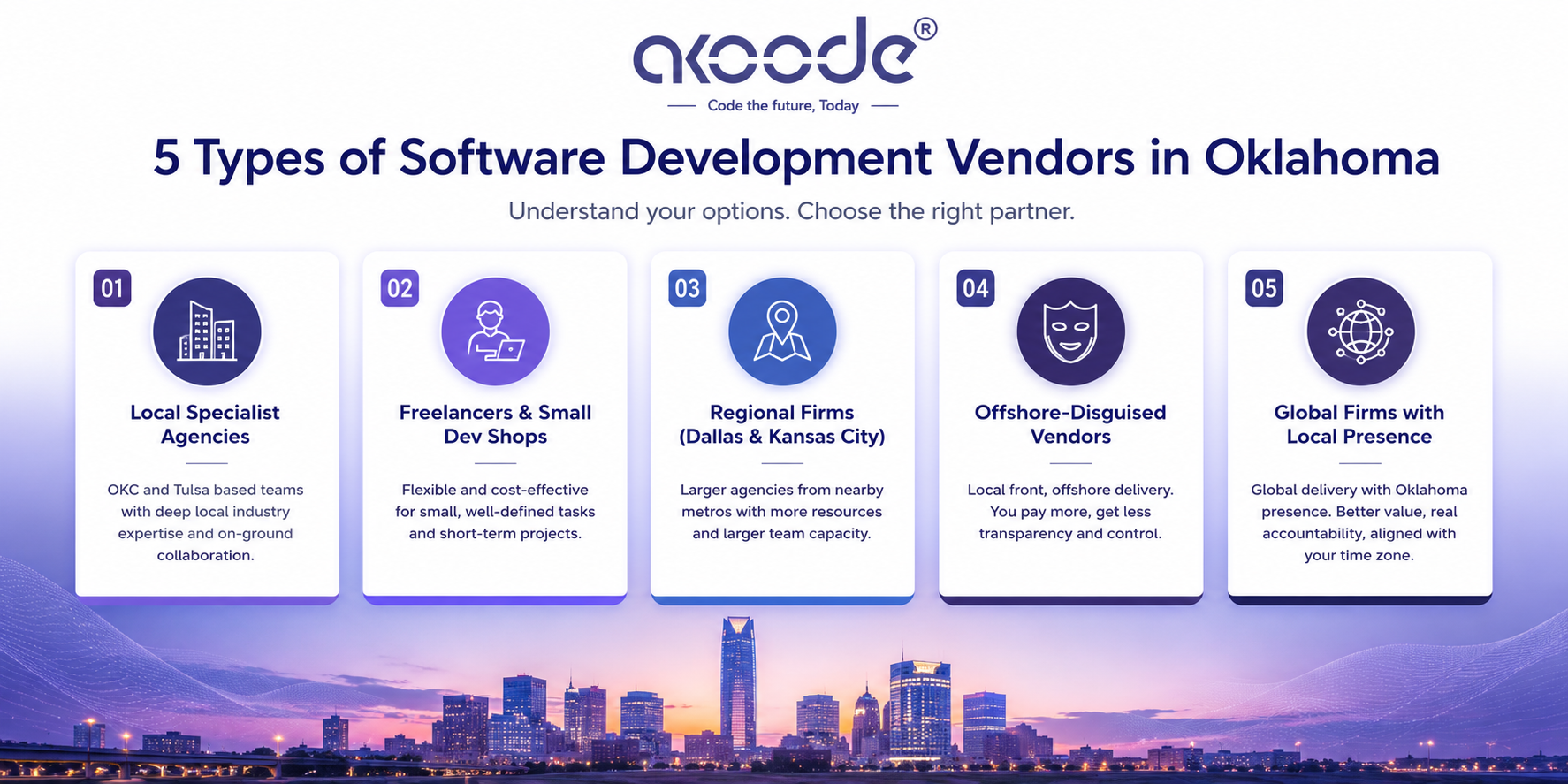
Know which type you're talking to before the first call. Half the confusion in the Tulsa director's three-quote story came from comparing across categories without realizing it.
Step-by-Step: How to Run the Hiring Process
Step 1: Write Your One-Page Project Definition First
Before any vendor conversation, write down:
The business problem — not the feature list. "Our field techs lose two hours a day on paper work orders" is a problem. "We want a mobile app" is a solution someone talked you into.
Success in numbers. Ticket volume down 40%. Dispatch time cut in half. Manual data entry eliminated.
Your real budget range — including the 15–20% reserve every experienced buyer holds, and the 15–20% annual maintenance cost that starts at launch. (Our full Oklahoma cost guide has the complete numbers for sanity-checking quotes.)
Your honest timeline and what's driving it.
What already exists — the systems the new software must connect to.
Vague briefs get vague proposals. Vague proposals are where budget overruns are born.
Step 2: Build a Candidate List From Real Sources
In a small market, sourcing matters more, not less:
Referrals from Oklahoma businesses that have shipped. The single best signal. Ask specifically: "Would you hire them again, and what went wrong?" Everyone has a "what went wrong." The honest ones tell you.
Clutch and GoodFirms verified reviews. Read the 3- and 4-star reviews — that's where the texture lives. Oklahoma City has a verified Clutch category; use it.
LinkedIn — the engineers, not the company page. Check team size, tenure, and whether the staff the sales deck describes actually exists. In a small market, a firm claiming 40 engineers with 12 visible on LinkedIn deserves a question.
Portfolio products you can actually use. Ten minutes inside a live product beats an hour of case study PDFs.
Aim for 4–6 candidates — realistic for this market. Include at least one global partner in the mix so you have a genuine price and capability comparison, not just local-vs-local.
Step 3: Evaluate Like an Investigator
Don't ask "do these portfolios look good?" Ask:
Is the product still live? Dead links deserve direct questions.
What was the firm's actual role? "We built it" sometimes means "we built one module for a subcontractor."
Is anything at your scale? A firm whose showcase is all enterprise energy platforms is mismatched to your $60K startup build — and vice versa.
Is anything in your sector? Oklahoma vendors with real energy, healthcare, or insurance experience know things coastal generalists don't — what a JIB statement is, what HIPAA actually requires, how royalty accounting works. That knowledge is worth real money in avoided mistakes.
Tip: Ask every finalist for one reference from a project that had problems. How a firm handles a rocky project tells you more than how they handle an easy one. A firm claiming zero difficult projects is telling you something — just not what they think.
Step 4: Take Discovery Calls and Listen for Patterns
Beyond the specific questions (full list below), listen for three things:
Who talks? If it's 100% salesperson and zero engineers, ask to meet the technical lead before a second call.
Do they push back? A firm that agrees with every idea you float isn't evaluating your project — they're closing a deal. The best partners tell you in the first call which of your assumptions look shaky.
Do they talk about your business or their process? Forty minutes of methodology and five minutes on your problem reveals their priorities.
Step 5: Read Proposals Where the Truth Hides
Compare scope line-by-line, never headline price. Build a spreadsheet: discovery, design, frontend, backend, QA, DevOps, PM, post-launch support. Mark what's in each proposal. This exercise is exactly how you decode the $45K/$110K/$190K spread — the cheap quote almost always excludes discovery, QA, and support, and stops being cheap once you add them back.
Look for named assumptions. Good proposals state them: "Assumes client provides API documentation for the existing dispatch system." Proposals without assumptions haven't thought hard enough to have any — which means they exist unspoken, and unspoken assumptions become change orders.
Check what happens after launch. If the proposal ends at deployment, the relationship is designed to end at deployment. Someone has to fix the bug you find in week three.
Step 6: Negotiate the Contract Terms That Actually Matter
IP assignment on payment, not project completion. You own what you've paid for, even if the engagement ends early.
Source code access from day one. Your repo, or full access to theirs. Never accept seeing the code only at handoff.
A defined change-order process with rates in writing.
A clean exit clause. 30 days' notice, orderly handover, payment for work completed.
Payment structure: 25–30% against a defined first milestone is market standard. A firm demanding 50%+ before discovery has cash flow or churn problems — and either one is about to become yours.
Red Flags Worth Walking Away From
From real Oklahoma engagements — ours and our clients' previous ones:
A price in the first call. Real estimates require discovery. A first-call number is a sales tactic calibrated to what they think you'll pay.
No engineers in the sales process. The people building your product are hidden for a reason.
"Yes" to everything. Real engineering involves trade-offs. A firm surfacing none is inexperienced or closing.
No assumptions section in the proposal. They'll surface later as change orders.
50%+ deposit demanded before discovery.
Won't share a reference from an imperfect project.
Evasive about team location. "We have a global presence" is not an answer to "where will my engineers be?"
Visible high turnover on LinkedIn. In a small market, this is easy to check — and if engineers last 8 months at a firm, your 12-month project will outlive its own developers.
Slow, sloppy communication during sales. This is their best behavior. It degrades from here.
They trash every previous vendor you mention. Occasionally a prior firm really failed. A pattern of blame is a pattern.
The 15 Questions to Ask Before Signing
Who exactly will work on my project, and can I meet them before signing? — Confirms the sold team is the delivered team.
Where are those people located? — Surfaces offshore-in-disguise immediately.
Show me a live product you built that's been in production 12+ months. — Separates shippers from demo-makers.
What was your specific role on it? — Filters inflated portfolio claims.
What's your average variance from original estimates, and why? — Honest firms have a number and a reason. "We always deliver on time" is a lie.
Tell me about a project that went badly. What changed afterward? — The single most revealing question on this list.
What does your discovery phase produce and cost? — In Oklahoma, expect $5,000–$15,000 for proper discovery. Firms that skip it to quote lower are deferring cost into change orders.
How do you price change requests? — Rates and turnaround in writing, before you need them.
Who owns the IP and when does it transfer? — You, on payment.
Do I get repo access from day one? — Non-negotiable.
What's your QA process, and who does it? — "Developers test their own code" is not a QA process.
Have you worked under HIPAA / CMMC / energy-sector cybersecurity requirements? — Oklahoma's dominant sectors each carry real compliance obligations. Not "can you." Have you.
What does post-launch support cost and include? — Budget 15–20% of build cost annually; get their number.
What does week one look like? — Firms with real onboarding describe it instantly: shared project tools, communication rhythm, structured kickoff.
Why would you be the wrong choice for some clients? — Honest self-awareness here predicts honest communication everywhere.
Local Oklahoma Agency vs. Global Partner: The Honest Comparison
Factor | Local OK Agency | Global Partner (Akoode) |
|---|---|---|
Senior rate | $100–$149/hr | $45–$75/hr |
Total project cost | Baseline (already good value) | 40–60% lower still |
In-person meetings | Easy | Video-first, OK presence for key sessions |
Time zone | Same (CT) | 3–4 hr overlap, async otherwise |
Sector depth (energy, aerospace) | Often strong | Verify per vendor |
CMMC / ITAR eligibility | Yes, if certified | Generally no — real constraint |
Team scaling | Constrained by small local pool | Fast — deeper talent bench |
Key-person risk | Higher at small firms | Lower — bench depth |
Engagement models | Usually fixed price or T&M | Fixed, T&M, dedicated teams |
The honest read: Oklahoma local rates are already among the best in America — which makes this a closer call than in New York or California. The deciding factors are usually compliance (defense work mandates local), sector depth (energy software favors local specialists), and scale (larger builds favor the deeper bench and lower rates of a global partner).
Many Oklahoma businesses land on a hybrid: local discovery and stakeholder work, global delivery for the build. That structure captures both advantages.
The Decision Framework
Answer these five questions:
Does your project require CMMC, ITAR, or other defense-sector compliance? (Common around Tinker AFB and OKC's aerospace corridor)
Does your project sit deep in a local specialty — energy operations, oilfield software, royalty accounting?
Do you need regular in-person collaboration?
Is your project under 10 weeks with fully locked scope?
Is your budget genuinely comfortable at local rates?
Three or more yes → local Oklahoma agency. The local premium is buying something real for your situation.
Zero or one yes → global partner. Even against Oklahoma's competitive rates, you'd be leaving 40–60% of your budget on the table for geography you don't need.
Two yes → hybrid. Fixed-price discovery with a team you can meet, then global delivery for the build. Increasingly the default for experienced Oklahoma buyers.
And if AI is part of your project, read our companion guide on why Oklahoma businesses are investing in AI software before you scope anything — AI projects add evaluation criteria that general software hiring misses entirely.
Frequently Asked Questions
How do I hire software developers in Oklahoma?
Start with a one-page project definition — business problem, success metrics, budget range, timeline, existing systems. Then build a list of 4–6 candidates from referrals, Clutch, and GoodFirms, including at least one global partner for comparison. Run structured discovery calls with the 15 questions in this guide, compare proposals line-by-line on scope rather than headline price, and check references with the "what went wrong" question.
How much does it cost to hire a software development company in Oklahoma?
Oklahoma agencies bill $50–$100/hour for mid-level talent and $100–$149/hour for senior engineers — 10–20% below comparable metros. Complete projects run $25,000–$55,000 for an MVP, $55,000–$130,000 for a business application, and $100,000–$250,000 for a SaaS platform. Global partners deliver equivalent scope 40–60% lower. Full breakdown in our Oklahoma cost guide.
Should I hire a freelancer or a software company in Oklahoma?
Freelancers ($40–$90/hour) work well for narrow, contained tasks — an integration, a website, a small tool. For multi-month product builds, a company provides coordinated engineering, QA, project management, and continuity when someone leaves. One freelancer's departure can stall an entire product; a firm's bench absorbs it.
How do I verify an Oklahoma software company is legitimate?
Four checks: verified Clutch/GoodFirms reviews (read the 3–4 star ones), a live production product you can personally test, engineer profiles on LinkedIn showing real tenure, and a reference call asking what went wrong on a past project. In Oklahoma's small market, the LinkedIn check is especially revealing — claimed team size versus visible staff is easy to compare.
What should a software development proposal include?
Itemized scope across discovery, design, frontend, backend, QA, DevOps, and project management; a named assumptions section; a defined change-order process with rates; post-launch support terms; IP assignment on payment; and source code access from day one. Proposals missing the assumptions section or post-launch terms are incomplete, not cheap.
How much should I pay upfront to a software development company?
25–30% against a defined first milestone is market standard. Dedicated team engagements typically bill monthly with no large deposit. A firm demanding 50% or more before discovery has cash flow or retention problems that shouldn't become yours.
Do Oklahoma software companies outsource their work?
Some do — and the practice itself isn't a problem when disclosed. The problem is paying $120/hour for work performed at $40/hour by an undisclosed offshore team, where the markup goes to a middleman. Ask directly: "Where will the engineers on my project be located, and can I meet them?" Transparent firms answer in one sentence.
When does defense or aerospace work require a local Oklahoma team?
Projects touching controlled defense data can trigger CMMC certification requirements and ITAR restrictions that mandate US-persons-only engineering teams. This is a real category in Oklahoma given Tinker AFB and the OKC aerospace corridor. If your project sits anywhere near this space, confirm the compliance requirements before shortlisting any vendor — it eliminates entire categories immediately.
How long does it take to hire a software development company in Oklahoma?
Run properly: 3–4 weeks. One week defining your project, one building the candidate list, one to two for calls and proposals, and a few days for references and contract. Oklahoma's smaller market actually speeds this up — fewer candidates to evaluate — but don't let that tempt you into skipping the reference checks.
Is it better to hire in Oklahoma City or Tulsa?
The markets are nearly identical on cost — OKC developers average $107,921/year and Tulsa $108,185. OKC has more depth in aerospace, defense, and insurance; Tulsa historically skews toward energy and has a growing startup scene around Tulsa Remote. Choose based on sector fit and specific firm quality, not city.
What to Do in the Next 48 Hours
If you're serious about hiring, don't start by searching "software development company Oklahoma" and calling whoever ranks first.
Start with the one-page project definition. Ninety minutes of work that improves every conversation for the next month.
Then build your list — 4–6 candidates from referrals and verified reviews, with at least one global partner included so your comparison has a real baseline.
Then start conversations with the 15 questions in hand.
And if you want one of those conversations to be with a team that operates in Oklahoma, prices globally, and will tell you honestly when a local specialist serves you better — we're easy to reach.
Talk to Akoode About Your Oklahoma Project
Akoode Technologies builds custom software, mobile apps, and AI systems with a US presence right here in Oklahoma — 100+ projects delivered across 15+ industries, 4.9/5 on Google, 5.0/5 on Clutch. Global engineering economics, US-hours communication, local accountability.
Review our case studies, our custom software development and mobile app development services — or skip straight to a conversation.
Book a free 45-minute consultation → calendly.com/akhil-akoode/ak
Get In Touch Now
View More Our Blog