


 July 26, 2026
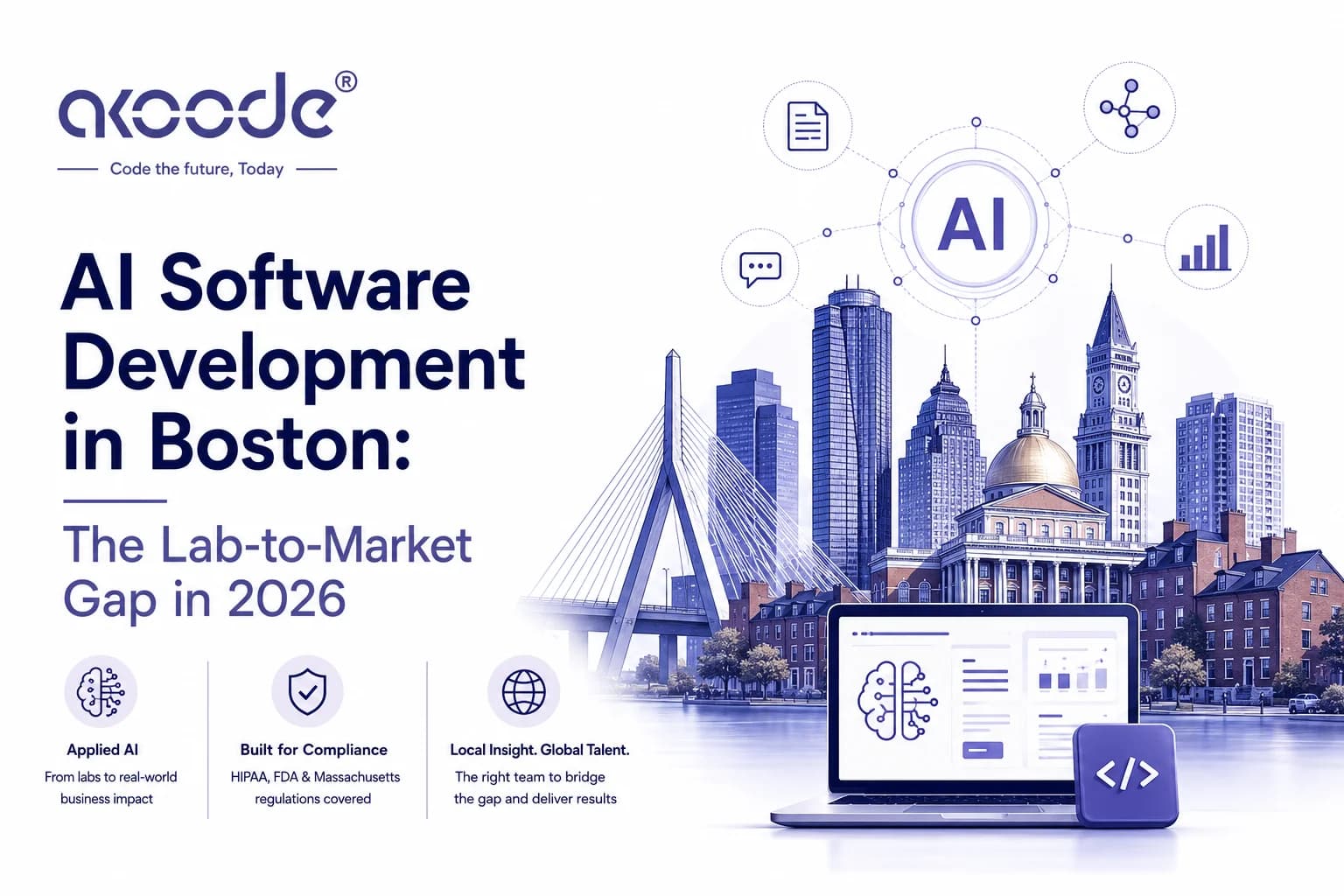
AI Software Development in Boston: The Lab-to-Market Gap in 2026
Boston has produced more foundational AI research than almost any city on earth — and that's exactly why buying AI here is so confusing.
Walk a mile through Cambridge and you'll pass MIT CSAIL, where half the techniques in modern machine learning were incubated. The Broad Institute, running some of the most sophisticated computational biology on the planet. Harvard's labs. The robotics companies descended from decades of local research. Venture funds whose partners wrote the papers your vendor's pitch deck cites.
That density creates something we call the lab-to-market gap: a market where the research vocabulary is everywhere, the academic credentials are dazzling, and the actual question facing a Boston business — what should we deploy, and what should it cost? — gets systematically overcomplicated and overpriced.
Because here's the truth the pedigree obscures: the fintech in the Financial District, the hospital network, the medical device company on Route 128, the Seaport SaaS startup — the overwhelming majority of what they need is applied AI: proven models wired competently into business workflows. That's engineering, not research. Its skills exist globally. And in Boston, it gets quoted at research-adjacent rates — senior AI engineers bill $195–$260/hour locally — for work whose global rate is a third of that with an identical stack.
This guide closes the gap. What Boston businesses are genuinely deploying in 2026, sector by sector. What AI development actually costs here versus globally. The Massachusetts compliance layer — HIPAA, FDA, 201 CMR 17.00 — that shapes all of it. And how to choose a partner who ships production systems rather than seminar material.
Boston's Two AI Economies
Every city we've written about has two AI economies. Boston's version is distinctive because its first economy is academic rather than corporate.
The research economy is the famous one: MIT and Harvard labs, the Broad's computational biology, the robotics cluster, pharma's drug-discovery ML teams, and the venture ecosystem funding all of it. This economy invents techniques, publishes papers, and occasionally spins out companies whose moat genuinely is the research. It employs brilliant people at compensation that anchors the entire regional AI salary market.
The applied economy is the useful one for almost every business reading this: proven models — GPT-4o, Claude, Gemini — connected to business workflows through retrieval architectures, orchestration frameworks, and APIs. Support agents. Document intelligence. Clinical documentation tools. Compliance automation. Forecasting.
The Boston-specific distortion: because the research economy is physically here and culturally dominant, its vocabulary and pricing leak into everything. Vendors lead with lab affiliations. Proposals cite papers. "Our founders are MIT PhDs" functions as a rate justification. And buyers — surrounded by the world's most credentialed AI environment — assume their document-processing problem requires it.
It almost never does. The most expensive mistake a Boston business can make in 2026 is paying research-pedigree prices for applied engineering. A rights-of-access workflow tool doesn't need a CSAIL alumnus. It needs a senior engineer who has shipped RAG systems into production — a skill available worldwide.
When the pedigree genuinely matters: computational biology, novel model work for drug discovery, robotics research, and products whose moat is the science. That's real — and it's a small fraction of the AI work Boston businesses actually buy.
What Boston Businesses Are Actually Deploying
Strip away the seminar vocabulary, and the AI in production across the Boston economy looks like this:
Healthcare and Hospital Systems
The deepest applied-AI market in the city, anchored by Mass General Brigham, Beth Israel Lahey, Boston Children's, and the digital-health companies orbiting them. In production:
Clinical documentation AI — ambient scribing and note generation returning hours per day to physicians, the single most-adopted healthcare AI category of the decade
Prior authorization automation — extracting, assembling, and submitting documentation that currently consumes armies of administrative staff
Claims and denial management — classification and appeal-drafting systems with measurable revenue impact
Patient scheduling and intake agents — handling routine coordination under human oversight
Every deployment lives under HIPAA — and in Massachusetts, under 201 CMR 17.00 as well. Our healthcare software development practice designs both in from Phase 1, because a clinical AI system that can't survive a hospital security review never ships. And Boston hospital security reviews are among the hardest in the country.
Life Sciences and Biotech
Two distinct layers here, and the distinction is the whole game:
The research layer — ML for target identification, molecular property prediction, trial design. Genuinely specialized, genuinely local, genuinely worth the premium when it's what you need.
The operational layer — where most of the actual spending opportunity sits: regulatory document intelligence (extracting and cross-referencing across IND/NDA submissions), clinical trial operations automation, lab workflow tools, quality documentation systems. This is applied document AI wearing a lab coat — and it's globally deliverable at applied rates.
Vendors love to blur these layers. Buyers should not.
Financial Services and Fintech
Fidelity, State Street, the quant funds, and the fintech startups between them deploy fraud detection, transaction monitoring, research summarization, compliance document review, and client-service automation — always with the explainability and audit trails regulators demand. Our finance and banking practice builds these systems with the escalation architecture examiners expect.
SaaS and Technology
Boston's B2B SaaS cluster — enterprise software has always been the region's quiet strength — faces the same table-stakes pressure as every market: in-product copilots that buyers now ask about in every evaluation, support agents resolving 65–85% of tier-1 volume (mechanics covered in our guide to AI customer support agents), and onboarding automation.
Manufacturing, Devices, and Robotics-Adjacent
The Route 128 corridor's device makers and manufacturers deploy computer vision quality inspection, predictive maintenance, and technical documentation AI — with FDA-regulated builds requiring validation discipline that only experienced vendors carry.
The pattern across every sector: repetitive, document-heavy, headcount-scaling work — in one of America's most expensive labor markets, where a fully loaded administrative or clinical-operations hire runs $75,000–$110,000. The avoided-headcount math is short.
What AI Development Costs in Boston vs. Globally
Concrete numbers, because the pedigree premium makes vague pricing especially expensive here.
Senior AI/ML engineers at Boston agencies bill $195–$260/hour. Complete projects:
AI Project Type | Boston Agency | Global Partner (Akoode) | Timeline |
|---|---|---|---|
AI chatbot / support agent | $60,000–$160,000 | $20,000–$60,000 | 6–14 weeks |
Document intelligence (regulatory, claims) | $80,000–$220,000 | $30,000–$80,000 | 8–16 weeks |
Clinical documentation tool | $90,000–$240,000 | $35,000–$90,000 | 10–20 weeks |
LLM-powered internal tool (RAG) | $90,000–$230,000 | $32,000–$85,000 | 10–20 weeks |
AI agent (action-taking) | $110,000–$280,000 | $40,000–$110,000 | 10–22 weeks |
Computer vision / inspection system | $110,000–$300,000 | $50,000–$130,000 | 12–24 weeks |
Enterprise AI platform | $300,000–$780,000+ | $110,000–$280,000 | 6–18 months |
Two things to understand.
The gap isn't a quality gap — it's a pedigree gap. A senior engineer building a RAG pipeline with Claude, LangChain, and Pinecone produces identical architecture in Gurugram and Kendall Square. What differs is the salary gravity of a market anchored by pharma ML teams and university labs — detailed in our Boston software development cost guide.
Ongoing costs never stop, anywhere: LLM API fees ($200–$20,000+/month scaling with usage), vector database and infrastructure hosting ($100–$5,000/month), and model monitoring plus retraining (15–20% of build cost annually — compounding at whatever rate structure built the system). Any vendor who doesn't raise these in the first conversation is deferring the discussion, not the cost.
The Massachusetts Compliance Layer
AI projects in Boston's dominant sectors carry a triple regulatory stack — and it shapes architecture more than model choice does.
HIPAA for anything touching patient data: BAAs with every vendor in the chain — including your LLM provider — encryption, audit logging, and minimum-necessary access design. Adds 15–25% to build costs, and must be architected in from Phase 1.
201 CMR 17.00 — Massachusetts' data security regulation, among the strictest in the nation. Any business holding Massachusetts residents' personal information needs a written information security program (WISP), encryption in transit, access controls, and verified vendor compliance — which means your AI vendor's own security posture is in scope. Asking a prospective vendor "how does your delivery process satisfy 201 CMR 17.00's third-party requirements?" is a devastating screening question. Most have never heard of it.
FDA software regulation for clinical and device-adjacent AI — design controls, validation documentation, change management. This is the one regime where Boston's specialized local vendors genuinely earn premium rates, because shipped FDA experience is rare and mistakes are existential.
SOC 2 for anything selling into Boston's enterprise, hospital, and financial buyers — who run among the most demanding security reviews anywhere. AI features expand the audit surface: model access controls, prompt data handling, vendor sub-processing.
The practical point: compliance adds 15–25% to regulated AI project costs — more under FDA. Designed in, it's a line item. Discovered during a hospital security review, it's a dead deal.
How to Choose an AI Partner in Boston
The general vendor process — contracts, references, the pedigree trap in full — is covered in our guide to hiring a software development company in Boston. AI adds six questions, and in this market one caution above all.
The caution first: academic credentials are not delivery credentials. "Founded by MIT PhDs" tells you the founders are smart. It tells you nothing about whether the firm has shipped systems that survived twelve months of real users, real data drift, and real security reviews. Some pedigree firms are exceptional builders. Others have never operated outside grant-funded timelines. The production questions below distinguish them — the resume doesn't.
1. "Show me an AI system you built that's been in production for 12+ months."
Ask what broke, how they monitored it, what they fixed. In the city of seminars, production scars are the only credential that survives scrutiny.
2. "Walk me through your RAG architecture decisions on a recent project."
Chunking strategy, embedding selection, retrieval tuning, and how they measured retrieval quality separately from answer quality. Fluency here separates engineers from paper-citers.
3. "How do you prevent hallucination in front of clinicians / regulators / customers?"
Good answer: retrieval grounding, confidence thresholds, response filtering, source citation, mandatory human escalation. Bad answer: "our models are state of the art."
4. "What's your model evaluation process before deployment?"
Golden datasets, accuracy benchmarks, adversarial testing. In Boston's regulated verticals, "we test thoroughly" should end the meeting.
5. "How do you handle model drift after launch?"
Clinical documentation patterns shift. Claims rules change. An engagement designed to end at deployment guarantees quiet decay until an auditor notices.
6. "Have you shipped under HIPAA — and what's your answer on 201 CMR 17.00's vendor requirements?"
The universal filter plus the Massachusetts-specific one. Not can you comply. Have you.
Boston AI Agency vs. Global Partner: The Honest Comparison
Factor | Boston AI Agency | Global Partner (Akoode) |
|---|---|---|
Senior AI engineer rate | $195–$260/hr | $45–$75/hr |
AI project cost | Baseline | 55–70% lower |
Research/computational biology depth | Genuine — world's best | Not the strength |
Applied AI delivery (LLM, RAG, agents, CV) | Excellent at good firms | Excellent — identical stack |
HIPAA / MA compliance fluency | Strong at good local firms | Strong at US-focused firms — verify |
FDA-regulated experience | Concentrated locally | Rare anywhere — verify hard |
Engineer retention | Poor — pharma, Big Tech, quant funds poach | Materially lower risk |
Time zone | Local | Natural Eastern-morning overlap |
Best fit | Research-layer and FDA-regulated work | Production applied AI |
The honest read: Boston's genuine local AI advantage is real and specific — research-layer science and FDA-regulated builds. For the applied catalog that constitutes most business AI — support agents, document intelligence, clinical documentation, RAG systems, forecasting — the premium buys proximity to a pedigree your project doesn't draw from.
One structural note in the global partner's favor here: Boston's Eastern time zone makes global delivery easier than in any West Coast market. India-based teams overlap Boston mornings naturally — standups at 9 AM Eastern are mid-evening in Gurugram, and a full working day of async progress lands in your inbox before breakfast.
Akoode Technologies serves Boston businesses on the applied side: production AI depth — GPT-4o, Claude, Gemini, LangChain, Pinecone, computer vision, deployments across healthcare, fintech, SaaS, and manufacturing — through our AI development services, at global economics with US presence, Eastern-hours overlap, and full transparency about where every engineer sits.
How to Start Without Funding a Seminar
Name the specific, expensive problem. Not "we need an AI strategy." Something like: "Our revenue cycle team spends 120 hours a week on denial appeals, and 70% follow recognizable patterns." That sentence transforms every vendor conversation.
Classify honestly: research layer or applied layer? Does your project require inventing anything — or connecting proven models to your data? In Boston's vocabulary-saturated environment, this discipline is rarer and more valuable than anywhere except San Francisco.
Check your data before anything else. Are the documents digitized? Is the knowledge base current? Is there one source of truth? Most AI failures are data failures wearing an AI costume.
Map your compliance stack early. HIPAA, 201 CMR 17.00, FDA, SOC 2 — whichever apply, they shape architecture from day one and vendor selection before that.
Start with one workflow, not a platform. A focused $50,000 system that automates one painful queue beats a $400,000 "AI transformation" — and teaches you what the second project should be.
Demand a paid discovery phase. Data assessment, compliance flags, success metrics, realistic scope. Vendors who skip it to quote fast are guessing with your money — at pedigree rates.
Frequently Asked Questions
How much does AI software development cost in Boston?
Boston AI agencies bill $195–$260/hour for senior AI engineers. Complete projects run $60,000–$160,000 for an AI support agent, $80,000–$220,000 for document intelligence, $90,000–$240,000 for a clinical documentation tool, and $300,000–$780,000+ for enterprise AI platforms. Global partners deliver identical applied scope 55–70% lower. Ongoing costs run $300–$25,000/month plus 15–20% of build cost annually.
What are Boston businesses actually building with AI in 2026?
Healthcare leads: clinical documentation AI, prior authorization automation, claims and denial management, and patient scheduling agents — all under HIPAA. Life sciences deploys regulatory document intelligence and trial operations automation. Fintech runs fraud detection, compliance review, and research summarization. SaaS ships in-product copilots and support agents. Manufacturing uses computer vision inspection and predictive maintenance.
What is the lab-to-market gap in Boston AI?
The distortion created by Boston's research density: academic vocabulary and pedigree pricing leak into ordinary business AI purchases. Most Boston businesses need applied AI — proven models wired into workflows — but get quoted research-adjacent rates justified by lab affiliations their project never draws on. The classification question (research layer or applied layer?) is the most consequential budget decision in this market.
Do I need an MIT-pedigree AI firm for my project?
Only if your project is genuinely research-layer: computational biology, novel model work for drug discovery, robotics research, or products whose moat is the science. For applied AI — document intelligence, support agents, RAG systems, clinical documentation — production experience matters and pedigree doesn't. Test with the production question: a system live 12+ months and the story of what broke.
What compliance affects AI projects in Boston?
HIPAA for anything touching patient data (BAAs including your LLM provider, adding 15–25% to build costs). Massachusetts' 201 CMR 17.00 data security regulation, whose third-party requirements put your AI vendor's own security posture in scope. FDA software regulation for clinical and device-adjacent AI — the one regime where specialized local vendors genuinely earn premium rates. And SOC 2 for enterprise and hospital sales.
How do Boston hospital security reviews affect AI vendor choice?
Boston's hospital systems run among the hardest security reviews in the country — and AI features expand the audit surface to model access controls, prompt data handling, and vendor sub-processing. Choose a vendor who has passedsuch reviews, not one who promises to. Compliance discovered during review is a dead deal; compliance designed in from Phase 1 is a line item.
Can a small Boston business afford AI?
Yes — and the math is favorable because Boston labor costs are top-tier. A focused AI agent handling support or document processing starts around $20,000–$60,000 with a global partner — a fraction of one fully loaded Boston hire. Start with one workflow, win, expand.
How long does it take to build an AI system in Boston?
Geography changes cost, not physics: a focused AI agent takes 6–14 weeks, document intelligence 8–16 weeks, an LLM tool with RAG 10–20 weeks, computer vision 12–24 weeks, enterprise platforms 6–18 months. Data preparation and compliance review are the most common timeline extenders in Boston's regulated sectors.
Does Boston's time zone help with offshore AI development?
Genuinely, yes — more than any West Coast market. India-based teams overlap Boston mornings naturally: a 9 AM Eastern standup is mid-evening in Gurugram, and a full day of async progress lands before breakfast. This makes the disciplined-global-delivery model structurally easier for Boston buyers than for their counterparts in Seattle or San Francisco.
Should I hire a Boston AI company or a global partner?
Classify first. Research-layer science or FDA-regulated builds: local specialists, vetted hard on shipped experience. Applied AI — most projects: a transparent global partner like Akoode Technologies delivers equivalent outcomes at 55–70% less with Eastern-hours overlap. Vet either identically: production proof, RAG fluency, compliance experience. Our Boston hiring guide covers the full process.
The Bottom Line
Boston's relationship with AI is unique: the research is genuinely here, the pedigree is genuinely dazzling, and both facts are genuinely irrelevant to most of what Boston businesses need to build.
The essential skill is classification. A small set of projects — computational biology, FDA-regulated clinical AI, research-moat products — draw on what only this city has, and for them the premium is honest. The overwhelming majority need proven models wired competently into document-heavy, headcount-scaling workflows — and for them, the pedigree premium buys a seminar.
The businesses getting this right named a specific expensive workflow, mapped their compliance stack, checked their data, and built one focused system. The ones getting it wrong funded research vocabulary at $240/hour.
If you're weighing where your project falls, that's a conversation worth having before you commit to anything.
Book a free 45-minute AI consultation → calendly.com/akhil-akoode/ak
We'll review your workflow, assess your data, map your HIPAA / 201 CMR 17.00 / FDA exposure, and give you a straight answer on scope, cost, and whether AI is even the right tool. Sometimes the answer is a $40,000 focused system. Sometimes it's a SaaS tool. Sometimes it genuinely is a research-layer specialist — and we'll say so.
Explore: Software Development Company in Boston | AI development services | Boston software costs | how to hire a Boston development company | akoode.com | contact us
Get In Touch Now
View More Our Blog