


 July 26, 2026
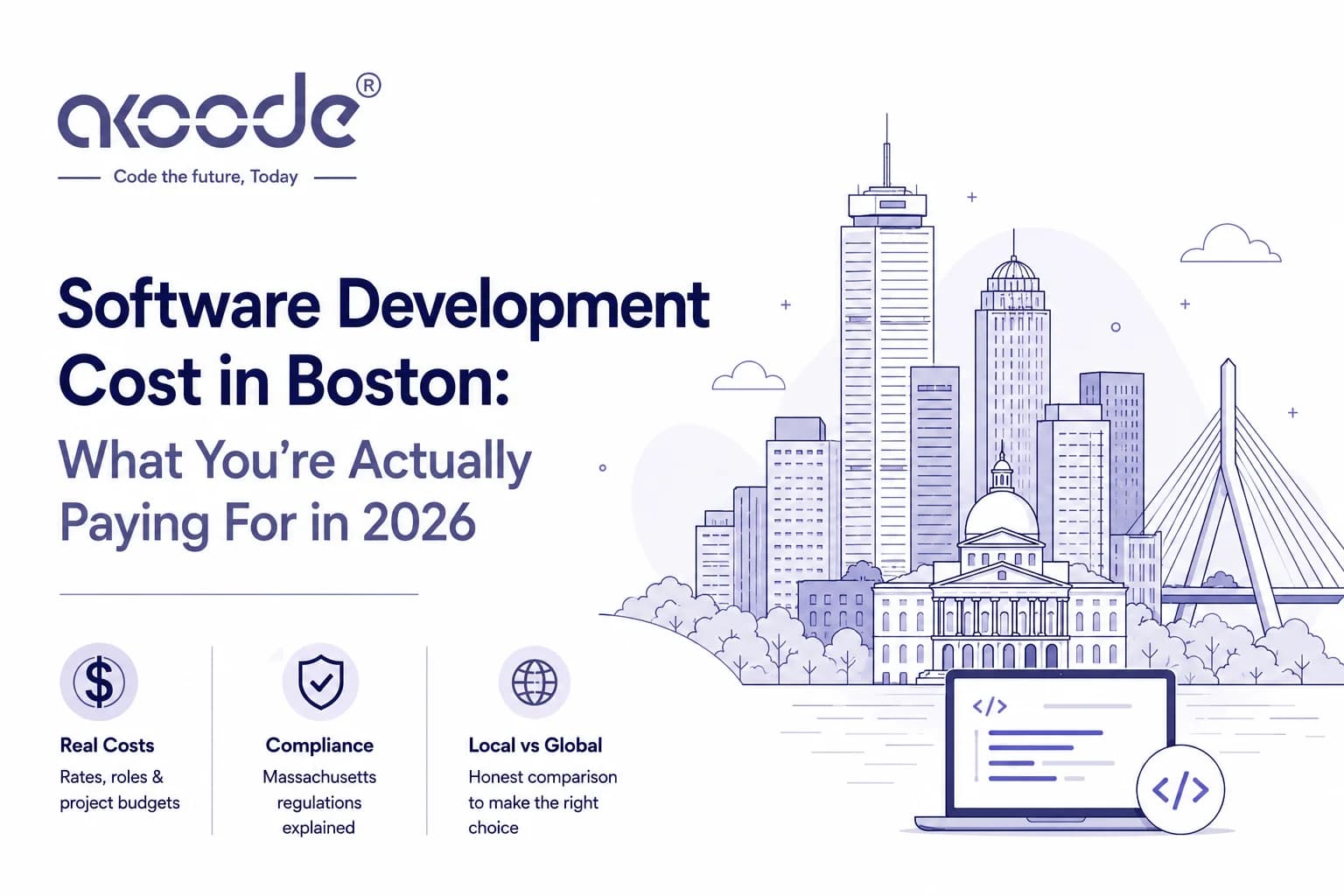
Software Development Cost in Boston: What You're Actually Paying For in 2026
Boston software pricing has a peculiar shape, and it comes from an unusual source: the lab bench.
Most expensive tech markets are anchored by consumer tech giants. Boston's premium is anchored by something different — the densest concentration of life sciences, biotech, and research institutions on the planet. Kendall Square alone hosts more drug discovery per square mile than most countries, MIT and Harvard pump out engineering talent that Big Tech outposts (Google, Amazon, Meta all maintain serious Boston engineering offices) compete ferociously to keep local, and the hospital systems — Mass General Brigham, Beth Israel, Boston Children's — run technology operations the size of mid-cap companies.
Every one of those institutions hires from the same talent pool your software vendor does. The result: Boston software developers average $138,590 per year according to Glassdoor — 13% above national — with software engineers at $167,559 and seniors at $219,792, top earners reaching past $319,000. Agencies bill $110–$190 per hour, placing Boston firmly in the top tier of US markets alongside Seattle and New York.
A mid-complexity SaaS platform runs $150,000–$380,000 with a Boston agency. The same scope with a senior-led global team runs $85,000–$125,000.
If you're planning a software build in or for the Boston market — whether you're a Seaport startup, a suburban medical device company on Route 128, or a fintech in the Financial District — this guide gives you the real numbers: rates by role, complete project budgets, the Massachusetts compliance layer almost no one covers, and an honest framework for local versus global.
Why Boston Costs What It Costs
Every quote is built on what engineers earn here. The sources, side by side:
Glassdoor (Software Developer): $138,590/year average — 13% above national — top decile at $208,619
Glassdoor (Software Engineer): $167,559/year from 11,487 submissions, typical range $138,139–$206,859, top earners at $248,515
Glassdoor (Senior Software Engineer): $219,792/year, top decile at $319,583
Salary.com: $144,208/year, with the seniority ladder running from $81,690 (Developer I) to $191,638 (Systems Developer VI)
ZipRecruiter: $121,509 (developer) to $160,261 (engineer)
Levels.fyi: median total compensation around $174,000, with 75th-percentile packages exceeding $235,000
The consistent story: mid-level Boston engineers earn $130K–$165K, seniors clear $185K+, and total compensation at competitive employers routinely tops $200K.
Two Boston-specific forces sharpen the market:
The life-sciences premium. Glassdoor's top-paying industries for Boston developers tell the story — Manufacturing ($163,696 median total pay, heavily pharma and medical devices) and Financial Services ($151,366) lead the table. Biotech and pharma companies treat software engineers as critical infrastructure for drug discovery pipelines, clinical trial platforms, and regulated manufacturing systems — and they pay accordingly. That pricing bleeds into every agency's rate card.
The academic gravity well. MIT and Harvard produce elite engineering talent, and the Big Tech outposts, quant funds, and venture-backed startups clustered from Kendall Square to the Seaport compete to keep it local. Every agency retains against that pull.
Run the agency math: a $160,000 engineer costs a firm roughly $210,000 fully loaded after benefits and employer costs, before Seaport or Cambridge office space, project management, sales overhead, and margin. Spread across billable hours, $110–$190/hour is what the economics produce — not a markup.
Boston Developer Hourly Rates: The Full Breakdown
Role | Junior (0–2 yrs) | Mid-Level (3–5 yrs) | Senior (6+ yrs) |
|---|---|---|---|
Frontend Developer | $80–$105/hr | $105–$145/hr | $145–$185/hr |
Backend Developer | $85–$115/hr | $115–$155/hr | $155–$195/hr |
Full-Stack Developer | $85–$110/hr | $110–$150/hr | $150–$190/hr |
Mobile Developer (iOS/Android) | $90–$120/hr | $120–$160/hr | $160–$200/hr |
UI/UX Designer | $70–$95/hr | $95–$130/hr | $130–$170/hr |
DevOps / Cloud Engineer | $90–$125/hr | $125–$165/hr | $165–$205/hr |
AI / ML Engineer | $110–$150/hr | $150–$195/hr | $195–$260/hr |
QA Engineer | $60–$85/hr | $85–$115/hr | $115–$150/hr |
Technical Project Manager | $90–$120/hr | $120–$155/hr | $155–$195/hr |
Three observations.
AI talent tops the chart — senior AI/ML engineers bill $195–$260/hour, pulled upward by the research density around MIT CSAIL, the Broad Institute's computational biology work, and the pharma industry's appetite for ML. Worth knowing before you pay it: most business AI work is applied engineering whose skills are globally available — a distinction we unpack fully in our companion guide on AI software development in Boston.
Regulated-industry experience commands its own premium inside every band. Engineers who've shipped under FDA software regulations (for medical devices), HIPAA, or financial compliance bill at the top of their ranges — and for genuinely regulated builds, that experience is worth paying for in avoided rework.
QA is not the place to save money in this market. Boston's dominant industries — health, finance, devices — are ones where defects have regulatory consequences. Vendors quoting thin QA lines are mispricing your actual risk.
What Complete Projects Cost in Boston
Web Application Development
Project Type | Complexity | Boston Cost | Timeline |
|---|---|---|---|
Marketing website / landing pages | Simple | $12,000–$32,000 | 3–6 weeks |
MVP / proof of concept web app | Simple-Medium | $40,000–$95,000 | 2–4 months |
Business web application | Medium | $95,000–$210,000 | 4–7 months |
SaaS platform | Medium-High | $150,000–$380,000 | 5–10 months |
Enterprise web platform | Complex | $320,000–$750,000+ | 9–18 months |
Mobile App Development
App Type | Boston Cost | Notes |
|---|---|---|
Simple MVP (cross-platform) | $45,000–$95,000 | Flutter/React Native, iOS + Android |
Mid-complexity app | $95,000–$200,000 | Integrations, custom UI, backend |
Complex / enterprise app | $200,000–$480,000+ | Real-time, multi-role, regulated data |
AI & Regulated-Industry Systems
Project Type | Boston Cost |
|---|---|
AI chatbot / support agent | $60,000–$160,000 |
Document intelligence / extraction | $80,000–$210,000 |
LLM-powered tool (RAG) | $90,000–$230,000 |
Healthcare platform (HIPAA) | $130,000–$450,000 |
Clinical trial / life sciences platform | $150,000–$500,000+ |
Fintech application | $150,000–$480,000 |
Enterprise AI platform | $300,000–$780,000+ |
Where Your Budget Actually Goes
A $220,000 Boston project distributes roughly like this:
Phase | Share | Amount |
|---|---|---|
Discovery & strategy | 8–12% | $18K–$26K |
UI/UX design | 18–25% | $40K–$55K |
Frontend development | 25–35% | $55K–$77K |
Backend & APIs | 20–30% | $44K–$66K |
QA & testing | 8–12% | $18K–$26K |
Deployment & PM | 10–15% | $22K–$33K |
In Boston's regulated verticals, expect QA and documentation to run at the top of their ranges — and treat that as correct pricing, not padding. A clinical platform or lending product with compressed QA isn't cheaper. It's a deferred incident.
The Hidden Costs Boston Proposals Rarely Include
Post-launch maintenance, priced at Boston rates, forever. Annual maintenance runs 15–25% of build cost — $33,000–$55,000/year on a $220,000 project — billed at the same rate structure that built it. The single most under-budgeted line in software financial models.
Massachusetts' compliance layer — the part almost nobody covers. Beyond federal standards, Massachusetts runs one of the strictest state data security regimes in the country:
201 CMR 17.00 — the Massachusetts data security regulation. Any business, anywhere, holding personal information of Massachusetts residents must maintain a written information security program (WISP), encrypt personal data in transit and on portable devices, control access, and verify third-party service providers can comply. It's been quietly setting the national bar since before most states had privacy laws — and it applies to your software's architecture whether your vendor has heard of it or not. Asking a prospective vendor "what's a WISP?" is a genuinely useful Massachusetts screening question.
HIPAA for the region's enormous health economy — 15–25% added build cost, BAAs for every vendor touching PHI.
FDA software regulations for medical device and clinical software — a genuinely specialized regime (design controls, validation documentation, audit trails) that adds 20–35% and demands vendors who've actually shipped under it.
SOC 2 — effectively mandatory for B2B SaaS selling into Boston's enterprise, hospital, and financial buyers, who run some of the most demanding security reviews in the country.
Third-party services scale with users: $500–$15,000/month from launch.
Engineer churn. Big Tech outposts, quant funds, and biotech pay packages agencies can't match. Check engineer tenure on LinkedIn before signing, and negotiate key personnel clauses on engagements over three months — protections we detail in our guide to hiring a software development company in Boston.
Discovery skipped in competitive bids. A proper discovery phase costs $12,000–$25,000 in Boston and prevents rework costing ten times more.
The rule: add 20–25% to any Boston quote for your internal budget.
Boston vs. Everywhere Else: The Honest Math
Market | Hourly Rate |
|---|---|
San Francisco / Silicon Valley | $150–$250/hr |
New York City | $130–$220/hr |
Seattle | $120–$200/hr |
Boston | $110–$190/hr |
Los Angeles | $100–$175/hr |
Austin | $90–$160/hr |
Nearshore (Latin America) | $40–$80/hr |
Offshore (India, senior teams) | $25–$55/hr |
The project math on a 2,500-hour SaaS build:
Team | Avg Rate | Total Cost |
|---|---|---|
Boston premium agency | $170/hr | $425,000 |
Boston standard agency | $140/hr | $350,000 |
Austin agency | $125/hr | $312,500 |
Nearshore (LatAm) | $65/hr | $162,500 |
Global (India, senior team) | $45/hr | $112,500 |
The $240,000–$310,000 gap between a Boston build and a senior global build buys the same architecture, the same stack, and the same timelines. A senior engineer produces identical output in Gurugram and Kendall Square. What differs is the salary structure underneath — anchored in Boston by pharma, hospitals, and the academic talent war.
The honest caveat, as always: global delivery done carelessly erodes its own savings through rework. The advantage holds only with a senior team, disciplined process, and real US-hours overlap — a vendor-quality question, not a geography question. (Boston's Eastern time zone actually makes this easier than any West Coast market: India-based teams overlap Boston mornings naturally.)
Akoode Technologies serves Boston businesses on exactly this model: senior global engineering, full transparency about where every engineer sits, US presence, and Eastern-hours communication overlap — at 55–70% below local agency rates.
When Boston Rates Are Worth Paying
Pay local rates when:
Your project lives under FDA software regulation — medical device software, clinical systems requiring design controls and validation. Vendors who've shipped under this regime are concentrated here, and their experience prevents mistakes that cost far more than rates.
Deep life-sciences domain integration — LIMS, clinical trial platforms, computational biology pipelines where the domain knowledge is genuinely local.
You need regular in-person collaboration — hospital stakeholder work, lab-adjacent builds, hardware integration.
Your contracts require US-based vendors or onshore data handling.
Look globally when:
The engineering is standard — web apps, mobile, SaaS, LLM integration, standard healthcare platforms under HIPAA (a regime experienced global firms ship under routinely). This describes most projects.
The build runs 3+ months, where the differential compounds into six figures.
Your team can manage a structured vendor relationship.
Budget matters — the $250,000+ difference funds a year of runway or your entire go-to-market.
Many experienced Boston buyers land on a hybrid: local discovery and regulatory strategy where the region's depth genuinely shines, global delivery for the build.
A Practical Budget Framework
1. Classify your regulatory exposure first. FDA-regulated, HIPAA/201 CMR 17.00-regulated, or standard commercial. In Boston, this determines your vendor pool and your cost floor more than any other factor.
2. Separate must-have from nice-to-have. At $140/hour, every descoped feature saves five figures.
3. Add 20–25% for hidden costs. Compliance architecture, third-party services, churn friction.
4. Budget maintenance from day one. 15–25% of build cost annually, at whatever rate structure built the product.
5. Get three quotes across tiers — including one global. Compare scope line-by-line, never headline price. Without a global quote, you're only comparing Boston premiums against each other.
Frequently Asked Questions
How much does software development cost in Boston in 2026?
Boston agencies bill $110–$190/hour, placing the city in the top tier of US markets. Complete projects run $40,000–$95,000 for an MVP web app, $150,000–$380,000 for a SaaS platform, and $320,000–$750,000+ for enterprise systems. Mobile apps run $45,000–$480,000+ by complexity. Equivalent scope with a senior global team runs 55–70% less.
What do software developers earn in Boston?
Glassdoor reports $138,590 average for developers — 13% above national — $167,559 for software engineers from 11,000+ submissions, and $219,792 for seniors, with top earners past $319,000. Levels.fyi puts median total compensation around $174,000. The top-paying industries are manufacturing (pharma and devices) and financial services.
Why are Boston software development rates so high?
The life-sciences premium and the academic gravity well. Biotech, pharma, and hospital systems treat engineers as critical infrastructure and pay accordingly, while MIT/Harvard talent gets retained locally by Big Tech outposts and quant funds. Every agency hires from and retains against that market. A $160,000 engineer costs a firm $210,000+ fully loaded before overhead and margin.
What is 201 CMR 17.00 and does it affect my project?
Massachusetts' data security regulation — one of the strictest in the nation. Any business holding personal information of Massachusetts residents must maintain a written information security program (WISP), encrypt personal data in transit, control access, and verify vendor compliance. It shapes software architecture regardless of where your vendor sits, and asking a prospective vendor about it is a useful screening question: firms fluent in it are demonstrating the compliance maturity Boston work requires.
How much does an app cost to build in Boston?
A cross-platform mobile MVP runs $45,000–$95,000 with a Boston agency. Mid-complexity apps run $95,000–$200,000; enterprise and regulated apps $200,000–$480,000+. The same builds with a senior global team run roughly a third to half of those figures.
How much does healthcare or medical software cost in Boston?
HIPAA-regulated platforms run $130,000–$450,000 locally; clinical trial and life-sciences platforms $150,000–$500,000+; and FDA-regulated device software adds 20–35% for design controls and validation documentation. HIPAA work is routinely delivered by experienced global teams at 55–70% below local rates; FDA-regulated work is where Boston's specialized local vendors genuinely earn their premium.
What's the biggest hidden cost in Boston software development?
Maintenance at Boston rates: 15–25% of build cost annually — $33,000–$55,000/year on a $220,000 project — forever, at the same rate structure that built it. Second is compliance retrofit: 201 CMR 17.00, HIPAA, or SOC 2 requirements discovered after architecture is fixed cost multiples of what designing them in would have.
How long does software development take in Boston?
The same as everywhere — geography changes cost, not physics. MVPs take 2–4 months, business applications 4–7 months, SaaS platforms 5–10 months, enterprise systems 9–18 months. Boston's Eastern time zone gives global teams natural morning overlap, making offshore coordination easier here than in any West Coast market.
Should I hire a Boston agency or a global team?
For FDA-regulated software, deep life-sciences domain work, or in-person hospital stakeholder needs — local, with churn protections. For standard web, mobile, SaaS, HIPAA platforms, and applied AI, a transparent global partner delivers equivalent outcomes at 55–70% less. Many experienced buyers hybrid: local regulatory strategy, global build. Our Boston hiring guide covers the full decision framework.
How can I reduce software development costs in Boston?
Three levers in order of impact: go global for standard engineering (55–70% savings), descope ruthlessly to a focused MVP, and structure a hybrid — local discovery and regulatory direction with global delivery. Akoode Technologies runs exactly these engagements for Boston clients.
The Bottom Line
Boston's rates are the honest output of a market anchored by the world's densest life-sciences economy and its most famous universities. The talent is genuinely elite — especially where software meets regulation, biology, and medicine. Nobody's gouging you. The lab-coat premium is just real.
Which makes the buyer's job clear: figure out whether your project draws on what only Boston has. FDA-regulated builds and deep life-sciences work sometimes genuinely do. Standard product engineering — most projects — doesn't, and for those the $250,000+ premium buys a zip code.
The best move before committing to any number: a clear, itemized picture of what you're buying — discovery, 201 CMR 17.00 and compliance architecture, maintenance at compounding Boston rates, and the retention risk no proposal mentions.
That's the conversation we offer.
Book a free consultation → calendly.com/akhil-akoode/ak
No pitch. No pressure. A straight conversation about what your project needs and what it should realistically cost.
Explore: Software Development Company in Boston | AI software development in Boston | how to hire a Boston development company | akoode.com | AI development | custom software | mobile apps
Get In Touch Now
View More Our Blog