




 July 20, 2026
AI Software Development in Austin: What Texas Businesses Are Building in 2026
Austin has two AI economies, and most businesses only hear about one of them.
The visible one makes headlines: Tesla's autonomy work, Oracle's AI infrastructure push, the venture-backed startups pitching foundation-model plays at Capital Factory. That economy is real, well-funded, and almost entirely irrelevant to what your business should build.
The second economy is quieter and far more useful. It's the SaaS company on the Domain whose AI support agent now resolves 70% of tier-1 tickets. The Central Texas health system automating prior authorization paperwork. The fintech running LLM-powered compliance review. The logistics operator on the I-35 corridor whose demand forecasting quietly cut inventory carrying costs by double digits.
That second economy is applied AI — proven models pointed at expensive, repetitive work. Its build costs collapsed over the past three years, its ROI math got short, and it's now firmly mid-market accessible.
This guide covers what Austin businesses are genuinely deploying, what it costs, the Texas compliance layer that shapes it, and how to choose a partner without burning six figures on a demo that never ships.
Why Austin Businesses Are Investing Now
Three forces converged, and the arithmetic changed.
Build costs collapsed. Five years ago, custom AI meant hiring ML PhDs and training models from scratch — a seven-figure commitment. Modern LLMs (GPT-4o, Claude, Gemini) changed the engineering problem entirely: AI development now means connecting proven models to your business data through architectures like RAG. A document-intelligence system that cost $500,000 to build in 2021 costs $60,000–$120,000 today.
The competitive pressure is local and immediate. Austin is one of the densest startup markets in America. When your competitor two blocks away runs support, onboarding, and document processing on AI, your cost structure is now a strategic disadvantage. In most cities AI adoption is offensive; in Austin it's increasingly defensive.
The talent signal flipped. Austin's AI engineering pool — fed by UT Austin, Tesla alumni, and coastal transplants — is deeper than any non-coastal US city. That's a genuine local advantage. It's also expensive: senior AI/ML engineers at Austin agencies bill $180–$250/hour, the steepest premium in the local market. Understanding when you need that talent locally versus when equivalent engineering is available globally at half the rate is one of the most consequential decisions in your project. More on that below.
What Austin Businesses Are Actually Building, Sector by Sector
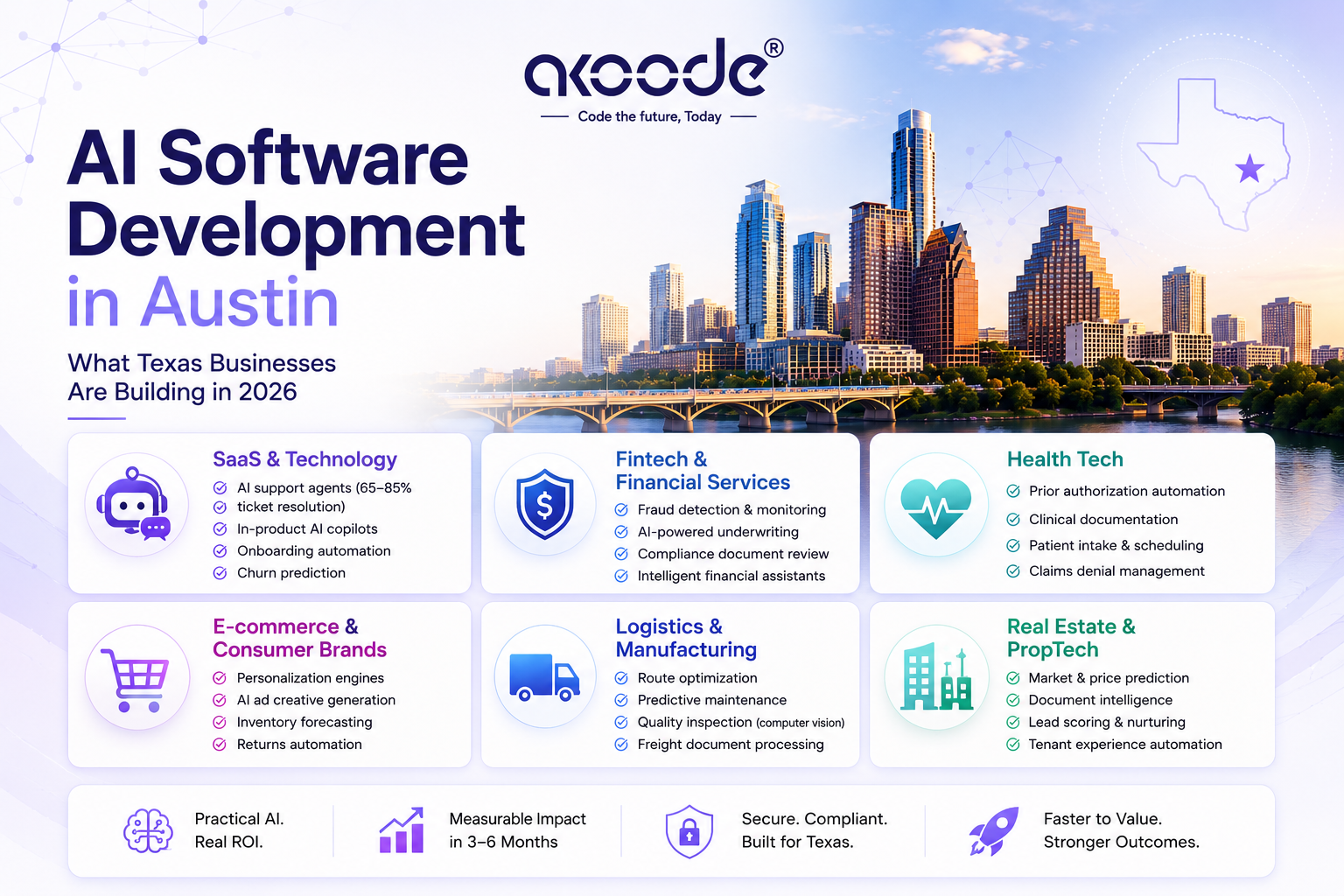
SaaS and Technology Companies
Austin's largest applied-AI category, for an obvious reason: the city is packed with software companies whose support and success teams don't scale linearly with growth.
AI customer support agents resolving 65–85% of tier-1 tickets — the mechanics are covered in our guide to AI customer support agents
In-product AI copilots — assistants embedded directly in SaaS products as a feature, increasingly table stakes for competitive positioning
Onboarding automation — AI walking new users through setup, cutting time-to-value
Churn prediction — models flagging at-risk accounts from usage signals before renewal conversations
For Austin SaaS companies specifically, AI is both an internal cost tool and a product feature. The second use case — shipping AI inside your product — is where the market pressure is sharpest in 2026.
Fintech and Financial Services
Austin's fintech cluster is genuine, and it's building:
Fraud detection and transaction monitoring — real-time pattern analysis
Automated underwriting assistance — AI-assembled risk profiles from applications and third-party data
Compliance document review — LLMs reviewing communications and filings against regulatory requirements
Customer-facing financial assistants — grounded in policy documents, not guessing
Every one of these carries explainability obligations. "The model said so" isn't an answer a regulator accepts — which shapes architecture from day one. Our finance and banking practice builds these systems with audit trails and human escalation designed in.
Health Tech
Central Texas healthcare — Ascension Seton, St. David's, Dell Medical's orbit, and a dense digital-health startup scene — is deploying AI against administrative burden:
Prior authorization automation — the most-requested use case we see from providers
Clinical documentation — AI drafting visit notes from encounters, returning hours per day to physicians
Patient scheduling and intake agents
Claims denial management — pattern analysis plus automated appeal drafting
All of it lives under HIPAA, which adds 15–20% to build costs and requires BAAs with every vendor touching patient data — including your LLM provider. Our healthcare software development work designs that compliance in from Phase 1, because a system that can't pass an audit can't ship.
E-commerce and Consumer Brands
Austin's DTC and consumer scene is deploying: personalization engines, AI-generated ad creative at scale, inventory forecasting, returns processing automation, and conversational shopping assistants. With Austin's design-forward consumer market, the bar for AI that customers actually touch is higher here than most cities — a badly implemented chatbot damages a brand that competes on experience.
Logistics and Manufacturing
The I-35 corridor moves enormous freight volume, and Tesla's gigafactory anchored a growing manufacturing base:
Route optimization and demand forecasting
Predictive maintenance — sensor-data models flagging equipment failures before they happen
Computer vision quality control on production lines
Freight document processing — bills of lading, customs paperwork, carrier reconciliation
Real Estate and PropTech
One of America's hottest property markets generates real AI demand: lease abstraction, automated valuation models, tenant screening, and investment analysis from raw property data. Our real estate software practice builds document-intelligence systems that cut lease review from hours to minutes.
What AI Software Development Costs in Austin
Concrete numbers, because vague AI pricing is how businesses overpay or under-scope.
Senior AI/ML engineers at Austin agencies bill $180–$250/hour — a 20–30% premium over the city's general development rates, stacked on an already-hot market. (Full context in our Austin software development cost guide.)
Complete AI projects:
AI Project Type | Austin Agency | Global Partner (Akoode) | Timeline |
|---|---|---|---|
AI chatbot / support agent | $50,000–$140,000 | $20,000–$60,000 | 6–14 weeks |
Document processing / extraction | $65,000–$180,000 | $28,000–$75,000 | 8–16 weeks |
LLM-powered internal tool (RAG) | $75,000–$200,000 | $32,000–$85,000 | 10–20 weeks |
In-product AI copilot feature | $80,000–$220,000 | $35,000–$95,000 | 10–20 weeks |
Custom ML model (train + deploy) | $130,000–$350,000 | $50,000–$140,000 | 14–24 weeks |
Computer vision system | $110,000–$300,000 | $50,000–$125,000 | 12–24 weeks |
AI-integrated enterprise platform | $230,000–$650,000+ | $100,000–$270,000 | 6–18 months |
Two things to understand.
The local-vs-global gap isn't a quality gap. A senior AI engineer working with GPT-4o, LangChain, and Pinecone produces the same architecture in Gurugram as in East Austin. What changes is the salary structure underneath — and in Austin, that structure is inflated by the hottest hiring market outside the coasts.
Ongoing costs are separate and permanent. LLM API fees, vector database hosting, and infrastructure run $500–$20,000/month depending on volume. Model monitoring and retraining adds 15–20% of build cost annually. Any vendor who doesn't raise this in the first conversation is deferring the cost, not eliminating it.
The Texas Compliance Layer
Austin AI projects carry obligations that generic national advice skips.
The Texas Data Privacy and Security Act (TDPSA) governs how businesses handle Texas residents' personal data — consent, data minimization, consumer rights around access and deletion, opt-outs for targeted advertising. Any AI system trained on or processing Texas consumer data needs these controls architected in from Phase 1. Retrofitting after launch costs multiples more.
HIPAA for health tech: 15–20% added build cost, BAAs with every vendor touching PHI including your LLM provider, encryption, audit logging.
PCI-DSS for the fintech and payments cluster.
Explainability obligations for financial services AI — architecture that can show why a model flagged a transaction or declined an application.
The practical point: compliance architecture adds 15–25% to AI project costs in Austin's dominant regulated verticals. A vendor who doesn't surface this during scoping either doesn't know the Texas regulatory environment or is choosing not to complicate the proposal. Both deserve a direct question.
The ROI Math That's Moving Austin Budgets
Two worked patterns we see repeatedly.
Example 1: SaaS support automation (Domain-area B2B company)
Current: 6 support agents at ~$60,000/year fully loaded = $360,000/year, ticket volume growing 40% annually
AI agent resolves 70% of tier-1 volume; team holds flat at 6 instead of scaling to 9
Build: $55,000 | Ongoing: $3,000/month
Year one: ~$180,000 in avoided hires against $91,000 total cost
Every year after: the avoided-headcount gap widens as volume grows
Example 2: Health system prior authorization (Central Texas provider group)
Current: 5 FTEs on prior auth paperwork at ~$52,000/year fully loaded = $260,000/year
AI drafts and tracks 65% of routine authorizations; staff drops to 2 handling complex cases
Build: $85,000 (HIPAA architecture included) | Ongoing: $3,500/month
Year two onward: ~$115,000/year recurring — plus faster approvals and fewer abandoned care plans
The pattern: Austin AI ROI is strongest where work is repetitive, document-heavy, or scales with growth you'd otherwise hire against. In a city where every hire is a bidding war, "avoided headcount" is worth more here than almost anywhere.
How to Choose an AI Partner in Austin
The general vendor process — red flags, contract terms, reference checks — is covered in our guide to hiring a software development company in Austin. AI adds six questions that general software hiring misses:
"Show me an AI system you built that's been in production 12+ months." Demos are trivially easy with modern LLMs. Production is hard. Ask what broke, how they monitored it, what they fixed.
"Walk me through your RAG architecture decisions." Chunking strategy, embedding selection, retrieval tuning, evaluation methodology. Fluency here separates shippers from prototypers.
"How do you prevent hallucination in a regulated environment?" Right answer: RAG grounding, confidence thresholds, response filtering, mandatory escalation. Wrong answer: "We use GPT-4, it's very accurate."
"What's your model evaluation process before deployment?" Golden datasets, accuracy benchmarks, adversarial testing. No framework means shipping on hope.
"How do you handle model drift and retraining?" AI degrades as data shifts. If the engagement ends at deployment, performance decays quietly until a customer notices.
"Have you shipped under TDPSA / HIPAA / PCI-DSS?" Not can you. Have you.
Most vendors — including well-regarded Austin agencies whose AI practice is eighteen months old — fail three of these. The ones who pass are your shortlist.
And the red flags specific to AI: leading with the model instead of your problem ("we use GPT-4o" is a component, not a solution), quoting before assessing your data, promising accuracy numbers before seeing your data, and treating compliance as a post-launch checkbox.
Local Austin AI Talent vs. Global: The Honest Answer
Factor | Austin AI Agency | Global Partner (Akoode) |
|---|---|---|
Senior AI engineer rate | $180–$250/hr | $45–$75/hr |
AI project cost | Baseline | 50–65% lower |
AI/LLM talent depth | Best non-coastal pool in the US | Deep bench — verify per vendor |
Novel ML research capability | Genuine local advantage | Not the strength |
Production AI application delivery | Excellent at top firms | Excellent |
Time zone | Same (CT) | 3–4 hr overlap, async otherwise |
Retention risk | High — Tesla/FAANG poaching is real | Lower |
Texas compliance fluency | Generally strong | Strong at US-focused firms — verify |
The honest read: Austin is one of very few non-coastal cities where the "you need local AI talent" argument is sometimes actually true — for genuinely novel ML work, research-adjacent projects, and products where AI architecture is the company.
But that's not most projects. Most Austin businesses need applied AI: an LLM connected to their knowledge base, their CRM, their document store, doing real work in a compliant architecture. That engineering is available globally at equivalent quality, and the $100,000+ difference is local salary inflation — not capability.
Akoode Technologies serves Austin on exactly this model: production AI depth — GPT-4o, Claude, LangChain, Pinecone, deployments across healthcare, fintech, SaaS, and e-commerce — through our AI development services, at global economics with US presence and Central Time communication.
How to Start Without Funding a Science Project
Step 1: Name the specific, expensive problem. Not "we want AI." Something like: "Our support team spends 120 hours a week on tickets, and 70% follow fifteen patterns." That sentence transforms every vendor conversation.
Step 2: Check your data before anything else. Accessible? Digitized? Structured enough to retrieve against? Most AI projects that fail in Austin fail on data, not models.
Step 3: Start with one workflow, not a platform. A focused $50,000 system automating one painful process returns more — and teaches more — than a $300,000 "AI transformation." Win once, then expand.
Step 4: Demand a paid discovery phase. $8,000–$20,000 in Austin for proper data assessment, success metrics, and realistic scope. Vendors who skip it to quote fast are guessing with your money.
Step 5: Talk to at least one vendor who'll tell you not to build. Sometimes the answer is a $200/month SaaS tool. Sometimes it's "digitize your documents first." The vendors willing to say so are the ones to trust with the projects worth doing.
Frequently Asked Questions
How much does AI software development cost in Austin?
Austin AI agencies charge $50,000–$140,000 for an AI chatbot or support agent, $75,000–$200,000 for an LLM-powered internal tool with RAG, and $230,000–$650,000+ for enterprise AI platforms. Senior AI engineers bill $180–$250/hour locally. Global partners deliver equivalent scope 50–65% lower. Budget separately for ongoing costs of $500–$20,000/month plus 15–20% of build cost annually for model maintenance.
What are Austin businesses building with AI in 2026?
Applied AI across the city's core sectors: SaaS companies deploying support agents and in-product copilots, fintech running fraud detection and compliance review, health systems automating prior authorization and clinical documentation, e-commerce brands building personalization and creative automation, and logistics operators on the I-35 corridor running forecasting and predictive maintenance.
What is RAG and why does it matter for Austin businesses?
Retrieval-Augmented Generation grounds AI responses in your actual business data — your docs, policies, tickets — rather than the model's training data. It retrieves relevant content at query time and answers from that, preventing hallucination (the AI confidently inventing facts). For Austin's regulated verticals — fintech, health tech — RAG is a requirement, not a feature.
Does Austin have good AI development talent?
Yes — the best non-coastal pool in America, fed by UT Austin, Tesla alumni, and coastal transplants. The trade-offs: senior AI engineers bill $180–$250/hour, and retention risk is real, with Tesla and FAANG actively poaching agency talent. For novel ML research, local depth is a genuine advantage. For applied AI — LLM integration, RAG systems, AI agents — equivalent engineering is available globally at half the rate.
How long does it take to build an AI system in Austin?
A focused AI agent takes 6–14 weeks. An LLM-powered tool with proper RAG takes 10–20 weeks. An in-product AI copilot takes 10–20 weeks. Custom ML models run 14–24 weeks, and enterprise AI platforms 6–18 months. These assume your data is accessible and reasonably clean — data preparation frequently adds weeks buyers don't anticipate.
What compliance affects AI projects in Austin?
The Texas Data Privacy and Security Act (TDPSA) governs Texas residents' personal data and must be architected in from Phase 1. HIPAA adds 15–20% to health tech builds and requires BAAs with every vendor touching patient data, including your LLM provider. PCI-DSS applies to payments. Financial services AI carries explainability obligations. Compliance adds 15–25% to project costs in regulated verticals.
Should my SaaS company build AI features into our product?
In Austin's competitive SaaS market, increasingly yes — in-product AI copilots are becoming table stakes for competitive positioning, and buyers now ask about AI capabilities in evaluations. The build runs $80,000–$220,000 locally or $35,000–$95,000 with a global partner. Start with the feature your users request most, not the one that demos best.
Can a small Austin business afford AI?
Yes — this changed completely since 2021. A focused AI agent handling support queries or document processing starts around $20,000–$60,000 with a global partner — less than one Austin hire. The key is starting with one workflow, not a platform. Businesses that win with a focused $40,000 system expand from the win.
Should I use a local Austin AI company or a global partner?
For genuinely novel ML research or products where AI architecture is the company, Austin's local depth justifies the premium. For applied AI — the vast majority of projects — a global partner with production depth delivers equivalent outcomes at 50–65% lower cost. Either way, vet identically: demand proof of AI in production for 12+ months, RAG fluency, and compliance experience in your vertical.
What's the first step for an Austin business considering AI?
Write one sentence naming the specific, expensive problem: "Our team spends X hours a week on Y, and Z% follows predictable patterns." Then check whether the relevant data is digitized and accessible. Then talk to two or three vendors — including at least one who will tell you honestly whether the project is worth doing at all.
The Bottom Line
Austin's AI moment isn't about the headline economy — the foundation models and autonomy labs. It's about the quiet arithmetic in the second economy: support agents that flatten headcount curves, document intelligence that returns hours to expensive professionals, forecasting that cuts carrying costs.
The build costs dropped into mid-market range. The competitive pressure is local and immediate. And in a city where every hire is a bidding war, avoided headcount is worth more than almost anywhere in America.
The businesses getting this right share one habit: they started with a specific problem, checked their data, built one focused system, and expanded from the win. The ones getting it wrong bought "AI" as a category and funded science projects at $220/hour.
If you're weighing where your business fits, that's a conversation worth having before you commit to anything.
Book a free 45-minute AI consultation → calendly.com/akhil-akoode/ak
We'll review your workflow, assess your data, surface the Texas compliance requirements you'll hit, and give you a straight answer on scope, cost, and whether AI is even the right tool. Sometimes the answer is a $40,000 focused system. Sometimes it's a SaaS tool. Sometimes it's "not yet." We'll tell you which.
Explore: Software Development Company in Austin | AI development services | Austin software costs | how to choose a vendor | akoode.com | contact us
Get In Touch Now
View More Our Blog