




 July 20, 2026
How to Hire a Software Development Company in Austin: The 2026 Buyer's Guide
Austin has a vendor problem that's the opposite of most cities.
In smaller markets, the challenge is finding enough credible candidates. In Austin, the challenge is drowning in them. The city's startup boom created hundreds of development agencies, studios, and consultancies — plus a constant stream of ex-FAANG engineers hanging out shingles, bootcamp-grad collectives, and out-of-state firms opening Austin offices to ride the brand.
The result: for any given project, you'll find vendors quoting anywhere from $60,000 to $300,000 for what sounds like the same scope. Standard Austin agencies bill $90–$160/hour. The premium tier bills $175–$250/hour — genuine Bay Area pricing. And underneath both sits a layer of offshore-disguised firms charging local rates for hidden overseas delivery.
Your job is to filter this noise without burning six months and a six-figure deposit learning who's real.
That's what this guide does. It's the vendor evaluation process we'd walk an Austin founder through in a private session: how the local market actually segments, which red flags predict failure, the questions that expose weak vendors in one call, and an honest framework for deciding between local, global, or hybrid.
The Austin Vendor Landscape: Six Types, Not Interchangeable
Before evaluating anyone, understand what you're choosing between.
Premium product studios ($175–$250/hour). Austin's top tier — mature agile process, strong design culture, CI/CD discipline, often staffed with ex-FAANG and successful-exit alumni. Right for: funded startups where product polish is the competitive edge, and enterprises buying process maturity. Wrong for: budget-conscious builds where a standard team delivers the same outcome for 40% less.
Standard local agencies ($90–$160/hour). The broad middle of the market — 10–80 person firms across the Domain, East Austin, and downtown. Quality varies enormously within this band, which is exactly why the evaluation process below matters. The best are excellent value; the worst are learning on your budget at premium prices.
Boutique studios and design-led shops. 5–20 people, often exceptional at UI/UX and consumer products. The risk: key-person dependency. If their one senior architect takes a Tesla offer mid-project — a genuinely common Austin scenario — you feel it immediately.
Freelancers and collectives ($60–$130/hour). Austin's freelance pool is deep and genuinely skilled. Excellent for contained tasks. Structurally risky for multi-month builds, and in this hiring market, retention risk is real — your freelancer is fielding recruiter calls weekly.
Offshore-disguised vendors. An Austin address, a local-sounding name, an undisclosed delivery team abroad. You pay $120/hour for work performed at $35/hour, and the spread goes to the middleman. The issue isn't offshore work — it's the concealment and the markup you absorb without benefit.
Global firms with transparent US presence. Akoode's model: global engineering delivery, disclosed openly, at 50–65% below Austin standard rates — with US presence, Central Time communication overlap, and local accountability. Right for: businesses that care about outcomes and total cost more than office geography. Wrong for: projects requiring regular in-person collaboration or US-persons-only compliance.
One question sorts the disguised category from the transparent one in thirty seconds:
"Where, specifically, will the engineers on my project be located — and can I meet them before we sign?"
Transparent firms answer in one sentence. Everyone else starts explaining their "global delivery model."
Step-by-Step: How to Run the Hiring Process
Step 1: Write Your One-Page Project Definition First
Before any vendor call, write down:
The business problem — not the feature list. "Our onboarding takes 11 days and loses 30% of signups" is a problem. "We want a customer portal" is a solution someone sold you.
Success in numbers. Onboarding cut to 2 days. Support tickets down 40%. Checkout conversion up 2 points.
Your real budget range — including the 15–20% reserve experienced buyers hold, and the 15–20% annual maintenance that starts at launch. (Sanity-check any quote against our Austin cost guide — it has full rate cards and project benchmarks.)
Your honest timeline and what's driving it. Note: compressing an Austin build from 9 months to 5 adds 20–40% to cost. If your date is fixed, budget the premium now.
What already exists — the systems the new software must connect to.
Vague briefs get vague proposals. Vague proposals are where the $60K-vs-$300K spread is born.
Step 2: Build a Candidate List From Real Sources
Referrals from Austin founders who've shipped. The single best signal in a market this dense. Ask specifically: "Would you hire them again, and what went wrong?" Everyone has a "what went wrong." Honest ones tell you.
Clutch and GoodFirms verified reviews. Read the 3- and 4-star reviews — that's where the texture lives. Austin's Clutch category is deep; use the filters for your project size.
LinkedIn — the engineers, not the company page. Check tenure especially. In Austin's hiring market, a firm where engineers last 8 months means your 12-month project will outlive several of its own developers.
Portfolio products you can actually use. Ten minutes inside a live product beats an hour of case study PDFs.
Aim for 5–7 candidates. Include at least one global partner so your comparison has a genuine price baseline — otherwise you're only comparing Austin premiums against each other.
Step 3: Evaluate Portfolios Like an Investigator
Don't ask "do these look good?" Ask:
Is the product still live? Dead links deserve direct questions.
What was the firm's actual role? "We built it" sometimes means "we built one module for a subcontractor of the company that built it."
Is anything at your scale? A firm whose showcase is all venture-backed consumer apps is mismatched to your $80K internal operations tool — and vice versa.
Is anything in your vertical? Austin has genuine depth in fintech, health tech, e-commerce, and logistics. A vendor with real experience in your regulated vertical knows what TDPSA compliance requires, what HIPAA actually costs, and where PCI-DSS bites. That knowledge is worth real money in avoided rework.
Tip: Ask every finalist for one reference from a project that had problems. How a firm handles a rocky project tells you more than how they handle an easy one. A firm claiming zero difficult projects is telling you something — just not what they think.
Step 4: Run Discovery Calls and Listen for Patterns
Beyond the specific questions (full list below), listen for three things:
Who talks? If it's 100% salesperson and zero engineers, ask to meet the technical lead before a second call. Firms confident in their engineering put engineers in front of clients early.
Do they push back? Austin's sales culture is polished — which makes agreeable vendors especially dangerous here. A firm that loves every idea you float isn't evaluating your project; they're closing a deal. The best partners tell you in the first call which assumptions look shaky.
Do they talk about your business or their process? Forty minutes of methodology and five minutes on your problem reveals priorities. Premium-tier Austin firms are particularly prone to this — process maturity is their pitch. Sometimes you need it. Often you don't.
Step 5: Read Proposals Where the Truth Hides
Compare scope line-by-line, never headline price. Build a spreadsheet: discovery, design, frontend, backend, QA, DevOps, PM, post-launch support. Mark what's in each proposal. This is exactly how the $60K/$140K/$300K spread decodes — the cheap quote almost always excludes discovery, QA, and support, and stops being cheap once you add them back.
Look for named assumptions. Good proposals state them: "Assumes client provides API documentation for the existing billing system." Proposals without assumptions haven't thought hard enough to have any — which means they exist unspoken, and unspoken assumptions become change orders at $140/hour.
Check what happens after launch. If the proposal ends at deployment, the relationship is designed to end at deployment. Someone has to fix the bug you find in week three — and in Austin, re-engaging a busy agency for small fixes is slow and expensive.
Check the integration line items. AI/ML features, payment gateways, and third-party APIs typically add $10,000–$50,000 to Austin budgets. If your project needs them and the proposal doesn't itemize them, they're coming later as surprises.
Step 6: Negotiate the Contract Terms That Actually Matter
IP assignment on payment, not project completion. You own what you've paid for, even if the engagement ends early.
Source code access from day one. Your repo, or full access to theirs. Never accept seeing code only at handoff.
A defined change-order process with rates in writing — before you need it.
Key personnel clauses for larger projects. In Austin's hiring market, this matters more than most cities. If you're buying a team partly for a specific technical lead, the contract should say so.
A clean exit clause. 30 days' notice, orderly handover, payment for work completed.
Payment structure: 25–30% against a defined first milestone is market standard. A firm demanding 50%+ before discovery has cash flow or churn problems — about to become yours.
Red Flags Worth Walking Away From
From real Austin engagements — ours and our clients' previous ones:
A price in the first call. Real estimates require discovery. A first-call number is a sales tactic calibrated to what they think you'll pay.
No engineers anywhere in the sales process. The people building your product are hidden for a reason.
"Yes" to everything. Real engineering involves trade-offs. Zero pushback means inexperience or a closing playbook.
No assumptions section in the proposal. They'll surface later as change orders.
50%+ deposit before discovery.
Won't share a reference from an imperfect project.
Evasive about team location. "We have a global presence" is not an answer to "where will my engineers be?"
Visible turnover on LinkedIn. Especially critical in Austin — check average engineer tenure before signing anything longer than three months.
The portfolio is all NDA-protected. Some confidential work is normal. An entire unverifiable portfolio is not.
Slow, sloppy communication during sales. This is their best behavior. It degrades from here.
They trash every previous vendor you mention. Occasionally a prior firm really failed. A pattern of blame is a pattern.
An Austin founder put it to us plainly: "Every red flag I rationalized in the sales process billed me for itself in month three." Sales-stage behavior is the ceiling, not the floor.
The 15 Questions to Ask Before Signing
Who exactly will work on my project, and can I meet them before signing? — Confirms the sold team is the delivered team.
Where are those people located? — Surfaces offshore-in-disguise immediately.
Show me a live product you built that's been in production 12+ months. — Separates shippers from demo-makers.
What was your specific role on it? — Filters inflated portfolio claims.
What's your average variance from original estimates, and why? — Honest firms have a number and a reason. "We always deliver on time" is a lie.
Tell me about a project that went badly. What changed afterward? — The single most revealing question on this list.
What does your discovery phase produce and cost? — Expect $8,000–$20,000 in Austin. Firms that skip it to quote fast are deferring cost into change orders.
How do you price change requests? — Rates and turnaround in writing.
Who owns the IP and when does it transfer? — You, on payment.
Do I get repo access from day one? — Non-negotiable.
What's your QA process, and who does it? — "Developers test their own code" is not a QA process.
What's your team's average tenure, and what happens if my technical lead leaves? — In Austin's market, they should have a real answer, because it happens.
Have you shipped under TDPSA / HIPAA / PCI-DSS? — Not "can you." Have you. Austin's regulated verticals make this concrete.
What does post-launch support cost and include? — Budget 15–20% of build cost annually; get their number.
Why would you be the wrong choice for some clients? — Honest self-awareness here predicts honest communication everywhere.
Austin Agency vs. Global Partner: The Honest Comparison
Factor | Austin Agency | Global Partner (Akoode) |
|---|---|---|
Standard rate | $90–$160/hr | $45–$75/hr |
Premium tier | $175–$250/hr | — |
Total project cost | Baseline | 50–65% lower |
Time zone | Same (CT) | 3–4 hr overlap, async otherwise |
In-person meetings | Easy | Video-first |
Design/product polish | Genuine strength at top firms | Equivalent at good firms — verify |
Texas compliance (TDPSA, HIPAA) | Generally strong | Strong at US-focused firms — verify |
Team scaling | Constrained by brutal hiring market | Faster — deeper bench |
Engineer retention risk | High — FAANG poaching is real | Lower |
Best fit | In-person needs, local-market products | Standard builds, cost-conscious scale |
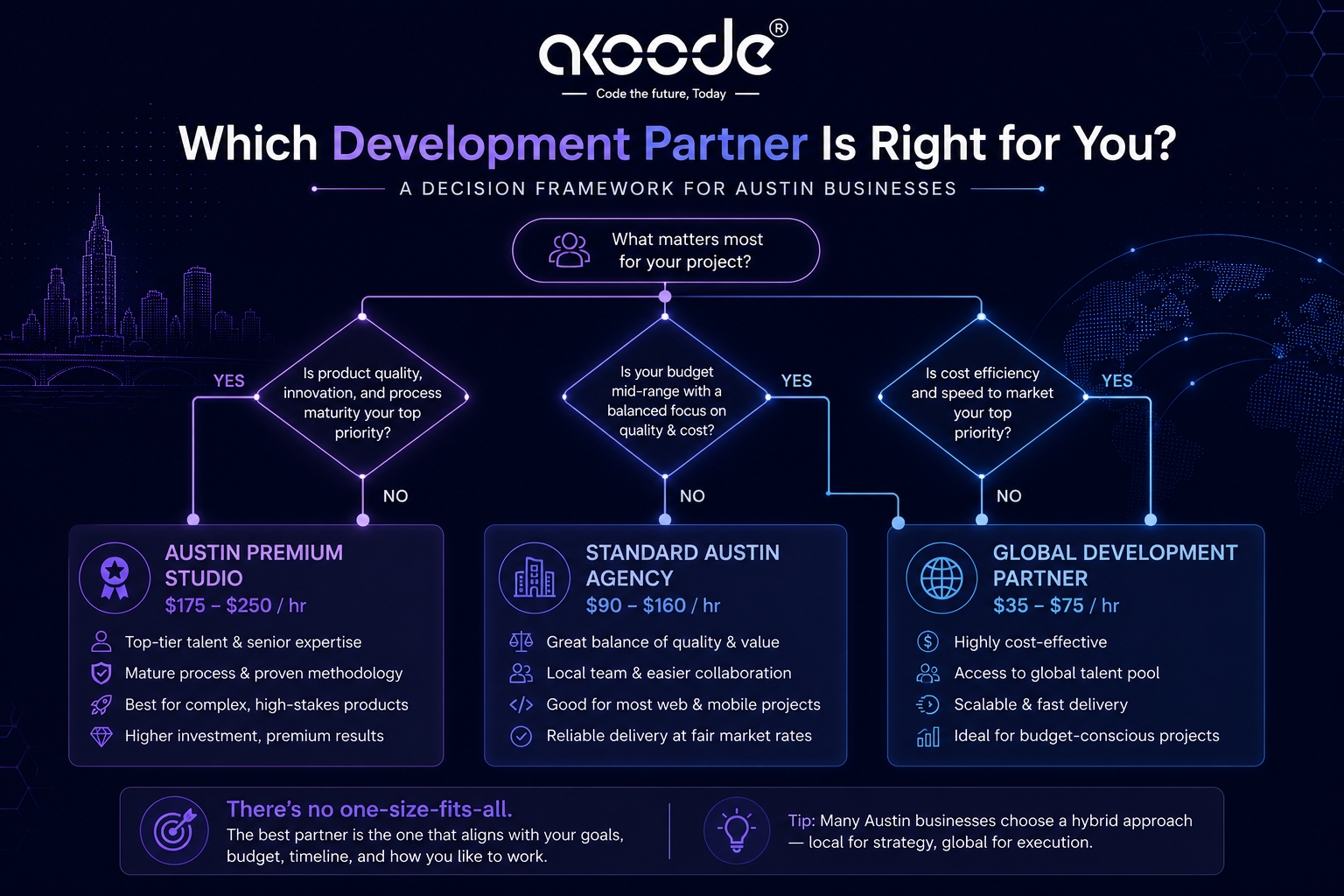
The honest read: Austin's top-tier firms genuinely deliver premium product craft — if your competitive edge is design polish and you have the budget, they earn their rates. But for standard web, mobile, and SaaS engineering, the $150,000+ difference between an Austin build and a well-managed global build is geography and local salary inflation — not quality. A senior engineer produces the same architecture in Gurugram as in the Domain.
Many experienced Austin buyers land on a hybrid: local discovery and design direction, global delivery for the build. It captures both advantages.
The Decision Framework
Answer five questions:
Does your project require regular in-person collaboration?
Do your contracts require US-based vendors or onshore data handling?
Is your project under 10 weeks with fully locked scope?
Is design polish your primary competitive differentiator — and is budget genuinely comfortable at premium rates?
Do you lack any internal capacity to manage a vendor relationship with structured communication?
Three or more yes → Austin agency (premium tier if question 4 drove it). The local premium is buying something real.
Zero or one yes → global partner. You'd be paying $100,000+ for geography you don't need.
Two yes → hybrid. Fixed-price discovery with a local team you can meet, then global delivery for the build.
And if AI is part of your project, read our companion guide on AI software development in Austin before scoping anything — AI adds evaluation criteria that general software hiring misses entirely.
Frequently Asked Questions
How do I hire a software development company in Austin?
Start with a one-page project definition — business problem, success metrics, budget range, timeline, existing systems. Build a list of 5–7 candidates from founder referrals, Clutch, and GoodFirms, including at least one global partner as a price baseline. Run discovery calls with the 15 questions in this guide, compare proposals line-by-line on scope rather than headline price, and check references with the "what went wrong" question.
How much does it cost to hire a software development company in Austin?
Standard Austin agencies bill $90–$160/hour; the premium tier bills $175–$250/hour. Complete projects run $30,000–$70,000 for an MVP, $75,000–$180,000 for a business application, and $130,000–$320,000 for a SaaS platform. Global partners deliver equivalent scope 50–65% lower. Full benchmarks in our Austin cost guide.
How do I verify an Austin software company is legitimate?
Four checks: verified Clutch/GoodFirms reviews (read the 3–4 star ones), a live production product you can personally test, engineer LinkedIn profiles showing real tenure, and a reference call asking what went wrong on a past project. In Austin specifically, add a fifth: check average engineer tenure — the local hiring market makes turnover your project's biggest hidden risk.
Should I hire a premium Austin studio or a standard agency?
Premium studios ($175–$250/hour) earn their rates when product polish is your competitive edge and process maturity matters — consumer apps, funded startups where design is the moat. For internal tools, standard B2B applications, and most SaaS builds, a good standard-tier team ($90–$160/hour) or a global partner delivers the same outcome for 40–65% less. A discovery phase usually answers which tier your project actually needs.
How much should I pay upfront to a software development company?
25–30% against a defined first milestone is market standard. Dedicated team engagements typically bill monthly with no large deposit. A firm demanding 50% or more before discovery has cash flow or retention problems that shouldn't become yours.
Do Austin software companies outsource their work?
Some do — and disclosed outsourcing isn't a problem. The problem is paying $130/hour for work performed at $35/hour by an undisclosed offshore team, with the spread going to a middleman. Ask directly: "Where will the engineers on my project be located, and can I meet them?" Transparent firms answer in one sentence.
What are the red flags when hiring an Austin dev agency?
The biggest: pricing before discovery, no engineers in sales calls, an unverifiable portfolio, agreement with everything you say, proposals without assumptions, 50%+ deposits, evasiveness about team location, and visible engineer turnover on LinkedIn. Two or more together is a pattern — and patterns don't improve after signing.
How long does it take to hire a software development company in Austin?
Run properly: 3–5 weeks. One week defining your project, one building the candidate list, one to two for calls and proposals, and one for references and contract. Austin's dense market means more candidates to filter, not fewer — don't let the abundance tempt you into shortcutting reference checks.
What should an Austin software development contract include?
IP assignment on payment, source code access from day one, a defined change-order process with rates, a key personnel clause (critical in Austin's hiring market), post-launch support terms, and a clean exit clause with 30 days' notice. Payment structured as 25–30% against a first milestone.
Is it better to hire local in Austin or go with a global team?
If you need in-person collaboration, US-vendor contract requirements, or premium design craft, hire locally. For standard engineering where quality depends on team experience rather than zip code, a transparent global partner like Akoode Technologies delivers equivalent outcomes at 50–65% less — with Central Time communication and no hidden delivery model.
What to Do in the Next 48 Hours
If you're serious about hiring, don't start by Googling "software development company Austin" and calling whoever ranks first.
Write the one-page project definition. Ninety minutes that improves every conversation for the next month.
Build your list — 5–7 candidates from referrals and verified reviews, with at least one global partner included so your comparison has a real baseline instead of just Austin premiums against each other.
Then start conversations with the 15 questions in hand — including at least one vendor who will tell you honestly whether your project is worth doing at all.
Talk to Akoode About Your Austin Project
Akoode Technologies builds custom software, mobile apps, and AI systems for Austin businesses — 100+ projects delivered across 15+ industries, 4.9/5 on Google, 5.0/5 on Clutch. Global engineering economics, US presence, Central Time communication, and full transparency about where every engineer sits.
Review our case studies, our custom software development and mobile app development services — or skip straight to a conversation.
Book a free 45-minute consultation → calendly.com/akhil-akoode/ak
Get In Touch Now
View More Our Blog