




 July 20, 2026
Software Development Cost in Austin: What You're Actually Paying For in 2026
Austin has a pricing paradox that catches most first-time software buyers off guard.
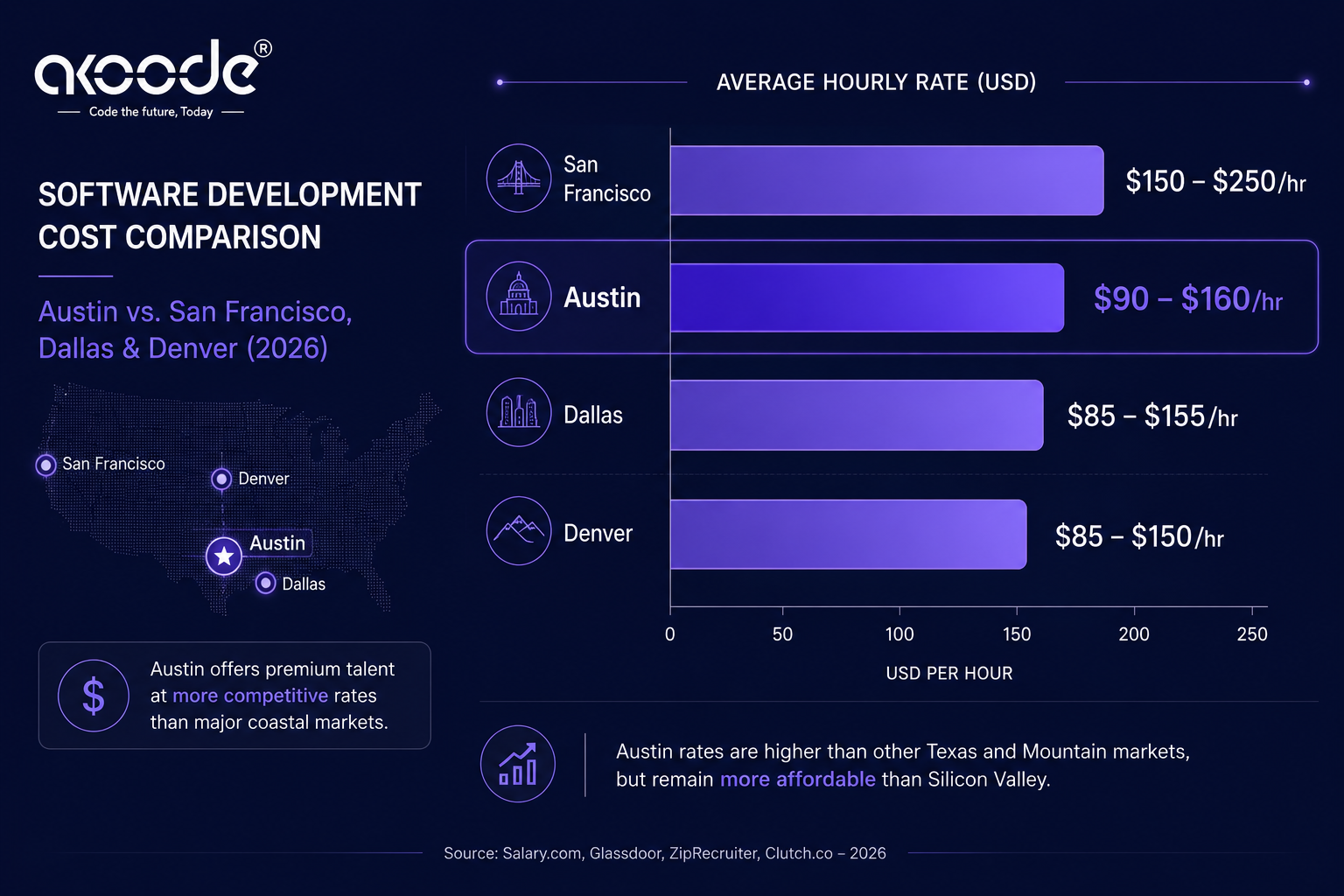
The city markets itself as the affordable alternative to Silicon Valley — and compared to San Francisco's $150–$250/hour rates, it is. But Austin is no longer cheap. Standard agency rates run $90–$160 per hour, and top-tier Austin development firms now charge $175–$250/hour — genuine Bay Area pricing, in Texas.
That spread is the story. The same project can be quoted at $60,000 by one Austin vendor and $220,000 by another, and both quotes can be "honest" — they're just built on completely different teams, processes, and assumptions.
A mid-complexity web application in Austin runs $75,000–$180,000 with a credible local agency. The same scope with a senior-led global team runs $35,000–$85,000.
If you're planning a software project in or for the Austin market, this guide gives you the real numbers — rates by role, complete project budgets, the hidden costs that never appear in proposals, and an honest framework for deciding when Austin's premium is worth paying.
Why Austin Costs What It Costs
Austin's rates are built on a decade of explosive growth colliding with a talent market that can't keep up.
The demand side: Tesla, Oracle, Apple, Google, Meta, and Samsung all built major Austin operations. The startup ecosystem around South Congress and the Domain generates constant hiring pressure. SXSW-fueled visibility keeps the pipeline of funded companies full.
The supply side: UT Austin and the city's coding bootcamps produce strong graduates — but demand outpaces supply, keeping hourly rates elevated. And while Austin's cost of living remains below Silicon Valley, it has risen sharply, pushing developer salaries to $110K–$150K annually.
Here's what developers actually earn, from the major salary sources:
Salary.com: $128,013/year average ($62/hour), ranging from $108,761 to $148,935
Glassdoor: $119,377/year ($57/hour), with top earners at $180,543 — based on over 6,000 submitted salaries
Entry-level (ZipRecruiter): $86,272/year ($41/hour), ranging up to $134,058 for the 90th percentile
The seniority ladder is steep. Salary.com's Austin data shows Software Developer I at $81,690, Developer III at $128,690, Lead Developers at $139,765, and senior systems developers reaching $191,637.
The top-paying Austin industries for developers: telecommunications ($146,014 median total pay), HR & staffing, financial services, and aerospace & defense. If your project sits in one of these verticals, expect the talent competing for it to be priced accordingly.
Now the agency math. A developer earning $125,000 costs a firm roughly $160,000–$175,000 fully loaded after benefits, taxes, and overhead. Add office space in one of America's hottest commercial markets, project management, sales costs, and margin — and the client-facing rate lands at $90–$160/hour for standard firms, $175–$250 for the premium tier.
Austin Developer Hourly Rates: The Full Breakdown
Austin sits near the top of the non-coastal US market: $90–$160/hour as the standard band, above Dallas/Houston ($85–$155) and Denver ($85–$150), below Seattle ($120–$200) and far below San Francisco.
Here's the fuller picture by role:
Role | Junior (0–2 yrs) | Mid-Level (3–5 yrs) | Senior (6+ yrs) |
|---|---|---|---|
Frontend Developer | $60–$85/hr | $85–$120/hr | $120–$165/hr |
Backend Developer | $65–$95/hr | $95–$135/hr | $135–$180/hr |
Full-Stack Developer | $65–$90/hr | $90–$130/hr | $130–$175/hr |
Mobile Developer (iOS/Android) | $75–$100/hr | $100–$140/hr | $140–$190/hr |
UI/UX Designer | $55–$80/hr | $80–$115/hr | $115–$155/hr |
DevOps / Cloud Engineer | $75–$105/hr | $105–$145/hr | $145–$195/hr |
AI / ML Engineer | $95–$135/hr | $135–$180/hr | $180–$250/hr |
QA Engineer | $50–$75/hr | $75–$105/hr | $105–$140/hr |
Technical Project Manager | $80–$110/hr | $110–$145/hr | $145–$185/hr |
Three observations worth making.
App developers specifically bill $75–$150/hour, with senior engineers and AI specialists at the higher end — and a reality check from the local market: it's unlikely you'll get a quality, production-ready custom application for under $20,000 from a legitimate Austin development company. Quotes below that line are telling you something.
AI talent carries the steepest premium. Austin's AI engineering pool is deeper than most non-coastal cities — a genuine advantage — but senior AI specialists routinely exceed $200/hour. (We cover what Austin businesses are actually building with that talent in our companion guide on AI software development in Austin.)
The premium tier is real. The $175–$250/hour Austin firms aren't just charging more for the same work — they typically bring mature agile, DevOps, and CI/CD practices that improve product quality. The question is whether your project needs that maturity or whether a standard-tier team delivers the same outcome for 40% less. Usually only a proper discovery phase answers that.
What Complete Projects Cost in Austin
Hourly rates are inputs. Here's what total builds actually run:
Web Application Development
Project Type | Complexity | Austin Cost | Timeline |
|---|---|---|---|
Marketing website / landing pages | Simple | $8,000–$25,000 | 3–6 weeks |
MVP / proof of concept web app | Simple-Medium | $30,000–$70,000 | 2–4 months |
Business web application | Medium | $75,000–$180,000 | 4–7 months |
SaaS platform | Medium-High | $130,000–$320,000 | 5–10 months |
Enterprise web platform | Complex | $280,000–$650,000+ | 9–18 months |
Mobile App Development
App Type | Austin Cost | Notes |
|---|---|---|
Basic single-platform MVP | $25,000–$60,000 | Floor of the legitimate market |
Mid-complexity cross-platform app | $60,000–$150,000 | Flutter/React Native, integrations |
Feature-rich enterprise app | $150,000–$250,000+ | iOS + Android, real-time, multi-role |
The local benchmark: mobile apps in Austin range from $25,000 for a basic single-platform MVP to $250,000 or more for enterprise-grade applications on both platforms.
Custom Software and Enterprise Systems
Project Type | Austin Cost |
|---|---|
CRM or internal operations tool | $35,000–$110,000 |
Custom ERP system | $140,000–$450,000+ |
Healthcare platform (HIPAA) | $100,000–$380,000 |
Fintech application | $120,000–$420,000 |
AI-integrated business application | $70,000–$300,000 |
Two Austin-specific cost drivers worth knowing:
UI/UX expectations run high. Austin's competitive product market demands polished, intuitive design — expect $5,000–$25,000 for professional UI/UX depending on complexity, and resist the temptation to cut it. In a market this crowded, design is table stakes.
Advanced integrations add real money. AI/ML features, payment gateways, and third-party API integrations typically add $10,000–$50,000 to an Austin project budget. Scope these explicitly upfront rather than discovering them as change orders.
Timeline pressure costs extra. Standard delivery (6–12 months) is most cost-effective. Accelerated delivery (3–6 months) requires larger teams and can increase costs by 20–40%. If your launch date is fixed, budget for the acceleration premium now.
Where Your Budget Actually Goes
A $150,000 Austin project distributes roughly like this:
Phase | Share | Amount |
|---|---|---|
Discovery & strategy | 8–12% | $12K–$18K |
UI/UX design | 18–25% | $27K–$37K |
Frontend development | 25–35% | $37K–$52K |
Backend & APIs | 20–30% | $30K–$45K |
QA & testing | 8–12% | $12K–$18K |
Deployment & PM | 10–15% | $15K–$22K |
Design and backend infrastructure together consume $57,000–$82,000 before a single user-facing screen ships. These aren't padding — cut them and you get software that doesn't work, doesn't scale, or doesn't get used in a market where users have alternatives.
The Hidden Costs Austin Vendors Rarely Quote
Third-party services start at launch and never stop. Stripe, Twilio, AWS, analytics, email. Budget $400–$10,000/month scaling with users.
Post-launch maintenance is permanent. 15–20% of build cost annually. A $180,000 Austin project carries $27,000–$36,000/year — forever, starting day one. This is the line item most financial models omit and most founders scramble to fund twelve months later.
Texas compliance is real. The Texas Data Privacy and Security Act (TDPSA) governs handling of Texas residents' data — consent, minimization, consumer rights, opt-outs — and needs to be architected in from Phase 1. HIPAA adds 15–20% for Austin's growing health tech sector. PCI-DSS applies to the fintech cluster. Austin's strong presence in fintech, healthcare, e-commerce, and logistics means compliance and security requirements push costs higher than generic estimates suggest.
Discovery gets skipped to win on price. A proper discovery phase costs $8,000–$20,000 in Austin and prevents rework costing ten times more. Vendors who skip it aren't cheaper — they're deferring cost into change orders.
The rule: add 15–20% to any quote for your internal budget.
Austin vs. Other Markets: The Honest Comparison
Market | Hourly Rate |
|---|---|
San Francisco / Silicon Valley | $150–$250/hr |
New York City | $130–$220/hr |
Seattle | $120–$200/hr |
Austin | $90–$160/hr (top firms $175–$250) |
Dallas / Houston | $85–$155/hr |
Denver | $85–$150/hr |
Nearshore (Latin America) | $40–$80/hr |
Offshore (South Asia) | $25–$55/hr |
Now the project math on a 2,000-hour SaaS build:
Team | Avg Rate | Total Cost |
|---|---|---|
Austin premium firm | $200/hr | $400,000 |
Austin standard agency | $125/hr | $250,000 |
Nearshore (LatAm) | $65/hr | $130,000 |
Offshore (India, senior) | $45/hr | $90,000 |
The honest read: a well-managed global engagement delivers the same 2,000 hours of senior engineering for roughly a third of Austin standard rates — and the quality ceiling is identical, because a senior engineer working in React, Node, and AWS produces the same architecture in Gurugram as in the Domain. What changes is the salary structure underneath.
The equally honest caveat: offshore done carelessly — chosen on price alone, managed set-and-forget — erodes its own savings through communication gaps and rework. The savings only stick with a senior team, disciplined process, and real US-hours overlap. That's a vendor-quality question, not a geography question.
Akoode Technologies serves Austin businesses on exactly this model: global engineering economics, US presence, Central Time communication overlap, and transparency about where every engineer sits — no local markup on offshore delivery.
When Austin Rates Are Worth Paying
Pay local Austin rates when:
You need regular in-person collaboration — workshops, on-site integration, stakeholder sessions that benefit from being in the room
Your contracts require US-based vendors or onshore data handling
Your project is under 10 weeks with locked scope, where coordination overhead could offset savings
Your product needs deep Austin-market context — a consumer app for the local market, or something that lives inside the city's startup ecosystem
You're competing for talent-signal reasons — some funded startups hire local agencies partly as an investor optic
Consider a global partner when:
Requirements are clear and the engineering is standard — web, mobile, SaaS, integrations
The project runs 3+ months, where the cost differential compounds
Your team can manage a vendor relationship with structured communication
Budget matters — where the difference between $250,000 and $90,000 funds a year of runway, marketing, or two key hires
And if you're actively evaluating vendors right now, our companion guide on how to hire a software development company in Austin walks through the full process — vendor types, red flags, and the questions that protect your budget.
A Practical Budget Framework
1. Define your project tier honestly. MVP, production replacement, or net-new platform — each has a different cost floor.
2. Separate must-have from nice-to-have. A focused MVP that does three things well costs half of a sprawling v1. Descoping is free and it's your biggest lever.
3. Add 15–20% for hidden costs. Third-party services, compliance, integration surprises.
4. Budget maintenance from day one. 15–20% annually, forever. If it breaks your economics, better to know now.
5. Get three quotes and compare scope, not price. The $60K and $220K quotes for the same project are almost never quoting the same thing. Itemize line by line — discovery, design, QA, DevOps, support — and the "cheap" quote usually stops being cheap.
Frequently Asked Questions
How much does software development cost in Austin in 2026?
Standard Austin agency rates run $90–$160/hour, with top-tier firms at $175–$250/hour. Complete projects range from $30,000–$70,000 for an MVP web app, $75,000–$180,000 for a business application, $130,000–$320,000 for a SaaS platform, and $280,000–$650,000+ for enterprise systems.
How much do Austin app developers charge per hour?
Austin app developers typically charge $75–$150/hour, with senior engineers and AI specialists at the higher end. Basic mobile MVPs start around $25,000 for a single platform; feature-rich enterprise apps on iOS and Android run $150,000–$250,000+.
Can I build a custom app for under $20,000 in Austin?
Realistically, no — not a production-ready one from a legitimate Austin development company. Quotes under that line typically exclude discovery, QA, or post-launch support, or signal a team that will learn on your project. If your budget is genuinely constrained, a global partner delivers Austin-equivalent quality starting around $18,000–$35,000 for a focused MVP.
What do software developers earn in Austin?
Average salaries range from $119,377 (Glassdoor, 6,000+ submissions) to $128,013 (Salary.com), with entry-level at $86,272 and top earners exceeding $180,000. Lead developers average $139,765 and senior systems developers reach $191,637. The top-paying industries are telecommunications, financial services, and aerospace.
Is Austin cheaper than San Francisco for software development?
Yes, meaningfully — Austin's $90–$160/hour versus San Francisco's $150–$250. But the gap is narrowing, and Austin's top-tier firms now charge genuine Bay Area rates of $175–$250/hour. Against Dallas ($85–$155) and Denver ($85–$150), Austin carries a modest premium driven by its hotter talent market.
How long does a software project take in Austin?
Standard timelines: a simple MVP takes 2–4 months, a mid-complexity application 4–7 months, and enterprise platforms 9–18 months. Accelerated delivery (compressing to 3–6 months) requires larger teams and increases costs 20–40%.
What compliance requirements affect Austin software projects?
The Texas Data Privacy and Security Act (TDPSA) governs Texas residents' personal data and should be architected in from Phase 1. HIPAA adds 15–20% for health tech. PCI-DSS applies to fintech and payments. Austin's strength in regulated verticals — fintech, healthcare, logistics — means compliance pushes real costs that generic estimates miss.
What does software maintenance cost after launch?
Plan 15–20% of build cost annually, starting at launch. A $180,000 Austin project carries $27,000–$36,000/year in updates, security patches, dependency management, and compatibility work — permanently.
Should I hire an Austin software company or go offshore?
If you need in-person collaboration, US-vendor requirements, or deep local-market context, Austin teams make sense. For standard web, mobile, and SaaS engineering, a well-managed global partner delivers equivalent quality at roughly a third of Austin standard rates. Akoode Technologies offers the middle path — global economics with US presence and Central Time communication.
Why are Austin software rates rising?
Demand outpacing supply. Tesla, Oracle, Apple, Google, and Meta all expanded Austin operations, competing with a dense startup ecosystem for the same UT Austin and bootcamp talent pipeline. Rising cost of living pushed salaries to $110K–$150K, which flows directly into agency rates.
The Bottom Line
Austin earned its reputation as America's startup capital — and its rates now reflect it. The talent is genuinely strong, the sector depth in fintech, health tech, and consumer products is real, and the premium tier delivers premium process.
But "cheaper than San Francisco" is a low bar. For most software projects, quality comes down to the team's experience, process discipline, and communication — not their zip code. The $150,000 difference between an Austin premium build and a well-managed global build funds a lot of product iteration, marketing, and runway.
The best move before committing to any number: a clear, itemized picture of what you're actually buying — discovery, compliance, maintenance, and the third-party costs that never appear in proposals.
That's the conversation we offer.
Book a free consultation → calendly.com/akhil-akoode/ak
No pitch. No pressure. A straight conversation about what your project needs and what it should realistically cost.
Explore: Software Development Company in Austin | akoode.com | AI development | custom software | mobile apps
Get In Touch Now
View More Our Blog