


 May 29, 2026
Most healthcare AI projects never reach production.
The models work fine in testing. The data pipeline runs cleanly in staging. Then the system hits a real clinical environment. The EHR integration assumptions break. The clinicians do not trust the alerts. The regulatory team asks questions nobody prepared for.
This is a builder's guide. It covers how to architect AI diagnostic tools and clinical decision support systems that actually work in production. Not what AI does in healthcare broadly. That is covered separately in the existing healthcare AI use cases guide. This guide is for developers, healthtech founders, and technical leads who need to build these systems correctly.
What Is the Difference Between Diagnostic AI and a CDSS?
They are related. They are not the same thing.
A diagnostic AI tool takes clinical inputs and produces an inference. It analyses a chest X-ray and flags a potential nodule. It reads lab results and calculates a sepsis risk score. It processes ECG data and identifies an arrhythmia. The system makes a clinical judgement from data.
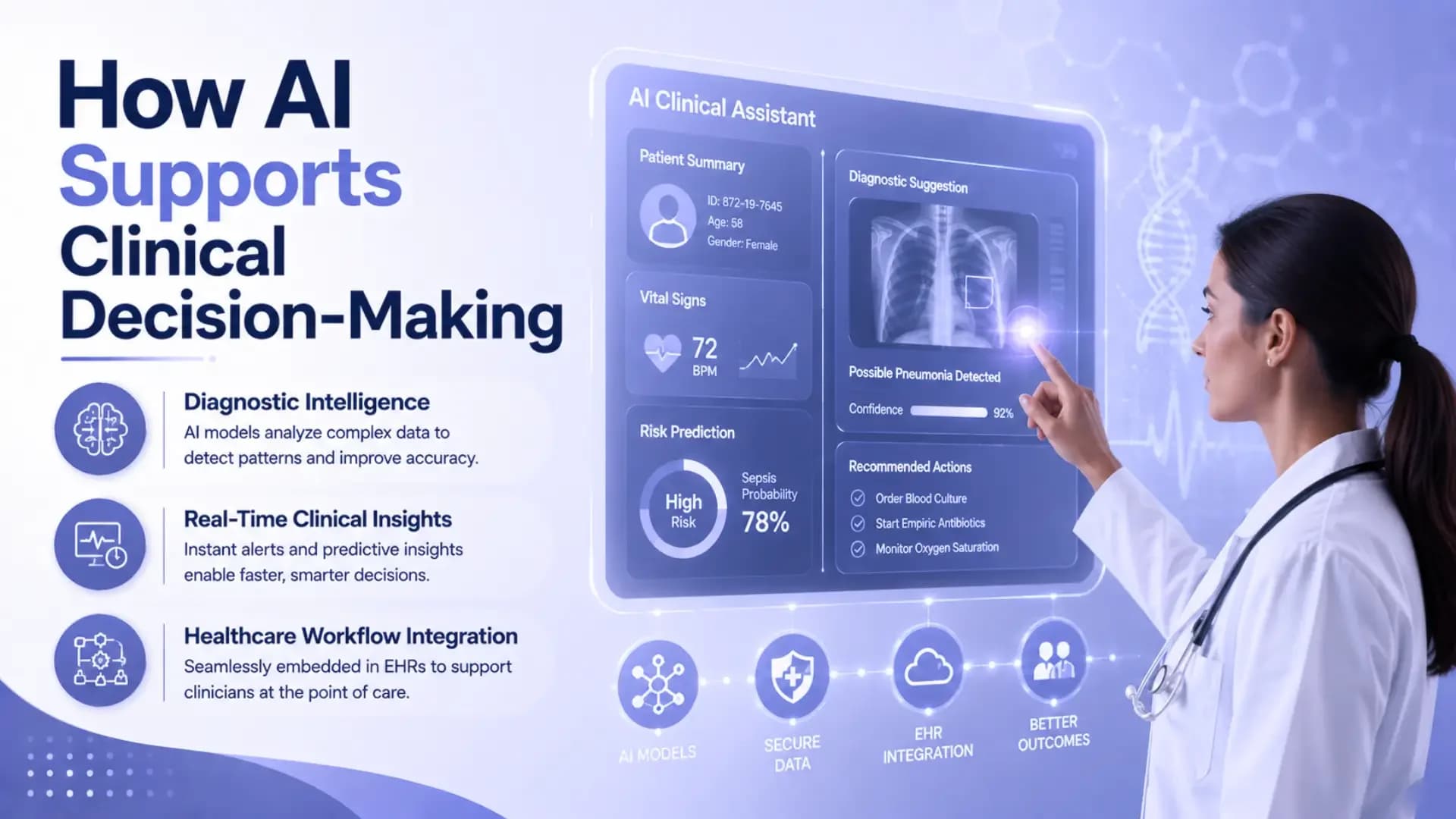
A clinical decision support system does something different. It lives inside the clinical workflow. A doctor opens a patient chart. The CDSS checks the new prescription against current medications and flags an interaction. A nurse records a vital sign. The CDSS calculates a deterioration score and alerts the team.
The architecture difference matters. Diagnostic AI is typically a standalone inference service. A defined input goes in. A prediction comes out. CDSS is workflow-embedded. It runs continuously inside the EHR environment. It must respond in the time window a clinician has between clicking and reading.
In 2026, the two categories are converging. A radiology AI that detects a critical finding and routes an alert through the EHR simultaneously is both. Designing for that convergence from the start is smarter than treating them as separate systems.
What Architecture Does a Production Healthcare AI System Need?
A demo environment is forgiving. A clinical environment is not.
Production healthcare AI needs five layers working together. Each one has failure modes that kill otherwise good systems.
Data ingestion and normalisation
Clinical data arrives from multiple sources. Labs. Imaging platforms. Pharmacy systems. Wearables. Every source uses a different format. This layer normalises everything before any model processes it. FHIR is the standard. Build around it from day one. Retrofitting FHIR compatibility to a non-FHIR architecture costs more than building it in correctly.
Clinical data pipeline
This is where most healthcare AI budget goes. Clinical data is messy. Values are missing. Units are inconsistent. Timestamps are unreliable. A patient weight in a cardiology note and one in a pharmacy record may be six months apart. The pipeline must handle this without introducing errors that reach the model. Teams that underestimate this layer overrun their budgets.
Inference engine
The model layer receives processed features and returns predictions. The model type depends on what the output needs to be. Convolutional networks for imaging. Gradient boosting for tabular clinical data. Transformers for unstructured notes. Each type has different latency, explainability requirements, and retraining cadences.
Alert delivery and workflow integration
This is where most systems underperform in production. The model produces a prediction. That prediction must reach the right clinician at the right moment without interrupting their current task. CDS Hooks is the standard protocol for embedding clinical decision support directly into EHR workflows. It defines trigger points. The EHR calls an external service. The service responds. The result surfaces in the clinician's interface. Build to this standard. Custom EHR integrations are expensive and brittle.
Monitoring and feedback
Production healthcare AI needs continuous performance tracking. Models drift. A sepsis prediction model trained on 2023 patient data may underperform on 2026 patients if care protocols or population demographics have shifted. Define performance thresholds before deployment. Build automated alerts when those thresholds are breached. Treat retraining as a scheduled operational task, not an emergency response.
How Does FHIR Integration Actually Work?
FHIR makes it practical to build healthcare AI that works across different EHR environments. Without it, every hospital client requires a custom integration.
FHIR represents clinical data as structured resources. A patient is a resource. A lab result is an Observation resource. A medication is a MedicationRequest resource. A clinical note is a DocumentReference. Each resource has a defined schema and a REST API. External systems read and write data consistently across different EHRs.
Two patterns matter most for AI systems.
Event-driven triggers. A FHIR subscription tells the EHR to notify the AI system when specific events occur. A new lab result arrives. A medication is ordered. A patient is admitted. The AI system receives the notification, retrieves context, runs inference, and returns a response within the available time window.
Bulk data access. FHIR Bulk Data lets a system extract large patient cohorts for training and evaluation. Building a dataset of ten thousand diabetic patients and their five-year lab trajectories requires bulk access. Individual resource retrieval at that scale is impractical.
In India, FHIR adoption is less mature than in Western markets. Many hospital information systems use proprietary formats with no FHIR layer. Building for the Indian market often means building a translation layer first. That layer converts proprietary HIS data into FHIR-compatible resources before the AI pipeline begins.
The investment is worth making. India's Ayushman Bharat Digital Mission mandates FHIR compliance for health data exchange. Building to that standard now means compliance is handled rather than chased.
How Do You Choose the Right Model for Clinical AI?
Model selection in healthcare AI is not a pure technical optimisation. It is a clinical and regulatory problem with a technical component.
Three questions determine the right model.
What is the output type?
Binary classification for risk stratification. Multi-class for diagnostic categorisation. Regression for continuous outcome prediction like length of stay. Sequence generation for note summarisation. Each output type has appropriate model families.
What does explainability require?
A triage score that influences care priority must be explainable when a clinician challenges it. A model that produces predictions without surfacing contributing factors will face clinical resistance and regulatory scrutiny. SHAP values for gradient boosting models, attention visualisations for transformers, and saliency maps for imaging models are the current standard for explainable clinical AI.
What does clinician review look like? The FDA's January 2026 guidance update makes clinician review a critical regulatory factor. A system whose outputs a clinician reviews, modifies, and accepts or rejects is treated differently from one that acts autonomously. Design the review workflow into the architecture from day one.
LLMs deserve a specific note. They are widely used in 2026 for clinical note summarisation, chart review assistance, and contextual data retrieval. They are not appropriate for risk scoring or diagnosis classification. Hallucination risk in a deterministic clinical decision pathway is not acceptable. Use LLMs where language is the problem. Use predictive models where clinical accuracy is the requirement.
What Are the Regulatory Constraints in India and Globally?
Regulatory compliance is an architectural constraint. Not a final-stage review.
In the US, the FDA classifies AI-based healthcare software under the Software as a Medical Device framework. The January 2026 guidance update clarified the criteria. The key question is whether the software replaces clinical judgment or supports it. Systems that surface information a clinician reviews and interprets stay in a more manageable regulatory zone. Systems that autonomously direct treatment decisions face premarket review requirements.
In India, the Central Drugs Standard Control Organisation classifies AI-based medical software under the Medical Devices Rules 2017. Diagnostic AI tools informing clinical decisions require registration. The pathway is still developing. But the directional requirement is clear. Clinical AI in Indian hospitals must demonstrate safety, clinical validity, and traceability of the decision process.
For healthtech companies building across both markets, unified clinical validation is more efficient than market-specific strategies. Designing for rigorous evaluation and outcome tracking satisfies both.
Data privacy adds a separate layer. India's Digital Personal Data Protection Act 2023 governs patient health data. HIPAA applies to US patient data. Any AI system processing clinical data must handle PHI through defined architectural boundaries. Access controls alone are not sufficient.
How Does Computer Vision Work in Healthcare Diagnostics?
Medical imaging is the most commercially deployed AI category in clinical diagnostics. The technology is mature. The architecture is well understood.
The core difference from other clinical AI is the input type. The model processes pixel data rather than tabular records. Convolutional neural networks and vision transformer architectures identify visual patterns associated with clinical findings across large training image sets.
For healthtech companies building imaging AI, computer vision development in medical contexts has specific requirements that general vision applications do not.
DICOM is the medical imaging standard. It requires specialised handling. Models must be validated across the full range of acquisition equipment. A model trained on high-resolution images from premium equipment will underperform on images from older hardware common in Tier 2 Indian hospitals. Building for the full equipment range from the start avoids a painful post-launch discovery.
Workflow integration for imaging AI must work inside the radiologist's existing environment. DICOM viewers, RIS-PACS systems, and reporting tools each have their own integration protocols. The most effective imaging AI products embed into existing workflows. They do not require a separate platform.
What Does Building Healthcare AI Look Like for Indian Healthtech Startups?
India's healthtech ecosystem is one of the most active AI adoption environments globally. The market conditions are genuinely different from Western markets in ways that shape both the opportunity and the build decisions.
The physician-to-patient ratio creates specific high-value use cases. A specialist managing hundreds of outpatients in a single session needs different tools from a physician in an environment where thirty minutes per patient is standard. AI that surfaces the three most clinically relevant data points from a patient history before the doctor opens the consultation solves a real problem at that ratio.
Data quality varies sharply across hospital tiers. Large private chains in metro cities have reasonably complete digital records. Government district hospitals often have fragmented data across disconnected systems. Building products that work across this range requires either focusing on higher-quality data environments first or investing significantly in data preparation infrastructure.
The regulatory environment is evolving faster than most startups plan for. Companies that build clinical validation into their development process from the start are better positioned as requirements firm up.
India's AI development market is deep and capable. The AI innovation trajectory India is on toward 2030 and the availability of experienced AI development teams in the Indian market both mean the capability to build sophisticated healthcare AI and the market conditions to deploy it are aligning faster than in most comparable emerging markets.
What Does Data Privacy and Model Governance Require?
Healthcare AI handles data that causes serious harm if exposed. Privacy engineering is a first-class architectural concern.
Data minimisation is the foundation. The AI system accesses only the data strictly necessary for the clinical inference it makes. Define the minimum necessary dataset for each model at design time. Enforce it at the data access layer.
Model governance in production requires version control for models, not just code. Every clinical prediction should be traceable to the specific model version and training data snapshot that produced it. When a clinical outcome raises a question about an AI recommendation, the governance trail must reconstruct what the system knew and how it reasoned at that moment.
This traceability is not just good engineering practice. It is increasingly a regulatory expectation. Build it in from the start.
Also Read: Healthcare App Development Cost: 2026 Full Guide
Conclusion
Healthcare AI built for production is harder than healthcare AI built for a demo. The gap between the two is where most projects fail.
The systems that work share a few habits. They were designed around how clinicians actually work. Regulatory requirements were mapped before the first model was trained. Monitoring was part of the initial architecture, not an afterthought.
India's healthcare AI market is at an early but fast-moving stage. The companies building the right technical foundations now will be very difficult to displace when the market matures.
Akoode Technologies is a leading AI and software development company headquartered in Gurugram, India, with a US office in Oklahoma. From AI-powered healthcare platforms and computer vision diagnostics to custom clinical software and full stack development, Akoode builds healthcare technology for startups, hospitals, and enterprise health systems globally. If you are building a diagnostic AI or clinical decision support system and want a team that knows both the architecture and the regulatory environment it operates in, that conversation starts here.
Frequently Asked Questions
1. What is the difference between diagnostic AI and a CDSS?
Diagnostic AI takes clinical inputs and produces a diagnosis or risk classification. A CDSS integrates into clinical workflows and surfaces alerts or recommendations at decision points inside the EHR. Diagnostic AI is a standalone inference service. CDSS is a workflow-embedded system that operates continuously within clinician tools.
2. What is FHIR and why does it matter for healthcare AI?
FHIR is the standard for exchanging clinical data between healthcare systems. It defines structured resources and REST APIs that allow AI systems to read and write patient data consistently across different EHR environments. Building around FHIR from the start avoids custom integration work for every hospital client and positions the product for India's ABDM compliance requirements.
3. What model type should a healthtech team use for clinical AI?
Use convolutional networks or vision transformers for imaging. Use gradient boosting models for tabular clinical data. Use recurrent networks for time-series clinical data. Use LLMs for note summarisation and contextual retrieval only. Do not use LLMs for risk scoring or clinical classification where hallucination risk is unacceptable.
4. What are the regulatory requirements for clinical AI in India?
The CDSCO classifies AI-based medical software under the Medical Devices Rules 2017. Diagnostic tools informing clinical decisions require registration. ABDM mandates FHIR compliance for health data exchange. Patient health data is governed by the Digital Personal Data Protection Act 2023.
5. What makes healthcare AI projects fail in production?
The most common causes are wrong integration assumptions about EHR environments, model performance degradation from data drift after deployment, clinician resistance from poor workflow design, and regulatory requirements discovered after the product is finished. All four are architectural problems, not model problems.
6. What are the specific challenges of building healthcare AI for India?
Data quality varies significantly across hospital tiers. FHIR adoption is less mature than in Western markets. The physician-to-patient ratio creates specific high-value use cases. Regulatory pathways for clinical AI are still developing. Building for the full range of clinical environments in India requires explicit design decisions from the start.