


 June 29, 2026
1. Introduction
Choosing an AI customer support platform in 2026 is harder than it looks.
Every vendor claims to be "AI-powered." Every demo looks polished. Every pricing page promises ROI. But underneath the marketing, these platforms differ dramatically — in how their AI actually works, how deeply they integrate with your existing systems, how well they handle edge cases, and what they cost once you're past the free trial.
This guide cuts through that noise.
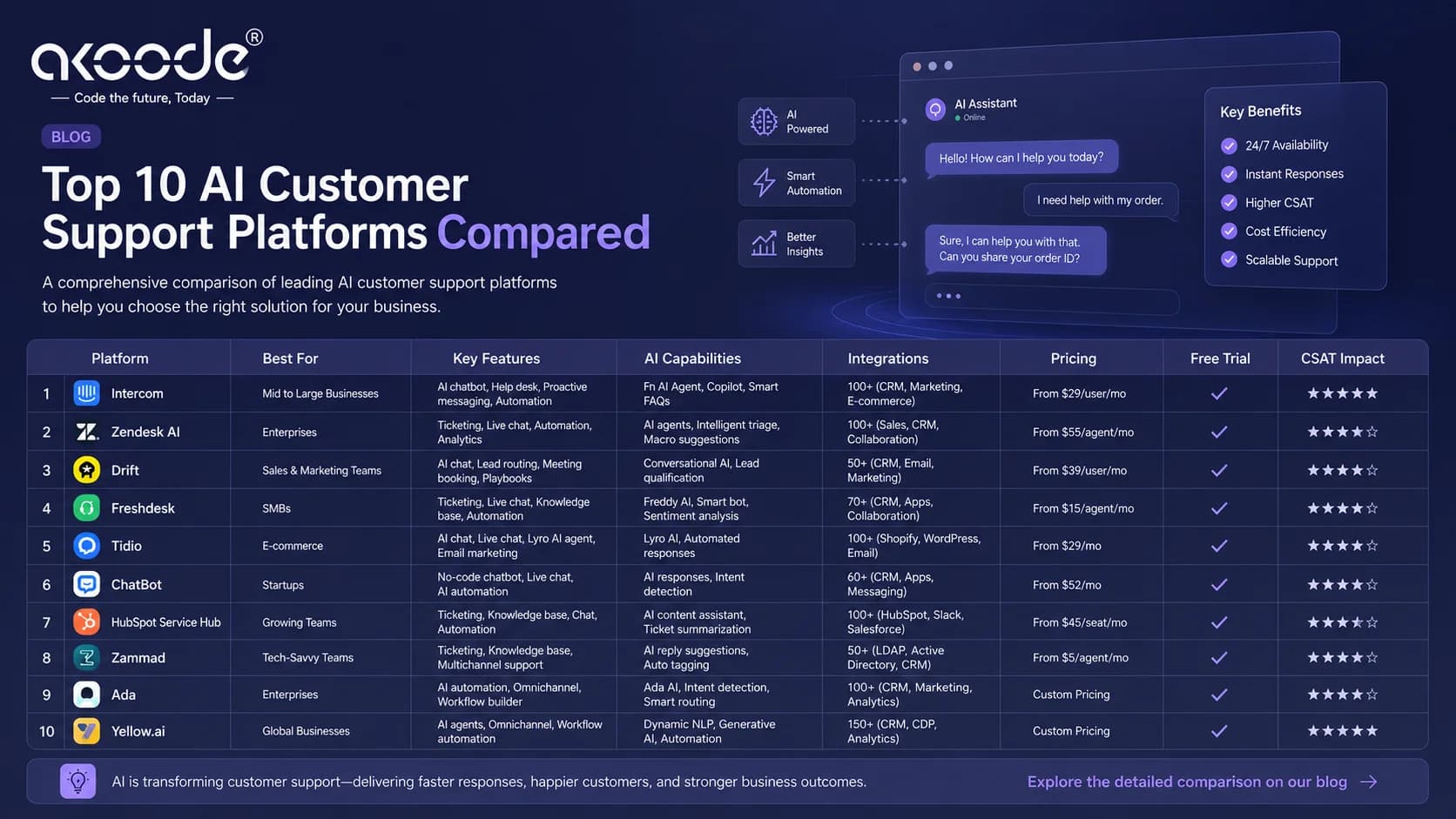
We have evaluated ten of the most widely used AI customer support platforms against consistent criteria: AI capability, integration depth, channel coverage, compliance posture, pricing transparency, and real-world suitability for different business types.
Whether you are a startup founder evaluating your first AI support tool, a SaaS CTO choosing infrastructure for 50,000 monthly tickets, or an enterprise IT leader standardising support across global markets — this comparison gives you a clear, honest picture of what each platform delivers and where each one falls short.
One upfront disclaimer: not every business should use an off-the-shelf platform. For companies with complex workflows, regulated industries, or deep CRM integration requirements, a custom-built AI customer support agentconsistently outperforms packaged software. We cover that case explicitly in Platform #10 and Section 15.
Let's get into it.
2. What to Look For Before You Compare
Before evaluating any platform, align on what actually matters for your business. These are the eight criteria we used to assess every platform in this guide.
1. AI Quality — Not Just "AI-Powered"
Does the platform use a real LLM (GPT-4o, Claude, Gemini) or an older intent classification model dressed up with new branding? The gap in resolution quality is enormous. Ask vendors for their underlying model and benchmark it against your actual support queries.
2. Resolution Rate
What percentage of queries does the AI resolve without human involvement? Platforms range from 30% to 85%. This number directly determines your ROI. Get it in writing, and ask for the definition — "deflection" and "resolution" are not the same thing.
3. Knowledge Base and RAG Architecture
Does the platform use retrieval-augmented generation to ground responses in your actual documentation? Or does it rely on keyword matching and decision trees? RAG is non-negotiable if you need accurate, policy-grounded responses.
4. CRM and Helpdesk Integration
Can it connect to HubSpot, Salesforce, Zoho, Zendesk, or your existing helpdesk? Shallow integrations that only log conversations are not enough — you need the AI to read customer history and take actions.
5. Channel Coverage
Web chat is table stakes. WhatsApp Business API, voice, email, SMS, and in-app support are where competitive advantage is built. Verify which channels are native versus bolt-on.
6. Compliance and Data Residency
For healthcare (HIPAA), finance (SOC 2, RBI), or EU customers (GDPR), compliance is non-negotiable. Most SaaS platforms offer basic GDPR compliance. HIPAA-eligible deployments are rarer and more expensive.
7. Pricing Transparency
Beware platforms that hide per-resolution fees, charge separately for AI features, or require enterprise contracts for basic functionality. The total cost of ownership often differs significantly from headline pricing.
8. Escalation and Human Handoff
A platform with no graceful escalation path is a liability. Evaluate how context transfers to human agents, whether queue management is included, and how the handoff experience feels from the customer's perspective.
💡 Expert Tip: Run a 30-query benchmark test with each shortlisted platform using your own support ticket data before making a decision. Real-world accuracy on your specific domain is more predictive than any vendor benchmark.
3. Platform #1 — Intercom Fin
Overview
Intercom Fin is the AI agent layer built on top of Intercom's established customer messaging platform. Launched in 2023 and significantly upgraded since, Fin uses GPT-4 as its backbone and retrieves answers from your connected knowledge sources — help articles, PDFs, URLs, and custom answers.
It is one of the most polished AI support products available off-the-shelf in 2026.
How the AI Works
Fin uses a RAG-based approach: it ingests your Intercom Help Centre articles, any URLs you point it to, and custom snippets you write. When a customer asks a question, Fin retrieves relevant content and generates a grounded response. It does not hallucinate answers to questions outside its knowledge scope — instead, it escalates.
The underlying model is GPT-4o (as of 2026). Anthropic Claude is available as an alternative model in some configurations.
Strengths
Genuinely impressive out-of-the-box resolution rates — Intercom claims 50%+ deflection for most customers, with some reaching 80%+
Clean, well-designed chat widget with excellent mobile experience
Strong omnichannel coverage: web, email, WhatsApp, iOS/Android in-app
Native CRM: Intercom's own contact and conversation database is robust
Fin Actions: the agent can perform actions (look up orders, check subscription status) via API connections — a major differentiator from older chatbot platforms
Excellent analytics dashboard: conversation topics, resolution rates, CSAT trends all in one place
Weaknesses
Pricing is per resolution, not per seat — this becomes expensive at scale. Each AI resolution costs $0.99. At 10,000 resolutions/month, that is $9,900/month in AI fees alone, before base platform cost
Limited native voice support — voice requires third-party integration
Customisation of AI behaviour is limited compared to a custom-built agent — you work within Intercom's framework
Data residency options are limited for markets requiring strict in-country storage
HIPAA compliance available only on the most expensive plans
Best For
Mid-market SaaS companies, e-commerce businesses, and consumer apps with predominantly web and mobile support needs, comfortable with per-resolution pricing.
Pricing (2026 estimate)
Base Intercom plan: from $74/month (Starter) to $349/month (Pro)
Fin AI: $0.99 per resolution (additional)
Enterprise plans: custom pricing
Akoode Verdict
Intercom Fin is the most polished ready-made AI support product available. If your use case fits its parameters and your query volume is manageable, it is an excellent choice. At scale or for regulated industries, the economics and compliance posture become challenging.
Rating: 8.5/10
4. Platform #2 — Zendesk AI
Overview
Zendesk needs no introduction — it has been the enterprise helpdesk standard for over a decade. Zendesk AI (formerly Answer Bot, now fully rebuilt as an LLM-powered layer) is deeply embedded across the entire Zendesk platform: agent workspace, ticket management, self-service, and analytics.
For enterprises already invested in the Zendesk ecosystem, the AI upgrade path is straightforward.
How the AI Works
Zendesk AI uses a combination of their proprietary intent classification models (trained on billions of historical support interactions) and LLM-generated responses. The hybrid approach means intent routing is exceptionally accurate — the AI knows whether a ticket is a billing issue, a bug report, or a cancellation request better than almost any other platform.
The self-service bot (previously Guide Answer Bot) now generates contextual responses from your Help Centre content using RAG.
Strengths
Best-in-class intent classification and ticket routing — reduces misrouted tickets dramatically
Deep integration with Zendesk's entire product suite: ticketing, agent workspace, Guide, Explore analytics
AI Summarisation: automatically summarises long tickets so agents don't have to read full conversation history
Copilot for agents: suggests responses, identifies sentiment, recommends knowledge articles in real time
Strong compliance posture: HIPAA available, SOC 2 Type II, ISO 27001, GDPR
Robust reporting: the Explore analytics suite is enterprise-grade
Wide channel coverage: email, chat, voice, WhatsApp, social, API
Weaknesses
Pricing is complex and expensive — full AI features require Advanced AI add-on ($50/agent/month on top of base plan)
The AI bot (for self-service) is less impressive than Intercom Fin or custom-built agents — resolution rates are lower
Configuration requires significant setup time and technical knowledge
Platform can feel bloated for smaller teams who only need AI chat
WhatsApp and voice are functional but feel like afterthoughts compared to native-first approaches
Best For
Mid-large enterprises already using Zendesk, particularly in industries requiring robust compliance (healthcare, finance, government), where ticket management and agent tooling matter as much as the AI bot itself.
Pricing (2026 estimate)
Suite Team: from $55/agent/month
Suite Professional: from $115/agent/month
Advanced AI add-on: $50/agent/month
Enterprise: custom
Akoode Verdict
Zendesk AI is the right choice if you are a large enterprise that needs the full package: ticket management + agent tools + compliance + analytics + AI. If you are primarily looking for a customer-facing AI bot with high resolution rates, there are better-performing options.
Rating: 8/10
5. Platform #3 — Freshdesk Freddy AI
Overview
Freshdesk (by Freshworks) has built Freddy AI as its artificial intelligence layer across the entire Freshworks suite — customer support, sales, and ITSM. For the customer support use case, Freddy AI powers self-service bots, agent assistance, and automated ticket classification.
Freshdesk's primary competitive advantage is value for money — it delivers solid AI functionality at a price point significantly below Zendesk and Intercom.
How the AI Works
Freddy AI Self Service handles customer-facing conversations. It uses Freshdesk's knowledge base (Solution Articles) as its primary knowledge source. In 2024–2025, Freshworks integrated LLM capabilities into Freddy, improving response quality considerably from earlier rule-based versions.
Freddy Copilot assists human agents with response suggestions, ticket summarisation, and sentiment detection.
Strengths
Excellent price-to-capability ratio — strong AI features available from the Growth plan
Freddy Copilot for agents is genuinely useful: response suggestions, tone adjustment, ticket summarisation
Good omnichannel coverage: web chat, email, phone, social media
WhatsApp integration available via marketplace
Clean, intuitive UI — lower learning curve than Zendesk
Solid knowledge base management with automatic article suggestions
Native integration across the full Freshworks ecosystem (Freshsales CRM, Freshteam HR)
Weaknesses
Self-service bot resolution rates lag behind Intercom Fin and custom agents — best suited for FAQ-type queries
LLM integration is more recent and less mature than competitors — edge case handling is weaker
Voice AI capabilities are limited compared to dedicated voice platforms
Analytics are functional but not as deep as Zendesk Explore
Enterprise compliance features (HIPAA) require highest-tier plans
Best For
SMBs and growing businesses wanting solid AI support features without enterprise-level pricing. Particularly strong for teams already using Freshsales CRM.
Pricing (2026 estimate)
Free plan: up to 10 agents
Growth: $15/agent/month
Pro: $49/agent/month
Enterprise: $79/agent/month
Freddy AI add-ons priced separately on higher tiers
Akoode Verdict
Freshdesk Freddy AI offers the best value in the market for SMBs. If you are a growing business that needs AI-assisted support without a five-figure monthly spend, Freshdesk is the strongest starting point. For enterprises needing high-accuracy self-service AI, you will eventually outgrow it.
Rating: 7.5/10
6. Platform #4 — Salesforce Einstein Service Cloud
Overview
Salesforce Einstein Service Cloud is the AI layer within Salesforce's customer service product. If your organisation is already running Salesforce CRM, this is the natural extension — Einstein AI is embedded directly in the agent console, case management, and self-service portals.
No other platform comes close to Salesforce's depth of CRM data integration. Einstein sees everything: every customer interaction, every purchase, every case history, every marketing touchpoint. That data advantage translates directly into AI response quality.
How the AI Works
Einstein uses Salesforce's proprietary AI models trained on your org's data, combined with LLM capabilities (powered by OpenAI partnership) for generative responses. Einstein Copilot (launched 2024, matured significantly by 2026) acts as an AI assistant for service agents — drafting replies, summarising cases, looking up knowledge articles, and executing actions within Salesforce.
The self-service bot (Agentforce) uses your Salesforce knowledge base and connected data to resolve customer queries autonomously.
Strengths
Unmatched CRM data depth — AI has access to the full customer 360 view within Salesforce
Agentforce (self-service AI agent) can take complex, multi-step actions within Salesforce — processing cases, updating records, triggering workflows
Einstein Copilot dramatically accelerates human agent productivity
Enterprise-grade compliance: HIPAA, SOC 2, ISO 27001, GDPR, FedRAMP
Salesforce ecosystem breadth — connects to Marketing Cloud, Commerce Cloud, Field Service
Highly customisable for enterprise-specific workflows
Weaknesses
Extremely expensive — Salesforce licensing is among the highest in enterprise software
Implementation complexity is significant — typically requires a Salesforce consulting partner
Not appropriate for small or mid-market businesses on cost or complexity grounds
UI is powerful but not intuitive — steep learning curve for agents
Time-to-value is long — expect 6–12 months for a full deployment
Best For
Large enterprises already on Salesforce with complex, multi-system support workflows and the budget and technical resources to implement properly.
Pricing (2026 estimate)
Service Cloud: from $75/user/month
Einstein AI features: additional licensing, typically $50–$150/user/month
Total enterprise deployments often $200–$500+/user/month fully loaded
Akoode Verdict
Einstein Service Cloud is the most powerful AI support platform available — for organisations that can afford it and have the implementation resources to deploy it properly. For everyone else, the cost and complexity make it impractical.
Rating: 8/10 (for enterprises) | 4/10 (for SMBs)
7. Platform #5 — HubSpot AI Help Desk
Overview
HubSpot launched its AI-powered Help Desk as part of Service Hub, significantly enhanced in 2024–2025 with generative AI features. For businesses already in the HubSpot ecosystem — using HubSpot CRM, Marketing Hub, or Sales Hub — the AI Help Desk is a natural and cost-effective extension.
HubSpot's strength is its CRM foundation. Every support conversation is automatically linked to the contact and company record, giving the AI and human agents immediate context without any additional integration work.
How the AI Works
HubSpot's AI Help Desk uses their proprietary AI (built on OpenAI models) to power: a customer-facing chatbot, agent reply suggestions, ticket summarisation, and automated ticket categorisation and routing. The chatbot draws from your HubSpot Knowledge Base articles.
Strengths
Seamless CRM integration — no separate connection required if you are already on HubSpot
Strong free tier — basic chatbot and ticketing available on the free plan
AI reply suggestions and ticket summarisation are genuinely useful for agents
Clean, intuitive interface — very low learning curve
Good reporting: ticket volume, agent performance, CSAT built in
Competitive pricing vs. Zendesk and Salesforce for equivalent features
Strong ecosystem: connects naturally to marketing, sales, and service workflows
Weaknesses
Self-service AI bot is less sophisticated than Intercom Fin — resolution rates are lower for complex queries
Limited channel coverage — voice is not natively available; WhatsApp requires third-party integration
Knowledge base AI is only as good as your HubSpot article quality — no external URL ingestion
Advanced AI features locked to Professional and Enterprise plans
Not ideal for businesses not already using HubSpot CRM
Best For
SMBs and mid-market companies already using HubSpot CRM who want a unified platform for marketing, sales, and support without additional integration complexity.
Pricing (2026 estimate)
Free: basic chatbot and ticketing
Starter: $15/seat/month
Professional: $90/seat/month
Enterprise: $130/seat/month
Akoode Verdict
HubSpot AI Help Desk is the right choice for HubSpot-first businesses. The CRM-native integration advantage is real and valuable. If you are not already on HubSpot CRM, the ecosystem lock-in may not justify the switch from a dedicated support platform.
Rating: 7.5/10
8. Platform #6 — Tidio Lyro
Overview
Tidio Lyro is the AI agent product from Tidio, a company that built its name on live chat for small e-commerce businesses. Lyro — launched in 2023 and significantly improved since — is one of the most accessible and affordable AI support agents on the market.
If you run a Shopify, WooCommerce, or Wix store and want a capable AI support agent without a large budget or a developer, Lyro is one of the strongest options available.
How the AI Works
Lyro uses Claude (Anthropic) as its underlying LLM, which gives it strong conversational quality relative to its price point. It ingests your support documents and FAQ content and uses RAG to ground responses. The setup is genuinely no-code — you can have Lyro live within hours.
Strengths
Fastest time-to-value of any platform on this list — genuinely live in hours for simple use cases
Claude-powered: strong language quality and safety guardrails
Excellent e-commerce integrations: Shopify, WooCommerce, Wix, BigCommerce
Affordable pricing — starts from $29/month, making it accessible to solo operators and very small businesses
Clean, simple UI with minimal configuration overhead
Handles order tracking, FAQ, and basic troubleshooting queries well
Good WhatsApp integration via Tidio's channel connector
Weaknesses
Limited depth for complex workflows — no sophisticated function calling or multi-step actions
Not suitable for enterprise or regulated industries
Analytics are basic compared to Zendesk or Freshdesk
CRM integration is shallow — reads Shopify customer data but cannot take complex actions in external systems
Conversation volume limits at lower pricing tiers
Not appropriate for B2B SaaS, healthcare, finance, or any compliance-sensitive deployment
Best For
Small e-commerce businesses, Shopify stores, solopreneurs, and early-stage startups that need an affordable AI support agent quickly without development resources.
Pricing (2026 estimate)
Free: up to 50 Lyro conversations/month
Lyro AI: from $29/month (includes 50 conversations)
Growth plans scale with conversation volume
Akoode Verdict
Lyro is the best entry-level AI support agent for small e-commerce businesses. It does what it promises at a price that almost any business can justify. For anything beyond basic e-commerce support, you will outgrow it quickly.
Rating: 7/10 (for target segment: 9/10)
9. Platform #7 — Drift (Salesloft)
Overview
Drift pioneered conversational marketing before pivoting heavily toward AI-powered revenue acceleration after its acquisition by Salesloft in 2023. Drift's AI is primarily positioned as a revenue tool — qualifying website visitors, booking meetings, and routing hot leads to sales — rather than a pure customer support platform.
That said, Drift's conversational AI is genuinely sophisticated and worth evaluating for B2B companies where support and sales conversations overlap heavily.
How the AI Works
Drift uses its own AI models combined with LLM capabilities for intent classification, personalised responses, and meeting scheduling. The system connects to your CRM (Salesforce, HubSpot) to identify known visitors and personalise conversations based on account data. Drift's bionic chatbots combine AI with pre-built playbooks for specific buyer journeys.
Strengths
Best-in-class for B2B lead qualification and meeting booking via AI
Deep Salesforce and HubSpot integration — reads account and opportunity data to personalise conversations
AI-powered website personalisation: different experiences for different visitor segments
Real-time buyer intent signals — identifies when a known prospect is on your site
Strong analytics around pipeline influence and revenue attribution
ABM-friendly: connects to 6sense, Demandbase for account-based targeting
Weaknesses
Not primarily a customer support platform — ticket management, SLA tracking, and support workflows are weak
Expensive for what you get on the support side — pricing justified by revenue impact, not support cost reduction
Post-acquisition integration with Salesloft has caused some product uncertainty
Not appropriate for e-commerce, healthcare, or high-volume support scenarios
Voice and email support are absent or limited
Best For
B2B SaaS and technology companies where the line between sales and support is blurred, and where converting website visitors and qualifying leads is as important as resolving support queries.
Pricing (2026 estimate)
Premium: from $2,500/month
Advanced and Enterprise: custom pricing
Drift is not appropriate for budget-conscious buyers
Akoode Verdict
Drift is a revenue tool with conversational AI capabilities, not a support platform with revenue features. Evaluate it only if pipeline generation from your website is a primary goal, not support resolution rates.
Rating: 7/10 (for B2B revenue use case) | 5/10 (for customer support use case)
10. Platform #8 — Kommunicate
Overview
Kommunicate is a customer support automation platform focused on helping businesses deploy AI chatbots across web, mobile, and messaging channels. It is particularly popular in the Indian market and among businesses looking for a Dialogflow or GPT-based bot with a simple integration layer.
Unlike the enterprise platforms above, Kommunicate positions itself as a bridge between no-code chatbot builders and development teams building custom bots.
How the AI Works
Kommunicate integrates with Google Dialogflow, AWS Lex, and custom LLM-based bots as the AI backend. It provides the conversation management layer — channel routing, agent handoff, conversation history, and analytics — on top of whichever AI engine you connect.
This architecture makes it flexible but also means the AI quality depends entirely on the backend you build or connect.
Strengths
Flexible integration: works with Dialogflow, AWS Lex, OpenAI, or custom-built bots
Strong channel coverage: web, mobile apps, WhatsApp, Facebook Messenger, Line, Telegram
Good handoff management — smooth transition from bot to human agent with full context
Competitive pricing for the Indian market and emerging markets
WhatsApp Business API integration is well-implemented
HIPAA-compliant tier available (Enterprise)
Weaknesses
The AI quality is only as good as the bot you connect — Kommunicate itself does not provide the AI
Setup requires more technical involvement than Tidio or Intercom
Analytics are basic compared to enterprise platforms
Limited native LLM integration — you bring your own AI
Smaller vendor with less ecosystem depth than Zendesk or Freshdesk
Best For
Development teams and businesses in India and emerging markets that want a channel management and agent handoff layer for their custom-built or Dialogflow-based AI bot, particularly for WhatsApp-first deployments.
Pricing (2026 estimate)
Starter: $40/month
Growth: $80/month
Business: $200/month
Enterprise: custom (HIPAA available)
Akoode Verdict
Kommunicate is a solid middleware layer for teams that have already built an AI bot and need a production-grade channel management and handoff system. Not the right choice if you are looking for a turnkey AI support solution.
Rating: 6.5/10
11. Platform #9 — IBM watsonx Assistant
Overview
IBM watsonx Assistant (formerly IBM Watson Assistant) is one of the oldest and most established enterprise AI platforms for customer service. IBM has been building conversational AI since before most current vendors existed, and watsonx Assistant reflects that depth — for better and worse.
It is a serious enterprise product built for organisations with complex requirements, strong governance needs, and significant technical resources.
How the AI Works
watsonx Assistant uses IBM's proprietary NLP and LLM models, integrated with the watsonx AI platform. It supports retrieval from internal knowledge bases, integration with enterprise systems via API, and multi-channel deployment. IBM's "Actions" framework allows non-technical teams to build conversation flows, while the underlying NLP handles intent classification.
Strengths
Strongest compliance and governance posture of any platform on this list: HIPAA, SOC 2, ISO 27001, FedRAMP, GDPR — all available
On-premises deployment option — critical for government and defence customers
Integration with the full IBM ecosystem: IBM Cloud, Sterling, Maximo
Genuinely multi-industry — purpose-built templates for banking, healthcare, retail, telecommunications
Strong multilingual support with high accuracy on non-English languages
Excellent analytics and conversation flow optimisation tools
Weaknesses
Steep learning curve — more complex to configure than modern SaaS alternatives
UI feels dated compared to Intercom or HubSpot
LLM response quality lags behind OpenAI and Anthropic-based platforms on conversational naturalness
Expensive, especially when combined with IBM Cloud hosting costs
Implementation typically requires IBM Business Partners or significant internal expertise
Slower to ship new AI features than venture-backed competitors
Best For
Large enterprises in regulated industries (banking, government, healthcare) requiring on-premises deployment, strict governance, or integration with IBM enterprise systems.
Pricing (2026 estimate)
Plus: from $140/month (1,000 MAUs)
Enterprise: custom — typically $50,000–$500,000+/year for large deployments
Akoode Verdict
watsonx Assistant is the right choice for government, defence, and heavily regulated large enterprises where compliance, governance, and on-premises deployment override everything else. For most commercial businesses, more modern and capable alternatives exist at lower cost.
Rating: 7/10 (for enterprise regulated) | 5/10 (for commercial businesses)
12. Platform #10 — Custom-Built AI Agent (LangChain + LLM)
Overview
This is not a SaaS product — it is an architecture. And for a significant proportion of businesses, it is the best answer on this list.
A custom-built AI customer support agent combines: your choice of LLM (GPT-4o, Claude, Gemini), LangChain or LlamaIndex for orchestration, Pinecone or Supabase for vector storage, Twilio for channel delivery, and your existing CRM and backend systems via API. The result is an AI agent built precisely for your business — your workflows, your compliance requirements, your channels, your escalation logic.
This is what Akoode Technologies builds for clients across healthcare, SaaS, e-commerce, real estate, and finance.
How the AI Works
Architecture: RAG pipeline retrieves from a custom vector database built from your knowledge base. LangChain orchestrates tool calls, conversation state, and escalation logic. The LLM generates responses grounded entirely in your content. API connectors enable the agent to take real actions in your CRM, order management system, or ERP.
For full architecture detail, see our guide on what is an AI customer support agent.
Strengths
No platform constraints — every behaviour, response, and workflow is exactly what your business needs
Best-in-class resolution rates — because the agent is trained on your exact knowledge base and integrated with your exact systems
Complete control over LLM choice, deployment region, data handling, and compliance architecture
HIPAA, SOC 2, GDPR, RBI, FCA — any compliance framework can be built in from the ground up
Omnichannel from day one: web, WhatsApp, voice, email, SMS, in-app — all on the same agent
No per-resolution pricing — costs are predictable and scale efficiently
Continuous improvement is faster — you own the system and can update it immediately
Build once, deploy anywhere — not locked to a single vendor's ecosystem
Weaknesses
Higher upfront build cost vs. a SaaS platform subscription
Requires a capable development partner or in-house AI engineering team
Longer initial time-to-deploy compared to no-code platforms
Ongoing maintenance requires technical involvement
Best For
Any business where the off-the-shelf platforms above have meaningful gaps: regulated industries (healthcare, banking, insurance), high-volume operations (50,000+ queries/month), businesses requiring deep CRM integration and action capabilities, or companies needing WhatsApp-first or voice-first deployments with sophisticated logic.
Pricing (2026 estimate)
Build cost: $15,000–$150,000+ depending on scope
Monthly operational cost: $1,500–$30,000+ depending on volume
(See full cost breakdown in our AI customer support guide)
Akoode Verdict
For businesses that are serious about AI customer support as a long-term competitive advantage — not just a cost-saving experiment — custom-built is almost always the superior choice beyond the startup phase. The economics work out in your favour within 12–18 months, and the capability ceiling is dramatically higher.
Rating: 9.5/10 (for businesses with the right scope and partner)
13. Side-by-Side Master Comparison Table
Platform | AI Engine | RAG | Best For | Voice | HIPAA | Starting Price | |
|---|---|---|---|---|---|---|---|
Intercom Fin | GPT-4o | Yes | SaaS, e-commerce | Limited | Yes | Enterprise | $74/mo + $0.99/resolution |
Zendesk AI | Proprietary + LLM | Yes | Enterprises | Yes | Yes | Yes | $55/agent/mo + AI add-on |
Freshdesk Freddy | LLM (newer) | Partial | SMBs | Partial | Marketplace | Enterprise | $15/agent/mo |
Salesforce Einstein | OpenAI + Proprietary | Yes | Large enterprises | Yes | Yes | Yes | $75/user/mo + AI fees |
HubSpot AI | OpenAI | Partial | HubSpot-first SMBs | No | 3rd party | Limited | $15/seat/mo |
Tidio Lyro | Claude | Yes | Small e-commerce | No | Yes | No | $29/mo |
Drift | Proprietary + LLM | Partial | B2B SaaS (revenue) | No | No | No | $2,500/mo |
Kommunicate | Bring your own | You build | Dev teams, India market | No | Yes | Enterprise | $40/mo |
IBM watsonx | IBM proprietary | Yes | Regulated enterprises | Yes | Yes | Yes | $140/mo (1K MAU) |
Custom-Built | GPT-4o / Claude / Gemini | Full | Any complex use case | Full | Full | Built-in | $1,500+/mo OpEx |
14. Which Platform Is Right for Your Business?
Use the decision framework below to identify your best starting point.
You are a small e-commerce business (under $500K revenue, Shopify/WooCommerce)
→ Start with Tidio Lyro. The pricing is accessible, setup takes hours, and Shopify integration is native. You will handle order tracking, returns FAQs, and basic troubleshooting without a developer.
When you hit 2,000+ monthly support queries and need more sophistication, revisit Freshdesk or a custom-built agent via Akoode's e-commerce solutions.
You are a growing SaaS business (1,000–10,000 MRR customers, 5,000–20,000 support tickets/month)
→ Evaluate Intercom Fin or Freshdesk Freddy AI. Intercom Fin gives you higher AI resolution rates; Freshdesk gives you lower cost. Run a 30-day trial of both against your actual ticket data and let the resolution rate and cost-per-ticket metrics decide.
If you are already on HubSpot CRM, HubSpot AI Help Desk avoids integration overhead.
You are a large enterprise (10,000+ employees, complex compliance requirements)
→ Zendesk AI if you need best-in-class ticket management and agent tooling. Salesforce Einstein if you are already invested in Salesforce. IBM watsonx if you need on-premises deployment or government-grade compliance.
In all three cases, plan for 6–12 months of implementation and a dedicated technical resource for the deployment.
You are in healthcare, banking, insurance, or any regulated industry
→ Custom-built agent via a specialist partner. Off-the-shelf platforms can achieve compliance, but with significant constraints. A custom-built agent lets you design compliance in from the ground up — choosing HIPAA-eligible infrastructure, designing audit logs correctly, and building escalation paths that satisfy your legal team.
Explore Akoode's healthcare AI solutions and finance and banking software for industry-specific implementations.
You are a B2B company where support and sales overlap
→ Consider Drift if pipeline generation is the primary goal. If support resolution matters equally, combine Intercom Fin (or Freshdesk) for support with HubSpot for CRM-native sales conversations.
You need WhatsApp-first support for Indian, MENA, or LATAM markets
→ Custom-built agent with Twilio WhatsApp Business API is the most robust solution. Intercom and Freshdesk offer WhatsApp but with limitations. For WhatsApp as your primary support channel with complex workflows, custom development gives you full control.
Akoode's AI solutions include WhatsApp-first deployment as a standard implementation pattern for Indian market clients.
15. When to Build Custom Instead of Buying a Platform
This question deserves a direct answer.
Buy a platform when:
You need to be live in weeks, not months
Your support queries are primarily FAQ-type and do not require complex business logic
Your tech team is small or non-existent
You are a startup still discovering what your support needs actually are
Budget is tight and you need a working solution immediately
Build custom when:
Off-the-shelf platforms have meaningful gaps for your specific use case
You process 30,000+ support queries per month and per-resolution pricing becomes prohibitive
You operate in a regulated industry where compliance architecture needs to be designed, not bolted on
You need the agent to take real actions in your specific backend systems (custom ERP, proprietary order management, legacy CRM)
You need voice AI with specific language or accent requirements
WhatsApp is your primary channel and you need sophisticated conversational flows
You want full data sovereignty — no customer data leaving your infrastructure
The break-even point for custom vs. platform is typically 12–18 months at mid-market scale. Beyond that, the economics of custom development are consistently superior and the capability ceiling is dramatically higher.
Our custom software development team has built AI customer support agents for businesses at every stage of this decision. If you are unsure which path is right for you, a conversation with our team will clarify it quickly — no commitment required.
16. Frequently Asked Questions
Q1. What is the best AI customer support platform in 2026?
There is no single best platform — the right choice depends on your business size, industry, query volume, compliance requirements, and existing tech stack. Intercom Fin leads for SaaS and e-commerce. Zendesk AI leads for enterprise ticket management. Custom-built agents lead for regulated industries and high-volume, complex use cases.
Q2. Which AI customer support platform is best for small businesses?
Tidio Lyro is the most accessible for very small businesses and e-commerce stores. Freshdesk Freddy AI is the best step up for growing SMBs that need more depth without enterprise pricing.
Q3. How much do AI customer support platforms cost per month?
Costs range from $29/month for Tidio Lyro (entry-level e-commerce) to $500+/user/month for full Salesforce Einstein deployments. Intercom Fin's per-resolution pricing can reach $5,000–$15,000/month for mid-market businesses. Custom-built agents typically run $1,500–$30,000/month in operational costs depending on volume and channels.
Q4. Which platform has the highest AI resolution rate?
Intercom Fin and custom-built agents consistently achieve the highest resolution rates — 70–85% for well-configured deployments. Zendesk AI and Freshdesk Freddy AI typically achieve 40–65%. Rule-based platforms and older chatbot tools typically achieve 15–30%.
Q5. Can AI customer support platforms handle WhatsApp?
Most enterprise platforms offer WhatsApp via integration (Intercom, Zendesk, Freshdesk). Kommunicate has strong native WhatsApp support. Custom-built agents using Twilio's WhatsApp Business API offer the most flexibility and control for WhatsApp-first deployments.
Q6. Which platform is HIPAA compliant for healthcare?
Zendesk AI, Salesforce Einstein, IBM watsonx Assistant, and Kommunicate Enterprise all offer HIPAA-eligible configurations. Intercom offers HIPAA only on enterprise plans. Custom-built agents can be built HIPAA-compliant from the ground up with your choice of HIPAA-eligible infrastructure.
Q7. Is Intercom Fin worth the per-resolution pricing?
At low to medium query volumes (under 5,000 resolutions/month), yes — the quality justifies the cost. At higher volumes, the per-resolution model becomes expensive and a flat-cost custom agent or Zendesk/Freshdesk model becomes more economical.
Q8. What is the difference between Zendesk AI and Freshdesk Freddy AI?
Zendesk AI is deeper, more enterprise-grade, and more expensive — best for large organisations that need advanced analytics, agent tooling, and compliance. Freshdesk Freddy is lighter, more affordable, and faster to set up — best for SMBs that need solid AI-assisted support without a large budget.
Q9. Should a startup use Tidio or Intercom?
For a very early-stage startup with low query volume, Tidio Lyro's pricing makes more sense. For a SaaS startup that is growing and values higher AI resolution rates and better analytics, Intercom Fin is worth the premium investment.
Q10. Can I switch platforms later without losing data?
Yes, but it requires planning. Most platforms allow data export. Conversation history, contact data, and knowledge base content can be migrated. The most complex part is rebuilding the AI's knowledge base and testing it in the new environment. Plan for 4–8 weeks for a full migration.
Q11. Which platform is best for Indian businesses?
For Indian businesses, WhatsApp-first capability is often the top priority. Kommunicate handles WhatsApp well for development teams. Freshdesk is popular in the Indian SMB market. For serious deployments at scale, a custom-built agent with Twilio WhatsApp Business API, OpenAI, and a CRM integration is the most effective approach — which is the core of what Akoode Technologies delivers for India-market clients.
Q12. How do I migrate from a traditional chatbot to an AI agent platform?
The four key steps: (1) Export your existing knowledge base content. (2) Clean and restructure it for LLM/RAG ingestion. (3) Map your existing conversation flows to the new platform's architecture. (4) Run shadow mode testing (AI runs in parallel with human agents) for 2–4 weeks before full cutover. Expect 6–10 weeks for a managed migration.
Q13. Does Salesforce Einstein replace human customer service agents?
No — Einstein is a force multiplier, not a replacement. It automates tier-1 queries and assists human agents with tier-2 interactions. Most Salesforce deployments see a 30–50% reduction in ticket volume handled by humans, not full replacement.
Q14. Which platform is best for voice AI customer support?
Zendesk AI and Salesforce Einstein have the most mature native voice capabilities. IBM watsonx Assistant also has strong voice. For the highest quality voice AI — natural-sounding, low-latency, customisable voice personas — a custom-built agent using Twilio + ElevenLabs is the best-performing option currently available.
Q15. What should I ask AI customer support vendors before buying?
Ask: What LLM powers your AI responses? What is your average documented resolution rate across similar customers? How does escalation to human agents work? What compliance certifications do you hold? What does pricing look like at 2x and 5x my current volume? Can I export my data at any time? What is your uptime SLA?
17. Conclusion
No single platform wins across all use cases — and any comparison that claims otherwise is trying to sell you something.
The honest answer in 2026 is this:
For small e-commerce businesses: Tidio Lyro gets you started quickly and affordably.
For growing SaaS companies: Intercom Fin delivers the best AI resolution rates in a managed platform.
For enterprise ticket management: Zendesk AI has the deepest feature set.
For Salesforce-native enterprises: Einstein Service Cloud is the logical choice.
For budget-conscious SMBs: Freshdesk Freddy AI offers the best value.
For regulated industries, high-volume operations, and businesses that need deep integration and full control: a custom-built agent is the superior long-term answer.
The platforms above are tools. The right tool depends entirely on your business context, your growth trajectory, and your willingness to invest in the AI foundation that will handle your customer relationships for the next five years.
If you are not sure which path fits your business, that is exactly what we help clarify.
Not Sure Which AI Customer Support Platform Is Right for You?
Book a free 45-minute AI consultation with Akoode Technologies. We will review your current support stack, query volume, compliance requirements, and growth plans — then give you a clear, honest recommendation on whether a platform or a custom-built agent is the right investment for your business.
We have built AI solutions for healthcare, SaaS, e-commerce, real estate, and finance clients across India, the UK, and the USA. We do not sell platforms — we build what is right for you.
👉 Book Your Free AI Consultation → calendly.com/akhil-akoode/ak
Or visit akoode.com | [email protected] | +91-9899300017
Get In Touch Now
View More Our Blog