 November 5, 2026
Short answer: A professionally set-up Shopify store costs about $3,000 to $10,000. A custom-designed store on a platform like Shopify runs $10,000 to $40,000. Shopify Plus, headless and B2B builds run $40,000 to $150,000 or more, and a fully custom commerce platform runs $75,000 to $250,000 or more. On top of the build, a store pays monthly platform fees, apps and upkeep. For most US stores, Shopify is the cheaper path for years. Custom pays off when your business logic is unusual or your store has outgrown what a platform does well.
Ask three agencies what an online store costs and you will get $5,000, $50,000 and $200,000. Each answer can be honest, because "an ecommerce website" covers a template store a founder launches in a month and a custom platform that runs a company's whole sales operation.
This guide is for the person who has to pick one: a founder, a head of ecommerce, an operations lead. We cover what the market looks like in 2026, what each path costs, a three-way cost model you can rerun with your own numbers, and the new question every store owner is now asked, which is whether AI shopping agents change any of this.
We build stores for a living, on Shopify and on custom code, so we have a point of view. Where our interest and your budget pull in different directions, we say so.
The market you are building for in 2026
Online share keeps growing
The Census Bureau's Quarterly Retail E-Commerce report put US online retail sales at $340.2 billion in the second quarter of 2026, up 12.2% from a year earlier. That is 17.1% of total retail sales on a seasonally adjusted basis, up from 16.3% a year before, and 16.4% before seasonal adjustment. Brick and mortar still handles most retail dollars, so most stores sell in more than one place.
Platforms are now selling to software, too
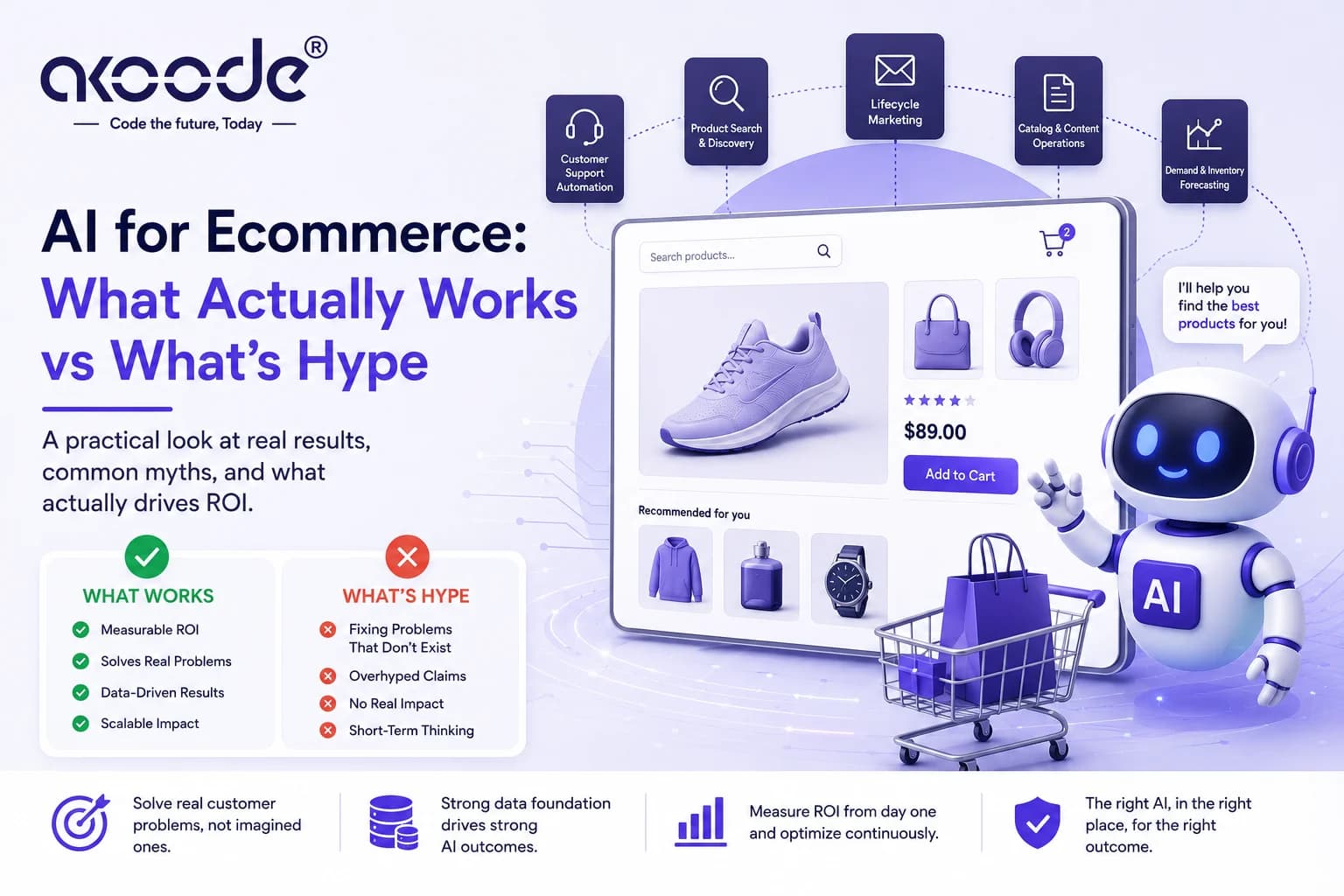
The newest wrinkle is "agentic commerce," where an AI assistant finds and sometimes buys products for a shopper. Google and Shopify announced the Universal Commerce Protocol in January 2026, with more than 20 retail and payments partners. Shopify turned on "Agentic Storefronts" for eligible stores in late March 2026, so their products can appear in ChatGPT, Google AI Mode, Gemini and Microsoft Copilot.
Keep the hype in check. OpenAI scaled back ChatGPT's Instant Checkout in March 2026 after only around 30 Shopify merchants had gone live, according to a Forrester analyst, and purchases now mostly send shoppers to the merchant's own site. The practical reading is that AI discovery is real, and AI checkout is early. Payment providers such as PayPal now support both major protocols through their existing integrations, which tells you where the plumbing is heading.
What an ecommerce website costs in the USA: planning bands for 2027
Our planning bands
These are our planning figures, built from the published ranges in the next section and sized for a US agency billing at a typical blended rate. They are not a quote for your project.
Tier | Planning range | Typical timeline | What it usually includes |
|---|---|---|---|
Template-based store | $3,000 to $10,000 | 3 to 6 weeks | A theme configured to your brand, product upload, payments, shipping and tax setup. Shopify, BigCommerce or WooCommerce. |
Custom-designed store on a platform | $10,000 to $40,000 | 6 to 12 weeks | Custom theme and sections, several integrations, a standard migration with redirects, app configuration. |
Shopify Plus, headless or B2B build | $40,000 to $150,000+ | 3 to 6 months | Custom checkout or storefront, B2B pricing, multi-market setup, ERP and fulfillment integrations. |
Fully custom commerce platform | $75,000 to $250,000+ | 4 to 9 months | Your own backend and admin, unusual business logic, deep integrations. Marketplaces and global builds can pass $250,000. |
Why published prices run from $1,500 to $500,000
Source (2026 guides) | What it says |
|---|---|
GetDevDone | Theme-led Shopify builds from about $3,000 to $8,000. Custom Shopify storefront around $10,000 to $35,000+. Headless Shopify $40,000 to $150,000+. |
IceCube Digital | Shopify development in the USA from $1,500 to $100,000. Shopify Plus or headless builds at $25,000 to $100,000+ for a typical US agency. |
Leads360 | Basic Shopify setup $3,000 to $8,000, custom Shopify $15,000 to $35,000, Shopify Plus from $30,000, Magento or Adobe Commerce $30,000 to $200,000+. |
Outerbox Design | Professionally designed custom ecommerce sites often $25,000 to $150,000+. Enterprise, B2B or headless builds beyond $250,000. |
Viacon | Small business store $3,000 to $10,000, custom ecommerce $40,000 to $150,000+, enterprise or marketplace $150,000 to $500,000+. |
Three things explain the spread. The guides define "store" differently, so a DIY template and a custom platform share one price list. Hourly rates run from about $100 to $250 at US agencies and far lower offshore. And almost every guide is written by an agency that wants a particular kind of client. Use them to find the range, then test any quote against the hours and roles behind it, as we show in our custom software development cost guide.
What running a Shopify store really costs
Plans and fees
As of mid-2026, Shopify's US plans look like this, based on several 2026 pricing guides. Check Shopify's own pricing page before you budget, because it changes.
Plan | Monthly price | Billed annually | Online card rate with Shopify Payments | Surcharge if you use another gateway |
|---|---|---|---|---|
Basic | $39 | $29 | 2.9% + 30 cents | 2.0% |
Grow | $105 | $79 | 2.7% + 30 cents | 1.0% |
Advanced | $399 | $299 | 2.5% + 30 cents | 0.6% |
Plus | From $2,300 | From $2,300 | Negotiated | 0.2% |
The costs that are not on the pricing page
Apps. Reviews, subscriptions, search, loyalty and shipping tools typically run about $100 to $300 a month between them, and a large store can pay more.
Themes. Premium themes are a one-time cost of roughly $100 to $500, and custom design costs more.
Migration. Moving from Magento to Shopify Plus runs from about $20,000 to $65,000+ in one guide's estimate, mostly for data and for keeping your search rankings through redirects.
Product data and photography. This is real work, and it matters more every month as search engines and AI assistants read your catalog.
Integrations. Connecting an ERP, a warehouse or a B2B pricing engine is often the largest line item after design.
Marketing. A store with no traffic has no revenue. Budget for it separately from the build.
Shopify or custom: a three-way cost model
Here is a simple model for the first three and five years. Every number is an assumption you should replace with your own. Both paths pay card processing, so we leave it out. The only Shopify-specific payment cost is the surcharge for skipping Shopify Payments.
The three paths
Shopify Advanced. A $25,000 custom-designed build, the $299-a-month annual plan ($3,588 a year), $300 a month of apps ($3,600 a year), and 15% of the build per year for improvements ($3,750). Running cost: $10,938 a year.
Shopify Plus. A $60,000 build, the $2,300-a-month plan ($27,600 a year), $600 a month of apps ($7,200 a year) and $9,000 a year for improvements. Running cost: $43,800 a year.
Custom platform. A $120,000 build, $24,000 a year for upkeep (20% of the build, a planning convention rather than an independent benchmark) and $12,000 a year for hosting and monitoring. Running cost: $36,000 a year.
What each path costs over time
Path | Build | Running cost per year | Three-year total | Five-year total |
|---|---|---|---|---|
Shopify Advanced | $25,000 | $10,938 | $57,814 | $79,690 |
Shopify Plus | $60,000 | $43,800 | $191,400 | $279,000 |
Custom platform | $120,000 | $36,000 | $228,000 | $300,000 |
How to read it
Against Advanced, a custom platform costs about four times as much over three years. It does not save money on running costs here, so it has to earn its keep. The three-year gap is about $170,000, or roughly $57,000 a year in extra gross profit. At a 40% gross margin, which is our assumption, that means about $142,000 more in sales every year. For a $2 million store that is a 7% lift. For a $10 million store it is 1.4%.
Against Plus, the picture changes. Over three years custom costs only about 19% more, and over five years about 7.5% more. A store that is already paying Plus prices and still fighting its platform is the classic candidate for custom. That is the honest answer on cost: for most stores, Shopify wins on price for years, and custom wins on fit.
What the model leaves out
Revenue effects. Better checkout flows, configurators or pricing logic can lift sales. A bad platform fit can quietly cost conversions.
Speed. A Shopify store is live in weeks. A custom platform takes months, and those months have a cost.
Ownership. Custom software needs someone to own it, which means a team or a long-term partner.
Platform risk. Platforms change fees and rules. You cannot negotiate with a pricing page.
Which path fits your store
Template-based Shopify or BigCommerce
Choose this when you are launching, your catalog is standard, and speed matters more than uniqueness. You can always move up later.
Custom-designed store on a platform
Choose this when your brand needs a look and flow a theme cannot give you, and you want to keep the platform's checkout, security and app ecosystem. Our Shopify development work covers this tier.
Shopify Plus, headless or open source
Choose this when you have high traffic, several markets, B2B pricing or a content-heavy storefront. Open-source platforms like Magento, WooCommerce and OpenCartsit in the same price range and give you more control, along with more maintenance.
A fully custom platform
Choose this when your business model does not fit a store: a marketplace, a product configurator, complicated subscription or quoting logic, or deep ERP integration where the website is only one screen of a larger system. If that sounds like you, our guide to custom software vs SaaS gives the broader build-or-buy math.
Costs that are specific to US stores
Sales tax across states
Selling nationally means calculating, collecting and filing sales tax in many states. Platforms and tax services automate most of it, and the setup and monthly fees belong in your budget. Custom platforms must integrate a tax service, so add it to the quote.
Accessibility and privacy
Build to a recognized accessibility standard such as WCAG 2.2 AA from the start. Fixing it after launch costs more. State privacy laws add consent and data-request tools, and card payments mean choosing hosted payment fields so that card data never touches your servers.
Getting ready for AI shopping agents
You do not need a custom protocol integration for this today. You do need clean, complete product data: accurate titles, attributes, prices, stock, shipping and returns, in a structured format. On Shopify, much of the plumbing is handled for you. On a custom platform, ask your vendor how product feeds and the major agent protocols will be supported, and what that costs. Budget for data quality first, because every channel, human or machine, depends on it.
Ways to keep the bill sensible
Start on a platform. Prove demand before you pay for a custom build.
Limit apps. Each one is a monthly fee and a speed cost. Audit them twice a year.
Use Shopify Payments if you can. The gateway surcharge is the most avoidable fee on the pricing page.
Pay for discovery. A one-to-two-week paid discovery phase costs a fraction of a mistaken build.
Plan the migration. Redirects and product data protect the search traffic you already have.
Launch in stages. Ship the core store, then add the second wave of features once you see real orders.
How to choose an ecommerce development partner
Questions to ask before you sign
Which roles and how many hours sit behind your quote?
What is excluded: design, product data entry, QA, migration, third-party fees?
Can I see live stores you built, and talk to the owners?
Who owns the theme code, the designs and the store accounts from day one?
How do you handle platform updates after launch, and what does it cost?
How are out-of-scope changes priced and approved?
What happens to my search rankings during migration?
Is there a paid discovery phase before a fixed price?
Where the work happens affects your taxes
Since 2025, US tax law lets companies deduct domestic software development costs right away, while research performed outside the United States is still spread over 15 years. That can shrink the real savings of an offshore build, and it may apply to custom store development. We explain it in the software cost guide, and your tax advisor should check how it applies to you. We are an India-based engineering team with a US office in Jenks, Oklahoma, so we would rather you hear it from us.
Selling in more than one market
If you sell across borders, currencies, taxes and duties add cost. Teams in Florida can start with our eCommerce development in Miami page, and brands in California with our eCommerce development in Los Angeles page.
How Akoode approaches ecommerce projects
We will tell you to use a platform when you should
We build on Shopify, Magento, WooCommerce, BigCommerce and OpenCart, and on custom code. If a Shopify store fits, that is what we will recommend, because it costs you less. We suggest custom work when your model needs it.
How we scope and price
We do not publish a rate card. A quote starts with a one-to-two-week discovery that settles the catalog, the integrations, the markets and the risks. It produces a roadmap and a scoped estimate tied to roles and hours. We work on a fixed-cost, dedicated-team or staff augmentation basis, depending on how settled your scope is. Our engineers are in-house, and you own the IP.
For the overview, see our eCommerce development company in the USA page and our eCommerce solutions. Teams in New York can start with eCommerce development in New York.
Proof from delivered projects
We built an OpenCart store for a precious metals retailer serving customers in Canada, covering product discovery, cart, checkout, customer accounts, payments and order history. Read the case study.
We built a QR-linked apparel platform where every garment carries a tag that opens a profile the buyer controls after purchase. Read the case study.
We built one connected system that runs three retail repair locations and a nationwide mail-in repair operation. Read the case study.
Our Google rating is 4.9 from 126 reviews, and we have delivered 180+ projects across 15+ industries.
Frequently asked questions
How much does an ecommerce website cost in the USA in 2027?
Plan on $3,000 to $10,000 for a template-based store, $10,000 to $40,000 for a custom-designed store on a platform, $40,000 to $150,000 or more for Shopify Plus, headless or B2B builds, and $75,000 to $250,000 or more for a fully custom platform. Monthly platform fees, apps and upkeep come on top. A paid discovery phase is the most reliable way to narrow your number.
How much does a Shopify store cost?
Shopify's plans run $39 to $399 a month on monthly billing ($29 to $299 billed annually), and Plus starts at $2,300 a month. Add apps at about $100 to $300 a month, card processing of 2.5% to 2.9% plus 30 cents with Shopify Payments, and the build itself: typically $3,000 to $10,000 for a template store or $10,000 to $40,000 for a custom design.
Is Shopify cheaper than a custom ecommerce site?
For most stores, yes. In our three-year model, a $25,000 Shopify Advanced build costs about $57,800 and a $120,000 custom platform about $228,000. Against Shopify Plus at about $191,400, custom costs only around 19% more. Custom pays off when your business logic is unusual or your store has outgrown what a platform does well.
What are the monthly costs of running a Shopify store?
Expect the plan fee ($29 to $299 a month on annual billing, from $2,300 for Plus), apps at roughly $100 to $300 a month, and card processing. Using a third-party payment gateway instead of Shopify Payments adds a surcharge of 2% on Basic, falling to 0.2% on Plus. Budget separately for improvements, marketing and support.
When should I choose headless or a custom ecommerce platform?
Choose headless or custom when you have high traffic, several markets, B2B pricing, a marketplace or product configurator, or deep ERP integration that a platform handles badly. If you are launching or your catalog is standard, start on a platform and move up when you have real order data.
How long does it take to build an ecommerce website?
A template-based store usually takes three to six weeks, a custom-designed store on a platform six to twelve weeks, a Shopify Plus, headless or B2B build three to six months, and a fully custom platform four to nine months. These are planning figures. Product data, integrations and migration set the pace more than design does.
Do I need to prepare my store for AI shopping agents?
You do not need a custom protocol integration today. AI discovery through ChatGPT and Google AI Mode is real, but AI checkout is still early, and ChatGPT's Instant Checkout was scaled back in March 2026. Focus on clean, complete product data. Shopify handles most of the plumbing by default. On a custom platform, ask your vendor how it will support product feeds and agent protocols.
Get a scoped estimate for your store
If you have a store in mind and want to know which tier it falls into, book a technical consultation. Bring whatever you have: a catalog sample, a competitor you want to match, the platform you are on today. We will tell you what we would ask in discovery, whether we would build on a platform or write custom code, and where we think the budget risk sits, whether or not you end up working with us.
Get In Touch Now
View More Our Blog