


 October 11, 2026
A software development company in Gurgaon should help you decide what to build before it starts building. Custom software makes sense when billing, stock, sales or approval workflows do not fit a ready-made product, or when the same data sits in too many separate tools. Akoode Technologies is a Gurgaon-based software and AI development company. This guide explains the nine business-software types Gurugram companies commonly commission, how custom, ready-made and integrated options differ, and what to check in any development partner before you sign.
What does a custom software development company do?
A custom software development company designs, builds, tests and supports software around your own workflows, such as billing rules, approval chains and stock logic, instead of asking you to adapt to a packaged product. A good partner also tells you when custom code is the wrong answer. Four different jobs often get mixed together:
Approach | What it means | Makes sense when | Watch for |
|---|---|---|---|
Custom development | New software built to your requirements | Your workflow is a differentiator, or no product fits | Higher upfront effort; you carry long-term maintenance decisions |
Configuration of ready-made software | Setting up an existing product with your fields, rules and templates | Your process is fairly standard and one product covers most of it | Limits on customisation; per-user licence costs |
Integration | Connecting tools you already use through APIs or middleware | The tools are fine but staff re-type data between them | Older systems with weak or no APIs |
Modernisation | Rebuilding or restructuring a legacy application | It works but is slow, unsupported or risky to change | Business rules hidden in old code that nobody has documented |
Many projects combine these: configure an accounting package, integrate it with a custom order portal, and modernise one old module. For the engagement models and team structure Akoode offers, see its software development services in Gurgaon page. This guide covers the decisions that come before and around a contract.
Custom business software for Gurgaon companies
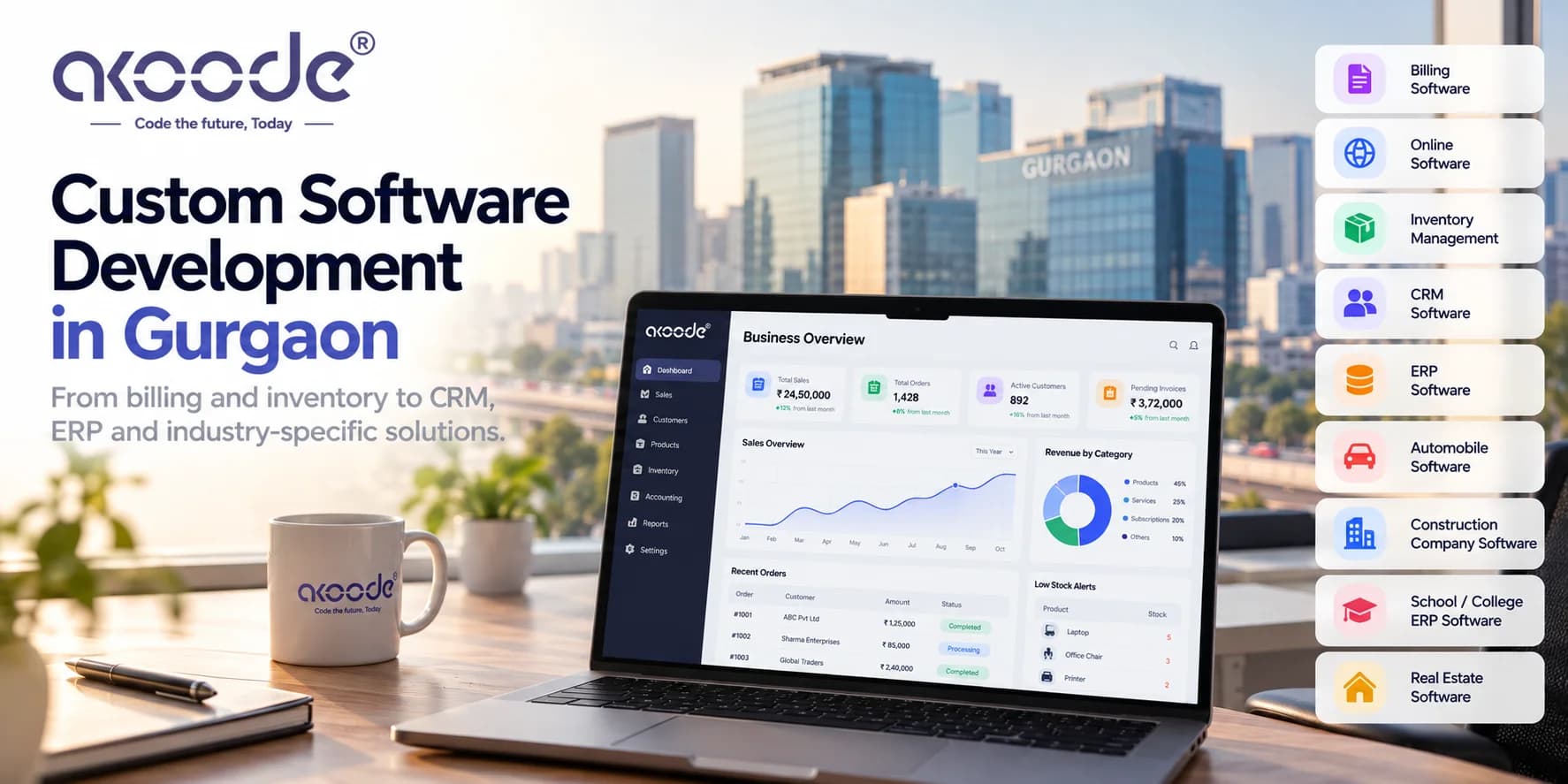
The nine scopes below are possible custom-development projects, not ready-made Akoode products. Features, integrations and rollout order are settled during discovery. Akoode's work across sectors is summarised on its industries we serve page.
Billing Software
Users: accounts staff, sales teams, owners.
Problem: quotations in spreadsheets, invoices in another tool, and no single view of who has paid. A custom billing system can convert an approved quotation into an invoice, run recurring billing for retainers or subscriptions, track payment status, age outstanding balances and pass entries to the accounting package you already use, subject to what that package's import or API allows.
Retail workflow: a store raises a bill at the counter, stock reduces, the payment mode is recorded, and head office sees daily collections by outlet. Retailers selling in-store and online can also look at Akoode's retail and eCommerce software solutions.
On GST: businesses above a turnover threshold, currently ₹5 crore aggregate turnover according to Tally Solutions' summary of the rules, must report B2B invoices to the government's e-invoice portal. Software can prepare the data, but compliance and tax treatment remain your chartered accountant's responsibility.
Online Software
"Online software" here means business software used through a browser, so nothing needs installing on each computer. Typical parts are employee dashboards, customer portals where clients check orders or tickets, role-based permissions, centralised records and access for several locations. Browser-based does not fix the hosting: the same application can sit on the public internet behind logins, be reachable only through a company VPN, or run in your own cloud account. That depends on your security and access requirements.
Workflow: a service company with branches in Gurugram and Noida logs every job in one system. Technicians update job status from a phone browser, customers see progress in a portal, and the manager views all branches together.
Inventory Management Software
Users:
purchase teams, storekeepers, warehouse supervisors, finance. Core features are purchase orders, goods received, stock movements between warehouses, reorder alerts, barcode scanning (scanner compatibility must be checked), returns, and reports on slow- and fast-moving items.
Illustrative distribution workflow (not a client case): a reorder alert triggers a purchase order; goods are scanned in at Warehouse A; part of the stock is transferred to Warehouse B; a dispatch reduces stock; a customer return goes into a quarantine bin until inspected. For warehouse-heavy operations, see Akoode's logistics and warehouse software development page.
CRM Software
Users:
sales teams, business-development staff, customer-support teams. A custom CRM captures leads from website forms and enquiry channels, tracks each deal through a pipeline, schedules follow-up reminders, keeps customer history in one place, prepares quotations and reports on sales performance.
WhatsApp or email integration is possible, but it depends on the rules, approvals and charges of the messaging provider, so confirm exactly what is supported during discovery. Workflow: an enquiry arrives from the website, is assigned to one salesperson, gets a reminder after two days of silence, and moves to "quoted" when a quotation is sent.
ERP Software
ERP lets purchasing, sales, inventory, finance and operations share one set of records instead of copying data between departments.
CRM and ERP are different: CRM manages the relationship up to the order; ERP manages what happens afterwards, such as procurement, stock, production, invoicing and accounts.
Do not build everything at once. A phased plan might start with purchase and inventory, then add finance, with migration of item masters and opening balances, user training and integrations with banks or accounting tools planned alongside. Firms with production and procurement complexity can read about Akoode's manufacturing software development work.
Automobile Software
The intended scope is dealership and workshop operations: vehicle inventory, enquiries, test-drive bookings, service appointments, workshop job cards and spare-parts requests. It does not cover safety-critical vehicle engineering. Akoode's automotive software development page lists dealer management, fleet and connected-vehicle software among its areas.
Workflow: a customer's service booking becomes a job card; the advisor lists the work; a spare-part request goes to the stores; the customer approves the estimate; and a pickup reminder follows the invoice.
Construction Company Software
Users: site engineers, project managers, procurement teams, contractors, finance. The scope covers daily site reports, progress tracking, material requests, procurement approvals, contractor records, budgets and documents.
Workflow: a site engineer raises a material request from a phone, with a photo. The project manager approves it against the budget, purchase issues an order to an approved vendor, the store records delivery against that order, and the site report updates cost-to-date. Ask early whether the mobile app must work offline, because connectivity on sites can be poor. Akoode's Gurgaon team can discuss this kind of workflow software for site approvals.
School/College ERP Software
Typical modules are admissions, student records, attendance, fee collection, timetables, examinations, and parent and student portals. Access control matters: a teacher should see only their classes, a parent only their child.
Do not treat every module as standard. Prioritise (for example admissions, fees and attendance first), plan migration of past records, and design for minors' data. The DPDP Rules, notified in November 2025, phase in most organisational duties by May 2027. Akoode's software development for schools and colleges page lists admissions, timetabling, attendance, fees and parent portals within its school management scope.
Real Estate Software
Three different products get called "real estate software":
Property website: listings, search and enquiry forms.
Brokerage CRM: enquiry routing, viewing schedules, documents, agent performance and reports.
Property-management software: tenancies, rent, maintenance and owner statements.
Decide which problem you have first. Akoode's real estate software development page covers the sector, and two published case studies below show a brokerage CRM and a property advisory site.
Connecting software with mobile, AI and eCommerce
A shared backend, exposed through APIs, lets one set of business records serve several front ends. That avoids three versions of the truth.
Mobile. Staff who work away from desks, such as technicians, site engineers and sales representatives, can use an app that reads the same records as the web dashboard. Decide on native or cross-platform, offline needs and push notifications. Many projects start with a responsive web application and add mobile later. See Akoode's mobile app development in Gurgaon page.
AI. Use it only where it removes a repetitive task and you can measure the result: classifying support tickets, answering questions from your own manuals, flagging unusual invoices. Before building, decide the operating cost per request (API usage is usually billed by volume), how accuracy will be measured on your own data, which records the model may see (permissions), where a human must approve changes to records or money, and what happens when confidence is low or the service is down. Not every project needs AI. Akoode's AI development services in Gurgaon page describes its approach.
eCommerce. An online store should not keep its own stock number. Orders should flow into the inventory and billing modules, and fulfilment status should flow back to the customer. Akoode's eCommerce development in Gurgaon page covers the store side.
How to choose the best software development company in Gurgaon
There is no single "best" software development company in Gurgaon. The best choice is the one whose project experience, process and commercial terms fit your project, judged on evidence you can inspect rather than badges. Use this table when comparing proposals.
Evaluation criterion | Evidence to request | Warning sign |
|---|---|---|
Relevant project experience | Two or three comparable projects with a reference call and a demo | Only logos, or portfolio items unrelated to your problem |
Discovery quality | Written scope, user roles, integration map, priorities | A fixed quote offered before anyone asks about your workflow |
Architecture and integration reasoning | Explanation of data model, APIs, and why each technology was chosen | "We use the latest technologies" with no reasons |
Delivery responsibilities and communication | Named roles, review cadence, escalation path | One account manager relaying messages |
Working-build reviews | Demos of running software at fixed checkpoints | Updates only as reports or slides |
Testing and security | Test plans, defect tracking, access control and data-protection approach | "Testing is included" with no detail |
Source-code and account ownership | Contract clause on code, repositories, cloud and app-store accounts in your name | Code held by the vendor until final payment, or vendor-owned cloud accounts |
Documentation, maintenance and exit | Handover documents, support terms, exit assistance | No written support scope; undocumented systems |
Use of AI coding tools | Policy on tools used and who reviews generated code | Claims that software is "built by AI" with no human review |
What should you expect from a top software company in Gurgaon?
Skip unsupported rankings and look for standards you can observe:
A documented scope with priorities.
Milestones tied to working software.
Estimates with stated assumptions.
A change-management process: how a new request is assessed for cost and time.
Demonstrable working software at each checkpoint.
Testing evidence.
Agreed acceptance criteria.
A planned handover.
The lowest quotation is not always the lowest total cost. A cheap quote that leaves out migration, testing, integrations or handover returns as change requests, delays and rework. Ask each vendor to price the same written brief so the quotes can be compared fairly.
Custom software versus ready-made software
Factor | Ready-made software | Custom software |
|---|---|---|
Workflow fit | Good for standard processes; you adapt to it | Built around your process |
Initial investment | Usually lower | Usually higher |
Deployment time | Often quick to start | Longer, because requirements, build and testing come first |
Integrations | Limited to what the product supports | Designed to match your systems |
Licensing | Recurring licences, often per user | No product licence for your own code, though third-party components may carry licences |
Ownership | Vendor owns the product | You can own the code, depending on the contract |
Maintenance | Vendor handles updates | You or your partner maintain and update it |
Ready-made software is enough when your process is standard, your users are few and an existing product already covers it. Custom development is justified when the workflow gives you an advantage, when several tools must work as one system, or when licence costs and workarounds keep growing. If you are undecided, read Akoode's guides on custom vs off-the-shelf software and custom software development.
Cost and timeline considerations
Estimates move with scope, integrations, data migration, number of user roles, design effort, performance targets, testing depth and the number of review cycles. This article gives no price figures because Akoode has not published approved ranges for these categories. Beware any page that quotes numbers without scope, tax treatment and date. Separate five cost lines when you compare proposals:
Cost line | What to ask |
|---|---|
Initial development | What is included in each milestone? What counts as a change? |
Hosting and infrastructure | Who pays, in whose cloud account, and how does cost grow with usage? |
Third-party licences | Maps, messaging, payments, or reporting tools: who holds the licence? |
AI and API usage | Cost per request, monthly cap, and what happens at the cap |
Maintenance and support | Response times, included hours, and cost of new features |
On timelines, ask for a plan with milestones rather than one date. Akoode's Gurgaon page describes discovery as taking one to two weeks; after that, the plan depends on the scope above.
Development process and deliverables
Stage | What you should receive | Decision you make |
|---|---|---|
Discovery | Scope document with priorities, current-systems and integration map, milestone plan | What goes into release one and what waits |
Design | User flows and screens for key journeys | Approve flows, roles and permissions |
Engineering | Working builds at agreed checkpoints; repository and staging access | Accept the work or redirect it; approve change requests |
Testing | Test cases, defect list, security checks, user-acceptance support | Sign off acceptance criteria and go-live |
Deployment | Production release, migrated data, runbook | Choose cut-over date and rollback plan |
Support | Support agreement, monitoring, documentation | Choose support level and who holds credentials |
Akoode's Gurgaon page lists a similar six-stage flow and says clients receive a scope document, integration map and milestone plan from discovery. Its mobile page says handover deliverables and post-launch support are agreed before release. Human engineers design, review and test the software; AI tools may assist but do not replace that.
Verified Akoode case studies
These are published Akoode projects for clients in Gurgaon and Delhi NCR. Each matches one of the scopes above.
1. Brokerage CRM for WeGrow InfraVentures (Gurgaon).
Problem: about twenty-two agents ran the business from three spreadsheets, a shared folder and around a dozen WhatsApp groups, so two agents could unknowingly call the same buyer, and nobody could trust a listing’s details. Solution: a web dashboard for managers, a Flutter app for agents on site visits, and subscription billing, all on one API and database, with server-enforced single ownership per lead. Relevance: it shows the field-plus-office split that real estate, field-service and construction software share. Read the WeGrow real estate CRM case study.
2. AI property advisor for BigCat Realty (Gurugram).
Problem: buyers of high-value properties needed guidance, not another grid of listings, and enquiries sat in form inboxes. Solution: a Next.js platform with BigCatGPT (an AI advisor), WhatsApp-first enquiry flows with property context attached, layered filters, and an admin dashboard for the team to manage listings and agents. Relevance: AI is used for a defined buyer need, and the client’s team runs more than 150 listings without developer help, as the case study reports. Read the BigCat Realty case study.
3. QR-linked apparel platform for Bacstory (Delhi NCR).
Problem: a clothing brand wanted each purchase tied to a verified customer identity after the sale. Solution: every garment ships with a QR tag; once the buyer verifies the purchase, the tag opens a profile they control and can keep editing. Relevance: it shows an online store connected to customer records rather than a stand-alone shop. Read the Bacstory case study.
A practical project-brief checklist
Before you contact any vendor, write one page covering:
Users: who uses it, how many, and in which locations.
Current workflow: how the work is done today, including the spreadsheets and chats involved.
Business problem: what is slow, costly or error-prone, and how you will know it is fixed.
Essential features: must-have versus later.
Integrations: accounting, payment, messaging, ERP, existing databases.
Data migration: what data moves, from where, and who cleans it.
Permissions: who can view, create, approve and delete.
Reporting: the five reports management actually uses.
Budget and deadline: the range, and what is fixed and flexible.
Acceptance criteria: the checks that decide a milestone is complete.
Illustrative before-and-after brief (fictional example):
Before | After | |
|---|---|---|
Statement | "We need software for stock and billing." | "A Gurugram auto-parts distributor with two warehouses and eight salespeople needs stock, quotation and invoice in one system. The accounts team uses an existing accounting package. Salespeople need a phone view of stock. Opening stock for about 4,000 items will be migrated from Excel. Only the owner approves discounts above an agreed limit. Release one covers stock and invoicing; credit-limit alerts follow in release two. Acceptance: a day of real invoices matches the accounts team's totals." |
FAQs
How do I choose the best software development company in Gurgaon? Compare relevant project experience, discovery quality, working-build reviews, testing, ownership terms and support. Ask for demos and reference calls rather than relying on rankings.
How should I compare quotations? Send every vendor the same written brief, then compare assumptions, milestones, what counts as a change, and what is excluded. The lowest quote may omit migration, testing or handover.
What decides the cost of custom software? Scope, integrations, data migration, user roles, design, performance, testing and review cycles. Hosting, third-party licences, AI usage and maintenance are separate recurring costs.
How long does custom software take? It depends on scope and decisions on your side. Ask for milestones with working builds rather than one delivery date. Phasing a large system often brings the first useful release sooner.
Can new software connect to my existing tools? Often yes, if the other tool offers an API or export. Older systems may need middleware or manual steps, so list every integration in the brief.
Do I need a mobile app or AI? Not necessarily. A mobile app helps staff who work away from desks; AI helps repetitive, measurable tasks. Many businesses start with a web application.
Who owns the source code, and what happens after launch? The contract decides. Ask for code, repositories and cloud and app-store accounts in your name, plus a written support and handover scope. Akoode's service pages say ownership and handover terms are defined in the project agreement.
Share your workflow with Akoode Technologies
Tell Akoode Technologies how your team works today, which systems you use and what you want fixed first. A short brief is enough to start a conversation. Visit Akoode's Gurgaon software page, or book a call with Akhil. Akoode's India office is at Unit 616, Tower B4, Spaze iTech Park, Sector 49, Gurugram, Haryana 122018.
Get In Touch Now
View More Our Blog