


 July 25, 2026
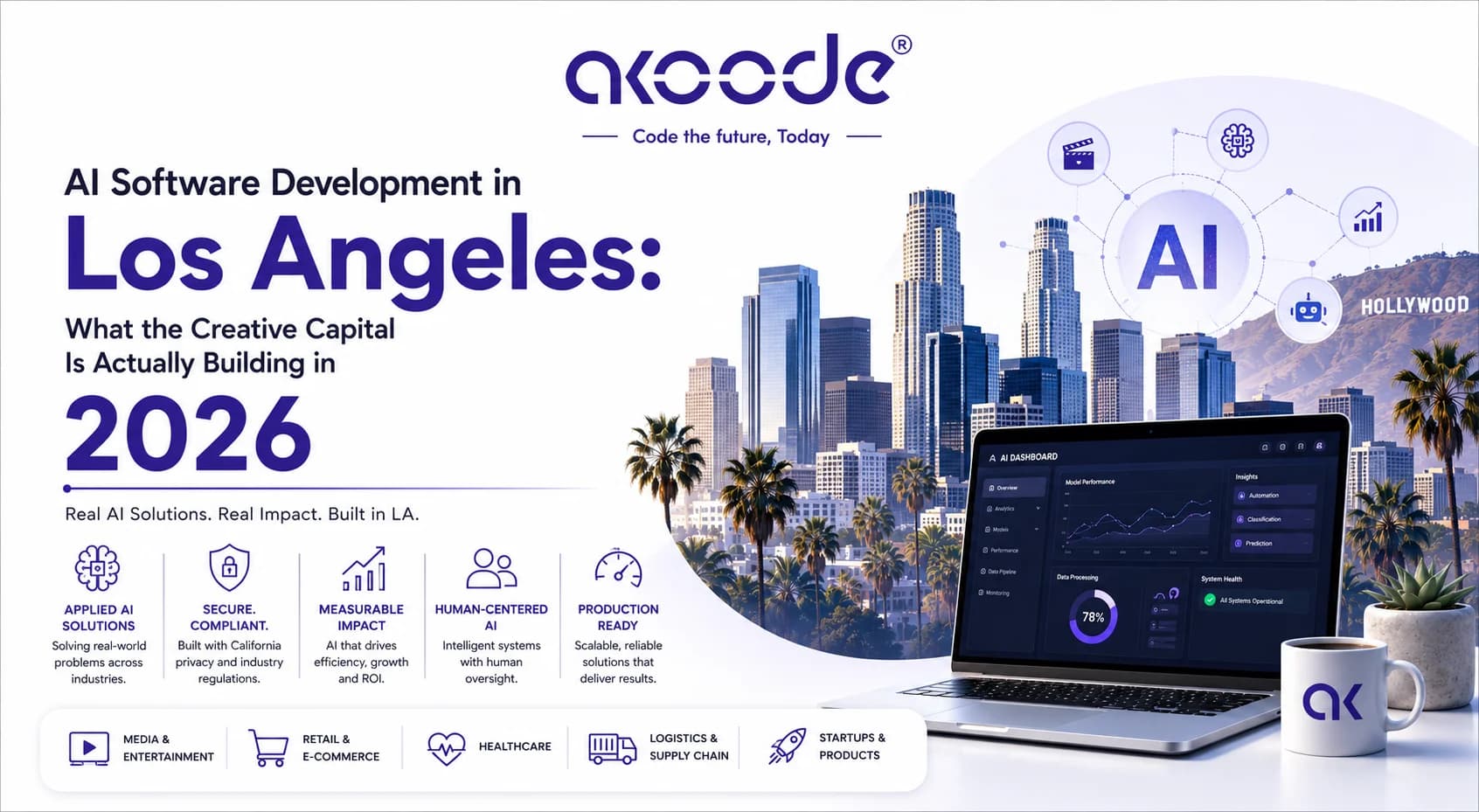
AI Software Development in Los Angeles: What the Creative Capital Is Actually Building in 2026
Every city tells itself a story about AI. San Francisco's is research. Seattle's is infrastructure. Los Angeles has the strangest story of all — because here, AI walked straight into the middle of a culture war and a gold rush at the same time.
This is the city where studios fought labor strikes over AI's role in writers' rooms, where streamers quietly run some of the largest content-AI operations on earth, and where a Culver City content platform drowning in manual moderation queues is such a common problem that it's practically a genre. AI in LA isn't a keynote abstraction. It's a working argument happening inside the industries that define the place.
And beneath the entertainment drama sits a much quieter reality: the rest of LA's enormous economy — the healthcare systems, the DTC retail brands, the port logistics operators, the aerospace suppliers — is adopting applied AI for the same unglamorous reason businesses everywhere are: the work is repetitive, document-heavy, and expensive, and the models finally handle it.
This guide covers both stories. What LA businesses are genuinely deploying in 2026, sector by sector. What AI development actually costs here versus globally — senior AI engineers bill $185–$250/hour locally, and most of what they build doesn't require that rate. The California compliance layer that shapes all of it. And how to choose a partner who ships production systems rather than pitch-meeting demos.
LA's AI Identity: Applied, Content-Heavy, and Wary of Hype
Los Angeles occupies a distinctive position in the American AI landscape. It's not a research capital — the foundation models are built up north. It's not an infrastructure capital — that's Seattle. What LA has is something arguably more useful for the businesses that operate here: the largest concentration of content, media, and consumer-experience workflows on the planet, which happen to be exactly what modern AI processes best.
Think about what this economy runs on: video libraries measured in petabytes, rights contracts stacked across decades of deals, moderation queues at streaming scale, fan communities generating oceans of user content, catalogs of products marketed through creative that refreshes weekly. All of it is unstructured data. All of it currently consumes expensive human hours. All of it is squarely inside what current AI does well.
That's why LA's applied-AI adoption looks different from other cities'. It's not led by chatbots. It's led by content intelligence — and it comes with a cultural sensitivity you won't find elsewhere. After the labor disputes that put AI at the center of Hollywood's contracts, LA companies deploy AI with an unusually sharp eye for where humans must stay in the loop. That instinct, honestly, makes for better AI systems. The best deployments here were designed around human review from day one, not because a regulator demanded it, but because the industry's politics did.
For buyers, this context matters practically: the vendors who understand LA's content workflows and its human-in-the-loop expectations build systems that get adopted. The ones who ship Silicon Valley-style full automation into this market build systems that get quietly turned off.
What LA Businesses Are Actually Deploying, Sector by Sector
Entertainment, Media, and Streaming
The deepest and most distinctive AI market in the city. What's in production:
Content moderation at scale — classification models triaging user-generated content, flagging policy violations, and routing edge cases to human reviewers. For platforms operating at streaming volume, this is the difference between a moderation team of forty and a team of eight handling exceptions.
Rights and royalty intelligence — extracting terms, territories, windows, and obligations from decades of distribution contracts that currently get reviewed by hand. A studio tracking rights across a dozen deals per property has one of the highest-ROI document-AI use cases anywhere.
Metadata and content tagging — automated tagging of massive libraries for search, licensing, and recommendation. The unglamorous work that makes catalogs sellable.
Recommendation and personalization engines — the core retention machinery of every streaming and content product.
Production workflow AI — script coverage assistance, localization pipelines, dubbing and captioning automation, dailies organization. Always with human creative control preserved — see the cultural point above.
Retail, DTC, and E-commerce
LA's consumer-brand economy — from Melrose fashion labels to national DTC operations — deploys AI for personalization, demand forecasting, ad creative generation at volume, returns automation, and conversational shopping. The bar for customer-facing AI is brutal here: these are brands that compete on aesthetic and experience, and a clumsy chatbot damages exactly what they sell. Our guide to AI customer support agents covers what well-built deployments actually achieve — 65–85% tier-1 resolution — and what separates them from the embarrassing ones.
Healthcare
The region's enormous health economy — Cedars-Sinai, UCLA Health, Providence, and the digital-health startups around them — is pointing AI at administrative burden: prior authorization automation, clinical documentation that returns hours to physicians, patient scheduling agents, and claims denial management. All of it under HIPAA, and all of it additionally under California's CCPA/CPRA. Our healthcare software development practice designs both layers in from Phase 1, because a health AI system that can't survive legal review never ships.
Logistics and the Ports
The San Pedro Bay port complex — the busiest container gateway in the Western Hemisphere — anchors a freight economy that runs on documents and schedules. In production: demand forecasting, drayage and route optimization factoring LA's singular traffic patterns, warehouse automation across the Inland Empire distribution corridor, and freight document processing — bills of lading, customs paperwork, carrier reconciliation.
Aerospace and Advanced Manufacturing
SpaceX's orbit, the El Segundo aerospace corridor, and the region's manufacturing base generate demand for predictive maintenance, computer vision quality inspection, and technical documentation intelligence — sectors where the data foundation usually already exists because the processes are instrumented.
The pattern across all five: repetitive, unstructured-data-heavy work that scales with headcount. In a market where a fully loaded content moderator, claims processor, or rights analyst costs $70,000–$100,000+ a year, the avoided-headcount math is short.
What AI Development Costs in LA vs. Globally
Concrete numbers, because vague AI pricing is how buyers overpay — especially in a market where "entertainment AI" carries its own premium mystique.
Senior AI/ML engineers at LA agencies bill $185–$250/hour, the steepest rates in the local market. Here's what complete projects run:
AI Project Type | LA Agency | Global Partner (Akoode) | Timeline |
|---|---|---|---|
AI chatbot / support agent | $55,000–$150,000 | $20,000–$60,000 | 6–14 weeks |
Content moderation / classification system | $70,000–$200,000 | $28,000–$80,000 | 8–16 weeks |
Document intelligence (rights, contracts) | $75,000–$210,000 | $30,000–$80,000 | 8–16 weeks |
LLM-powered internal tool (RAG) | $85,000–$220,000 | $32,000–$85,000 | 10–20 weeks |
Recommendation / personalization engine | $90,000–$250,000 | $38,000–$100,000 | 10–20 weeks |
Computer vision system | $100,000–$280,000 | $50,000–$125,000 | 12–24 weeks |
Enterprise AI platform | $280,000–$700,000+ | $100,000–$270,000 | 6–18 months |
Two things to understand.
The gap isn't a quality gap. A senior engineer building a classification pipeline with modern models, LangChain, and Pinecone produces the same architecture in Gurugram as in Culver City. What differs is the salary structure underneath — inflated in LA by the entertainment premium and the Silicon Beach talent war we detailed in our Los Angeles software development cost guide.
Where local knowledge genuinely earns its premium: deep entertainment-domain work. A rights-management AI needs a team that understands how distribution deals are actually structured — windows, territories, holdbacks, residuals. That domain fluency is concentrated in LA, and for those specific builds, paying for it prevents expensive mistakes. For everything else — the support agents, the RAG systems, the forecasting models — the engineering is globally available at half to a third of the rate.
And the ongoing costs never stop, anywhere: LLM API fees ($200–$20,000+/month scaling with usage), vector database and infrastructure hosting ($100–$5,000/month), and model monitoring plus retraining (15–20% of build cost annually — compounding at whatever hourly rate structure built the system). Any vendor who doesn't raise these in the first conversation is deferring the discussion, not the cost.
The California Compliance Layer
AI projects touching California users operate under the most aggressive privacy regime in America — and AI sharpens every edge of it.
CCPA and CPRA give California residents rights over their personal data: access, deletion, correction, opt-out of sale and sharing. For AI specifically, the pressure points are training data provenance, the right to deletion from datasets, and disclosures around automated decision-making — all active regulatory territory in 2026. Systems must be architected for these from Phase 1; retrofitting after launch costs multiples more.
HIPAA for health AI: 15–25% added build cost, BAAs with every vendor touching PHI — including your LLM provider — encryption, and audit logging.
Publicity and likeness rights — the LA-specific layer. California's right-of-publicity law is the strongest in the country, and AI-generated content involving performers' likenesses, voices, or styles sits at the center of active litigation and new legislation. Any generative-content system built for this market needs legal architecture around consent and provenance that vendors elsewhere have never had to think about.
SOC 2 for anything selling into enterprise, and explainability expectations for financial services AI.
The practical point: compliance adds 15–25% to AI project costs in regulated LA work — and in entertainment specifically, the likeness-rights question can determine whether a generative feature is buildable at all. A vendor who doesn't surface this during scoping either doesn't know the California environment or is choosing not to complicate the proposal.
How to Choose an AI Partner in Los Angeles
The general vendor process — contracts, references, red flags, the offshore-in-disguise filter — is covered in our guide to hiring a software development company in Los Angeles. AI adds six questions that general software hiring misses entirely:
1. "Show me an AI system you built that's been in production for 12+ months."
Demos are trivially easy with modern models. Production is hard. Ask what broke, how they monitored it, what they fixed. In a market as pitch-polished as LA, production scars are the only credential that survives scrutiny.
2. "Walk me through your RAG architecture decisions on a recent project."
Chunking strategy, embedding selection, retrieval tuning, how they measured retrieval quality separately from answer quality. "We use RAG" without a level deeper is vocabulary, not engineering.
3. "How do you prevent hallucination in front of my customers?"
Good answer: retrieval grounding, confidence thresholds, response filtering, source citation, human escalation. Bad answer: "the latest models are very accurate." False in exactly the situations that matter.
4. "What's your model evaluation process before deployment?"
Golden datasets, accuracy benchmarks, adversarial testing. No framework means shipping on hope — at $220/hour.
5. "How do you handle model drift after launch?"
AI degrades silently as content and behavior shift — and in media workflows, they shift constantly. An engagement designed to end at deployment guarantees quiet decay until someone notices publicly.
6. "How would you design human-in-the-loop for this workflow — and have you shipped under CCPA/HIPAA?"
The LA-specific double question. In this market's post-strike climate, human review design isn't a technical afterthought — it's an adoption requirement. And compliance experience must be demonstrated, not claimed.
The red flags specific to this market: vendors leading with generative demos rather than your workflow, "entertainment AI" positioning with no actual studio or platform deployments behind it, generative-content proposals with no answer on likeness rights, and accuracy promises made before anyone has looked at your data. Nobody can promise accuracy before seeing your data. Anyone who does is guessing with your budget.
LA AI Agency vs. Global Partner: The Honest Comparison
Factor | LA AI Agency | Global Partner (Akoode) |
|---|---|---|
Senior AI engineer rate | $185–$250/hr | $45–$75/hr |
AI project cost | Baseline | 55–70% lower |
Entertainment domain depth | Genuine advantage for rights/content work | Verify per vendor |
Applied AI delivery (LLM, RAG, CV, agents) | Excellent at good firms | Excellent — identical stack |
CA compliance fluency (CCPA, likeness) | Strong at good local firms | Strong at US-focused firms — verify |
Engineer retention | Poor — Snap, streamers, SpaceX poach constantly | Materially lower risk |
Time zone | Local | 3–4 hr Pacific overlap, async otherwise |
Best fit | Deep entertainment-domain builds | Production AI applications |
The honest read: LA's genuine local AI advantage is narrow and real — entertainment-domain fluency for rights, content, and production workflows where industry knowledge prevents expensive mistakes. For the broader applied catalog — support agents, document intelligence, forecasting, personalization — the premium buys proximity to a talent pool your project doesn't draw from, plus a retention risk that never becomes your problem with a deeper bench.
Akoode Technologies serves LA businesses on the applied side: production AI depth — GPT-4o, Claude, Gemini, LangChain, Pinecone, computer vision, deployments across media, retail, healthcare, and e-commerce — through our AI development services, at global economics with US presence, Pacific-hours overlap, and full transparency about where every engineer sits.
How to Start Without Funding a Pitch Deck
Name the specific, expensive problem first. Not "we need an AI strategy." Something like: "Our moderation team reviews 40,000 items a week, and 80% follow twenty recognizable patterns." That sentence transforms every vendor conversation.
Check your data before anything else. Is the content library accessible? Are the contracts digitized? Is the catalog structured enough to retrieve against? Most AI failures in LA — like everywhere — are data failures wearing an AI costume.
Design the human-in-the-loop role early. In this market especially, the systems that get adopted are the ones where the humans affected shaped the escalation design. Retrofit adoption is far harder than retrofit architecture.
Start with one workflow, not a platform. A focused $50,000 system that automates one painful queue beats a $400,000 "AI transformation" — and teaches you what the second project should be.
Demand a paid discovery phase. Data assessment, success metrics, compliance flags, realistic scope. Vendors who skip it to quote fast are guessing with your money.
Frequently Asked Questions
How much does AI software development cost in Los Angeles?
LA AI agencies bill $185–$250/hour for senior AI engineers. Complete projects run $55,000–$150,000 for an AI support agent, $70,000–$200,000 for a content moderation system, $85,000–$220,000 for an LLM-powered tool with RAG, and $280,000–$700,000+ for enterprise AI platforms. Global partners deliver identical applied scope 55–70% lower. Ongoing costs run $300–$25,000/month plus 15–20% of build cost annually.
What are Los Angeles businesses actually building with AI in 2026?
Content-heavy applied AI leads: moderation and classification at streaming scale, rights and royalty document intelligence, metadata tagging, recommendation engines, and production workflow tools with human creative control preserved. Beyond entertainment: retail personalization and forecasting, healthcare prior authorization and clinical documentation, port logistics optimization and freight document processing, and aerospace predictive maintenance.
Why is AI adoption in LA different from other cities?
Two reasons. First, LA's economy runs on unstructured content — video, contracts, catalogs, creative — which is precisely what modern AI processes best, so adoption is led by content intelligence rather than chatbots. Second, after the labor disputes that put AI at the center of Hollywood's contracts, LA companies deploy with unusually strong human-in-the-loop expectations — and vendors who design for that get adopted, while full-automation approaches get quietly turned off.
What is a content moderation AI system and what does it cost?
A classification pipeline that triages user-generated or platform content, flags policy violations, and routes uncertain cases to human reviewers — letting a team of eight handle exceptions instead of a team of forty reviewing everything. In LA it runs $70,000–$200,000 with a local agency or $28,000–$80,000 with a global partner, plus ongoing model monitoring as content patterns shift.
What compliance affects AI projects in Los Angeles?
CCPA/CPRA for anything touching California residents' data, with AI-specific pressure on training data provenance and automated decision-making disclosures. HIPAA for health AI, adding 15–25% to build costs. California's right-of-publicity law — the nation's strongest — for any generative content involving performers' likenesses or voices, an actively litigated area. And SOC 2 for enterprise sales. Compliance adds 15–25% to regulated AI project costs.
When is an LA AI agency worth the premium over a global partner?
For deep entertainment-domain builds — rights management, content pipeline, production workflow AI — where fluency in how distribution deals and studio workflows actually function prevents expensive mistakes. For the broader applied catalog — support agents, RAG systems, document intelligence, forecasting — equivalent engineering is available globally at half to a third of local rates with identical stacks.
How long does it take to build an AI system in Los Angeles?
Geography changes cost, not physics: a focused AI agent takes 6–14 weeks, a moderation or document intelligence system 8–16 weeks, an LLM tool with RAG 10–20 weeks, computer vision 12–24 weeks, and enterprise platforms 6–18 months. Data preparation — digitizing the contract archive, structuring the catalog — is the most common timeline extender.
Can a small LA business afford AI?
Yes — and the math is favorable here because LA labor costs are coastal-high. A focused AI agent handling support queries or document processing starts around $20,000–$60,000 with a global partner — a fraction of one fully loaded LA hire. Start with one workflow, win, expand.
What should I check before contacting any AI vendor?
Three things: name the specific expensive workflow with a number attached, verify your data is digitized and accessible, and identify your compliance exposure (CCPA always; HIPAA and likeness rights where relevant). A vendor who quotes before assessing your data hasn't scoped your project — they've scoped a demo. Our LA hiring guide covers the full evaluation process.
Should I hire an LA AI company or a global partner?
Classify the project first. Entertainment-domain work with real industry-knowledge requirements: consider local, with the production-proof questions applied hard. Applied AI — most projects: a transparent global partner like Akoode Technologies delivers equivalent outcomes at 55–70% less, with Pacific-hours overlap and materially lower retention risk. Vet either identically: production proof, RAG fluency, compliance experience, human-in-the-loop design.
The Bottom Line
LA's AI story is unlike any other city's: the technology arrived here already politicized, already commercial, and already pointed at the largest concentration of content workflows on earth. That's produced a market with unusually mature instincts — human-in-the-loop by default, wary of demos, focused on the unglamorous queues where the money actually is.
The essential buyer skill is the same classification discipline as everywhere, with an LA flavor: does your project genuinely draw on entertainment-domain knowledge that's concentrated here — or is it applied engineering whose skills exist globally at a third of the rate? Most projects are the second kind, including plenty that arrive wearing entertainment costumes.
The businesses getting this right named a specific expensive workflow, checked their data, designed the human role early, and built one focused system before buying a platform. The ones getting it wrong funded pitch decks at $220/hour.
If you're weighing where your project falls, that's a conversation worth having before you commit to anything.
Book a free 45-minute AI consultation → calendly.com/akhil-akoode/ak
We'll review your workflow, assess your data, flag your CCPA and likeness-rights exposure, and give you a straight answer on scope, cost, and whether AI is even the right tool. Sometimes the answer is a $40,000 focused system. Sometimes it's a SaaS tool. Sometimes it's "digitize the contract archive first." We'll tell you which.
Explore: Software Development Company in Los Angeles | AI development services | LA software costs | how to hire an LA development company | akoode.com | contact us
Get In Touch Now
View More Our Blog