


 August 6, 2026
The short answer
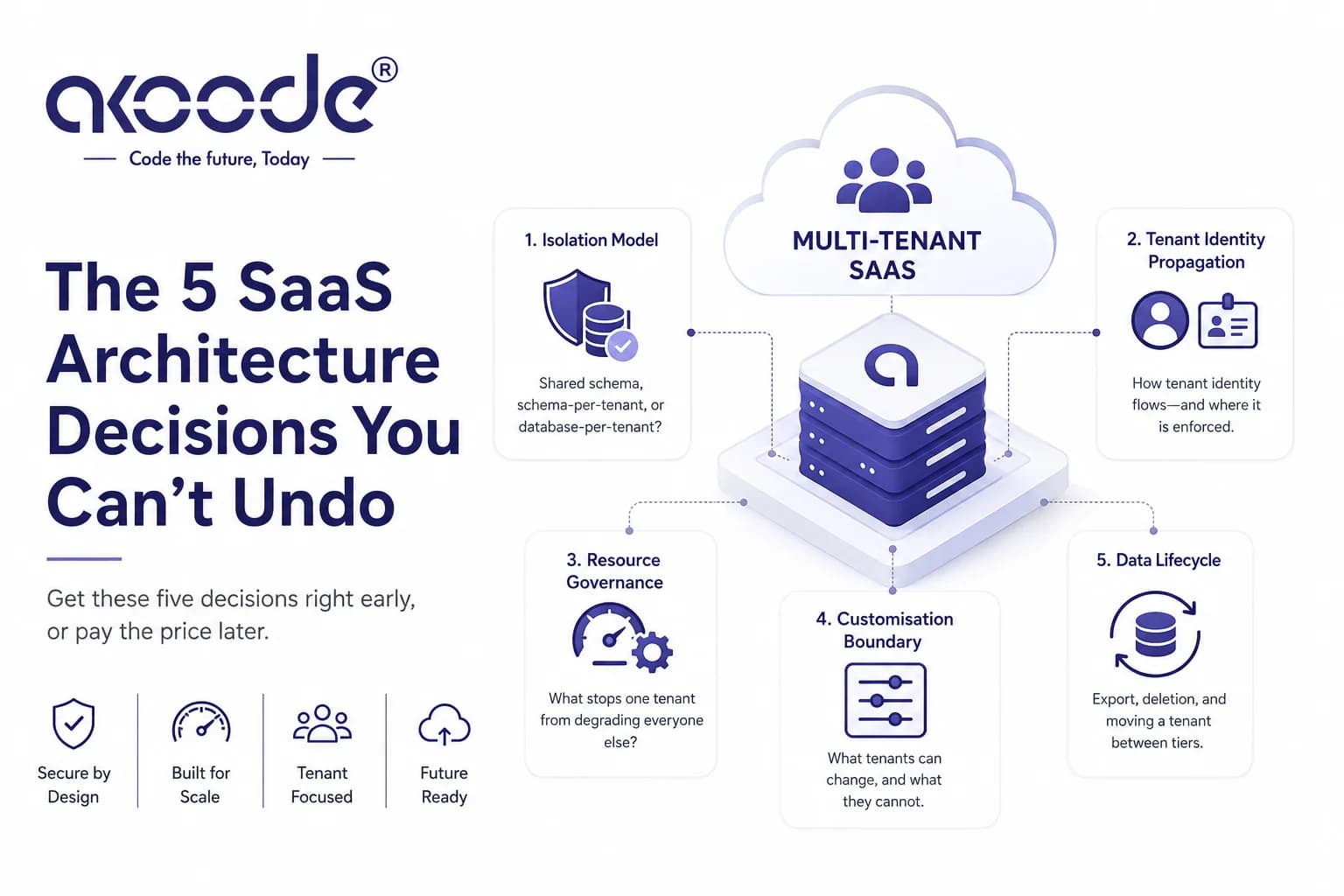
Five architectural decisions in multi-tenant SaaS are effectively irreversible once you have paying customers. Getting them wrong does not cause an outage. It causes a rewrite, usually somewhere between month eighteen and month thirty, at the exact point the business is trying to accelerate.
The five:
Isolation model — shared schema, schema-per-tenant, or database-per-tenant
How tenant identity propagates — and where it is enforced
Resource governance — what stops one tenant degrading everyone else
The customisation boundary — what tenants can change, and what they cannot
Data lifecycle — export, deletion, and moving a tenant between tiers
The common thread is that each one is cheap to decide before launch, moderately expensive to change with ten customers, and close to a full rebuild with two hundred.
For most B2B SaaS the correct starting answer is a shared schema with a tenant discriminator, row-level security enforced at the database, and a documented path to promoting individual tenants to isolated databases. This guide explains why, and when it is wrong.
Why these five and not the other twenty
Plenty of decisions in SaaS are consequential. Most are reversible.
You can change your payment provider. You can migrate from one cloud to another — painfully, but you can. You can replace your frontend framework, restructure your API, swap your search engine.
These five are different, for one specific reason: they are load-bearing for every row of customer data you have already written.
Changing your isolation model means migrating live customer data across a structural boundary while the system is serving traffic. Changing how tenant identity flows means auditing every query in the codebase. Changing your customisation boundary means telling customers that something they configured no longer works.
That is the test I would apply to any architecture decision in SaaS: does reversing this require touching existing customer data? If yes, decide it deliberately now. If no, defer it — you will have better information later.
The five below all fail that test.
Decision 1 — The isolation model
The foundational choice, and the one most often made by accident.
The three models
Shared schema (pooled). All tenants share the same tables. Every row carries a tenant_id. One database, one schema.
Schema-per-tenant (bridge). One database, but each tenant gets its own schema. Tables are duplicated per tenant.
Database-per-tenant (siloed). Each tenant gets a physically separate database, sometimes separate infrastructure entirely.
How they actually compare
Shared schema | Schema-per-tenant | Database-per-tenant | |
|---|---|---|---|
Infra cost per tenant | Lowest | Medium | Highest |
Onboarding a tenant | Insert a row | Create a schema | Provision a database |
Blast radius of a bad query | All tenants | All tenants (same instance) | One tenant |
Noisy neighbour risk | High | High | Low |
Schema migrations | One migration | N migrations | N migrations |
Per-tenant backup and restore | Hard | Moderate | Trivial |
Data residency per tenant | Very hard | Hard | Straightforward |
Cross-tenant analytics | Trivial | Moderate | Hard |
Risk of cross-tenant data leak | Highest | Medium | Lowest |
Practical tenant ceiling | Very high | ~500 before migrations hurt | Limited by ops capacity |
What to actually choose
Start with shared schema unless a specific requirement forbids it. It is cheapest to run, simplest to migrate, and it is the only model where onboarding a customer is genuinely instant.
Choose database-per-tenant from the start when:
You are selling into regulated sectors where customers contractually require physical data separation — common in healthcare and parts of financial services
Data residency varies by customer (EU data in the EU, and so on)
Your tenants are few and large — twenty enterprise accounts rather than two thousand SMBs
A single tenant's data volume could realistically dominate the instance
Schema-per-tenant is the model to be most sceptical of. It looks like a compromise and behaves like the worst of both: you still share an instance, so noisy-neighbour risk remains, but you now run migrations N times. It makes sense in a narrow band — perhaps 20 to 200 mid-sized tenants with moderate isolation requirements — and outside that band one of the other two is better.
The mistake that costs the most
Choosing shared schema and then enforcing tenant separation only in application code.
Every query in the codebase must remember WHERE tenant_id = ?. One ORM call that forgets it, one raw SQL query written under deadline pressure, one background job that iterates without scoping — and you have cross-tenant data exposure. It will not surface in testing, because test data usually has one tenant.
Enforce it at the database. PostgreSQL row-level security, or the equivalent in your engine. Set the tenant context on the connection, define the policy once, and the database refuses to return another tenant's rows regardless of what the application asks for.
This costs about a day to set up correctly and it is the single highest-return security decision in multi-tenant SaaS. Application-level-only enforcement is not a shortcut. It is a data breach with a delay fuse.
Decision 2 — How tenant identity flows
Once you have chosen an isolation model, tenant identity has to reach every layer that touches data. How it gets there determines how easy it is to get wrong.
The three approaches
Explicit parameter. Every function that touches data takes tenantId as an argument. Verbose, but impossible to forget — the code will not compile or the call will fail.
Ambient context. Tenant is resolved once at the request boundary and stored in request-scoped context (thread-local, async-local, or equivalent). Data access reads it implicitly. Much cleaner to write, and the risk moves to anywhere that context does not propagate.
Connection-scoped. Tenant is set on the database connection or session, and row-level security enforces it. The application does not carry it at all after the boundary.
What actually works
Connection-scoped plus RLS, with ambient context for anything the database cannot see. This is the combination that fails safe.
The critical detail people miss: background jobs, queues, scheduled tasks and webhooks are where tenant context leaks. A request has an obvious boundary where you resolve the tenant. A job pulled off a queue three hours later does not, unless the tenant was serialised into the job payload and re-established when it runs.
Every async path needs an explicit rule:
Tenant ID is part of the job payload, always
The job re-establishes tenant context before touching data
A job without a tenant context fails loudly rather than running unscoped
The test that catches this: write an integration test that creates data for tenant A, runs every background job with tenant B's context, and asserts that nothing from tenant A is touched. Most codebases fail this the first time it is run, and finding out in CI is dramatically better than finding out from a customer.
Where to resolve tenant identity
Subdomain (acme.yourapp.com), path prefix (/t/acme/...), custom domain, or a claim in the auth token.
Use the auth token as the source of truth. Subdomain and path are user-controlled inputs; the token is signed. Resolve from the token, and treat the URL as a routing hint that must match — never as the authority.
Decision 3 — Resource governance
The noisy-neighbour problem. In a shared model, one tenant can degrade the experience of every other, and it usually happens without malice.
A customer imports 400,000 records at 9am. Another writes a report query with no index. A third integrates your API into a loop. None of them intended harm; all of them cause an incident.
What actually needs limiting
Request rate. Per-tenant rate limits, not just per-user or global. Global limits do not stop one tenant consuming the whole budget.
Query cost. Statement timeouts scoped per tenant. A query that runs for four minutes should be killed, and the tenant that issued it should not be able to issue twenty more.
Background job concurrency. The most commonly missed. One tenant queuing 50,000 jobs will starve every other tenant's queue unless work is fair-scheduled. Per-tenant queues, or weighted fair queuing, not a single FIFO.
Storage and row counts. Enforced at the tier level, with a defined behaviour when exceeded — degrade, block writes, or bill for overage. Decide which, and tell the customer in advance.
Connection pool share. One tenant should not be able to exhaust the pool.
Why this must be designed early
Adding governance later means retrofitting limits onto customers who are already exceeding them. That conversation — "the behaviour you have relied on for a year is now capped" — is one of the worst in SaaS account management, and it is entirely avoidable.
Ship limits from day one, set generously. A limit nobody hits is invisible. A limit introduced in year two is a breaking change with a support ticket attached.
The observability requirement
Per-tenant metrics are not optional in a shared model. When latency degrades, the first question is always which tenant. If your dashboards only show aggregates, you cannot answer it, and you will spend the incident guessing.
Tag every metric, log line and trace with the tenant ID. This connects directly to the observability requirement in our monolith versus microservices guide — the tooling overlaps almost entirely, so build it once.
Decision 4 — The customisation boundary
The decision that determines whether your product scales commercially or turns into a consultancy that bills monthly.
The spectrum
Configuration. Tenants toggle features, set values, choose from options you defined. Everything lives in data. No deployment required.
Extension. Tenants add custom fields, define workflows, build templates — within a structure you control.
Customisation. Tenants get code changes. Per-tenant branches, per-tenant deployments, per-tenant logic in the codebase.
Where to draw the line
Configuration and structured extension, yes. Per-tenant code, essentially never.
The moment a if (tenantId === 'acme') branch enters your codebase, three things become permanently true: every future change must be tested against Acme's special case, no engineer can safely refactor that area, and your largest customer has an implicit veto over your architecture.
It rarely stays at one. The second enterprise deal asks for the same accommodation, citing the first, and within eighteen months a meaningful share of engineering capacity is servicing per-tenant behaviour rather than building product.
How to say yes without saying yes
The commercially useful version:
Custom fields with a defined type system. Tenants add fields; you control the types, validation and storage model. A JSONB column with a per-tenant schema definition handles most of this well.
Workflow rules as data. Conditions and actions built from primitives you defined, stored as configuration, executed by an engine you wrote. The tenant composes; they do not code.
Webhooks and an API. The strongest answer to most customisation requests. Instead of building their logic into your product, give them the events and let them build it in theirs. This converts a permanent maintenance liability into an integration.
A theming layer with a hard boundary. Colours, logos, email templates. Not arbitrary CSS injection, which becomes a support burden the first time you change your markup.
The honest trade-off
Building a configuration engine costs meaningfully more up front than hardcoding one customer's requirement. Two to six weeks of engineering, typically.
That is the correct trade. Hardcoding is cheaper for the first tenant and more expensive for every tenant after — and the crossover point usually arrives around the fourth or fifth request, well inside the first two years.
Decision 5 — Data lifecycle
The least glamorous of the five and the one most often deferred until a contract requires it.
What you will be asked for
Full tenant data export. Enterprise contracts require it, GDPR gives individuals a related right, and prospects ask about it during procurement precisely because it signals you are not trying to lock them in. It needs to be complete, structured, and self-service — not a support ticket that generates a CSV three days later.
Verifiable deletion. When a tenant leaves, their data must actually be gone — including backups, search indexes, caches, analytics stores, logs and any third-party processor. In a shared schema this is a DELETE cascade plus a list of every other place tenant data has spread to. Write that list at build time, because reconstructing it under a contractual deadline is genuinely hard.
Tenant migration between tiers. Moving a tenant from the shared pool to a dedicated database. Almost every successful B2B SaaS eventually needs this, when a customer grows large enough or contractually demands isolation. If the shared schema and the isolated schema have drifted apart, this becomes a bespoke engineering project every time.
Point-in-time restore for one tenant. A customer deletes something important and asks for it back. In a shared database, restoring one tenant from a backup without touching the others is hard unless designed for. At minimum: soft deletes on core entities with a retention window, plus an audit log.
The design implications
Keep the shared and isolated schemas identical. Same tables, same columns, same migrations. The only difference should be where the data lives. This is what makes tier migration a data movement problem rather than a transformation problem.
Soft delete core entities with a retention window before hard deletion.
Maintain a written inventory of every store holding tenant data — primary database, search index, cache, object storage, analytics warehouse, log aggregator, and each third-party processor. Update it whenever a new store is added.
Build export as a first-class feature, not an admin script.
What multi-tenancy actually costs
Multi-tenancy is a 1.4 to 1.8× multiplier on the same feature set, which lines up with the complexity multipliers in our software development cost analysis.
Where the additional effort goes:
Component | Additional engineer-days | Note |
|---|---|---|
Tenant model, resolution, context propagation | 8 – 15 | Foundation for everything else |
Row-level security and enforcement testing | 5 – 10 | Includes the cross-tenant test suite |
Tenant provisioning and onboarding automation | 8 – 18 | Higher for schema/database-per-tenant |
Resource governance and rate limiting | 10 – 20 | Per-tenant queues are the expensive part |
Configuration and customisation engine | 15 – 40 | Widest variance; depends on extension depth |
Admin surface for tenant management | 10 – 20 | Support cannot operate without it |
Per-tenant observability | 5 – 12 | Overlaps with general observability work |
Data export, deletion, tier migration | 12 – 25 | Usually deferred, then urgent |
Total | 73 – 160 | Roughly $20,000 – $50,000 at India blended rates |
That is real money on top of the base product. It is also the difference between a product you can sell to two hundred customers and one you can sell to twenty before the architecture stops you.
What to build now versus later:
Before first customer: tenant model, RLS, context propagation, basic rate limits, admin surface
Before customer ten: per-tenant observability, background job fairness, data export
Before customer fifty: tier migration path, configuration engine, per-tenant restore
Deferring the first group is the expensive mistake. Deferring the third is normal and correct.
The hybrid model most mature SaaS ends up with
Very few successful B2B SaaS platforms run one isolation model forever. The pattern that emerges repeatedly:
Shared schema pool for the long tail. The majority of customers, on standard plans, in a shared database with RLS. Cheapest to run, instant onboarding.
Dedicated databases for enterprise tier. Customers who pay for isolation, have data residency requirements, or are large enough to be a noisy-neighbour risk to everyone else. Same schema, different location.
A promotion path between them. A documented, tested, ideally automated process for moving a tenant from pool to dedicated. Run it in staging regularly so it works when a $400,000 contract depends on it.
This is worth planning for even if you never build the enterprise tier, because it is free if the schemas stay identical and expensive if they drift. The discipline is the whole cost: one migration set, applied to every location, always.
It also gives you a clean commercial story. "Isolated database" becomes a genuine enterprise-tier feature with a real cost basis rather than a concession you negotiate away deal by deal.
Migration paths between models
If you have already chosen and need to change, the difficulty varies enormously by direction.
Shared → database-per-tenant. Moderate. Provision, copy the tenant's rows, verify, cut over, delete the originals. Per-tenant downtime is measured in minutes if designed for. This is the easiest of the transitions and the reason shared-schema is a safe starting point.
Database-per-tenant → shared. Hard. Merging requires resolving primary key collisions across every table, and you inherit whatever schema drift accumulated between instances. Rare, and usually driven by operational cost pressure.
Schema-per-tenant → shared. Hard, for the same reason. Every schema is a potential variant.
Application-only enforcement → RLS. Do this immediately if it applies to you. Add the policies, set the connection context, then run your full test suite plus a deliberate cross-tenant test. Any place the application relied on unscoped access will fail loudly, which is exactly what you want. This is a one-week project that closes your largest security exposure.
Failure patterns
The forgotten WHERE clause. Cross-tenant data exposure from one unscoped query. The most damaging failure in multi-tenant SaaS and entirely preventable with RLS.
The shared cache without tenant keys. Cache keys that omit the tenant ID serve one tenant's data to another. Same class of bug as the missing WHERE, harder to spot, and it will not appear in a code review of the database layer.
The unbounded background job. A job that iterates all records without tenant scoping. Usually written for an admin task, later reused in a customer-facing path.
Per-tenant branches in the codebase. Discussed above. The point of no return is the second one, not the first — the second establishes the precedent.
Schema drift between tiers. Enterprise tenants on dedicated databases receive migrations late, or a hotfix applied to one location only. Tier migration then becomes bespoke work each time. Automate migrations across all locations from day one.
No per-tenant metrics. Latency degrades, and nobody can determine which tenant is responsible. Every minute of that incident is guesswork.
Analytics built on the operational database. Cross-tenant reporting queries against the live database compete with customer traffic. This is a leading cause of noisy-neighbour incidents that appear to have no external cause. Move analytics to a replica or a warehouse before it becomes an incident.
A pre-build checklist
Before writing the first line of a multi-tenant product, have an answer to each:
Which isolation model, and what specific requirement drives it?
Is tenant separation enforced at the database, not only in application code?
How does tenant context reach background jobs, queues and webhooks?
What is the source of truth for tenant identity — token, subdomain, or path?
What are the per-tenant limits on requests, query time, job concurrency and storage?
What happens when a tenant exceeds a limit — degrade, block, or bill?
Are metrics, logs and traces tagged with tenant ID?
What can a tenant configure, and where is the hard line before code changes?
How does a tenant export all of their data, self-service?
Which stores hold tenant data, and is that list written down?
Can a tenant be moved from shared to dedicated, and has that been tested?
Do shared and isolated deployments run identical schemas?
Twelve questions. Each takes minutes to answer at the whiteboard and weeks to retrofit later.
Frequently asked questions
What is multi-tenant architecture in SaaS?
Multi-tenant architecture serves multiple customers, or tenants, from a single application instance while keeping their data logically or physically separated. The three common models are shared schema with a tenant identifier on every row, a separate schema per tenant within one database, and a separate database per tenant.
Which multi-tenancy model should I choose?
Start with shared schema and row-level security unless a specific requirement forbids it — it is cheapest to run and simplest to migrate away from later. Choose database-per-tenant from the start if customers contractually require physical separation, data residency varies by customer, or your tenants are few and very large.
Is shared schema multi-tenancy secure?
Yes, when tenant separation is enforced at the database using row-level security rather than only in application code. Application-only enforcement means every query must remember to filter by tenant, and a single omission in a query, background job or cache key exposes one tenant's data to another.
How much does multi-tenancy add to development cost?
Multi-tenancy is roughly a 1.4 to 1.8× multiplier on the same feature set. In effort terms, expect 73 to 160 additional engineer-days across the tenant model, security enforcement, provisioning, resource governance, configuration engine, admin surface, observability and data lifecycle.
What is the noisy neighbour problem?
In shared infrastructure, one tenant consuming disproportionate resources degrades performance for all others — a large data import, an expensive report query, or a flood of background jobs. It is addressed with per-tenant rate limits, statement timeouts, fair-scheduled job queues and per-tenant observability.
Can I migrate from shared schema to database-per-tenant later?
Yes, and this direction is comparatively straightforward: provision a database, copy the tenant's rows, verify, cut over. Per-tenant downtime is minutes if designed for. The reverse — merging isolated databases into a shared schema — is much harder because of primary key collisions and accumulated schema drift.
Should I allow per-tenant code customisation?
Almost never. Per-tenant branches mean every future change must be tested against every special case, refactoring becomes unsafe, and large customers gain an implicit veto over your architecture. Offer configuration, structured extension such as custom fields and workflow rules, plus webhooks and an API instead.
How do I handle tenant data deletion?
Maintain a written inventory of every store holding tenant data — primary database, search index, cache, object storage, analytics warehouse, logs and third-party processors — and build deletion as a first-class feature covering all of them. Soft delete core entities with a retention window before hard deletion.
How does tenant context reach background jobs?
The tenant ID must be part of the job payload and re-established as context before the job touches data. Jobs without a tenant context should fail loudly rather than run unscoped. Background jobs, queues and webhooks are the most common place tenant isolation leaks, because they have no request boundary to resolve from.
Do I need per-tenant observability?
In any shared model, yes. When latency degrades the first question is which tenant is responsible, and aggregate dashboards cannot answer it. Tag every metric, log line and trace with the tenant ID from the start — retrofitting it during an incident is not possible.
What is schema-per-tenant good for?
A narrow band: roughly 20 to 200 mid-sized tenants with moderate isolation requirements. Outside that range it tends to combine the drawbacks of both alternatives — you still share an instance, so noisy-neighbour risk remains, but you now run every migration N times.
When should I build a configuration engine?
Before the fourth or fifth customisation request, which usually arrives inside the first two years. Building one costs two to six weeks up front and is cheaper than hardcoding from roughly the fourth tenant onward. Hardcoding is only cheaper for the first customer.
Conclusion
Multi-tenancy is not a feature you add. It is a set of constraints you accept at the beginning, and the five decisions above are the ones that cannot be quietly revisited once real customer data exists.
The reassuring part is that the default answer is usually right. Shared schema, row-level security at the database, tenant context propagated explicitly into every async path, generous limits shipped from day one, configuration rather than code, and identical schemas everywhere so a tenant can be promoted to isolation when a contract demands it.
That combination is not the most sophisticated architecture available. It is the one that stays cheap at ten customers and still works at a thousand — and it leaves every expensive door open rather than closing it in month three.
The test I would apply to any SaaS architecture decision: does reversing this require touching existing customer data? If yes, decide it now, deliberately. If no, defer it, because you will know more in six months.
How Akoode approaches this
We build shared-schema multi-tenancy with database-enforced isolation by default, and design the promotion path to dedicated databases into the first release even when no customer has asked for it. It costs almost nothing while the schemas are identical, and it is the difference between winning an enterprise deal in month twenty and starting a migration project.
Across 180+ software products delivered in 15+ industries, the multi-tenant systems that aged well shared three things: isolation enforced at the database rather than in application code, tenant-tagged observability from the first release, and a hard line against per-tenant code branches. The ones that became expensive had at least one of those missing.
Our enterprise HRMS platform is a useful example of the customisation boundary in practice. Payroll and leave governance rules vary enormously between organisations, and the pressure to hardcode per-client logic was constant. Building those rules as configuration executed by a shared engine cost more up front and is why the same platform serves organisations with genuinely different statutory requirements without branching.
We are rated 4.9 out of 5 from 110 Google reviews and 5.0 on GoodFirms.
If you are designing a multi-tenant platform, book a call with me directly. Bring your expected tenant profile — how many, how large, and whether any of them will contractually demand isolation. Those three answers determine most of the architecture.
You can also read how we approach SaaS product development and custom software engagements, or post your requirement for a response within one business day.
Get In Touch Now
View More Our Blog