


 August 11, 2026
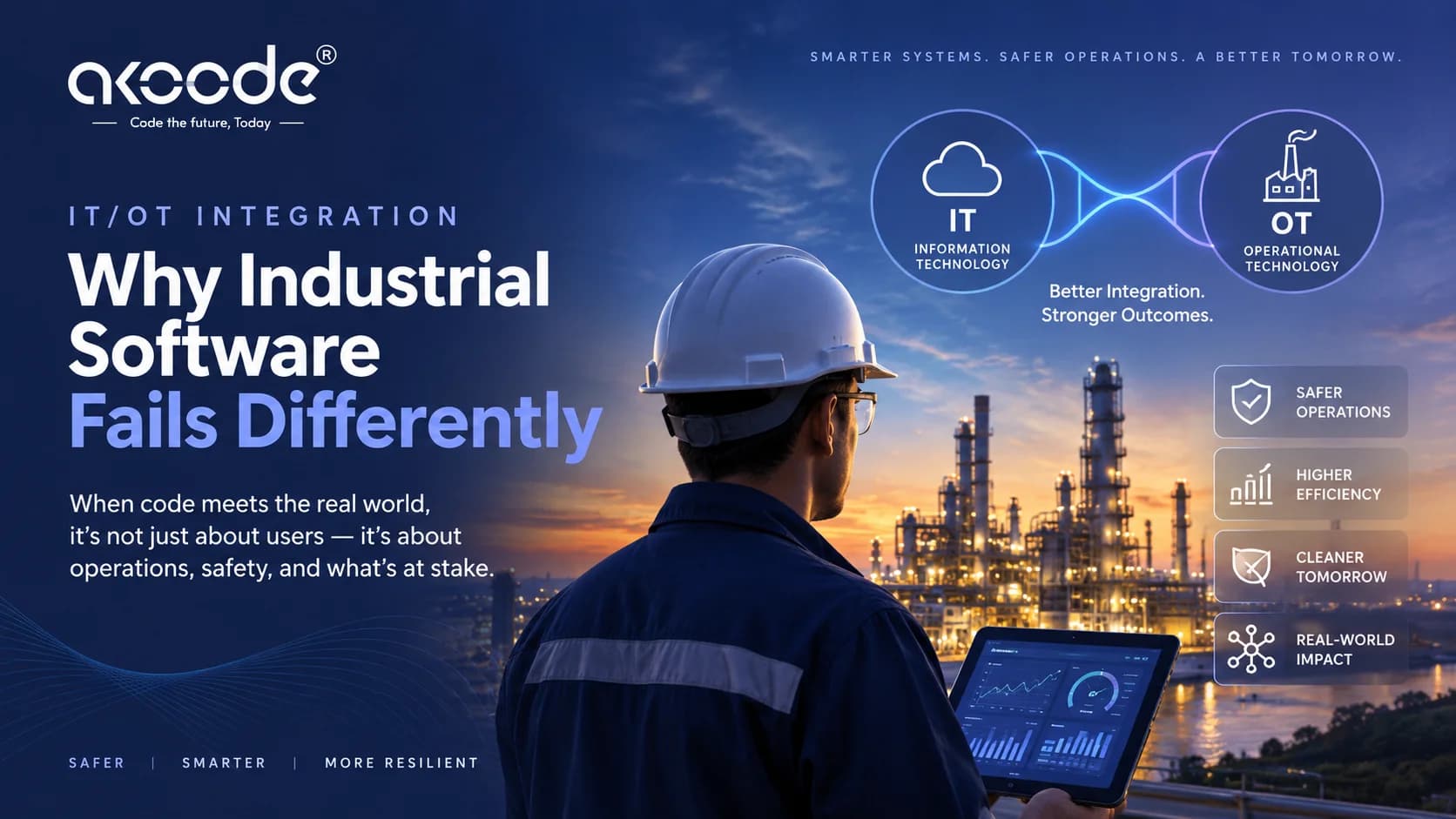
There's a category of software failure most engineering teams have never encountered, and it explains why so many industrial technology projects stall after a promising start.
In a commercial application, when a dashboard stops updating, users complain and someone opens a ticket. In an industrial environment, when a pipeline monitoring dashboard stops updating during a shift changeover, the operator on the other end doesn't know whether a pressure reading is stale or whether nothing has changed. That ambiguity — not the outage itself — is what turns a software problem into a safety report.
The same pattern repeats across every asset-heavy sector. A dropped record in a hospital scheduling system creates a gap in a care pathway that someone reconciles manually, under regulation, with documentation. A customs classification error in a freight platform leaves a container in a yard accruing demurrage while paperwork gets rewritten.
This is the defining characteristic of industrial software, and it's rarely discussed with the seriousness it deserves: when code is coupled to physical systems, the failure modes stop being about user experience. They become operational, regulatory, and occasionally physical.
That single fact changes what "good engineering" means — the architecture, the testing philosophy, the documentation standards, the disaster recovery posture, and the kind of team that can actually deliver.
This guide covers what IT/OT integration genuinely requires, why most projects underestimate it, and how to evaluate a partner for work where the consequences are real.
The IT/OT Divide, Precisely {#the-divide}
Most software engineers spend their careers in information technology — systems whose job is to store, move, and present data to people. Asset-heavy industries run substantially on operational technology: systems whose job is to monitor and control physical processes. Valves. Turbines. Compressors. Infusion pumps. Cranes. Conveyors.
The two worlds hold opposite assumptions, and the gap between them is where industrial software projects get into trouble.
Dimension | Information Technology | Operational Technology |
|---|---|---|
Optimizes for | Features, iteration speed | Determinism, availability |
Deployment posture | Deploy Friday, roll back Monday | Change requires justification and review |
Age of running systems | Legacy = liability | Eleven years unmodified = proven asset |
Data character | Transactional, reasonably clean | Time-series firehose with gaps, drift, unit inconsistency |
Security model | Patch continuously | Often can't patch — segment and monitor instead |
Failure cost | Downtime, lost conversions | Shutdown, environmental release, injury |
None of these differences are subtle, but they're easy to miss on paper. A project scoped as "we'll pull sensor data into a cloud analytics platform" looks like a data pipeline engagement and behaves like an industrial systems engagement.
What a team who understands this does differently:
Treats the OT/IT boundary as unidirectional by default — read from control systems, never write to them, unless the entire safety case has been examined by people qualified to examine it
Asks about data historians (PI, Ignition, or equivalents) before asking about the cloud stack
Budgets serious time for sensor data cleaning, unit normalization, and tag mapping
Assumes network segmentation exists and designs around it, rather than requesting firewall exceptions that will not be granted
Validates model outputs against what operators already know to be true
A fast diagnostic for any vendor: ask what they'd do if the sensor data they need sits behind an air-gapped network. If the answer involves opening a port, keep interviewing.
Where the Value Actually Sits {#where-value-sits}
The highest-return industrial software work of the last several years hasn't been control system replacement. Nobody sensible wants to touch a working control system.
It's been the analytics layer above it — pulling operational data out of historians and control networks into environments where it can be modeled, forecast, and acted on, without ever writing back into the control path.
That's where predictive maintenance lives. Production optimization. Emissions accounting. Yield analysis. Fleet and asset intelligence. All of it reads from OT and writes to people, never to machines.
The architecture that makes this safe is well-established and worth naming plainly:
Unidirectional data flow. Data gateways or diodes that physically or logically permit reads out and prevent writes in. This isn't paranoia — it's what allows a security team to approve the project at all.
A staging layer that owns data quality. Raw historian output lands somewhere before it becomes analytics. Tag mapping, unit normalization, gap handling, and outlier flagging happen here, once, rather than being reimplemented badly in every downstream consumer.
Clear ownership boundaries. The control engineers own everything up to the gateway. The software team owns everything after it. Ambiguity at that line produces either paralysis or, worse, someone making a change nobody reviewed.
Read-only credentials, enforced at the infrastructure level. Not by convention. By configuration that can be demonstrated to an auditor.
Get this architecture right and everything downstream becomes ordinary software engineering. Get it wrong and the project either never receives security approval or becomes the reason a new approval process exists.
The Data Problem: Historians, Tags, and Trust {#data-problem}
Here's the part that consistently blows up timelines, and it has nothing to do with modeling.
Industrial sensor data is not clean. It has:
Tag naming that reflects institutional history rather than logic. A plant built in 1994, acquired twice, and expanded three times has tag conventions that made sense to people who no longer work there. There is frequently no documentation. The knowledge lives in a control engineer's memory, and sometimes in a retired one's.
Unit inconsistency across sources. The same physical quantity recorded in different units by different systems, occasionally within the same facility.
Calibration drift. A sensor reading 3% high for eighteen months produces a beautifully consistent dataset that is beautifully wrong. Nobody flagged it because the operators mentally corrected for it.
Gaps. Maintenance windows, communication failures, and instrument outages produce holes that must be handled deliberately — interpolation is sometimes appropriate and sometimes dangerously misleading.
Operating regime changes. Equipment modified, feedstock changed, setpoints adjusted. Historical data from before the change may describe a system that no longer exists.
The consequence is a trust problem, not a technical one. If your first model output contradicts what the plant team knows to be true, they will disregard the system — and once operator trust is lost, adoption almost never recovers. You can be technically correct and functionally dead.
The teams that succeed here do something specific: they validate against operator knowledge before they present anything. Sit with the people who run the asset. Show them what the data says. When they say "that's not right," find out why — because they're usually correct, and the reason they're correct is the missing piece of your data model.
Case Study in Concentration: Houston {#houston}
If you want to see every one of these dynamics compressed into one geography, look at Houston.
The Energy Corridor's oil and gas operations sit forty minutes from the Texas Medical Center, the largest medical complex in the world, with the Port of Houston — moving more foreign tonnage than any other US port — in between. Three industries, each running software coupled to physical consequences, each with a different definition of a finished product.
Energy: "done" means it survives an operational review. Reliability under real load, integration with systems predating the cloud, and documentation that withstands both an internal safety review and — very commonly — a merger. This sector consolidates constantly, and every acquisition triggers technical due diligence where undocumented systems become liabilities on a spreadsheet. Architecture decisions get written down as they're made, because the acquiring company's team will ask.
Healthcare: "done" means it passes vendor security review. Access control granularity, audit logging, encryption architecture, business associate agreements down the full subprocessor chain, tested disaster recovery, documentation. Compliance-aware architecture has to be designed into the data model from sprint one — retrofitting after a failed review means rewriting, not patching.
Logistics: "done" means it handles the actual volume. A route optimization engine that performs beautifully on simulated traffic and falls over on real port congestion hasn't shipped — it's demoed. Load testing against realistic volume, exception handling as a first-class concern, and integration with the customs and documentation systems freight genuinely runs through.
The city also concentrates something else: an unusually deep pool of engineers with genuine domain literacy.Pipelines through Rice, the University of Houston, and Texas A&M produce people who understand what a compressor curve means. Software capability plus domain understanding is far rarer than general engineering skill, and it's the difference between a team that spends two sprints learning your data and one that starts productive.
For organizations building specifically for this market, our software development company in Houston page covers how we approach energy, healthcare, and logistics engagements there.
The Energy Transition Is a Data Lineage Problem {#energy-transition}
Most discussion of the energy transition concerns molecules — hydrogen pathways, carbon capture, grid buildout, renewables interconnection. Underneath all of it is a software problem receiving far less attention.
Traditional hydrocarbon operations were built around a small number of very large, well-instrumented assets. A refinery. A platform. A pipeline network. Enormous data volume, but stable topology and well-established reporting requirements.
Transition assets invert that. Distributed generation. Battery storage. Charging infrastructure. Carbon monitoring across dispersed sites. Many more assets, more heterogeneous, more geographically scattered, with newer and less standardized telemetry — and reporting requirements still being written.
An operator running both a legacy hydrocarbon business and a growing transition portfolio needs systems that speak both languages simultaneously.
And the reporting demands compound: emissions accounting, regulatory filings across multiple regimes, investor-grade sustainability data, and increasingly third-party verification.
That last point is where the engineering rigor requirement actually comes from. Operational data that ends up in a regulatory filing or an investor report isn't analytics — it's an assertion someone signs. Which means data lineage, audit trails, and the ability to explain how a number was produced eighteen months later, to someone who wasn't there.
A dashboard that displays a number is a weekend project. A system that can defend that number to an auditor is a real build — and the difference is almost entirely in architecture decisions made before any interface work begins.
The organizations getting this right treat operational data infrastructure as the foundation and reporting as a consequence, rather than building reporting tools that scrape whatever data happens to be reachable. Slower to start. Dramatically cheaper across a decade.
Our energy and utilities practice builds across exactly this seam.
Designing for Correlated Failure {#correlated-failure}
Most disaster recovery planning assumes uncorrelated failures: a server dies, an availability zone degrades, a deploy goes wrong. Industrial operations in exposed geographies face something else entirely.
Gulf Coast hurricane risk is the clearest example — a known, recurring, region-wide business continuity risk arriving on a schedule every year from June through November. But the pattern generalizes: wildfire regions, seismic zones, grid-fragile areas, and any operation where a single event can take out the primary data center, the office, the engineering team's homes, and the client's operations simultaneously.
Standard DR assumptions quietly break under correlation. What genuinely designing for it requires:
Multi-region by architecture, not aspiration. Not "we could fail over" — an actually tested failover, with replication meeting a stated recovery point objective, and routing that can be switched without a heroic manual intervention by someone who may be evacuating.
Recovery objectives set by consequence. A monitoring system, a clinical scheduling platform, and an internal reporting tool have genuinely different acceptable downtimes. Treating them identically either overspends on one or underprotects another.
Runbooks written for someone else. The person who knows how failover works may be unreachable. Documentation assuming tribal knowledge fails precisely when it's needed.
Testing before the season, not during it. An untested DR plan is a hypothesis. Teams running a genuine annual failover drill find the broken assumptions — the certificate existing in only one region, the unrotated credential, the dependency on an unreplicated service.
Degraded-mode design. What does the system do when connectivity is intermittent rather than absent? Field applications need to function on partial signal and reconcile on reconnection — an architecture decision made in sprint one, not a feature bolted on later.
There's a useful second-order effect: this discipline produces better systems generally. A team that has genuinely designed for correlated regional failure builds more robust software everywhere. It's one of the few cases where a hard local constraint yields globally better engineering. Our cloud and DevOps practice treats it as standard rather than exceptional.
Industrial AI: What Works and What Doesn't {#industrial-ai}
Industrial environments generate enormous volumes of operational data with clear, expensive problems attached — which makes them among the most genuinely promising applied-AI settings anywhere. The conference circuit reflects it, with major energy-AI and digital transformation events now drawing hundreds of operators annually.
What's genuinely working in production:
Predictive maintenance on rotating equipment. Pumps, compressors, turbines — modeled on vibration, temperature, and pressure data to catch degradation before failure. The most mature industrial AI category, with the clearest economics: an unplanned shutdown costs orders of magnitude more than an early intervention.
Production optimization and forecasting against real historical operational data, not a generic model applied to an unfamiliar asset base.
Document and contract intelligence. Asset-heavy industries run on paper: leases, joint operating agreements, regulatory filings, service contracts, maintenance records. Extracting terms, obligations, and dates from decades of documents is high-value, low-risk, and consistently underrated.
Emissions and regulatory reporting automation, with the lineage and audit trail requirements discussed above.
Computer vision for inspection and quality control — equipment condition assessment, cargo and manifest verification, defect detection.
Claims and clinical documentation AI in healthcare-adjacent operations, where the same document-heavy dynamics apply.
What requires far more caution:
Anything writing into control systems. The safety case for closed-loop AI control is a different discipline with different qualifications behind it.
Operational recommendations without human review, where an error propagates into physical action.
Any model whose outputs can't be explained to the operator expected to act on them.
The requirements industrial AI adds on top of ordinary ML engineering:
Human-in-the-loop is not optional for anything touching operations or clinical decisions
Explainability over accuracy alone — an operator will not act on a confidence score they can't interrogate, and shouldn't
Evaluation frameworks are mandatory — a golden dataset measured before every release, not "it seems accurate"
Drift monitoring matters more here, because equipment ages, feedstocks change, and a model tuned on last year's operating envelope quietly stops being right
Data assessment before modeling. Historian data with unmapped tags and uncalibrated sensors produces a confident model that plant engineers immediately distrust
Our AI development services are built around this discipline: production systems trained on the client's own operational data and shipped with monitoring, not lab demonstrations.
Legacy Integration: The Line Item Nobody Scopes {#legacy}
A pattern worth naming plainly, because it wrecks budgets across every industrial sector.
The company has a modernization initiative. The new system is well-specified. The vendor scopes the build competently. And somewhere around month four, the project discovers the system it must integrate with is:
A twenty-year-old ERP with customizations nobody documented
A historian whose tag convention predates two acquisitions
An EHR module whose interface engine requires a vendor engagement to modify
A homegrown scheduling tool that one person maintains and everyone depends on
None of these are unusual. All are normal in industries that are asset-heavy, merger-prone, and old enough to have genuine technical archaeology.
The discipline that prevents crisis:
Integration discovery before commitment. Not "we'll integrate with your ERP" but a documented inventory of what exists, who owns it, what its interfaces genuinely support, and where undocumented behavior lives. This takes real time and should be paid work. Vendors who wave it away are deferring risk into your timeline.
Phased migration around live operations. Asset-heavy businesses can't stop for a cutover weekend. Shipping doesn't pause. Clinical operations don't pause. Process plants very much don't pause. A migration plan requiring everything to stop is a plan that gets rejected — or worse, accepted and abandoned mid-transition.
Strangler-pattern thinking. Replace capability by capability, running old and new in parallel with reconciliation between them until confidence is earned. Slower on paper. Vastly more likely to finish.
Documentation as archaeology output. When your team maps an undocumented legacy system, that map is a durable asset — arguably more valuable than the integration itself. Make it a contractual deliverable.
How to Evaluate an Industrial Software Partner {#evaluating}
Generic vendor evaluation applies, but this work demands additional filters. Seven questions that separate teams who've built in operational environments from teams who've read about it:
1. "Which review does this build have to survive?"
This should be their first question, not yours. An internal security audit, a hospital vendor procurement checklist, and a port operator's integration requirements are three different bars. A vendor starting with features is scoping a demo.
2. "Walk me through how you'd get data out of our historian without touching the control network."
The answer reveals whether they've done industrial work. Fluency about unidirectional gateways, segmentation, and read-only patterns is the tell.
3. "Show me a system you built that's been running through a full operating cycle — including a regional disruption. What broke?"
Production scars are the only real credential. Ask what the failover actually did versus what the runbook claimed.
4. "How do you handle sensor data quality?"
Real answers involve tag mapping, unit normalization, calibration drift, gap handling, and validation against operator knowledge. Vague answers mean they've only worked with clean transactional data.
5. "How would you phase this migration around live operations?"
If the plan requires a cutover weekend, they haven't worked with an operation that can't stop.
6. "What documentation will exist at handover, and when is it written?"
Written as decisions are made, or assembled before a deadline? Merger due diligence and compliance audits can tell the difference.
7. "Who exactly is building this, where are they located, and is any of it subcontracted?"
Ask plainly. Domain knowledge compounds across an industrial project — the person who understood your tag mapping in month two needs to be reachable in month fourteen.
Red flags specific to this work:
A quote before anyone has looked at the legacy systems or the data
Disaster recovery discussed as an SLA rather than an architecture
AI accuracy promised before anyone has assessed the historian data
No question about which regulatory or security review applies
A migration plan requiring operations to stop
Documentation treated as a final-phase task
Any suggestion of writing into control systems without a safety case
Key Takeaways {#takeaways}
Industrial software fails differently. When code couples to physical systems, failure modes become operational, regulatory, and occasionally physical — raising the bar on reliability, testing, and documentation well above commercial norms.
The value sits above the control layer. Read from OT, write to people, never back into the control path. That architecture is what makes security approval possible at all.
Data quality is a trust problem, not a technical one. Tag mapping, unit normalization, and calibration drift determine whether operators believe your system. Once trust is lost, adoption rarely recovers.
Reporting data is an assertion someone signs. Emissions and regulatory outputs need lineage and audit trails, not just a dashboard.
Correlated failure breaks standard DR assumptions. Design multi-region for real, set recovery objectives by consequence, write runbooks for whoever is available, and test before the season.
Industrial AI needs human-in-the-loop, explainability, evaluation frameworks, and drift monitoring — not as best practices, but as adoption requirements.
Legacy integration is the most under-scoped line item in industrial projects. Insist on paid integration discovery and treat the resulting system map as a deliverable.
Frequently Asked Questions {#faqs}
What is IT/OT integration?
IT/OT integration connects information technology systems — which store, move, and present data — with operational technology systems that monitor and control physical processes like pumps, turbines, and valves. In practice it usually means extracting operational data from historians and control networks into analytics environments, without ever writing back into the control path.
Why do IT/OT integration projects fail?
Most fail for three reasons: the team treats it as a standard data pipeline project and underestimates sensor data quality work; the architecture requests network access that security teams will never approve; or model outputs contradict what operators already know, destroying trust before adoption. Technical correctness doesn't save a system operators have stopped believing.
What is a data historian and why does it matter?
A historian is a time-series database purpose-built for industrial process data, recording sensor readings continuously across an asset. It's usually the primary data source for industrial analytics — and its tag naming conventions, unit inconsistencies, and calibration history determine how much preparation work a project actually requires. Any vendor should ask about your historian before your cloud stack.
Should industrial software ever write back into control systems?
Not by default. Reading from OT and writing to people is the architecture that makes security approval feasible and keeps the safety case intact. Closed-loop AI control is a different engineering discipline with different qualifications and a formal safety case behind it — and it should never be treated as an incremental feature of an analytics project.
Why is sensor data quality such a large part of an industrial AI project?
Industrial data carries tag names reflecting institutional history rather than logic, inconsistent units across sources, calibration drift that operators mentally correct for, gaps from maintenance and comms failures, and regime changes that make older data describe a system no longer running. Cleaning and mapping this is frequently the largest work stream — and skipping it produces confident models that plant engineers immediately reject.
What industrial AI applications actually work in production?
Predictive maintenance on rotating equipment (the most mature category, with the clearest economics), production optimization and forecasting, document and contract intelligence across leases and filings, emissions reporting automation with audit trails, and computer vision for inspection and quality control. What requires caution: anything writing into control systems, or operational recommendations acted on without human review.
How should disaster recovery differ for industrial operations in exposed regions?
Standard DR assumes uncorrelated failures. Regional events — hurricanes, wildfires, grid failures — can take out your data center, office, engineering team, and client operations at once. That requires genuinely tested multi-region failover, recovery objectives set by consequence rather than convention, runbooks written for whoever is available, degraded-mode design for intermittent connectivity, and drills run before the risk season rather than during it.
Why do legacy integrations derail industrial software projects?
Asset-heavy, merger-prone industries accumulate undocumented ERP customizations, historians with tag conventions predating acquisitions, and interface engines requiring vendor engagement to modify. The fix is paid integration discovery before commitment — a documented inventory of what exists, who owns it, and where undocumented behavior lives — plus phased migration that never requires operations to stop.
How do I evaluate a vendor for industrial software work?
Ask which review the build must survive (their first question should be this, not yours), how they'd extract historian data without touching the control network, what broke in a system they've run through a full operating cycle, how they handle sensor data quality, how they'd phase a migration around live operations, what documentation exists at handover and when it's written, and who exactly is building it.
Where is industrial software demand concentrated?
Anywhere assets are heavy and consequences are physical — but Houston is the densest single concentration in the US, with energy operations, the world's largest medical complex, and the highest-foreign-tonnage port in the country within one metropolitan area. It's also a market with unusually deep domain-literate engineering talent, which matters more than raw software skill for this work.
The Bottom Line
Industrial software isn't hard because the engineering is exotic. It's hard because the consequences are real.
Systems coupled to refineries, hospitals, grids, and cargo don't reward the fastest demo. They reward the team that asked which review the build must survive, mapped the legacy estate before quoting, designed the failover before the season, validated the data against operator knowledge, and wrote down why the architecture works the way it does — for someone who wasn't in the room.
That discipline is expensive to develop and impossible to fake. It's also what produces software still running well after the vendor's engagement ends.
If you're scoping work at the IT/OT seam, that's the standard worth holding a partner to — and the conversation worth having before anyone writes a line of code.
Book a free consultation → calendly.com/akhil-akoode/ak
We'll look at which review your build has to clear, what your integration surface actually looks like, where your data readiness stands, and give you a straight answer on scope and approach.
Explore: energy and utilities | manufacturing | logistics and supply chain | AI development | cloud and DevOps | custom software | software development company in Houston | case studies
Get In Touch Now
View More Our Blog