


 October 14, 2026
Short Answer
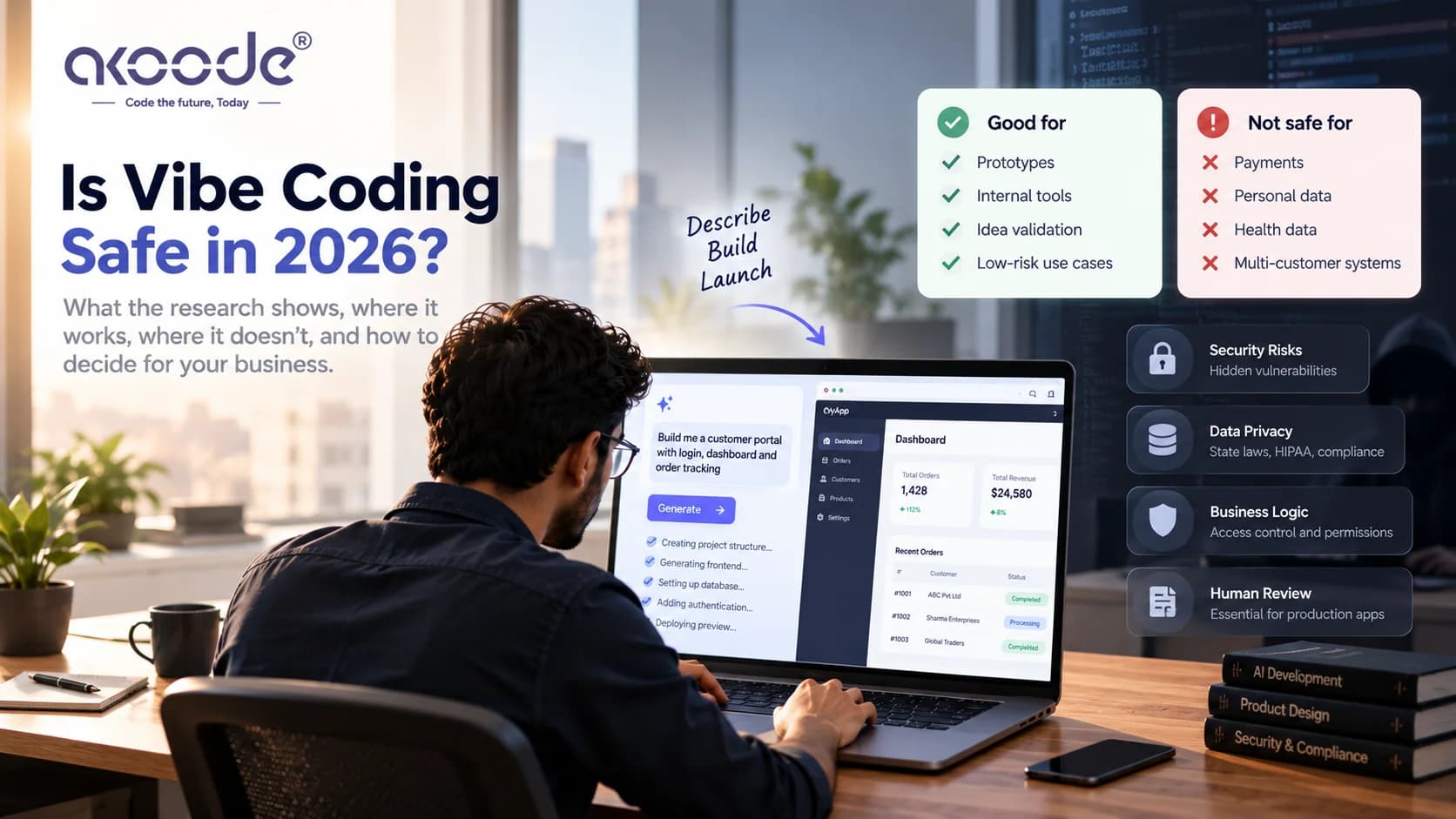
Vibe coding is safe enough for prototypes, demand tests and internal tools that touch no sensitive data. It is not safe by default for anything that handles payments, personal data, health data or several customers' data in one system. The problem is rarely that the AI writes obviously broken code. Security testing in 2026 keeps finding the same pattern: these tools handle the textbook vulnerabilities well and miss the ones that depend on your business rules, such as who is allowed to see which record. In the US there is a second layer on top. State privacy laws, biometric laws and HIPAA apply to what your app collects, and "the AI wrote it" is not a defense. The practical rule is to sort every app by what happens if it fails: vibe-code the low-risk ones, have a human review the middle tier, and hand the high-risk ones to engineers.
On October 13, 2026, Google announced that Play users in the United States and other select markets can build a custom Android app in Google AI Studio and run it privately on their own phone with only a standard Google account.[1] A year ago that would have been a curiosity. Now it is a product feature. Building software by describing it in plain English has gone from a term Andrej Karpathy coined in early 2025 to a default starting point for founders, operators and a fair number of professional developers.
That makes the question in the title a business question, not a developer debate. If you are about to put a vibe-coded app in front of customers, or you have already, this guide covers what the research shows, how to decide which apps can stay vibe-coded, what US law expects of you, and what to check before real users touch it.
What Vibe Coding Means in 2026
Vibe coding means building software by directing an AI model in natural language and accepting what it produces, often without reading the code closely. It differs from AI-assisted engineering, where a developer uses the same tools but reads, tests and owns every line that ships. The tools are identical. The discipline around them is what differs, and it is the discipline that decides whether the result is safe.
Most of the confusion in the headlines comes from blurring those two practices. A professional engineer using an AI assistant to write tests is not doing what a first-time founder does when they prompt an app into existence and publish it. Both get counted as "using AI to code," and the statistics get muddy.
How Many People Actually Vibe Code
It depends on who you ask and what you ask them. Stack Overflow's 2025 survey of more than 49,000 developers found 84% using or planning to use AI tools, yet 77% said vibe coding is not part of their professional workflow.[2] A separate survey of 240 US and UK engineers by Adaptavist found 83.9% vibe code in some form.[3] Both can be true. One counted anyone who has ever prompted their way to a working result, the other counted people who treat it as a professional practice.
The builders themselves are changing too. In a survey of more than 14,300 users on the Lovable platform, 60.5% said they were not yet earning money from what they had built, and only 10.7% reported direct product revenue.[4] That is vendor data, so read it as directional, but it matches what most agencies see: creating an app has become easy, and turning it into a business that survives real customers is where the work still sits.
What the Security Research Found
No single study settles this, and most are controlled benchmarks rather than audits of live products. Taken together they point the same direction.
What was measured | Finding | Caveat |
|---|---|---|
Builders' own view of their output | 68% called it "fast but flawed"; 36% skipped QA entirely[5] | Peer-reviewed, but small samples of practitioner accounts |
Security testing across 100+ language models | 45% of generated code samples failed security tests or introduced an OWASP Top 10 weakness[6] | Benchmark tasks, not production audits |
15 apps built by five widely used AI tools from identical prompts | 69 vulnerabilities, about 6 rated critical; every app lacked CSRF protection and security headers[7] | Small sample; no exploitable SQL injection or XSS found |
470 open-source pull requests | AI-authored PRs averaged 10.83 issues vs 6.45 for human-only; security issues up to 2.74x higher[8] | AI authorship inferred from co-authorship signals |
Secrets leaked in public GitHub commits | 3.2% of AI-assisted commits leaked a password or API key vs a 1.5% baseline[9] | Depends on how AI assistance was detected |
The third row is the most useful if you read it closely. The tools did well on the problems every security course teaches. The researchers found no exploitable SQL injection or cross-site scripting anywhere across the 15 apps. What they found instead were authorization logic flaws, business logic holes and server-side request forgery, the flaws where safe versus dangerous depends on context the model was never given. The AI knows how to sanitize an input. It does not know that a salesperson should see their own accounts but not the whole company's.
Leaders are noticing. A 2026 Retool survey, as summarized by Modelence, found 93% of senior technology and security leaders concerned about vibe-coded tools in production, and a split between roles: 71% of CTOs called AI coding a net positive, while only 47% of CISOs agreed.[10] The people who build and the people who defend are reading the same evidence differently, which is a good argument for getting both in the room before launch.
One more result worth knowing, because it cuts against the speed story. METR's randomized trial put 16 experienced open-source developers on 246 real tasks in codebases they knew well. They took 19% longer with AI tools and still believed afterward that AI had made them faster.[11] We cover that research in more depth in our piece on how AI is changing software development costs and timelines. The point for this article: feeling fast and being safe are different things.
Real Failures Look Like Missing Permissions, Not Typos
The clearest public example is CVE-2025-48757. Researchers found that Lovable-generated projects built on Supabase had insufficient row-level security policies, exposing data across more than 170 production applications. In plain terms, the AI built the database but not the rules that say user A can only read user A's rows.[12]Anyone who knew the pattern could request someone else's data.
That is the failure to plan for. It rarely announces itself, because the app works perfectly in a demo with one user. It only breaks when the second user shows up, or when a curious customer changes an ID in a web address.
An academic experience report on vibe coding in production reached the same conclusion from the engineering side. The generated code consistently under-specified multi-tenancy, access control and asynchronous processing, and the authors argued these are "non-delegation zones" where a human has to own the design.[13] The effort does not vanish. It moves from typing code to specifying constraints and checking that they held.
A Risk-Tier Framework: What to Vibe Code, Review or Engineer
The useful question is not "is vibe coding safe," it is "what is the worst thing that happens if this app is wrong." Sort each app into one of three tiers.
Tier | Typical examples | Vibe code alone? | What it needs |
|---|---|---|---|
1. Low blast radius | Prototypes, demand tests, one-person tools, internal calculators with no sensitive data | Yes | Keep it off production data and off the public internet when possible; set an expiry date |
2. Moderate | Internal tools using company data, simple customer-facing pages, lead forms, dashboards | Draft yes, ship no | Human code review, secrets and dependency scan, access test per role, a named owner |
3. High | Payments, accounts with personal or health data, multi-tenant SaaS, anything regulated or investor-facing | No | Engineer-led architecture, security review, tests, monitoring, privacy and compliance sign-off |
Apps move up the tiers over time, and that is where most trouble starts. A prototype for ten friendly users becomes a product for a thousand strangers without anyone deciding to re-tier it. Set a rule that the day an app gets real customer accounts, takes a payment or stores personal data, it gets re-sorted and reviewed.
What US Law Expects From an App You Vibe-Coded
US regulators do not care which tool wrote the code. They care what the app collects and what you do with it, and the rules vary by where your users live, not where you are based.
State privacy laws. As of 2026, 20 states have comprehensive consumer privacy laws in effect, including California, Texas, Virginia, Colorado, Washington and, since January 1, 2026, Indiana, Kentucky and Rhode Island. If your app collects personal data from residents of those states, you likely owe them access, deletion and opt-out rights, and a privacy notice that matches what the app really does. A vibe-coded app often collects more than its owner realizes, because analytics and third-party SDKs get added by default. Our US data privacy and compliance guide for software buyerslists the states and the details.
California. CCPA penalties run up to $2,663 per unintentional violation and $7,988 per intentional violation (2025 figures), with no overall cap.[14] The largest settlement to date, $12.75 million from General Motors in 2026, was about selling data without proper consent, not about a hack. If you serve California users, data minimization and honored opt-outs are product requirements.
Biometrics. If an AI-built feature uses face, fingerprint or voice recognition, Illinois' BIPA applies to Illinois residents' data and carries a private right of action. It has produced a $228 million jury verdict. Teams building for Illinois should raise any biometric feature at the start.
Health data. If protected health information touches your app, HIPAA expects a business associate agreement with each vendor that handles it. Before patient data goes into any AI builder, check whether that vendor will sign one at all, and on which plan.
The theme across all four is the same: you are responsible for the behavior of the app, and a regulator or plaintiff will not accept "the AI built that part" as an answer.
The Pre-Launch Checklist: 12 Checks Before Real Users Touch It
This is the list we would run on any AI-built app before launch. None of it requires reading every line of code.
Cross-account test. Log in as user A and try to open user B's records by changing an ID in the address bar or an API call. If it works, stop.
Tenant isolation. Confirm the database enforces access rules itself, such as row-level security, and does not rely on the front end to hide data.
Role test. Try every action as every role, including a logged-out visitor.
Secrets scan. Search the repository and its history for API keys, passwords and tokens.
Dependency scan. Check libraries for known vulnerabilities and for packages nobody recognizes.
Browser protections. Verify CSRF protection and security headers, the two gaps found in every app in the 15-app study.
Server-side validation. Confirm inputs are checked on the server, not just in the form.
Rate limits and abuse. Make sure login, signup and any AI-powered feature cannot be hammered or run up your bill.
Logging and alerts. Know who did what, and get notified when something unusual happens.
Backups and restore. Test restoring a backup, since an untested backup is a hope.
Privacy match. Compare the privacy policy to the data the app actually collects, including analytics and third-party SDKs, and confirm you can honor deletion and opt-out requests.
Human review of the risky parts. Have an experienced engineer read the code for authentication, payments and anything touching sensitive data.
When to Bring in a Software Development Company
You do not need an agency to build every app. Bring one in when any of these is true:
Real customers have accounts, or you are about to take payments.
The app stores personal, health or financial data.
Several customers' data sits in one system.
An enterprise buyer, investor or insurer is asking security questions you cannot answer.
Small changes keep breaking unrelated features.
Nobody on your team can explain how the app is structured.
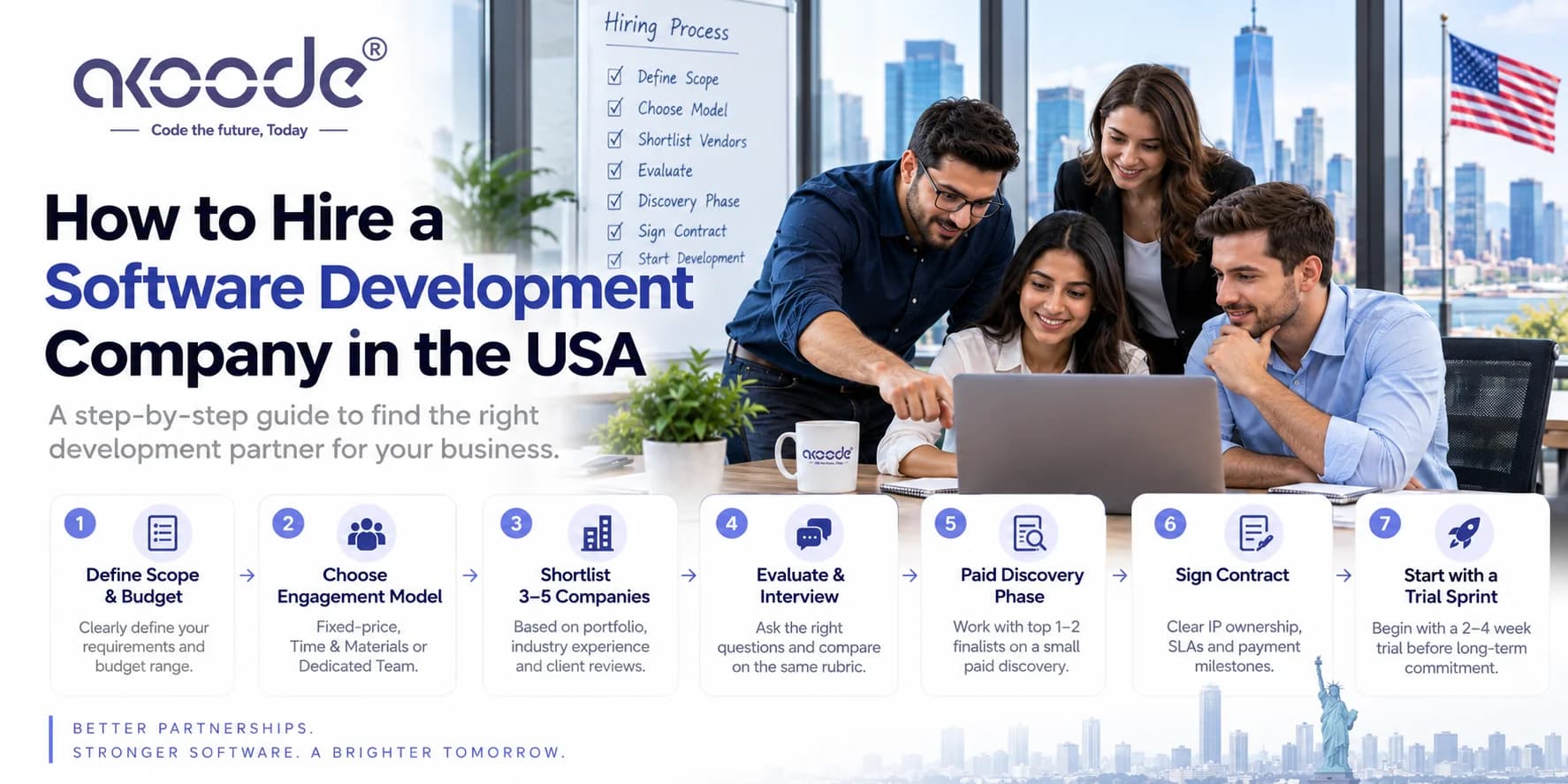
A good partner starts by finding out what you actually have, not by quoting a rebuild. That means a short audit of the architecture, access model and data flows, then a clear recommendation: keep it, harden it, or rebuild the parts that cannot be saved. Many prototypes turn out to have a usable interface and a thin foundation, which points to targeted work, not starting over. Ask for that assessment as a paid, scoped first step so you get a real answer before committing to a larger project. Our guide to hiring a software development company in the USA covers how to run that conversation and what to put in the contract, and our software development cost guide explains what drives the price of the work that follows.
Harden or Rebuild: How to Decide
Five questions settle most cases. Is the data model sound, meaning would you design the tables the same way today? Is there a real authorization model, or does every screen assume one kind of user? Are there tests that tell you when a change breaks something? Is the same business rule copied into several places? And can one person explain the architecture to a new engineer in an hour?
Mostly yes means harden: add access controls, tests and monitoring, and keep going. Mostly no, especially on the data model and authorization, means the foundation is worth replacing even if the screens are worth keeping. The cost of fixing a weak foundation grows with every customer you add, so the best time to ask is before the first big one signs.
How Professional Teams Use AI Tools Safely
The alternative to vibe coding is not avoiding AI. It is using it where it helps and keeping people accountable where it does not. At Akoode, engineers use AI for scaffolding, test generation and documentation, while architecture decisions and security review stay with senior engineers. The code AI produces gets the same review as anything else, since independent testing shows it needs more of it, not less. We outline the questions to ask any vendor about their AI usage in our guide to AI software development in the USA, and the staffing side of the same shift in our piece on software development team structure.
What Comes Next: Personal Apps and Shadow Software
The Google Play change points at the next problem. When anyone with a Google account can build and run their own app, the apps multiply faster than anyone can review them. The Cloud Security Alliance describes the business version as shadow operations: employees building and deploying data-processing apps on approved platforms without IT or security involvement.[12] For a company that means a short policy, not a ban. Decide who may build what, what data it may touch, and when something has to be reviewed. Generating software is becoming easy, and verifying it is becoming the real job. Whether that changes who gets hired is a separate question we examine in will AI replace software engineers.
Frequently Asked Questions
Is vibe coding safe for production?
It depends on what the app does. Prototypes, internal tools without sensitive data and demand tests carry limited risk. Apps that handle payments, personal data, health data or multiple customers' data need an engineer-led review first, because AI tools handle common vulnerabilities well and context-dependent authorization poorly.
Can I launch a vibe-coded app to real customers?
Yes, if it passes a proper review first. Test access controls between accounts, scan for exposed secrets, verify browser protections, and compare your privacy policy to what the app really collects. If the app takes payments or stores sensitive data, have an experienced engineer review the authentication and data handling.
What is the difference between vibe coding and AI-assisted development?
Vibe coding means accepting AI-generated code with little or no review. AI-assisted development uses the same tools, but a developer reads, tests and owns the code that ships. The tools are the same, and the difference is the review process.
How secure is AI-generated code?
Benchmark testing across more than 100 language models found 45% of generated samples failed security tests or introduced a common weakness. Separate research found the tools handle well-known flaws like SQL injection but miss authorization and business-logic flaws, so AI-generated code needs the same or more review as human-written code.
Do US privacy laws apply to apps built with AI tools?
Yes. Privacy, biometric and health-data laws apply based on what your app collects and where your users live, not how the app was built. Twenty states have comprehensive privacy laws in effect in 2026, and California penalties run up to $7,988 per intentional violation.
Can a vibe-coded app pass an enterprise security review?
It can, but rarely without changes. Enterprise buyers typically ask about access controls, data isolation, logging, backups and testing, areas where prototypes are usually thin. Plan for hardening work before the first large customer asks.
Should I fix or rebuild a vibe-coded app?
Check the data model, the authorization model, test coverage, code duplication and whether anyone can explain the architecture. If the foundation is sound, harden it. If the data model or access control is weak, replace those parts even if the interface is worth keeping.
Will vibe coding replace software developers?
The evidence points to a shift, not a replacement. Generating code is getting easier, while reviewing, securing and maintaining it is becoming a larger share of the work.
Sources
Unite.AI, "Google Play Lets Users Run Vibe-Coded Apps Privately on Their Devices," October 13, 2026: unite.ai
Adaptavist, vibe coding survey of 240 US and UK engineers: theadaptavistgroup.com
Lovable, "The Build Economy" user survey (vendor data): thebuildeconomy.lovable.app
California Privacy Protection Agency, CCPA fine and penalty adjustments for 2025: cppa.ca.gov
Akoode Technologies builds custom software and AI systems for clients across the USA, UK and India, with engineering in Gurugram and a US office in Jenks, Oklahoma. The team holds a 4.9 rating from 126 reviews on Google and a 5.0 rating on GoodFirms. If you have built something with AI tools and want a straight read on whether it is ready for customers, explore our custom software development services and AI development services, or book a time on our calendar.
Get In Touch Now
View More Our Blog