



 August 14, 2026
Most software vendor evaluations test whether a team can build the thing. In Denver, that's rarely the binding constraint.
The engineering talent here is genuinely strong — a metro anchoring one of the country's densest aerospace corridors, with pipelines out of CU Boulder and the Colorado School of Mines, does not have a capability shortage.
What Denver has instead is an unusual concentration of builds that face a reviewer who wasn't in the room.
A federal procurement officer working through contract documentation. A Colorado Privacy Act compliance question landing eighteen months after launch. An acquirer's technical due diligence team during the next round of aerospace consolidation. None of these people were at your kickoff. None of them will accept "the engineer who built it understood it."
That changes the buying question. It isn't can they build it. It's what will exist when someone who wasn't there asks how this works — and whether the vendor produced that artifact while the decision was fresh or assembled it under deadline six months later.
Reviewers can generally tell the difference. One reads like a record. The other reads like an alibi.
This guide covers the Denver vendor landscape, the documentation and compliance tests that predict how a build will fare under review, the seniority question that drives cost more here than almost anywhere, and fifteen questions worth asking before anyone signs.
Why This Market Is Different
Three characteristics shape how software should be bought in Denver.
The reviewer is often external and arrives late. Aerospace and defense-adjacent contracts carry documentation standards that consumer software never produces. Colorado Privacy Act compliance questions can surface long after launch. Both want the same artifact: a defensible trail of who decided what, and when.
The regulatory target keeps moving. Colorado has amended its privacy law three times since 2024, adopted new implementing regulations, and has an Automated Decision-Making Technology framework taking effect January 1, 2027. A vendor who architected against the 2023 version and hasn't revisited it has missed biometrics, minors provisions, precise geolocation, and updated opt-out specifications. Our Colorado Privacy Act engineering guide covers what that regime actually demands.
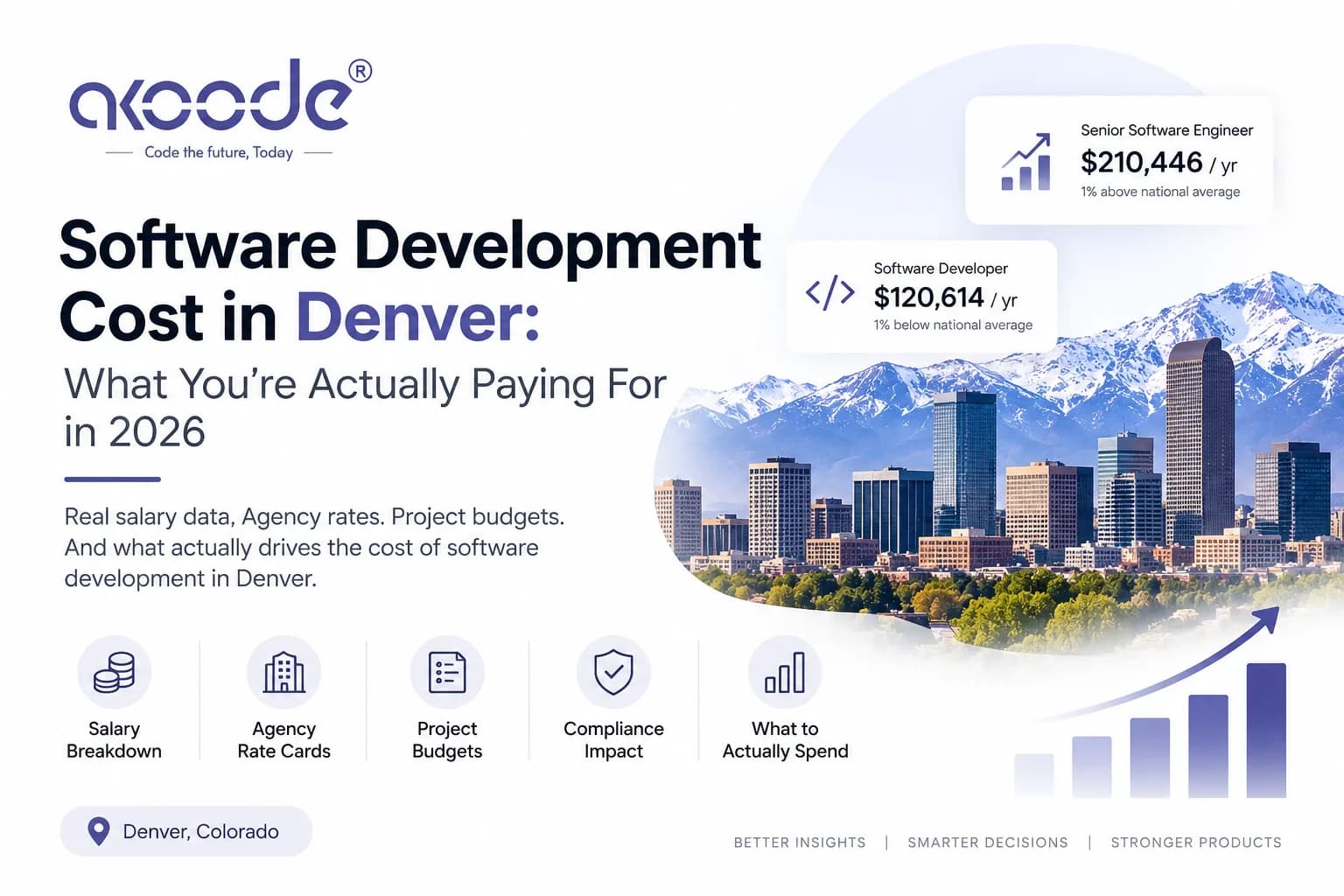
Seniority is the dominant cost variable. As we found analysing compensation data in our Denver cost guide, this market has an unusual signature: general developers earn slightly below the national average while senior engineers earn slightly above it. That inversion is the market pricing judgment — and it means team composition drives your quote more here than in most cities.
The Denver Vendor Landscape: Six Types
Aerospace and defense-adjacent specialists ($130–$190/hour). Firms built around federal contract work — documentation standards, controlled data handling, telemetry and simulation systems, procurement-ready artifacts. Where the experience is genuine, the premium is earned: a team that has been through a procurement review knows what a reviewer asks for. The trap is the imitation — firms that built one dashboard for an aerospace client and now market themselves as defense specialists. The documentation question below separates them.
Regulated fintech and healthtech specialists ($120–$180/hour). Teams built around CPA and HIPAA architecture — consent models, sensitive-data gating, consumer rights workflows, audit logging. Verify with the amendment question rather than the capability claim.
Enterprise consultancies. Larger organizations serving major contractors, health systems, and public agencies. Procurement-friendly, governance-rich, comfortable with multi-stakeholder sign-off. Right for multi-year institutional programs where documentation is contractually part of the deliverable. Expensive overhead for a mid-market build.
Standard local agencies ($90–$150/hour). The broad middle across LoDo, RiNo, the Denver Tech Center, and Boulder. Quality varies widely — the best offer real value; the weakest are learning your compliance domain on your budget. This is where disciplined evaluation returns the most.
Contractor collectives. An "agency" that is functionally a rotating bench of independents. Individuals are often strong, but nobody on your project is an employee. In documentation-heavy work this is a specific risk: the person who wrote your architecture decision records needs to be reachable when a reviewer questions one two years later.
Global firms with transparent delivery. Offshore or nearshore engineering, disclosed openly, at materially lower rates. Akoode's model sits here: senior engineers owning architecture through every sprint review, Mountain Time standups during your working day, no subcontracting, and documentation written as decisions get made. Right for builds where engineering quality matters more than in-person presence. Wrong for cleared facilities, plant-floor observation, or recurring on-site compliance sessions.
And the category to identify quickly: firms with a Denver address and an undisclosed delivery team elsewhere. Disclosed global delivery is legitimate and frequently the right call. Concealed global delivery means paying a local rate for offshore work and absorbing the spread without benefit.
One question sorts them in thirty seconds:
"Where, specifically, will the engineers on my project be located — and is any part of delivery subcontracted?"
Transparent firms answer plainly, in either direction. Everyone else starts describing a "global delivery model."
The Documentation Tests
This is the section that matters most in this market, and it's the one buyers most often skip because documentation sounds like a formality rather than a differentiator.
It isn't. In Denver it's the deliverable most likely to determine whether a build passes review.
Test 1: The timing question
"What documentation will exist at handover, and when during the project is it written?"
A strong answer names artifacts and ties them to milestones: architecture decision records written when the decision is made, data flow diagrams updated as the model changes, access control specifications, and a rationale trail explaining why the system works the way it does.
A weak answer defers. "We produce documentation at the end" describes a document assembled from memory, and reviewers reading it can usually tell.
Test 2: The reviewer question
"Show me documentation you produced for a build that went through a federal procurement review or a compliance check. What came back?"
Real answers involve specifics — an access control gap a reviewer flagged, a data flow diagram that didn't match the implementation, a retention policy nobody had written down. Firms that have never been through it can't manufacture those details convincingly.
Test 3: The successor question
"If your entire team left tomorrow, what would my next engineer need to understand this system — and would it be in the repository?"
This is the question that reveals whether documentation is a genuine practice or a deliverable line item. Good teams have an opinion about it, because they've inherited someone else's undocumented system and remember how that went.
Test 4: The amendment question
"Colorado's privacy law has changed several times since 2024, and an automated decision-making framework takes effect in January 2027. How would you structure this build so the next amendment doesn't mean rework?"
The answer separates architects from implementers. Strong responses describe a data classification layer rather than scattered conditionals, consent as a queryable service rather than a boolean on a user record, purpose-bound processing, and decision logging separated from application logs. Weak responses describe adding a checkbox.
A vendor who hasn't tracked the amendments — biometrics in 2025, minors provisions defining anyone under 18, precise geolocation in August 2026 — is telling you how current their compliance knowledge is generally.
The Seniority Question
Denver's inverted salary structure makes team composition a bigger cost lever here than in most markets, and it cuts both ways.
Ask for the staffing plan by seniority, and the reasoning behind the mix.
A senior-heavy plan is sometimes exactly right. Federal documentation standards and architecture that must absorb regulatory amendments are senior work by definition. Junior engineers implement patterns; senior engineers decide which patterns the next amendment will still permit.
And sometimes it's a vendor optimizing margin. A senior-weighted team building a standard internal tool is expensive without being better.
Meanwhile a suspiciously cheap quote on a regulated build usually means a junior-weighted team — and that cost surfaces later as rework when the documentation doesn't survive review.
The useful follow-up: "Which parts of this build specifically require a senior engineer, and which don't?" A vendor who can answer that precisely is thinking about your budget. One who insists everything requires seniority is selling.
Step-by-Step: Running the Process
Step 1: Write the one-page definition
Before any vendor call:
The business problem, not the feature list. "Our telemetry pipeline drops readings during handover windows and nobody notices until the next report" is a problem. "We want a dashboard" is a solution someone sold you.
Which review the build must survive. Federal procurement documentation, CPA compliance, HIPAA, or standard commercial. The most consequential line on the page.
Which consumer populations you touch. Colorado residents? Anyone under 18? Biometric or precise geolocation data? These determine your compliance surface.
Whether your systems make automated decisions about people — relevant given the January 2027 ADMT deadline.
Your integration surface. Even a rough inventory: which systems, who owns them, what interfaces exist.
Success in numbers. Downtime avoided. Manual review queue reduced. Response time. Review pass rate.
Budget posture, including the 20–25% reserve experienced buyers hold and the 15–25% annual maintenance that begins at launch.
Step 2: Build a list from sources that reflect this market
Operator referrals from your own sector. Another aerospace program manager's or fintech CTO's assessment outweighs any review platform. Ask: "Would you hire them again, and what went wrong?" Everyone has a "what went wrong." Honest people tell you.
Verified review platforms — read the three- and four-star reviews, where the texture lives.
LinkedIn, filtered to delivery engineers rather than founders. Tenure, and whether their backgrounds include aerospace, regulated fintech, or healthtech systems.
Live products you can test.
Aim for five to seven candidates matched to your review tier, including at least one out-of-market or global option so your comparison has a real baseline rather than local quotes measured only against each other.
Step 3: Interrogate portfolios properly
Is the system still running?
What was the firm's actual role? "We worked with [major contractor]" frequently means one engineer touched one module. Ask what specifically they built and who owned the architecture.
Did the documentation survive a review? In this market, ask directly.
Is anything in your compliance tier? A vendor with genuine CPA delivery can describe their consent architecture. One without will show you a nice interface.
Ask for a reference from a project that went badly.
Step 4: Read proposals where the truth hides
Compare scope line by line, never headline price. Spreadsheet it: discovery and compliance scoping, architecture, design, frontend, backend, QA, security testing, documentation, DevOps, project management, post-launch support.
In this market the cheap quote almost always omits three items — usually compliance scoping, security testing, and documentation. Those are precisely the three that determine whether the build survives review.
Require an explicit documentation line item on any regulated or aerospace-adjacent build. Its absence tells you either it was omitted or it's planned badly.
Look for a named assumptions section. A proposal without one hasn't been thought about hard enough to have assumptions — which means they exist unspoken and resurface as change orders.
Check what happens after launch. In this market, the review frequently arrives after your launch date.
Step 5: Negotiate the terms that matter
IP assignment on payment, not project completion
Source code and repository access from day one — non-negotiable
Documentation as a contractual milestone deliverable, not a promise. This matters more in Denver than almost anywhere, because two different kinds of reviewer will ask for it.
The integration and architecture map as a deliverable. When your vendor reverse-engineers an undocumented legacy system, that map is a durable asset. Own it explicitly.
Key personnel clause naming your technical lead
A change-order process with rates in writing
A clean exit clause — 30 days' notice, orderly handover, payment for work completed
Payment at 25–30% against a defined first milestone. A firm demanding 50%+ before discovery has cash flow or delivery problems that shouldn't become yours.
Red Flags Worth Walking Away From
Documentation deferred to the end — or absent from the proposal entirely on a regulated build.
A price in the first call. Real estimates require knowing the review tier and integration surface.
They never ask which review the build must survive.
No awareness of Colorado privacy amendments. If biometrics, minors provisions, and geolocation are news to them, their compliance knowledge is stale generally.
"We're CPA compliant" stated as a company property. Compliance is a characteristic of a system.
Everything requires a senior engineer. Sometimes true, often selling.
No assumptions section in the proposal.
50%+ deposit before discovery.
Evasiveness about team location or subcontracting.
Delivery team is mostly contractors — ask plainly how many are employees.
Won't share a reference from an imperfect project.
No decision logging proposed for a system that makes automated determinations about people, with the ADMT deadline four months out.
Slow, sloppy communication during sales. This is their best behavior. It degrades from here.
The 15 Questions to Ask Before Signing
What documentation will exist at handover, and when during the project is it written?
Show me documentation you produced for a build that went through a procurement review or compliance check. What came back?
If your team left tomorrow, what would my next engineer need — and is it in the repository?
How would you structure this so the next Colorado privacy amendment doesn't mean rework?
What's the staffing plan by seniority, and which parts specifically require a senior engineer?
What's your average variance from original estimates, and why? ("We always deliver on time" is a lie.)
Tell me about a project that went badly. What changed in your process afterward?
Which review do you think this build has to survive, and how does that change the architecture?
Do our systems make automated decisions about people — and how would you prepare for the January 2027 requirements?
Who exactly will work on this, where are they located, and is any part subcontracted?
How many of the proposed team are employees versus contractors?
What does your discovery phase produce and cost?
Who owns the IP, when does it transfer, and do I get repository access from day one?
What's your QA process, who performs it, and what does security testing cover?
Why would you be the wrong choice for some clients?
Denver Agency vs. Global Partner: The Honest Comparison
Factor | Denver Agency | Global Partner (Akoode) |
|---|---|---|
Standard rate | $90–$150/hr | $45–$75/hr |
Specialist tier | $120–$190/hr | — |
Total project cost | Baseline | 50–65% lower |
Time zone | Local | Mountain-hours overlap during your working day |
Cleared facilities / on-site | Available | Not a fit |
Aerospace documentation depth | Genuine at real specialists — verify | Verify identically |
CPA / regulatory architecture | Strong at specialists — verify | Strong at regulated-focused firms — verify |
Standard product engineering | Good at solid firms | Excellent — identical stack |
Team scaling | Moderate local market | Faster — deeper bench |
The honest read: Denver's genuine local advantages are cleared and on-site work, plus embedded and telemetry depth built up around the aerospace corridor. For the engineering itself, documentation discipline and compliance currency matter more than proximity — and Denver's Mountain Time position makes distributed delivery workable in both directions.
The vetting standard shouldn't change with the answer. Whether the team sits in the Tech Center or on another continent, the questions are identical: what documentation exists and when was it written, what came back from the last review, and how does the architecture absorb the next amendment.
The Decision Framework
Five questions:
Does the build require in-person presence — cleared facilities, plant floor observation, recurring on-site compliance sessions?
Does it require controlled or export-restricted data handling with US-person or onshore requirements?
Does it involve hardware, firmware, or direct sensor integration?
Do your contracts require US-based vendors?
Is the scope fully locked and the timeline under ten weeks?
Three or more yes → a domain specialist, local, verified with the documentation tests above.
Zero or one yes → a strong generalist or transparent global partner, vetted with exactly the same questions.
Two yes → hybrid. Local compliance and stakeholder strategy, distributed delivery for the build.
Note what isn't on this list: whether the build faces CPA compliance. That's an architecture capability, not a geography one — and it should be tested identically regardless of where the team sits.
Frequently Asked Questions
How do I hire a software development company in Denver?
Start with a one-page definition covering the business problem, which review the build must survive, which consumer populations you touch, your integration surface, success metrics, and budget posture. Build a list of five to seven review-matched candidates including one out-of-market option, run the four documentation tests plus the seniority question, then compare proposals line by line on scope rather than headline price.
What should I look for in a Denver software vendor that's different from other markets?
Documentation discipline and compliance currency. Denver builds frequently face a reviewer who wasn't in the room — a federal procurement officer, a Colorado Privacy Act compliance question, or an acquirer's due diligence team. The differentiating question is what artifact will exist when that person asks how the system works, and whether it was written while the decision was fresh.
How do I verify a vendor's Colorado Privacy Act experience?
Ask how they'd structure the build so the next amendment doesn't mean rework. Strong answers describe a data classification layer rather than scattered conditionals, consent as a queryable service, purpose-bound processing, and separated decision logging. Then check whether they're current: Colorado added biometric provisions in July 2025, minors protections defining anyone under 18 in October 2025, and precise geolocation as sensitive data in August 2026. A vendor unaware of those has stale compliance knowledge generally.
Why does team seniority matter so much in Denver pricing?
Denver has an unusual salary structure — general developers earn slightly below the national average while senior engineers earn slightly above it, because the local economy concentrates work where judgment is the scarce input. That makes team composition the single largest cost lever. Ask for the staffing plan by seniority and which parts specifically require a senior engineer; a vendor who insists everything does is selling.
What's the most useful question to ask a software vendor here?
"What documentation will exist at handover, and when during the project is it written?" A strong answer names artifacts tied to milestones. A weak answer defers to the end — which describes a document assembled from memory, and reviewers can generally tell.
How much should I pay upfront to a software development company?
25–30% against a defined first milestone is standard. Dedicated team arrangements typically bill monthly without a large deposit. A firm demanding 50% or more before discovery has cash flow or delivery problems that shouldn't become yours.
Do Denver software companies subcontract their work?
Some do, and disclosed global or nearshore delivery is legitimate — often the right call. The problem is the undisclosed version: a Denver address over a delivery team elsewhere, with you paying a local rate for offshore work. Ask directly where engineers will sit and whether any part of delivery is subcontracted.
What contract terms matter most for a Denver build?
IP assignment on payment, repository access from day one, documentation as a contractual milestone deliverable, the architecture and integration map as an owned deliverable, a key personnel clause, a written change-order process, and a clean exit clause. Documentation being contractual matters more here because two different kinds of reviewer will ask for it.
Should I ask about the January 2027 ADMT deadline when hiring?
Yes, if your systems make automated decisions about people. Colorado's Automated Decision-Making Technology framework takes effect January 1, 2027, with reported requirements around documentation, consumer notices, adverse-outcome explanations, three-year compliance records, and meaningful human review. Preparation begins with inventorying every automated decision your systems make — discovery work that reliably surfaces surprises, which argues against starting late.
Is it better to hire locally in Denver or use a distributed team?
For cleared facilities, on-site observation, controlled data handling, or hardware integration — local. For the engineering itself, documentation discipline and compliance currency matter more than proximity, and Mountain Time gives overlap in both directions. Evaluate either identically: what documentation exists and when it was written, what came back from the last review, and how the architecture absorbs the next amendment.
How long does the hiring process take?
Run properly, three to five weeks: one week defining the project and mapping your compliance and integration surface, one building the candidate list, one to two for discovery calls and proposals, one for references and contract negotiation. The documentation tests add roughly a day and eliminate weak candidates faster than any other step.
What to Do in the Next 48 Hours
Don't start by searching for agencies and calling whoever ranks first.
Write down which review this build has to survive. Federal procurement documentation, CPA compliance, HIPAA, or standard commercial. This single line determines your vendor pool and how you weight every subsequent evaluation.
List which consumer populations you touch. Colorado residents, anyone under 18, biometric or precise geolocation data. Your compliance surface follows from this.
Note whether your systems make automated decisions about people. With January 2027 four months out, this is worth establishing before conversations rather than during them.
Check delivery-team backgrounds on LinkedIn for any firm already on your radar. Ten minutes per firm, and it cuts through marketing faster than any call.
Then open conversations with the documentation timing question and the amendment question. Those two answers will sort your shortlist before you've discussed a single feature.
Talk to Akoode About Your Denver Project
Akoode Technologies builds custom software, SaaS platforms, and applied AI for Denver's aerospace-adjacent, fintech, and healthtech companies. 180+ projects delivered across 15+ industries, 97% client retention, 4.9/5 on Google and 5.0/5 on Clutch.
No subcontracting — the engineer who designed your telemetry pipeline or your consent architecture is the person your team reaches a year later. Senior engineers own architecture through every sprint review, not just the kickoff. Compliance scoped into the architecture from sprint one. Documentation written as decisions get made, for a team that wasn't in the room. Mountain Time standups during your working day.
Review our case studies, our manufacturing, finance and banking, and healthcare practices, or our AI development and cloud and DevOps services.
Book a free consultation → calendly.com/akhil-akoode/ak
A senior engineer reviews every inbound project — not an account manager — and replies within thirty working minutes.
akoode.com | contact us | info@akoode.com
About the Author
Tejveer is Sr Engineer at Akoode Technologies, a software development and AI company serving clients across the USA, UK, and India. Akoode has delivered 180+ projects across 15+ industries — including regulated platforms, sensor-data applications, and applied AI with human-review workflows — with 97% client retention.
This guide reflects direct experience across regulated and documentation-heavy software engagements, including compliance architecture and phased migrations around live operations. Rate ranges are market observations current as of August 2026 and vary by scope and specialization. Regulatory references are engineering context, not legal advice.
Get In Touch Now
View More Our Blog