


 August 14, 2026
Software Development Cost in Denver: What You're Actually Paying For in 2026
Denver has the most interesting salary structure of any mid-tier US software market, and the pattern only appears when you look at seniority rather than averages.
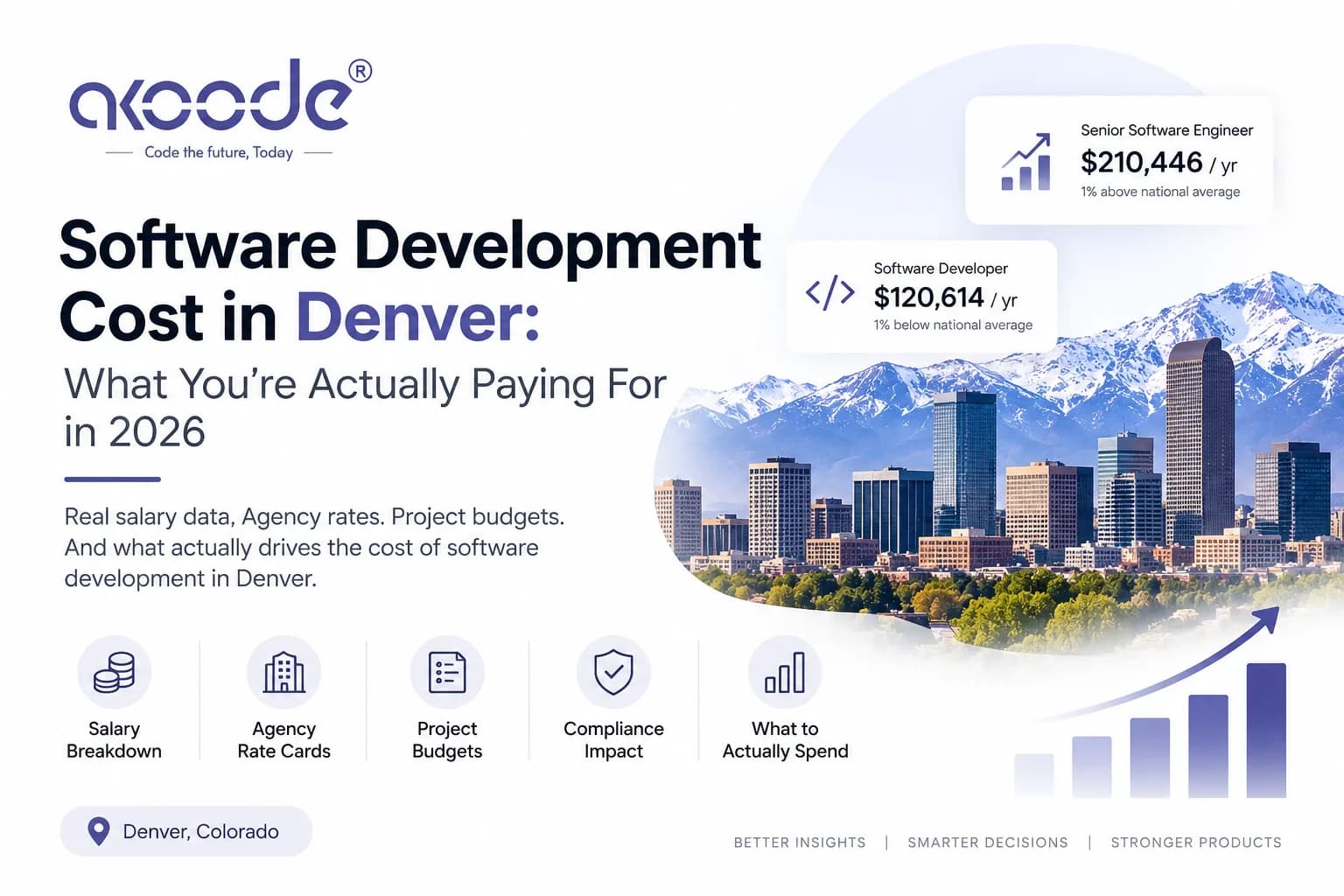
Software developers in Denver earn $120,614 — 1% below the national average, according to Glassdoor's February 2026 data from 2,961 submissions.
Senior software engineers earn $210,446 — 1% above the national average, from 3,407 submissions as of July 2026, with the 75th percentile at $259,350 and top earners reporting $311,022.
That inversion is unusual. Most markets scale uniformly: below-average cities are below average at every tier. Denver's general engineering market is priced like a secondary market while its senior tier is priced like a coastal one.
The explanation is structural, and it's the single most useful thing a software buyer here can understand: Denver's economy runs on work where senior judgment is the scarce input. Aerospace and defense-adjacent contractors clustered around the metro need engineers who understand federal documentation standards. Fintech and healthtech firms operate under the Colorado Privacy Act — one of the few comprehensive state privacy regimes in the country, and one that has been amended three times since 2024. Neither of those is junior work.
This guide covers what software development actually costs in Denver in 2026: sourced salary figures with sample sizes, agency rate cards by role and seniority, complete project budgets, what compliance documentation genuinely adds, and an honest framework for what to spend.
How This Guide Was Compiled
A note on method, because cost content is easy to write badly.
Every salary figure below comes from a named public source with its sample size and reporting month stated. Where sources diverge — and they diverge by more than $20,000 in Denver — we show the spread rather than selecting the flattering number.
Agency rate ranges reflect what firms in this market bill, derived from published rate cards, public procurement data, and our own delivery experience. Project cost ranges draw on 180+ completed projects across 15+ industries, including AI systems, mobile platforms, and regulated builds for US clients — several referenced directly below because their constraints are documented publicly in our case studies.
Ranges are stated as ranges because compliance documentation, integration surface, and data readiness change totals by multiples. Anyone quoting a single number for "a SaaS platform" hasn't scoped a SaaS platform.
Salary data current as of August 2026. Figures are point-in-time and shift; treat them as directional.
What Denver Engineers Actually Earn
Source & Date | Role | Figure | Sample / Note |
|---|---|---|---|
Glassdoor (Feb 2026) | Software Developer | $120,614/yr($58/hr) | 2,961 submissions; 1% below national; range $99,558–$147,846 |
Glassdoor (Apr 2026) | Software Engineer | ~$147,000/yr | 6,825 submissions; range $123,011–$182,513 |
Glassdoor (Jul 2026) | Senior Software Engineer | $210,446/yr($101/hr) | 3,407 submissions; 1% above national; range $174,170–$259,350; 90th pct $311,022 |
Glassdoor (Jun 2026) | Developer | $120,448/yr | 296 submissions; 1% above national; 90th pct $191,342 |
Glassdoor (Mar 2026) | Entry Level Developer | $98,155/yr($47/hr) | 1% below national; range $82,253–$118,295 |
Glassdoor (Aug 2026) | Entry Level Software Engineer | $125,355/yr | 2% below national; range $105,122–$151,379 |
SalaryExpert(Aug 2026) | Software Developer | $142,016/yr($68/hr) | Plus $6,348 average bonus; entry $99,255; senior 8+ yrs $160,946 |
Glassdoor (May 2026) | Colorado statewide | $118,381/yr | 3,789 submissions; 3% below national |
Two forward-looking data points worth noting. SalaryExpert projects Denver software developer compensation rising roughly 13.7% over five years — meaningful if you're modeling maintenance costs across a product's life, since maintenance is billed at whatever rate structure exists at the time. And Glassdoor notes Colorado developers at startups report an average of roughly $20,500 in stock options and profit sharing on top of base — relevant if you're competing for the same talent your vendor is.
The practical read: entry-level $82K–$118K, mid-level $120K–$150K, senior $174K–$260K. The gap between mid and senior is the widest of any market we've analyzed at this price tier.
The Inversion, and What It Means for Your Quote
Return to the pattern: general developers 1% below national, senior engineers 1% above.
Two forces produce it.
Aerospace and defense-adjacent documentation standards. Denver anchors one of the country's densest aerospace corridors. Software vendors working anywhere near that sector need engineers who understand federal contract documentation requirements — the paper trail that procurement review demands and that consumer software never has to produce. That is a senior skill by definition, and it does not scale down.
Colorado Privacy Act complexity. Colorado has one of the few comprehensive state privacy laws in the US, and it is not static. Biometric provisions took effect in July 2025. Minor protections followed in October 2025, defining a minor as anyone under 18 and requiring data protection assessments for minor-facing services. Precise geolocation became sensitive data in August 2026. Department of Law rule amendments took effect July 1, 2026. And an Automated Decision-Making Technology law arrives January 1, 2027.
Architecting against a moving regulatory target is senior work. Junior engineers implement patterns; senior engineers decide which patterns the next amendment will still permit.
What this means when you read a quote:
Team composition drives cost more here than in almost any market. A senior-heavy staffing plan lands dramatically higher than a mixed one. Sometimes that's correct — for aerospace documentation or CPA architecture, it is. Sometimes it's a vendor optimizing margin. Ask for the staffing plan by seniority and the reasoning behind the mix, not just the total.
Conversely, a suspiciously cheap quote on a regulated build usually means a junior-weighted team, and the cost surfaces later as rework when the documentation doesn't survive review.
Denver Agency Rate Cards by Role and Seniority
Translating salary into billing: a $150,000 engineer costs a firm roughly $195,000 fully loaded after benefits, payroll taxes, and employer costs — before office space, project management, sales overhead, non-billable time, and margin. Standard utilization assumptions put billable hours well below total hours, which is why the salary-to-rate multiple looks large.
Role | Junior (0–2 yrs) | Mid-Level (3–5 yrs) | Senior (6+ yrs) |
|---|---|---|---|
Frontend Developer | $70–$95/hr | $95–$130/hr | $130–$170/hr |
Backend Developer | $75–$100/hr | $100–$140/hr | $140–$185/hr |
Full-Stack Developer | $75–$100/hr | $100–$135/hr | $135–$180/hr |
Mobile Developer (iOS/Android) | $80–$105/hr | $105–$145/hr | $145–$190/hr |
UI/UX Designer | $60–$85/hr | $85–$115/hr | $115–$155/hr |
DevOps / Cloud Engineer | $85–$115/hr | $115–$155/hr | $155–$200/hr |
Data / Telemetry Engineer | $85–$115/hr | $115–$155/hr | $155–$205/hr |
Compliance-Documentation Engineer | — | $125–$170/hr | $170–$220/hr |
Embedded / Firmware Engineer | $90–$120/hr | $120–$165/hr | $165–$215/hr |
AI / ML Engineer | $95–$130/hr | $130–$175/hr | $175–$235/hr |
QA Engineer | $55–$80/hr | $80–$110/hr | $110–$145/hr |
Technical Project Manager | $80–$110/hr | $110–$145/hr | $145–$185/hr |
Three observations.
Denver sits in the favorable middle of US markets — below the coastal tier, roughly level with Atlanta and Philadelphia, above Houston at the senior end. For a company needing Mountain Time collaboration with meaningful overlap in both directions, the arithmetic is strong.
Compliance-documentation engineering has no junior tier, and that's not an oversight. Producing a documentation trail that survives federal procurement review or a CPA compliance check requires knowing what a reviewer will ask for — knowledge acquired by having been asked. This is the one specialization where paying above market reliably pays for itself, because the alternative is rework after a review you didn't pass.
Embedded and firmware capability carries a genuine local premium driven by the aerospace corridor. If your project touches hardware, sensors, or device firmware, Denver's talent depth is real and priced accordingly.
What Complete Projects Cost
Web Applications
Project Type | Complexity | Denver Cost | Timeline |
|---|---|---|---|
Marketing site / landing pages | Simple | $9,000–$27,000 | 3–6 weeks |
MVP / proof of concept | Simple-Medium | $33,000–$82,000 | 2–4 months |
Business web application | Medium | $82,000–$180,000 | 4–7 months |
SaaS platform | Medium-High | $120,000–$295,000 | 5–10 months |
Enterprise web platform | Complex | $255,000–$630,000+ | 9–18 months |
Mobile Applications
App Type | Denver Cost | Notes |
|---|---|---|
Cross-platform MVP | $36,000–$82,000 | Flutter/React Native, iOS + Android |
Mid-complexity app | $82,000–$175,000 | Integrations, custom UI, backend |
Offline-first field app | $95,000–$230,000 | Sync architecture for foothills, remote lodge, field service |
Real-time / low-latency app | $110,000–$270,000 | Sub-second response constraints, on-device processing |
Complex / enterprise app | $175,000–$430,000+ | Multi-role, regulated data, hardware integration |
A real reference point on the low-latency tier: our AI-powered pelvic floor fitness app for M2 Method was built to a hard 300ms maximum response constraint — turning a client's AI proof of concept into a production mobile platform. Latency budgets like that are not a feature; they are an architecture that shapes model selection, on-device versus server-side processing, and the entire data pipeline. If your build has a hard performance ceiling, it belongs in this tier rather than the mid-complexity one.
Aerospace-Adjacent, Regulated, and AI Systems
Project Type | Denver Cost |
|---|---|
AI chatbot / support agent | $48,000–$132,000 |
Document / claims NLP pipeline | $65,000–$185,000 |
LLM-powered internal tool (RAG) | $72,000–$195,000 |
Predictive maintenance / anomaly detection | $95,000–$280,000 |
Telemetry ingestion & visualization platform | $110,000–$320,000 |
CPA-compliant consumer data platform | $95,000–$260,000 |
HIPAA-regulated healthcare platform | $110,000–$380,000 |
Simulation / mission-support tooling | $140,000–$450,000+ |
Enterprise AI platform | $270,000–$730,000+ |
What Actually Moves the Number
In Denver, feature count is a weaker predictor of cost than four other factors.
1. Which review the build has to survive
A federal contract documentation review and a Colorado Privacy Act compliance check are different bars requiring different architectures — and a standard commercial launch is a third. Establishing which one applies is the first job of discovery, and it changes the roadmap rather than just the testing plan.
Budget 15–25% above an equivalent unregulated build for documentation-heavy work, and treat that as correct pricing.
2. Documentation as a deliverable, not a byproduct
This is the Denver-specific cost driver, and it's the one buyers most consistently underestimate.
Aerospace procurement and CPA compliance want the same artifact: a documented trail of who decided what, and when. Architecture decision records. Data flow diagrams. Access control specifications. Data protection assessments. Written as the build happens.
Reviewers can generally tell the difference between documentation written when a decision was fresh and documentation assembled retroactively under deadline. One reads like a record. The other reads like an alibi.
The cost implication: documentation is a work stream with hours attached, not something that happens in the margins. A proposal without an explicit documentation line for a regulated build has either omitted it or is planning to produce it badly.
3. The moving regulatory target
Colorado's privacy regime has changed materially three times since 2024 and changes again on January 1, 2027 with the arrival of the Automated Decision-Making Technology law. Architecting for a regime that will amend is genuinely harder than architecting for a static one — it favors configurable consent flows, abstracted data classification, and auditable decision logging over hardcoded compliance logic.
Teams that build for the current letter of the law pay again at every amendment. Teams that build for the shape of the regime absorb amendments as configuration changes.
4. Data readiness, for anything involving AI
A predictive maintenance model trained on inconsistent sensor logs, or a fraud model built on incomplete transaction history, produces confident output that domain experts immediately distrust. Data preparation is frequently the largest work stream in an applied AI project and the most under-quoted.
Our AI player performance tracking system — extracting real-time metrics like top speed and distance from match footage, replacing manual review — is instructive. The visible product is the analytics view. The engineering weight sits in the extraction pipeline and its accuracy under real conditions, which is exactly where AI budgets go and exactly what a demo conceals.
Where a Budget Actually Goes
A $190,000 Denver project distributes approximately:
Phase | Share | Amount |
|---|---|---|
Discovery & compliance scoping | 8–14% | $15K–$27K |
Architecture & data modeling | 10–15% | $19K–$28K |
UI/UX design | 15–22% | $28K–$42K |
Frontend development | 20–28% | $38K–$53K |
Backend & APIs | 20–28% | $38K–$53K |
QA & security testing | 10–15% | $19K–$28K |
Documentation, deployment & PM | 12–17% | $23K–$32K |
Note the final row runs higher than a standard commercial breakdown. In a market where documentation is a review artifact rather than a nicety, that allocation is the difference between passing a review and repeating one.
The Costs That Continue After Launch
Maintenance runs 15–25% of build cost annually, billed at whatever rate structure exists at the time — $28,500–$47,500 per year on a $190,000 project, permanently. Given SalaryExpert's projection of roughly 13.7% Denver salary growth over five years, that number rises rather than holding flat.
Compliance is a cycle, not an event. CPA obligations recur: data protection assessments for qualifying processing, consumer rights request handling within 45 days with a documented appeals process, records retained for at least 24 months, and universal opt-out signal handling maintained as technical specifications update. Aerospace-adjacent documentation similarly refreshes with each contract cycle.
Infrastructure and third-party services scale with usage: $400–$14,000/month depending on volume, retention, and whether burst capacity runs for seasonal demand.
For AI systems: model API fees ($200–$20,000+/month scaling with usage), pipeline hosting, plus monitoring and retraining at 15–20% of build cost annually. Models against sensor and transaction data need retraining more often than commercial ones because operating conditions shift.
A working rule: add 20–25% to any quote for your internal planning number.
Denver Against Other Markets
Market | Senior Rate Range |
|---|---|
San Francisco / Bay Area | $150–$250/hr |
New York City | $130–$220/hr |
Seattle | $120–$200/hr |
Boston | $110–$190/hr |
Los Angeles | $100–$175/hr |
Denver | $95–$175/hr |
Atlanta | $95–$170/hr |
Philadelphia | $95–$165/hr |
Austin | $90–$160/hr |
Houston | $85–$155/hr |
Nearshore (Latin America) | $40–$80/hr |
Offshore (India, senior teams) | $25–$55/hr |
The math on a 2,000-hour business application:
Team | Avg Rate | Total |
|---|---|---|
Coastal agency (NYC/SF tier) | $175/hr | $350,000 |
Denver agency | $128/hr | $256,000 |
Nearshore (LatAm) | $65/hr | $130,000 |
Global (India, senior team) | $45/hr | $90,000 |
Two honest readings.
Denver is strong domestic value — particularly for aerospace-adjacent and regulated work, where the local talent pool has embedded, telemetry, and documentation depth that few markets match at this price point. Mountain Time also gives genuine overlap with both coasts, which is an underrated logistical advantage for distributed teams.
And the global gap remains substantial. A senior engineer produces the same architecture in Gurugram as in the Denver Tech Center. What distributed delivery can't replicate is in-person presence — genuinely valuable for a plant floor, a cleared facility, or a recurring compliance officer session, and irrelevant for many builds.
The caveat we state everywhere: global delivery chosen on price alone and managed set-and-forget erodes its own savings through rework. It holds only with senior engineers owning architecture, disciplined process, and real working-hours overlap. That's a vendor-quality question, not a geography question — and it deserves equal scrutiny either way.
Akoode Technologies works with Denver's aerospace-adjacent, fintech, and healthtech clients on exactly this model: senior engineers owning architecture through every sprint review, Mountain Time standups during your working day, no subcontracting, and documentation written as decisions get made rather than reconstructed before a review.
A Practical Budget Framework
1. Identify which review the build must survive. Federal contract documentation, CPA compliance, HIPAA, or standard commercial. This determines your cost floor before scope does.
2. Ask for the staffing plan by seniority and the reasoning. Denver's inverted spread makes team composition the single largest cost lever in this market.
3. Require an explicit documentation line item on any regulated build. Its absence tells you something.
4. Map your integration surface. Even a rough inventory improves estimate accuracy materially.
5. Add 20–25% for what proposals omit. Compliance architecture, security testing, integration surprises.
6. Model maintenance against rising rates, not today's. Five-year projections matter when maintenance is permanent.
7. Get three quotes and compare scope line by line. Headline comparison is how buyers select the vendor who omitted documentation. Our Denver hiring guide covers exactly how to run that comparison.
Frequently Asked Questions
How much does software development cost in Denver in 2026?
Denver agencies typically bill $95–$175/hour depending on role and seniority, with compliance-documentation and embedded specialists ranging higher. Complete projects run $33,000–$82,000 for an MVP, $82,000–$180,000 for a business application, $120,000–$295,000 for a SaaS platform, and $255,000–$630,000+ for enterprise systems. Regulated and documentation-heavy builds carry a 15–25% premium.
What do software developers earn in Denver?
Glassdoor's February 2026 data puts software developers at $120,614 from 2,961 submissions — 1% below the national average — with a typical range of $99,558 to $147,846. Senior software engineers average $210,446 from 3,407 submissions, 1% above national, ranging $174,170 to $259,350. SalaryExpert reports $142,016 plus an average $6,348 bonus, with senior engineers at 8+ years averaging $160,946.
Why do senior engineers in Denver earn above the national average when general developers earn below it?
Denver's economy concentrates work where senior judgment is the scarce input: aerospace and defense-adjacent contractors requiring federal documentation standards, and fintech and healthtech firms architecting against the Colorado Privacy Act, which has been amended three times since 2024 and changes again in January 2027. Neither is junior work, and that demand shows up in the senior tier specifically.
What drives software costs up in Denver more than feature count?
Four things: which review the build must survive, documentation treated as a deliverable rather than a byproduct, architecting against a regulatory regime that keeps amending, and data readiness for AI projects. Feature count is a weak predictor of total cost in this market.
How much does Colorado Privacy Act compliance add to a software build?
Expect 15–25% above an equivalent unregulated build, covering consent architecture, sensitive-data opt-in handling, universal opt-out signal processing, consumer rights request workflows with a 45-day response window and documented appeals, data protection assessments where required, and 24-month record retention. Designed in from sprint one it's a line item; retrofitted after a compliance review it's re-architecture.
What's the biggest hidden cost in Denver software projects?
Documentation that doesn't survive review. Federal procurement and CPA compliance both want a trail of who decided what and when — and reviewers can tell retroactively assembled documentation from the real thing. Rebuilding that trail after a failed review costs more than producing it correctly would have. Maintenance at 15–25% annually, against rising rates, is second.
How much does an AI system cost to build in Denver?
Focused systems run $48,000–$132,000 for a support agent, $65,000–$185,000 for document or claims NLP, $95,000–$280,000 for predictive maintenance and anomaly detection, and $270,000–$730,000+ for enterprise AI platforms. Projects with hard latency constraints sit higher than their feature scope suggests — a sub-second response ceiling is an architecture requirement, not a feature.
Is Denver cheaper than the coastal markets for software development?
Meaningfully. Denver's $95–$175/hour compares to $130–$220 in New York and $150–$250 in the Bay Area. On a 2,000-hour build that's roughly $95,000 saved versus a coastal agency, with Mountain Time overlap in both directions and genuine aerospace and embedded depth in the local talent pool.
How long do Denver software builds take?
Most mid-size builds run 8 to 20 two-week sprints. Aerospace-adjacent clients typically see QA and documentation phases extend, because federal contract standards require a paper trail consumer software never produces. The most common timeline extender isn't development — it's producing documentation that will actually survive review.
Should I hire locally in Denver or use a distributed team?
For work requiring in-person presence — plant floor observation, cleared facilities, recurring compliance sessions — local has real value. For the engineering itself, documentation discipline and compliance experience matter more than proximity, and Denver's Mountain Time position makes distributed delivery straightforward in both directions. Evaluate either the same way: which review have they cleared, and what came back the first time.
Does Colorado's lack of a state income tax advantage affect software costs?
Colorado does levy a state income tax, unlike Texas or Washington, and it forms part of the compensation picture Denver employers compete within. It doesn't produce the discount some buyers expect. The market's genuine value comes from a strong engineering pipeline out of CU Boulder and the Colorado School of Mines combined with cost-of-living levels below the coastal tier.
The Bottom Line
Denver's cost structure rewards buyers who read past the average.
The headline number says a slightly-below-national market. The seniority breakdown says something more precise: a market where ordinary engineering is affordable and senior judgment commands a premium — because this city's economy runs on work where a documentation gap or a compliance misread has consequences.
The buyers who do well here understand what that premium should attach to. Not the sector label. Instead: documentation that survives federal procurement review, architecture that absorbs the next Colorado Privacy Act amendment as configuration rather than rework, embedded and telemetry depth where hardware is involved, and the seniority composition of the team actually assigned to your build.
Pay for those. Question everything else.
The most useful step before committing to a number is the same one that improves every subsequent conversation: identify which review your build has to survive, and ask any prospective vendor for their staffing plan by seniority. Those two answers move an estimate more than any feature list will.
Book a free consultation → calendly.com/akhil-akoode/ak
A senior engineer reviews every inbound project — not an account manager — and replies within thirty working minutes.
Explore: Software Development Company in Denver | Colorado Privacy Act software compliance guide | how to hire a Denver development company | finance and banking | manufacturing | AI development | case studies
About the Author
Tejveer is Sr Engineer at Akoode Technologies, a software development and AI company serving clients across the USA, UK, and India. Akoode has delivered 180+ projects across 15+ industries — including AI systems with hard latency constraints, regulated healthcare platforms, and sensor-data applications for US clients — with 97% client retention, 4.9/5 on Google, and 5.0/5 on Clutch.
Get In Touch Now
View More Our Blog