



 August 14, 2026
Most privacy compliance guides make the same quiet assumption: that the law is a fixed target you architect against once.
Colorado breaks that assumption, and it breaks it repeatedly.
Since the Colorado Privacy Act took effect, the state has amended it three separate times through the legislature, adopted new implementing regulations through the Department of Law, and — as of a bill signed in May 2026 — set an entirely new automated decision-making framework to take effect on January 1, 2027.
That is four material changes in roughly two and a half years, with the largest one still ahead.
For engineering teams, this changes the problem from "how do we comply with the CPA" to something considerably more interesting: how do we build a system whose compliance posture survives amendments we can't yet read?
That's the question this guide answers. It covers the current state of the regime as of August 2026, the amendment timeline that shapes architecture decisions, the engineering patterns that absorb regulatory change as configuration rather than rework, and what the ADMT law arriving in January 2027 will actually require of teams shipping automated decision systems.
It is written for architects and technical leaders rather than privacy counsel — and it is engineering guidance, not legal advice. Validate your specific obligations with a lawyer who practices in this area.
Why Colorado Is a Different Compliance Problem {#why-different}
Three characteristics make the CPA distinct from the other state privacy laws engineering teams encounter.
It uses an opt-in model for sensitive data. Where California's framework generally permits processing sensitive personal information unless a consumer opts out, Colorado requires affirmative opt-in consent before processing sensitive data at all. That's not a settings-page difference. It's a data model difference, because a system built to collect first and honor opt-outs later cannot be reconfigured into one that collects only after consent.
It has detailed, AG-issued implementing rules. Colorado is one of the few states where the Attorney General has promulgated specific technical regulations rather than leaving interpretation to general statutory language. That means less ambiguity — and also less room to argue that a reasonable interpretation was sufficient.
Enforcement runs through the Attorney General and district attorneys, with no private right of action. This is the inverse of Illinois' biometric statute, which has generated extensive private litigation. Colorado violations are treated as deceptive trade practices under the Colorado Consumer Protection Act, carrying civil penalties reported at up to $20,000 per violation — higher than most comparable state laws.
And one detail that changed the risk calculus materially: the 60-day cure period sunsetted on January 1, 2025.Under the original framework, a controller receiving notice of a violation had a window to fix it before enforcement. That safety net is gone. What you ship is what you're assessed on.
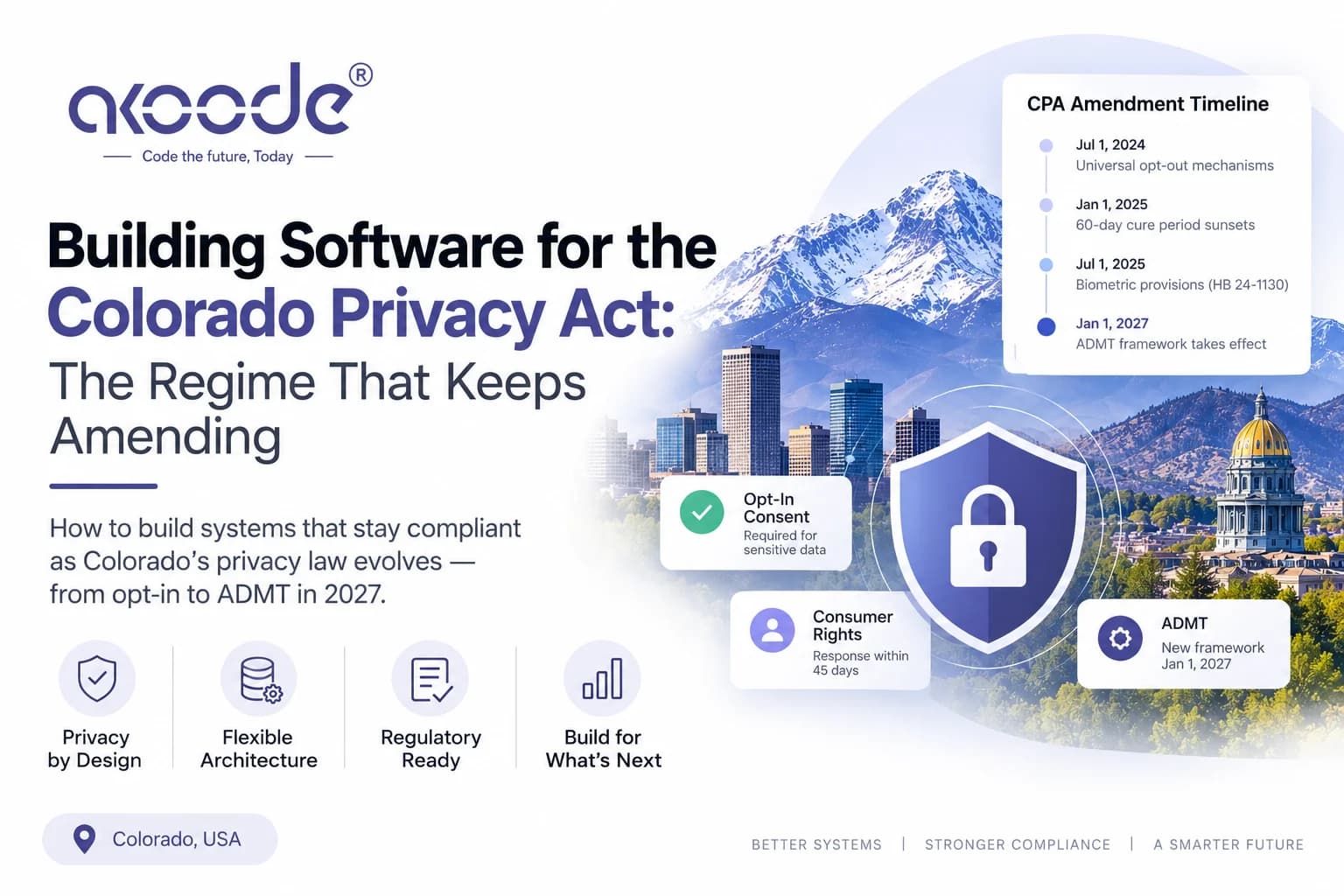
The Amendment Timeline {#timeline}
The sequence matters, because it reveals the direction of travel.
Effective | Change | Engineering impact |
|---|---|---|
July 1, 2024 | Universal opt-out mechanisms mandatory | Server-side signal handling; honoring Global Privacy Control |
January 1, 2025 | 60-day cure period sunsets | No remediation window; ship correct |
July 1, 2025 | Biometric provisions (HB 24-1130) | Opt-in consent for biometric identifiers; access rights over biometric processing |
October 1, 2025 | Minors provisions (SB 24-041) | DPIAs for minor-facing services; consent gates on targeted advertising, sale, profiling, and engagement-extending design features |
July 1, 2026 | Department of Law rule amendments | Updated UOOM technical specifications; clarified minor and geolocation requirements; finalized biometric provisions; AI-training disclosure in notices for minor-facing services |
August 12, 2026 | Precise geolocation as sensitive data (SB 25-276) | Location within roughly 1,850 feet now requires opt-in consent |
January 1, 2027 | Automated Decision-Making Technology law (SB 26-189) | Documentation, consumer notices, adverse-outcome explanations, retained compliance records, meaningful human review |
Read down that column and the pattern is unmistakable: the definition of what counts as sensitive keeps widening, and the obligations attached to automated processing keep deepening.
A team that architected against the 2023 version of this law and hasn't revisited it has now missed biometrics, minors, geolocation, and updated opt-out specifications — with ADMT arriving next.
Note on currency: Colorado's rulemaking is active and ongoing, and the Department of Law has established a process for issuing opinion letters providing further clarity. Verify current requirements before relying on any summary, including this one.
The Architecture Principle: Build for the Shape {#architecture-principle}
Here is the central engineering insight, and it applies well beyond Colorado.
Teams that encode the current letter of a privacy law into application logic pay again at every amendment. Teams that encode the shape of the regime absorb amendments as configuration.
What does building for the shape actually mean in practice?
A data classification layer, not scattered conditionals. Every field in your data model carries a classification — sensitive, personal, pseudonymous, non-personal — held in a central registry rather than inferred from field names. When Colorado added precise geolocation to the sensitive category in August 2026, teams with a classification layer changed one registry entry. Teams without one went looking for every place location data was touched.
Consent as a queryable state, not a boolean on a user record. What was consented to, for what purpose, when, through what mechanism, and is it still current? The 2023 version of the law needed less granularity than the 2026 version does. The 2027 version will need more.
Purpose-bound processing. Every processing operation declares its purpose and checks consent for that specific purpose before executing. This is more work upfront than a global permission check, and it is the only structure that survives a regime where new purposes acquire new consent requirements.
Decision logging separate from application logging. When an automated system makes a consequential determination about a person, that determination — inputs, logic version, output, and any human review — needs to be reconstructible later. Application logs rotate. Decision records need retention aligned to compliance requirements.
Configurable jurisdiction rules. Colorado, California, Texas, Connecticut, Virginia, and the EU do not agree with each other, and none of them are finished amending. A jurisdiction resolution layer that maps a consumer to an applicable rule set beats a codebase full of if (state === 'CO').
None of this is exotic engineering. It is ordinary good design, applied to a domain where teams routinely skip it because the first version of the requirement looked simple enough to hardcode.
Consent Architecture and the Moving Sensitive-Data Boundary {#consent}
The opt-in requirement for sensitive data is where most architectural pain concentrates, because the boundary of "sensitive" has moved twice and will likely move again.
Currently within the sensitive category: health data, racial or ethnic origin, religious beliefs, sexual orientation, citizenship status, biometric identifiers used for unique identification, children's data, and — as of August 2026 — precise geolocation.
The engineering consequences of opt-in rather than opt-out:
Collection must be gated, not filtered. A pipeline that ingests everything and applies preferences downstream fails an opt-in requirement, because the processing has already occurred. The gate belongs at the collection boundary.
Default state is no consent. Every new sensitive category added by amendment applies to data you're already collecting. If your architecture assumes prior collection was permitted, an expanded definition creates a live problem rather than a forward-looking one.
Consent must be specific and revocable. A single blanket acceptance does not satisfy a regime that distinguishes purposes. And revocation must propagate — including to downstream systems, caches, analytics warehouses, and any model trained on the data.
That last point is the hardest engineering problem in this space, and it deserves stating plainly: if sensitive data has been used to train or fine-tune a model, revocation raises genuinely difficult questions about what removal means. The defensible architectural posture is to keep sensitive data out of training pipelines by default and require an explicit, consented, documented exception — rather than discovering the question after the fact.
Practical pattern: treat consent as a service with an API, not as columns on a user table. Every processing operation queries it. Every grant and revocation is an event with a timestamp and a mechanism. This makes both compliance and auditability tractable, and it survives amendments that add categories.
Universal Opt-Out as an Engineering Requirement {#uoom}
Since July 2024, Colorado controllers must honor recognized universal opt-out mechanisms — browser and device signals through which a consumer communicates a blanket opt-out rather than interacting with each site individually. Global Privacy Control is the recognized example, and the Department of Law maintains the list of qualifying mechanisms. The July 2026 rule amendments updated the technical specifications.
What teams routinely get wrong:
Treating it as a frontend concern. A banner that reads the signal and suppresses a cookie is not compliance. The signal is an opt-out request that must propagate to your server-side processing, your data sharing arrangements, and your downstream systems.
Handling it only on first visit. The signal arrives with every request. Honoring it once and caching a preference misses the case where a consumer enables it later.
Not reconciling conflicts. A consumer with a universal opt-out signal who has previously granted a specific consent creates a conflict your system must resolve deliberately. Have a documented rule rather than whatever your code happens to do.
Not logging it. If you honored a signal and cannot demonstrate that you honored it, you are in the same position as not having honored it.
Not tracking specification updates. The technical specifications are maintained and revised. A signal handler written to a 2024 specification needs review against the current one.
The 45-Day Machine: Consumer Rights Workflows {#rights-workflows}
The CPA grants consumers rights of access, correction, deletion, and portability — and attaches operational timelines that are, in engineering terms, a service level agreement with a regulator.
Verified requests must be answered within 45 days, with one 45-day extension permitted where notice is given. Denied requests require a documented internal appeals process with its own 45-day response window. A privacy officer or point of contact must be designated for AG inquiries. And records of requests and responses must be retained for at least 24 months.
What this means architecturally — and it is more than a support inbox:
Identity resolution across systems. A deletion request means deleting that person everywhere: primary database, replicas, backups, analytics warehouse, CRM, support platform, log archives, and any third party you've shared with. If you cannot enumerate where a person's data lives, you cannot fulfill the request within 45 days.
Verification without over-collection. You must verify the requester's identity without collecting more personal data than necessary to do so — a genuine design tension.
Portability in a usable format. Structured, commonly used, machine-readable. Not a PDF of a screenshot.
Correction propagation. A correction that fixes the primary record but leaves a stale copy in a downstream system hasn't been fulfilled.
Appeals as a first-class workflow. With its own timer, its own record, and its own retention.
The design principle: build the rights workflow as a system with automated fulfillment paths and an audit trail, not as a manual process someone performs. At any meaningful volume, manual fulfillment misses timelines — and a missed timeline is a documented violation in a regime with no cure period.
Minors: The Provision That Expands Your Scope Quietly {#minors}
The minors amendment that took effect in October 2025 is the provision most likely to apply to a team that assumed it didn't.
A minor is anyone under 18 — not under 13. That is a substantially wider population than teams accustomed to children's privacy frameworks typically design for. For those under 13, consent comes from a parent or guardian; those aged 13 to 17 may consent directly.
Crucially, the framework does not require you to implement age-verification systems. It attaches obligations once a knowledge threshold is met. Which produces an uncomfortable but important engineering reality: what your system knows or reasonably should know matters, and building deliberate ignorance is not a strategy.
Once that threshold is met, obligations include exercising reasonable care to avoid heightened harm, conducting data protection assessments of processing that may affect minors, and obtaining consent before targeted advertising to minors, selling their data, profiling them, or using design features intended to significantly extend their use of the service.
That last clause deserves engineering attention. Infinite scroll. Autoplay. Streak mechanics. Variable-reward notifications. Engagement optimization loops. These are standard product patterns, and in a minor-facing service they now sit inside a consent requirement.
And the July 2026 rule amendments added a notably forward-looking obligation: notices must disclose the use of personal data to train AI models for services that might reasonably be considered minor-facing. If you are fine-tuning on user interaction data and any meaningful portion of your users are under 18, that disclosure obligation likely reaches you.
ADMT: What January 1, 2027 Actually Requires {#admt}
This is the change with the largest gap between how much attention it has received and how much engineering work it implies.
Colorado's 2024 high-risk AI framework was replaced by an Automated Decision-Making Technology law, signed in May 2026 and effective January 1, 2027. As of this writing, that is roughly four months away.
Reported obligations for developers and deployers of covered ADMT include:
Documentation of the system, its purpose, and its operation
Consumer notices disclosing that automated decision-making is in use
Post-adverse-outcome explanations — where a decision goes against a consumer, an explanation of why
Compliance records retained for three years
Meaningful human review workflows
Each of these is an architecture requirement, not a policy document.
"Documentation of the system" means versioned model and logic records. Which model version, trained on what, with what parameters, deployed when. If you cannot say which version of your system made a decision six months ago, you cannot document it.
"Consumer notices" means the decision path is known at design time. You cannot disclose automated decision-making you haven't inventoried. Many organizations will discover during preparation that more of their stack makes consequential automated determinations than anyone had catalogued.
"Post-adverse-outcome explanations" is the hardest requirement, and it should influence model selection directly. If a consumer is declined, deprioritized, or otherwise adversely affected, you need to explain why — in terms a person can understand. A model that produces a score without attributable reasoning makes this obligation difficult to satisfy. This is a strong architectural argument for interpretable models, or for explanation layers, in any decision path with consumer consequences.
"Three-year compliance records" means decision logging with real retention. Inputs, outputs, logic version, timestamp, and human review status — retained separately from application logs that rotate on a much shorter cycle. This is a storage and schema decision, and it is far cheaper made now than backfilled.
"Meaningful human review" is the requirement most likely to be implemented badly. A human who rubber-stamps a queue of algorithmic outputs is not meaningful review, and an interface designed for throughput will produce exactly that. Meaningful review means the reviewer sees the reasoning, has genuine authority to override, has time to exercise it, and leaves a record of the decision. That is a UX and workflow design problem as much as a compliance one.
What to do in the remaining window:
Inventory every automated decision your systems make about people. This alone usually surprises teams.
Classify by consequence. Which decisions adversely affect someone?
Assess explainability for each consequential path. Where explanation is currently impossible, that's your architecture backlog.
Design the decision log schema now — retention, fields, separation from application logs.
Design the human review workflow as a real interface, not a queue.
Confirm current requirements with counsel, because rulemaking under this framework is likely to continue.
Where Teams Consistently Get It Wrong {#failure-patterns}
1. Encoding the current law rather than the regime's shape. Guarantees rework at every amendment — and Colorado amends.
2. Treating opt-in as opt-out with different wording. A pipeline that collects then filters fails an opt-in requirement structurally, not cosmetically.
3. Handling universal opt-out signals only in the browser. The signal must reach server-side processing and data sharing.
4. Manual rights-request fulfillment. Works at ten requests a month, fails at a hundred — and there is no cure period for a missed timeline.
5. Assuming the minors provisions don't apply because the product isn't aimed at children. The threshold is under 18, and it attaches on knowledge rather than intent.
6. Deferring ADMT preparation until December 2026. Decision inventory and explainability assessment are discovery work with unpredictable findings. Starting late means discovering an unexplainable decision path with weeks to remediate.
7. Sensitive data in training pipelines by default. Creates a revocation problem with no clean answer. Exclude by default; permit by documented exception.
A Case Study in Density: Denver {#denver}
Colorado's regime affects any business processing the data of Colorado residents, wherever it operates. But the market where teams live with it daily is Denver — and the way that market has adapted is instructive.
Denver's economy concentrates two kinds of work that both reward the same discipline. The metro anchors one of the country's densest aerospace corridors, where federal contract documentation standards demand a defensible trail of who decided what and when. And its fintech and healthtech sectors operate under the CPA, which demands functionally the same artifact for a different reviewer.
The result is a local engineering culture where documentation is treated as a deliverable rather than a byproduct— and, as we found analysing compensation data in our Denver software development cost guide, a labor market with an unusual signature: general developers earning slightly below the national average while senior engineers earn slightly above it.
That inversion is the market pricing exactly this capability. Architecting against a regime that keeps amending is senior work. Junior engineers implement patterns; senior engineers decide which patterns the next amendment will still permit.
For organizations building under Colorado's framework, our software development company in Denver practice works with aerospace-adjacent, fintech, and healthtech clients on exactly these constraints — with consent architecture, decision logging, and compliance documentation designed in from sprint one rather than assembled before a review.
How to Evaluate an Engineering Partner {#evaluating}
Seven questions that distinguish teams who have shipped under this regime from teams who have read about it.
1. "How would you structure our consent model so a new sensitive-data category doesn't require rework?"
The answer should describe a data classification layer and purpose-bound processing. A vendor who describes adding a checkbox has not thought about amendments.
2. "Where does the universal opt-out signal reach in your architecture?"
If the answer stops at the browser, keep interviewing.
3. "How would you fulfil a deletion request across our whole estate within 45 days?"
The answer requires identity resolution across systems, including backups, analytics, and third parties. Vagueness here means manual fulfillment.
4. "Walk me through your ADMT readiness approach."
Decision inventory, consequence classification, explainability assessment, decision log schema, human review workflow. A pause means they haven't started thinking about January 2027.
5. "How do you keep sensitive data out of training pipelines, and what happens on revocation?"
Exclusion by default with documented exceptions is the defensible answer.
6. "What documentation will exist at handover, and when is it written?"
Written as decisions are made, or assembled before a review? Reviewers can tell.
7. "What would make you tell us not to build this feature?"
A partner who has declined an engagement-extending design pattern for a minor-facing service is demonstrating exactly the judgment you're buying.
Red flags: compliance discussed as a phase near launch; "we're CPA compliant" stated as a company property rather than a system characteristic; no question about which consumer populations you touch; no decision logging in a proposal for a system that makes automated determinations; documentation deferred to a pre-review sprint.
Key Takeaways {#takeaways}
Colorado is an amending regime, not a static one. Three legislative amendments and new implementing rules since 2024, with an ADMT framework effective January 1, 2027.
Build for the shape, not the letter. A data classification layer, consent as a queryable service, purpose-bound processing, and separated decision logging absorb amendments as configuration.
Opt-in is structurally different from opt-out. Collection must be gated rather than filtered, and every expanded sensitive category applies to data you already hold.
Universal opt-out is a server-side requirement. Browser-level handling isn't compliance, and the technical specifications get revised.
Consumer rights are an SLA with a regulator — 45 days, documented appeals, 24-month retention, and no cure period since January 2025.
The minors provisions reach further than teams expect — under 18, attaching on knowledge rather than intent, and covering engagement-extending design patterns.
ADMT preparation is discovery work. Inventory automated decisions, classify by consequence, assess explainability, design decision logging and meaningful human review. Starting in December leaves no room for what you find.
Frequently Asked Questions {#faqs}
What is the Colorado Privacy Act and who does it apply to?
The CPA is one of the first comprehensive US state data privacy laws, applying to controllers conducting business in Colorado or targeting products and services to Colorado residents, subject to processing thresholds that vary by provision. Some amendments — notably certain minor protections — apply without those general thresholds. It grants consumers access, correction, deletion, portability, and opt-out rights, and requires opt-in consent before processing sensitive data.
How is the Colorado Privacy Act different from California's law?
The most consequential engineering difference is the consent model: Colorado requires affirmative opt-in before processing sensitive data, while California's framework generally permits processing unless a consumer opts out. Colorado also has detailed Attorney General-issued implementing rules and a mandatory universal opt-out mechanism list. Enforcement runs through the AG and district attorneys with no private right of action.
What counts as sensitive data under the CPA?
Health data, racial or ethnic origin, religious beliefs, sexual orientation, citizenship status, biometric identifiers used for unique identification, children's data, and — as of August 12, 2026 — precise geolocation within roughly 1,850 feet. All require affirmative opt-in consent before processing. The category has expanded twice through amendment, which is why a data classification layer beats hardcoded conditionals.
What is the Colorado ADMT law and when does it take effect?
Colorado's Automated Decision-Making Technology law, signed in May 2026, replaced the state's 2024 high-risk AI framework and is set to take effect January 1, 2027. Reported obligations for developers and deployers include system documentation, consumer notices about automated decision-making, explanations following adverse outcomes, compliance records retained for three years, and meaningful human review workflows. Rulemaking may continue, so verify current requirements.
How do I prepare my software for the ADMT requirements?
Inventory every automated decision your systems make about people — this usually surprises teams. Classify those decisions by consequence. Assess explainability for each consequential path, since adverse-outcome explanations are difficult with models that produce scores without attributable reasoning. Design a decision log schema with three-year retention, separate from rotating application logs. And design meaningful human review as a genuine interface with override authority, not a rubber-stamp queue.
What does honoring universal opt-out mechanisms actually require?
Since July 2024, controllers must honor recognized universal opt-out signals such as Global Privacy Control. Engineering-wise, the signal must propagate to server-side processing and data sharing arrangements — not merely suppress a cookie in the browser. It arrives with every request rather than only on first visit, conflicts with prior specific consents need a documented resolution rule, and honoring it must be logged. Technical specifications are maintained and were updated in the July 2026 rule amendments.
What are the CPA consumer rights response timelines?
Verified requests must be answered within 45 days, with one 45-day extension permitted where notice is given. Denied requests require a documented internal appeals process with its own 45-day response window. Records of requests and responses must be retained for at least 24 months, and a privacy officer or point of contact must be designated for Attorney General inquiries.
Do the Colorado minors provisions apply to my product?
Possibly, even if it isn't aimed at children. A minor is anyone under 18, and obligations attach once a knowledge threshold is met rather than requiring intent to target minors. Age-verification systems are not required. Once obligations attach, they include data protection assessments, and consent before targeted advertising, data sale, profiling, or using design features intended to significantly extend a minor's use of the service — which reaches common engagement patterns like streaks and autoplay.
What are the penalties for a Colorado Privacy Act violation?
Violations are treated as deceptive trade practices under the Colorado Consumer Protection Act, with reported civil penalties up to $20,000 per violation — higher than most comparable state laws. Enforcement is by the Attorney General and district attorneys; there is no private right of action. Notably, the 60-day cure period sunsetted on January 1, 2025, so there is no longer a remediation window before enforcement.
Can we train AI models on data covered by the CPA?
It depends heavily on the data category, purpose, and consent obtained — and it creates a difficult revocation problem, since removing an individual's contribution from a trained model is not straightforward. The defensible architectural posture is to exclude sensitive data from training pipelines by default and permit exceptions only with documented, specific consent. Note also that the July 2026 rule amendments added disclosure obligations regarding AI training on personal data for services that might reasonably be considered minor-facing.
How much does CPA compliance add to a software build?
Typically 15–25% above an equivalent unregulated build, covering consent architecture, sensitive-data gating, universal opt-out handling, consumer rights workflows with automated fulfillment paths, data protection assessments, decision logging, and documentation. Designed in from sprint one it's a line item; retrofitted after a compliance question it's re-architecture. Our Denver cost guide breaks down where that premium goes.
Does the CPA apply to businesses outside Colorado?
Yes — it applies based on whether you conduct business in Colorado or target products and services to Colorado residents, not on where your company is headquartered. A company with no Colorado presence that markets to Colorado consumers can be in scope. This is why Colorado's framework matters well beyond Denver, and why it functions as a bellwether other states watch.
The Bottom Line
The instinct most engineering teams bring to privacy compliance is to treat it as a requirement to satisfy — a list to work through before a launch, ideally once.
Colorado has spent two and a half years demonstrating why that instinct fails. Biometrics, minors, geolocation, updated opt-out specifications, and now automated decision-making — each arriving after teams had already declared themselves compliant with the previous version.
The teams handling this well made a different bet early: that the regime would keep moving, and that the right response was structural. A classification layer instead of scattered conditionals. Consent as a service instead of a column. Decision logging instead of hoping nobody asks. Documentation written when the decision was fresh.
They pay a modest premium at build time and absorb each amendment as configuration. Everyone else pays a rework tax roughly every nine months, with no cure period to fall back on.
With ADMT arriving January 1, 2027, the next amendment is already on the calendar. The inventory work it requires — cataloguing every automated decision your systems make about people — is the kind of discovery that tends to surface surprises. That argues for starting it now rather than in December.
Book a free consultation → calendly.com/akhil-akoode/ak
A senior engineer reviews every inbound project — not an account manager. We'll look at where your consent architecture sits today, what your automated decision inventory actually contains, and what the January deadline realistically requires.
Explore: AI development services | SaaS product development | finance and banking | healthcare | software development company in Denver | case studies
About the Author
Tejveer is Sr Engineer at Akoode Technologies, a software development and AI company serving clients across the USA, UK, and India. Akoode has delivered 180+ projects across 15+ industries, including regulated healthcare platforms, consumer data systems, and applied AI with human-review workflows, with 97% client retention.
This guide reflects the Colorado Privacy Act and its amendments as published by the Colorado General Assembly and the Colorado Attorney General's office, current as of August 2026. Colorado rulemaking is active and ongoing. This is engineering guidance, not legal advice — validate your specific obligations with qualified counsel.
Get In Touch Now
View More Our Blog