


 July 10, 2026
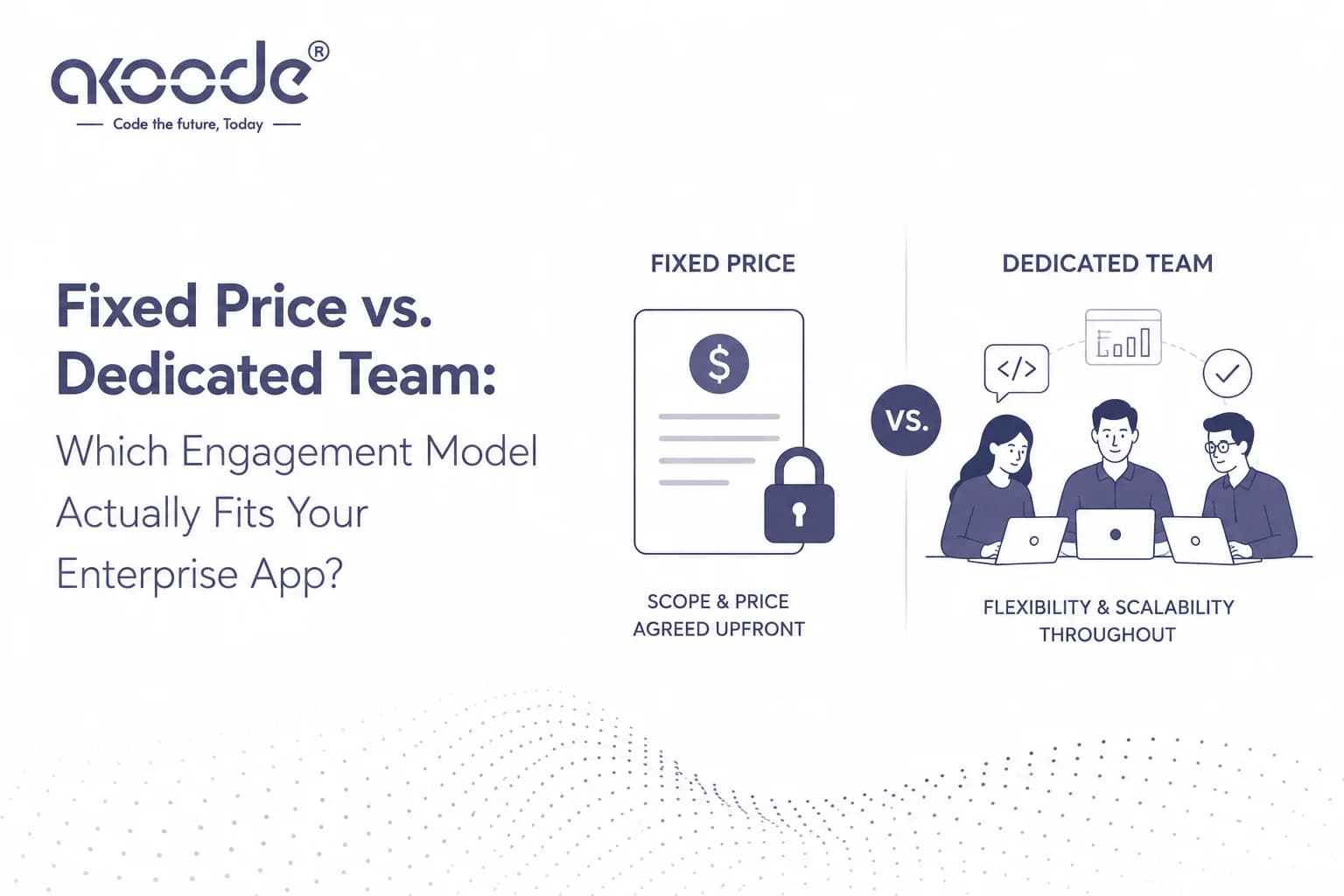
Fixed Price vs. Dedicated Team: Which Engagement Model Actually Fits Your Enterprise App?
Here is the short answer: if you know exactly what you want to build and that won't change, fixed price gives you a locked budget. If your product will evolve as you build it — and most enterprise products do — a dedicated team gives you the flexibility to adapt without paying for it every single time.
Everything else in this article is helping you figure out which side of that line you're on.
Why This Decision Gets Underestimated
When most companies start evaluating software development partners, they focus on technology stack, team experience, and price. The engagement model — how you actually structure the working relationship — tends to get discussed late, often after the vendor has already shaped the conversation toward what they prefer to sell.
That's backwards.
The engagement model determines how change gets handled, who absorbs risk, and how much energy you'll spend on commercial negotiations versus actually building your product. Getting it wrong doesn't show up immediately. It shows up three months in, when your requirements have shifted and you're suddenly negotiating a change order instead of shipping a feature.
Fixed Price: The Honest Picture
What It Is
You agree on exactly what gets built, what it costs, and when it will be delivered — before a single line of code is written. The development company commits to that scope and price. If you want something different later, you submit a change request. That change request has its own cost and its own timeline.
Think of it like a building contractor. You agree on the blueprint. Changing the blueprint after construction has started costs extra.
When It Actually Makes Sense
Fixed price works well in a narrow set of circumstances that are worth being honest about:
Your requirements are fully documented, reviewed, and signed off before development starts
The project is relatively short — typically under 10–12 weeks
The technology involved is well understood by both sides
You're building something with a known pattern — a v2.0 of an existing product, a compliance tool with locked regulatory specifications, a customer portal replacing a legacy system with defined functionality
If you can tick all of those honestly, fixed price is a reasonable choice.
The Real Pros
Budget certainty. Finance teams love this. You can get a project approved with a single number and no contingency conversation.
Clear accountability. The vendor owns delivery risk within the agreed scope. If they underestimate the work, that's their problem to solve, not yours.
Lower day-to-day management. You define the output upfront, then largely step back during delivery. That suits organisations without a dedicated product manager to stay actively involved.
Procurement-friendly. Fixed-price contracts are easier to push through formal approval processes. One number, one sign-off.
The Real Cons
Scope definition becomes expensive before you've even started. Writing a specification detailed enough to hold a fixed-price contract together takes real time and skill. Miss something — and you will miss something — and it becomes a change order later, when you have less leverage.
You're paying a risk premium. Vendors price uncertainty into fixed-price contracts. That premium typically runs 15–25% above what the same work would cost on a time-and-materials or dedicated team basis. You're not just buying certainty — you're paying for it.
Change is slow and expensive. Every modification goes through a formal process. In practice, this means some changes get deferred, some get dropped, and some get quietly worked around. None of those outcomes are good for the product.
Vendors deliver the spec, not the vision. This is the subtle one. A fixed-price contract incentivises the development company to build exactly what was written, not necessarily what you actually needed. That gap between the spec and the intent shows up at user acceptance testing, and by then you're close enough to delivery that fixing it properly feels too costly.
Dedicated Team: The Honest Picture
What It Is — And What It Isn't
A dedicated team is a group of engineers — typically a mix of frontend and backend developers, a QA engineer, and a technical lead — who work exclusively on your product. You pay a monthly rate based on team size and seniority. The team works within your processes, attends your standups, uses your project management tools, and operates on your sprint cycle.
Here's the part that gets undersold: a good dedicated team isn't hired help you point at a task list. They become part of your engineering culture. They care about your product architecture, flag problems they see coming, push back on decisions that will create technical debt, and build institutional knowledge about your system that compounds over time.
The difference between a dedicated team that feels like an extension of your company and one that feels like a vendor is almost entirely about how the engagement is structured and how the development partner approaches it. At Akoode Technologies, we onboard dedicated teams with the same culture alignment conversations we'd have for an internal hire — because that's the relationship that actually produces good software.
When It Makes Sense
Dedicated team is the right model when:
Your product requirements will evolve as you build and test — which is true of most serious enterprise apps
The project runs longer than 3–4 months
You have complex integrations where the full picture only becomes clear during development
You want the team to build genuine knowledge of your product over time, not hand over a codebase at the end
You need to scale the team up or down as different phases of the product require different skills
The Real Pros
Flexibility without friction. Priorities shift between sprints with no commercial process involved. You changed your mind about a feature? Fine. You want to reprioritise next sprint? Done. No change order, no negotiation, no delay.
The team gets smarter about your product over time. This is underrated. Engineers who have spent six months on your codebase make better decisions than engineers who just arrived. They know where the bodies are buried, which shortcuts cause problems later, and which parts of the system are most fragile. That knowledge is genuinely valuable and it doesn't show up on any invoice.
You're not paying a risk premium. The monthly rate reflects actual work. There's no contingency baked in for uncertainty that may never materialise.
Iteration speed increases after onboarding. Once the team knows your product, shipping new features gets faster — not slower — as time goes on. The opposite is usually true with fixed-price projects, where each new engagement resets the learning curve.
They become invested in outcomes, not just outputs. A dedicated team that has been working on your product for a year has opinions about it. They'll tell you when a feature is a bad idea. They'll surface problems you haven't noticed. That's not a nuisance — it's the difference between a vendor and a partner.
The Real Cons
Total cost depends on duration and scope — both of which can grow. Monthly costs are predictable. Total project cost is not. Without internal discipline about what you're building and why, scope can expand in ways that are individually reasonable but collectively expensive.
You need to show up as a product owner. The dedicated team builds what you direct them to build. If your priorities are unclear, or if the person responsible for product decisions is unavailable, the team slows down. This model requires genuine engagement from your side, not just sign-off at milestones.
Onboarding takes a few weeks. A new dedicated team won't hit full speed on day one. Expect 2–3 weeks before they're fully operational on your codebase. This is normal and manageable — but it's worth planning for.
The Comparison Matrix
Factor | Fixed Price | Dedicated Team |
|---|---|---|
Scope Flexibility | Low — changes need formal approval | High — priorities shift between sprints |
Risk Allocation | Vendor carries delivery risk | Client owns scope and direction |
Budget Predictability | Total cost fixed upfront | Monthly cost fixed, total cost varies |
Management Overhead | Lower during delivery | Requires active product ownership |
Speed to Market | Fast for locked scope | Faster for evolving products post-onboarding |
Best Project Duration | Under 12 weeks | 3 months to multi-year |
Cost of Change | High — formal change orders | Low — handled within normal sprint cycle |
Knowledge Retention | Low — ends at project close | High — compounds over the engagement |
Team Feel | External vendor | Extension of your engineering team |
Vendor Risk Premium | Built into contract price | Not applicable |
The Hybrid Model: What Most Enterprise Companies Actually End Up Doing
Here's something worth knowing: the fixed price vs. dedicated team question isn't always either/or. For complex enterprise builds, the most effective structure usually combines both — in sequence.
Phase 1: Fixed-Price Discovery
Before any development starts, you run a structured discovery engagement. This is fixed price because the deliverables are clearly defined — you're not building the product yet, you're building the foundation for building the product.
A typical discovery phase runs 3–6 weeks and costs $8,000–$20,000 depending on complexity. What it produces:
Detailed functional specifications
Technical architecture design
Data model and integration mapping
UI/UX wireframes validated with actual users where possible
A phased development roadmap
An effort estimate for the build phase that's grounded in evidence, not optimism
Phase 2: Dedicated Team Build
With a properly scoped specification in hand, you transition to a dedicated team for development. The discovery output gives them a clear starting point. The dedicated model gives you the flexibility to incorporate what you learn during development — because you will learn things during development.
This structure gives you budget certainty where certainty is actually achievable, and flexibility where flexibility is actually needed.
Why Skipping Discovery Is Usually a Mistake
The most common cause of enterprise software projects running significantly over budget isn't poor engineering. It's insufficient scoping before development starts. When requirements aren't properly defined upfront, sprint planning is imprecise, integration dependencies surface late, and every week someone is making an assumption that will need to be undone later.
The discovery investment — $10,000–$20,000 for a complex product — typically returns its cost many times over in reduced rework and more accurate project planning. It's not overhead. It's the thing that makes the rest of the project work.
A Simple Framework for Making the Decision
Answer these four questions before choosing a model:
1. How solid are your requirements right now?
If you can document every feature, integration, and edge case before development starts — and you're confident that won't change — fixed price is viable. If you have a clear product vision but expect requirements to sharpen as you build, dedicated team is the right call.
2. How long is your project?
Under 10 weeks with stable requirements: fixed price. Over 3 months with evolving complexity: dedicated team. In between: run a fixed-price discovery to find out.
3. Can someone on your team actively engage with the development process?
Dedicated teams need a product owner on the client side. If your team doesn't have that capacity right now, fixed price reduces the management burden — at the cost of flexibility.
4. What does a wrong decision cost you?
In a short, well-defined project, a wrong turn is recoverable. In a 12-month enterprise build, an architectural decision made on incorrect assumptions in month two can cost months of rework in month eight. Dedicated teams surface and fix these issues faster because the relationship supports honest, ongoing communication.
Quick Decision Checklist
Fixed price is probably right if:
Requirements are fully documented and signed off before you start
Project duration is under 12 weeks
Technology stack is established and well understood
Internal management bandwidth is limited right now
You're building something with a known pattern
Dedicated team is probably right if:
Requirements will evolve through building and testing
Project spans 3 months or more
Integration complexity is high or partially unknown
You want knowledge continuity past the initial delivery
Iteration speed matters more than total cost predictability
Hybrid model is probably right if:
You need requirements clarity before committing to a build budget
The product is large enough to justify discovery investment
Stakeholders need a credible budget estimate before full approval
You want the benefits of both models without the downsides of choosing one blindly
Frequently Asked Questions
Can I switch models mid-project if things change?
Yes, but it takes time and a contract renegotiation. The cleaner path is to structure the engagement properly from the start. A fixed-price discovery followed by a dedicated team build is specifically designed to give you structure early and flexibility later — without the disruption of switching models mid-flight.
Is a dedicated team more expensive overall?
Often less expensive, actually. Fixed-price contracts include a risk premium of roughly 15–25% to account for uncertainty. That premium is built into the quote whether the risk materialises or not. For longer projects with evolving requirements, accumulated change orders on fixed-price contracts frequently exceed what a dedicated team would have cost for the same scope.
How do I keep a dedicated team aligned with our culture, not just our tasks?
This starts at onboarding. Share your product principles, your technical standards, your definition of done, and your communication norms from day one — exactly as you would with an internal hire. At Akoode Technologies, dedicated teams go through a culture and context onboarding before touching the codebase. The goal is for the team to understand why you're building what you're building, not just what to build next.
What if my requirements aren't clear enough for either model?
That's the right time for a discovery phase, not a development contract. Trying to start a fixed-price project with fuzzy requirements produces expensive change orders. Trying to start a dedicated team engagement without direction produces slow, unfocused sprints. Discovery is the answer when you're not sure what you're building yet.
How big should a dedicated team be for an enterprise app?
For most enterprise projects, 3–5 people is a productive starting point: a technical lead, 2–3 developers at varying seniority, and a QA engineer. Some projects start leaner during architecture and scale up for feature development. The right answer depends on your target timeline and the complexity of your integrations, not a standard template.
How do I manage a dedicated team without deep technical experience?
The technical lead on the dedicated team handles day-to-day engineering decisions. Your job is product direction — setting priorities, validating that what gets built matches what you actually need, and making decisions when trade-offs come up. A well-run dedicated engagement from a partner like Akoode Technologies includes regular sprint reviews and clear progress reporting designed for non-technical product owners, not just engineers.
Working With Akoode Technologies
There's no engagement model that's right for every project. The right one depends on your requirements clarity, project duration, integration complexity, and what your internal team can realistically commit to.
Akoode Technologies works with enterprise clients across healthcare, SaaS, fintech, real estate, and e-commerce on both fixed-price and dedicated team engagements — and frequently on the hybrid structure for complex multi-phase builds. Our custom software development and dedicated engineering teams are set up to operate as genuine extensions of your product organisation, not external vendors executing a brief.
When we talk to a new client, the first conversation is always about your project — your current requirements maturity, your internal team's capacity, and your honest timeline expectations. From that conversation we can recommend a structure that actually fits, and explain clearly why.
That conversation takes about 45 minutes and costs nothing.
Book a free consultation → calendly.com/akhil-akoode/ak
Or explore our work and client case studies at akoode.com.
Get In Touch Now
View More Our Blog