


 July 27, 2026
AI in eCommerce 2026: What's Actually Working — and Why Most Retailers Are Stuck
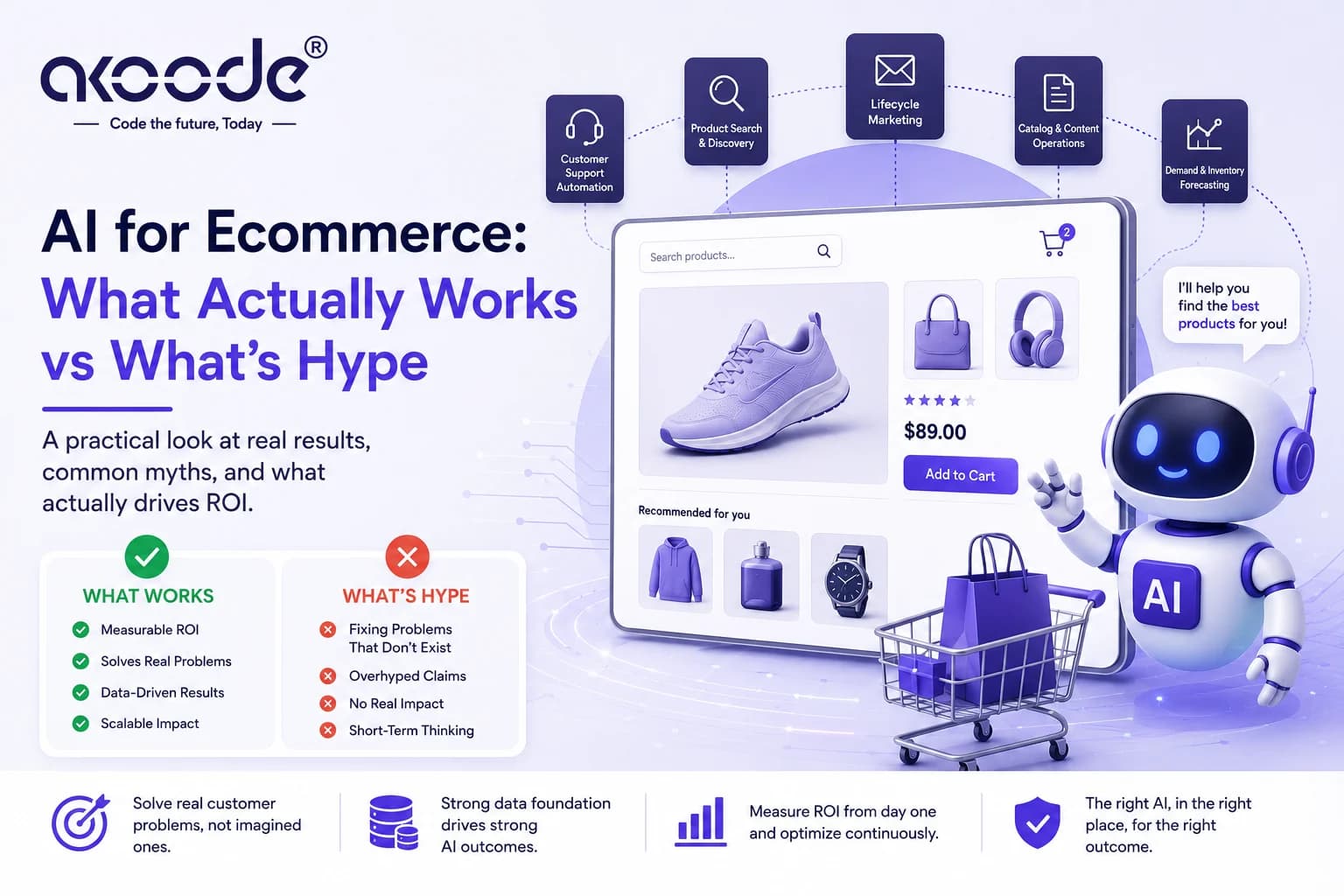
There's a statistic that explains the entire state of AI in eCommerce right now, and it isn't a growth number.
89% of retailers have adopted AI. Only about 7% have reached fully scaled deployment.
Read that again, because it's the whole story. Nearly every online retailer has done something with AI — a chatbot pilot, a product description generator, a recommendation experiment. Almost none have gotten it into the bloodstream of their operation, where it compounds. The gap between those two states is where 2026's competitive advantage lives, and it's not a technology gap. It's an engineering and data gap.
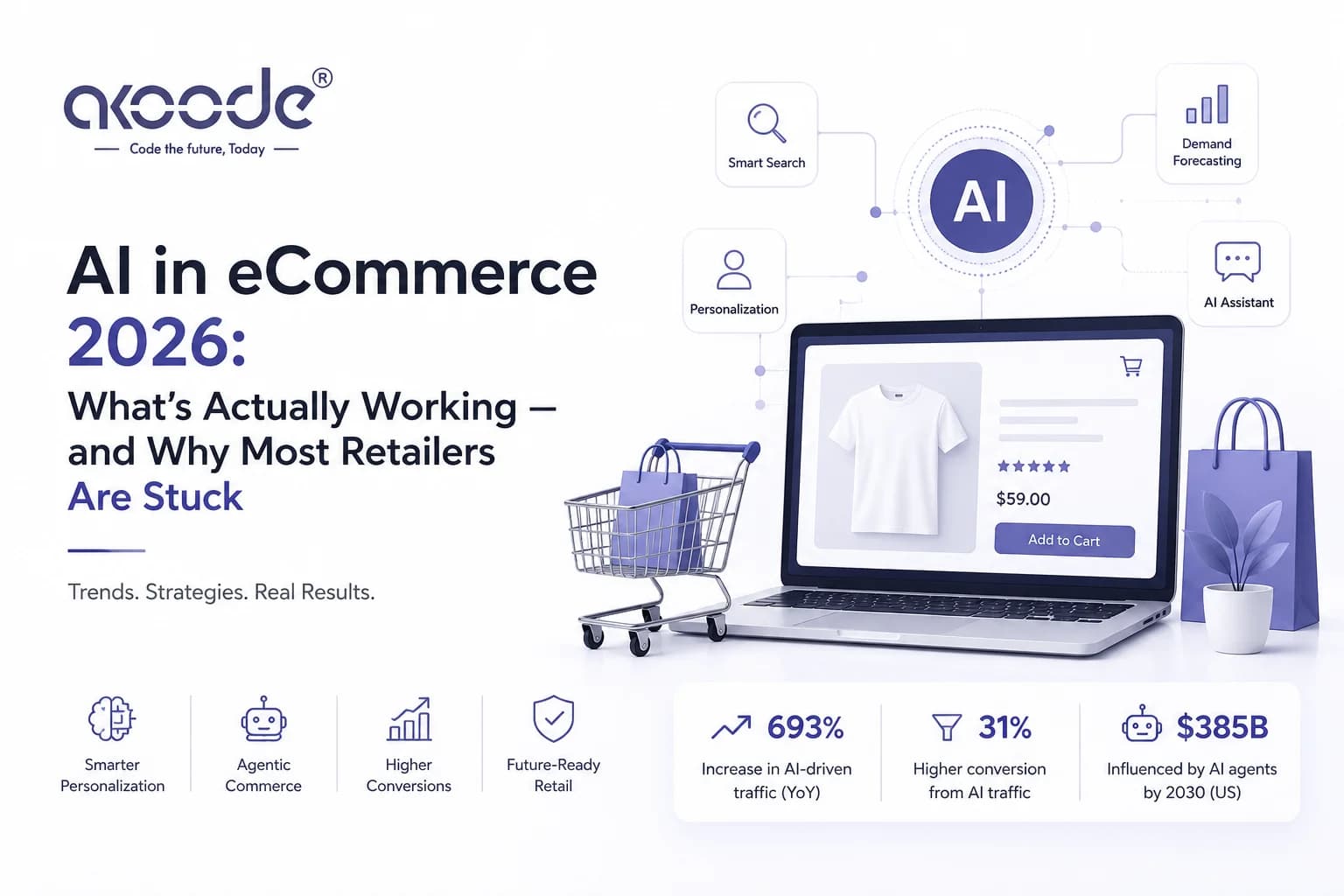
Meanwhile, the ground is moving underneath everyone. Traffic from generative AI sources to retail sites surged 693% year over year during the 2025 holiday season — and that traffic converted 31% higher than other sources. Consumers are increasingly starting product research inside AI assistants rather than search engines. And a new commerce layer is being built where the shopper is sometimes a machine: Morgan Stanley and Shopify project roughly a third of online retailers will use advanced AI agents by 2028, up from under 1% today, potentially influencing $385 billion in US eCommerce by 2030.
This guide is about closing the gap. What's genuinely working in eCommerce AI in 2026 — with real numbers. What agentic commerce actually requires of your infrastructure. What it costs to build. What to do first. And how to tell a vendor who ships production systems from one selling you a demo.
The Maturity Gap: Why Most eCommerce AI Stalls {#maturity-gap}
The 89%-adopted / 7%-scaled split isn't a story about lazy retailers. It's a story about what pilots hide.
A pilot runs on curated data, a friendly test group, and a champion's enthusiasm. Production runs on your actual catalog — with its missing attributes, its inconsistent naming, its 40,000 SKUs where 6,000 have no proper category. Production runs on your real customer service volume, including the 11% of conversations that don't fit any template. Production runs for eighteen months while models drift, your assortment changes, and nobody's watching the accuracy.
The stall points are consistent across the retailers we've worked with and the research we track:
The catalog wasn't ready. This is the single biggest killer. AI-driven personalization, search, and agent discoverability all depend on structured, complete, consistent product data. Most catalogs are none of those things. A recommendation engine trained on a catalog where "colour," "color," and "shade" are three different fields will produce confident nonsense.
Nobody owned accuracy. Without an evaluation framework — a set of test cases with known-correct answers, measured before every release — the go/no-go decision comes down to anecdotes. One bad screenshot in an executive Slack channel ends a program.
The economics were never modeled past the pilot. Model API costs scale with traffic. A system that costs $400/month in testing can cost $14,000/month at Black Friday volume. That surprise kills more projects than accuracy problems do.
The system was built to launch, not to live. No monitoring, no drift detection, no retraining cadence. Performance decays quietly until a customer notices publicly.
The pattern: retailers who scaled AI didn't start with better models. They started with better data, an owner accountable for accuracy, and honest production economics.
The Agentic Commerce Shift {#agentic-commerce}
The biggest structural change in eCommerce since mobile is happening right now, and most retailers are watching it as a headline rather than an architecture problem.
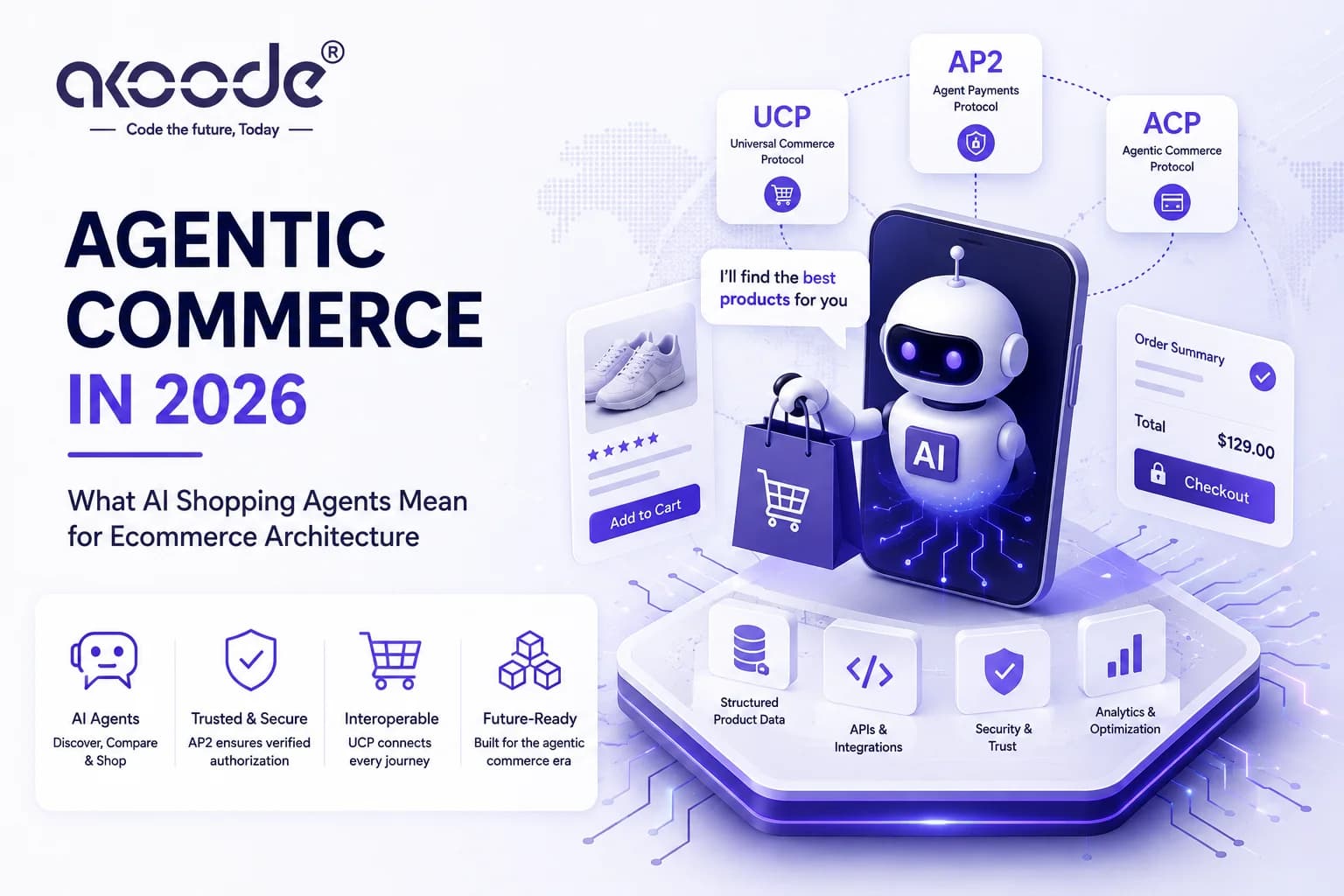
Agentic commerce means AI agents — operating on behalf of shoppers — discovering products, comparing options, and increasingly completing transactions. The infrastructure is being formalized fast: the Agentic Commerce Protocol, backed by Stripe and OpenAI, alongside parallel efforts from Shopify and Google, is standardizing how agents read catalogs and execute purchases. Gartner projects 40% of enterprise applications will embed AI agents by 2026.
The projections are large enough to be worth taking seriously even if you discount them heavily: McKinsey estimates agentic AI could mediate up to $1 trillion in US retail revenue by 2030, with global figures reaching $3–5 trillion. About 63% of retailers already believe non-adopters will fall behind within two years.
Here's what actually matters for your business, stripped of the futurism:
In agentic commerce, your customer is a machine — and machines can't infer
A human shopper looking at a product page with a missing "material" field will figure it out from the photo. An AI agent filtering for "cotton, machine washable, under $60" will simply exclude your product from consideration. Not rank it lower. Exclude it.
This is why the emerging concept of a machine-readable commerce layer matters more than any single AI feature:
Product, pricing, and inventory data exposed via clean, consistent APIs
Complete and consistent attributes across the entire catalog — not just the hero SKUs
Real-time availability that agents can trust
Structured data that survives being consumed without a human interpreting the page
The measurement problem nobody warns you about
In traditional eCommerce you see everything: impressions, dwell time, add-to-cart, funnel drop-offs. In agentic commerce, an agent may evaluate your catalog and reject it without generating a single signal you can observe. You lose the visibility you've spent fifteen years optimizing against.
Retailers who invest early in agent-aware analytics — measuring what agents request, what they surface, and where they abandon — will be operating with sight. The rest will be guessing.
The near-term reality check
Consumer demand is real but conversion currently lags, precisely because merchant infrastructure wasn't built for agents. That gap is the opportunity. The retailers closing it in 2026 aren't building an "agentic strategy." They're doing catalog hygiene, attribute completion, and API work — the unglamorous foundation everything else sits on.
What's Actually Working: Nine Use Cases With Real Numbers {#use-cases}
Setting aside the futurism, here's what's genuinely producing measurable results for retailers today.
1. Hyper-Personalization and Recommendations
The most proven category. Early adopters leading in AI-driven personalization generate roughly 40% higher revenuethan non-adopters, according to Stord's 2026 research. Modern implementations go well beyond "customers also bought": real-time behavioral signals, context-aware merchandising, and personalized landing experiences.
Prerequisite: clean product data and identity resolution across sessions. Without those, personalization degrades into noise.
2. Demand Forecasting and Inventory Optimization
Predictive demand modeling with dynamic segmentation delivers 20–30% reductions in total inventory levels while maintaining or improving service levels. For any retailer with meaningful working capital tied up in stock, this is frequently the highest-ROI AI project available — and it rarely gets built first because it's less visible than a chatbot.
3. AI Customer Support Agents
Well-built support agents resolve 65–85% of tier-1 volume, with AI implementations reducing overall support query load by roughly 30% through proactive resolution and self-service. The mechanics — what separates a genuinely useful agent from an embarrassing one — are covered in depth in our guide to AI customer support agents.
The line that matters: an agent that confidently gives wrong return-policy information costs more than the headcount it saved.
4. Conversational and Guided Shopping
On-site AI assistants that handle discovery ("I need a jacket for a wet commute, under $150") rather than keyword search. Retailer-branded assistants have real traction — a majority of surveyed consumers report having knowingly used one.
5. Generative Content and Creative at Scale
Product descriptions across tens of thousands of SKUs, ad creative variants, localized copy, category page content, and — increasingly important — the structured attribute completion that agentic discovery depends on. This is the workhorse use case that quietly makes other use cases possible.
6. Visual Search and Computer Vision
Image-based product discovery, automated attribute extraction from product photography (color, pattern, material, silhouette), and visual quality control on catalog imagery. For fashion, home, and beauty especially, vision models can populate the attribute fields your catalog is missing faster than any manual process.
7. Dynamic Pricing and Promotion Optimization
Demand-responsive pricing, markdown optimization, and promotion targeting based on predicted elasticity rather than blanket discounting. Requires clean historical transaction data and — critically — guardrails, since pricing errors compound publicly and fast.
8. Fraud Detection and Trust & Safety
Covered in its own section below, because the conventional framing is wrong.
9. Returns and Reverse Logistics Intelligence
Predicting return likelihood at purchase, classifying return reasons at scale, automating disposition decisions, and identifying the SKU-level and sizing patterns driving returns. In categories where returns run 25–40%, this is a margin lever hiding in plain sight.
Our retail and eCommerce practice builds across all nine — with the data foundation work that makes them actually hold up.
The $443 Billion Blind Spot {#false-declines}
Here's the most counterintuitive finding in 2026's eCommerce research, and it reframes an entire category of AI investment.
False declines — legitimate transactions wrongly rejected — cost retailers an estimated $443 billion annually. Actual fraud losses run around $48 billion.
The fear of fraud costs roughly nine times more than fraud itself.
Every one of those declines is a real customer, with a real card, trying to give you real money — turned away at checkout. Many never come back. The lifetime value destroyed doesn't appear in any fraud dashboard, because fraud tools measure what they blocked, not what they cost.
The AI opportunity here isn't "better fraud detection" in the traditional sense. It's precision: models that distinguish legitimate-but-unusual behavior from genuine fraud, that account for context rather than firing on blunt rules, and that route ambiguous cases to review instead of hard-declining them.
If you run a fraud stack tuned years ago on rules nobody has revisited, your decline rate is probably a bigger revenue leak than your fraud rate. It's worth measuring before you build anything else.
What eCommerce AI Costs to Build {#costs}
Honest ranges, based on scope and data readiness:
Project Type | Cost Range | Timeline |
|---|---|---|
AI support agent (RAG-grounded) | $20,000–$60,000 | 6–14 weeks |
Conversational shopping assistant | $30,000–$85,000 | 8–16 weeks |
Product content & attribute generation at scale | $25,000–$70,000 | 6–14 weeks |
Recommendation / personalization engine | $38,000–$110,000 | 10–20 weeks |
Demand forecasting & inventory optimization | $45,000–$130,000 | 12–22 weeks |
Visual search / computer vision attribution | $50,000–$130,000 | 12–24 weeks |
Agentic commerce readiness (API + catalog layer) | $40,000–$120,000 | 8–20 weeks |
Returns intelligence system | $35,000–$95,000 | 10–18 weeks |
Enterprise AI platform (multi-use-case) | $110,000–$300,000+ | 6–18 months |
These are ranges for senior-led global delivery. US agency rates typically run 2.5–4x higher for identical scope — a gap we break down market by market across our city guides.
The costs that continue after launch — and that most proposals omit:
Model API fees: $200–$20,000+/month, scaling directly with traffic. Model your Black Friday volume, not your Tuesday-in-March volume.
Vector database and infrastructure: $100–$5,000/month
Monitoring, retraining, and re-indexing: 15–20% of build cost annually
A vendor who doesn't raise these in the first conversation is deferring the discussion, not the cost.
And the prerequisite cost nobody quotes: if your catalog needs attribute completion and normalization before any of this works, that's a real project. Budget for it honestly. It's also the single highest-leverage thing you can do, because it unlocks personalization, search, agentic discovery, and content generation simultaneously.
Build vs. Buy vs. Platform-Native: A Decision Matrix {#build-vs-buy}
Factor | Platform-Native (Shopify, Adobe, Salesforce AI features) | Buy (specialized SaaS) | Build (custom) |
|---|---|---|---|
Best when | Standard needs, already on the platform | A mature category solution fits closely (search, reviews, fraud) | Workflow is specific to your business, data, or margins |
Time to value | Days–weeks | Weeks | 2–5 months |
Differentiation | None — competitors get the same features | Low — competitors buy the same tool | High — built on your data |
Data requirements | Minimal | Moderate | Organized catalog + transaction history |
Cost shape | Bundled / usage tiers | Per-seat or GMV-based fees that scale against you | Build cost + infrastructure + maintenance |
Ceiling | Whatever the platform ships | Vendor's roadmap | Yours |
Common mistake | Assuming defaults are optimized for your catalog | Stacking six tools that don't share data | Building custom for something a $200/month tool solves |
Practical guidance for most mid-market retailers: turn on platform-native features first — they're often included and occasionally excellent. Buy where a mature category solution genuinely fits. Build where the AI touches your proprietary data, your margin structure, or a workflow your competitors don't have.
And watch the stacking trap: six specialized AI tools that each hold a slice of your customer data, none of which talk to each other, is a worse position than one well-built system. An honest partner will tell you which category your problem falls into — including when the answer is "you already pay for this."
The Trust Ceiling — and Why Human-in-the-Loop Still Wins {#trust}
One finding should govern every design decision you make in 2026:
Roughly 73% of consumers use AI somewhere in their shopping journey. Only about 14% trust AI to make autonomous purchases on their behalf.
That gap is not a temporary lag to be engineered away. It's a design brief.
Consumers want AI that helps them decide — surfacing options, answering questions, comparing specs, remembering preferences. They're far more hesitant about AI that decides for them, especially involving payment. Satisfaction among users who have adopted AI shopping is rising sharply, which suggests trust will grow — but it will grow through good experiences, not through retailers pushing autonomy faster than comfort.
What this means practically:
Design for assistance and transparency first: show sources, show reasoning, make the handoff to a human obvious and easy
Keep humans in the loop on high-stakes and irreversible actions — refunds above a threshold, account changes, anything a customer would be angry to have happen without asking
Route low-confidence cases to people rather than guessing confidently
Treat autonomy as something you earn incrementally, category by category
The retailers who will win agentic commerce aren't the ones who automate hardest. They're the ones whose AI earns enough trust that customers let it do more.
Your First 90 Days: A Practical Roadmap {#roadmap}
Weeks 1–2: Measure what you're actually losing.
Pull three numbers: your checkout decline rate (and what fraction are likely false declines), your tier-1 support volume and its cost, and your catalog completeness score — what percentage of SKUs have every attribute a shopper or agent would filter on. These three usually reveal your first project before any vendor conversation.
Weeks 3–4: Fix the foundation before the features.
Attribute completion and normalization on your top-selling 20% of SKUs. Unglamorous, and it multiplies the return on everything that follows. If you can only do one thing this quarter, do this.
Weeks 5–8: Ship one focused system.
Not a platform. One workflow: the support agent, the content generation pipeline, or the forecasting model — whichever your week-1 numbers pointed at. Require an evaluation framework from day one: a test set with known-correct answers, measured before every release.
Weeks 9–12: Instrument and decide.
Monitor accuracy, cost per interaction, and business impact against the baseline you measured in week 1. Then make an evidence-based call on project two — which, if your first project went well, should be the one with the largest number attached, not the most exciting one.
Running throughout: agentic readiness.
Clean APIs for product, price, and inventory. Consistent attributes. Real-time availability. This work pays off in personalization and search today, and in agent discoverability tomorrow.
How to Choose an eCommerce AI Partner {#choosing}
Every agency now claims AI capability. Very few have shipped AI that survives a peak-season traffic spike. Seven questions that separate them:
1. "Show me an eCommerce AI system you built that's been in production 12+ months — including through a peak season."
Ask what broke on Black Friday. Production scars are the only credential that matters.
2. "Walk me through how you'd assess our catalog before quoting."
The right answer involves looking at your data. A vendor who quotes before assessing your catalog hasn't scoped your project — they've scoped a demo.
3. "How do you prevent the assistant from giving wrong policy or product information?"
Good: retrieval grounding, confidence thresholds, source citation, human escalation. Bad: "the models are very accurate now."
4. "What will this cost to run at peak volume?"
They should model your Black Friday traffic, not your average day, and discuss caching and model routing to control it.
5. "How do you measure accuracy before launch and detect drift after?"
Golden datasets, adversarial testing, monitoring dashboards, retraining triggers.
6. "How would you approach our agentic commerce readiness?"
A vendor fluent here talks about structured product data, API exposure, and attribute completeness — not about "an AI strategy."
7. "What would make you tell us not to build this?"
Firms with standards have declined projects. It's the strongest trust signal available.
Red flags: accuracy promises before seeing your data, a portfolio of demos with no sustained production deployments, no discussion of ongoing costs, fine-tuning recommended before retrieval is even mentioned, and agreement with every idea you float.
Key Takeaways {#takeaways}
The gap is execution, not adoption. 89% of retailers use AI; roughly 7% have scaled it. The differentiator in 2026 is production engineering — data pipelines, evaluation, monitoring — not model access.
AI readiness is catalog readiness. Personalization, search, content, and agent discoverability all depend on complete, consistent, structured product data. Fix that first; everything else multiplies.
Agentic commerce is an infrastructure problem before it's a strategy problem. Machines can't infer missing attributes — they exclude you. Clean APIs and complete data are the entry ticket.
Your biggest leak may be false declines, not fraud — an estimated $443B annually versus $48B in actual fraud losses. Measure your decline rate before building anything else.
Design for assistance, not autonomy. 73% of consumers use AI in shopping; only 14% trust it to buy for them. Human-in-the-loop isn't a limitation — it's what earns the trust that unlocks more later.
Start with one workflow with a number attached. A focused system that fixes one expensive queue beats an "AI transformation" every time — and teaches you what to build second.
Frequently Asked Questions {#faqs}
What is AI in eCommerce in 2026?
AI in eCommerce spans personalization and recommendations, demand forecasting and inventory optimization, customer support agents, conversational shopping, generative product content, visual search, dynamic pricing, fraud precision, and returns intelligence. The defining shift in 2026 is agentic commerce — AI agents discovering and purchasing on shoppers' behalf, which turns structured product data into a discoverability requirement rather than a nice-to-have.
How many retailers actually use AI?
Around 89% of retailers are actively using or assessing AI, and roughly 80% have integrated it into some operation — but only about 7% have reached fully scaled deployment. That maturity gap, not adoption, is where competitive advantage sits in 2026.
What is agentic commerce?
Agentic commerce is AI agents acting on behalf of shoppers — discovering products, comparing options, and increasingly completing purchases. Standards like the Agentic Commerce Protocol (backed by Stripe and OpenAI, with parallel efforts from Shopify and Google) are formalizing how agents read catalogs and transact. Projections suggest roughly a third of online retailers will use advanced AI agents by 2028, up from under 1% today.
How do I make my store ready for AI shopping agents?
Build a machine-readable commerce layer: expose product, pricing, and inventory data through clean consistent APIs; complete and normalize product attributes across the full catalog, not just hero SKUs; keep availability real-time and trustworthy; and instrument agent-aware analytics so you can see what agents request and where they abandon. Agents can't infer missing attributes — incomplete products get excluded from consideration entirely.
What is the ROI of AI in eCommerce?
The strongest documented returns: retailers leading in AI-driven personalization generate roughly 40% higher revenue than non-adopters, predictive demand modeling reduces total inventory levels by 20–30%, AI support agents resolve 65–85% of tier-1 volume and cut overall query load around 30%, and generative-AI-sourced traffic converted 31% higher than other sources during the 2025 holiday season. Actual returns depend heavily on data quality.
How much does eCommerce AI development cost?
With senior-led global delivery: $20,000–$60,000 for a RAG-grounded support agent, $30,000–$85,000 for a conversational shopping assistant, $38,000–$110,000 for a recommendation engine, $45,000–$130,000 for demand forecasting, and $110,000–$300,000+ for multi-use-case platforms. US agency rates typically run 2.5–4x higher. Ongoing costs — model APIs, infrastructure, monitoring and retraining — run separately and permanently.
Should I build custom AI or use my platform's built-in features?
Turn on platform-native features first — they're often included and sometimes excellent. Buy specialized SaaS where a mature category solution fits closely. Build custom where the AI touches proprietary data, your margin structure, or a workflow competitors don't have. Watch the stacking trap: six tools that each hold a slice of your customer data and don't talk to each other is worse than one well-built system.
Do customers actually trust AI shopping?
Partially — and the distinction matters. Roughly 73% of consumers use AI somewhere in their shopping journey, but only about 14% trust AI to make autonomous purchases for them. Satisfaction among AI shopping users is rising sharply, especially among Gen Z and Millennials. Design for assistance and transparency first; treat autonomy as something earned incrementally.
What's the biggest hidden cost in eCommerce AI?
Two. First, model API fees that scale with traffic — a system costing $400/month in testing can cost $14,000/month at peak season, so model Black Friday volume rather than an average Tuesday. Second, catalog preparation: if your product data needs attribute completion and normalization before AI works, that's a real project most proposals don't quote.
Why do most eCommerce AI pilots fail to scale?
Four consistent reasons: the catalog wasn't structured enough to support production use, nobody owned accuracy so the go/no-go decision came down to anecdotes, operating economics were never modeled past pilot volume, and the system was built to launch rather than to live — no monitoring, no drift detection, no retraining cadence.
What should my first AI project be?
Measure three numbers first: your checkout decline rate, your tier-1 support volume and cost, and your catalog completeness percentage. Whichever reveals the largest quantified loss is your first project. Then complete and normalize attributes on your top-selling 20% of SKUs — unglamorous, and it multiplies the return on everything after it.
How long does it take to build an eCommerce AI system?
A focused support agent or content pipeline takes 6–14 weeks. Conversational shopping and recommendation engines run 8–20 weeks. Demand forecasting and computer vision run 12–24 weeks. Multi-use-case platforms take 6–18 months. Data preparation is the most common timeline extender everywhere — which is why honest vendors assess your catalog before committing to dates.
The Bottom Line
The eCommerce AI conversation in 2026 has finally moved past whether it works. It works. The question now is whether your organization can get it into production and keep it there — and the evidence says most can't yet.
What separates the 7% from the 89% isn't budget or model access. It's three unglamorous things: product data clean enough to build on, someone accountable for accuracy after launch, and honest economics modeled at real volume rather than pilot volume.
Meanwhile agentic commerce is quietly raising the stakes on the first of those three. When the shopper is a machine, an incomplete catalog doesn't rank lower — it disappears.
The good news: the foundational work pays off immediately. Attribute completion improves search, personalization, and content generation today, and it's the entry ticket to agent discoverability tomorrow. The retailers who spend this year on data quality will be the ones with options next year.
Book a free 45-minute consultation → calendly.com/akhil-akoode/ak
We'll look at your catalog, your support volume, and your decline rate, and give you a straight answer on where AI would actually move a number — and where it wouldn't. Sometimes the answer is a focused custom system. Sometimes it's a feature you already pay for. Sometimes it's "fix the catalog first." We'll tell you which.
Explore: eCommerce solutions | AI development services | custom software development | case studies | akoode.com | contact us
Get In Touch Now
View More Our Blog