


 June 19, 2026
A telecom operator can build the fastest network in the country. None of it matters if the billing system cannot charge for it correctly.
That sounds obvious. It is also where a surprising number of telecom businesses get stuck. Legacy billing platforms were built for voice and SMS plans. They were never designed for 5G network slicing, edge computing services, or IoT devices generating millions of micro-transactions every second.
The market reflects this pressure directly. Mordor Intelligence puts the global telecom billing and revenue management market at $24.43 billion in 2026. It is growing toward $39.96 billion by 2031. That is a 10.28 percent annual growth rate. The growth is not just more operators buying billing software. Operators are replacing systems that cannot keep up with what 5G monetization actually requires.
This guide covers what telecom billing software needs to do. It also covers how it integrates with the rest of an operator's systems and what it costs to build or modernise one in 2026.
What Does Telecom Billing Software Actually Do?
Telecom billing sits inside a much bigger system most people have never heard of. BSS and OSS.
As Ericsson puts it plainly, BSS is the business engine. It handles billing, charging, mediation, and order management. The function is simple to describe. Sell. Deliver. Get paid. OSS handles the network side. It keeps services running behind the scenes. The two systems work together constantly. They still do fundamentally different jobs.
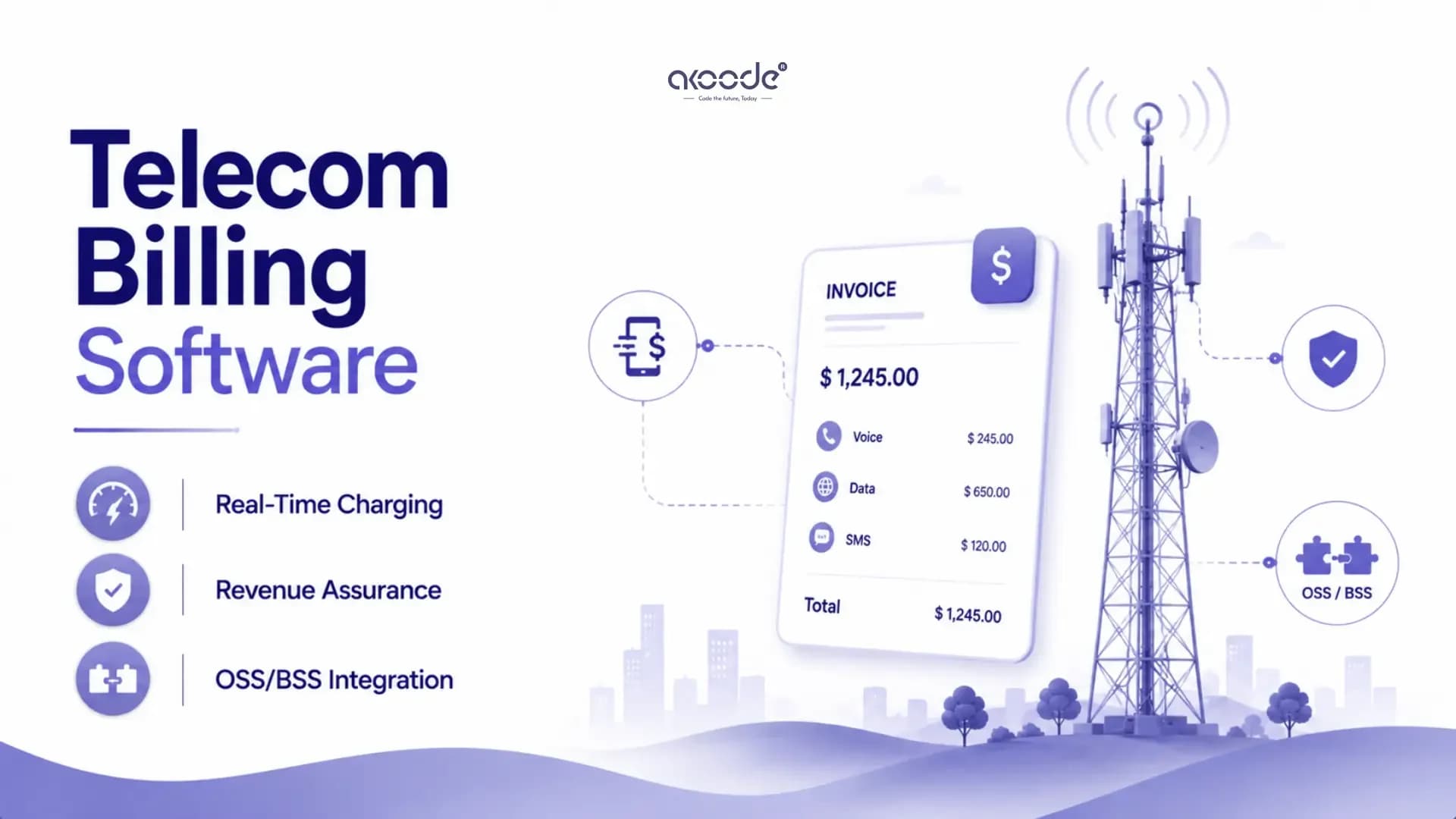
Billing specifically covers four core functions. Rating determines what a customer owes based on usage. Charging applies that rate in real time or at the end of a billing cycle. Invoicing presents the charge to the customer in a format they can understand and dispute if needed. Revenue assurance makes sure the network actually billed for everything it delivered.
That last point deserves emphasis. Unbilled usage is a direct and quiet revenue leak. VC4's analysis of telecom operations found disconnected OSS and BSS systems lead directly to billing discrepancies and lost revenue. Service usage data does not get properly tracked across the gap between the two systems. A telecom operator running fragmented systems is, in a very literal sense, leaving money on the table every billing cycle.
What Must-Have Features Does a Telecom Billing System Need?
Real-time charging is non-negotiable for modern telecom services. Prepaid customers, IoT devices, and 5G network slicing all need charging decisions made in milliseconds. Not at the end of a billing period. A system that can only batch-process charges overnight cannot support prepaid mobile data. It cannot handle per-second IoT billing models either.
Convergent billing means handling voice, data, SMS, and value-added services through one unified system. Not separate platforms bolted together. Most legacy telecom architectures grew through acquisition and incremental feature addition. The result is often three or four billing systems trying to produce one invoice. That setup is fragile and expensive to maintain.
Flexible rating and pricing engines let an operator launch new pricing models without months of custom development. Mordor Intelligence's research highlights this as a market driver. New-generation billing systems use a flexible business rule engine. That engine can cut time-to-market for new pricing plans from months to hours.
Partner and wholesale settlement handles the genuinely complicated math of interconnect, wholesale, MVNO, and OTT partner relationships. An operator with multiple MVNOs on its network needs accurate settlement calculations for each one. Getting this wrong creates disputes that eat real legal and financial time.
Invoicing and dunning management covers the customer-facing side. Clear, accurate bills reduce support call volume. Automated dunning workflows recover revenue without manual intervention on every late payment.
Revenue assurance and fraud detection continuously checks that usage data matches what gets billed. This matters more, not less, as 5G enables higher-volume service types. A small percentage gap between usage and billing can represent a large absolute revenue loss at scale.
Self-service customer portals let subscribers view usage, change plans, and make payments without contacting support. This feature consistently reduces support costs while improving satisfaction. Most billing-related contact volume is genuinely solvable through self-service if the interface is built well.
How Does Telecom Billing Software Integrate with OSS and the Rest of the Stack?
Billing software does not operate in isolation. Getting the integration architecture right matters as much as the billing logic itself.
The connection to OSS is the most critical one. OSS handles network operations, service provisioning, and inventory. BSS, including billing, handles the customer-facing and revenue side. When a customer activates a new service, OSS provisions it on the network. BSS needs to know that activation happened so it can start charging correctly. A gap between these two systems creates one of two problems. Either you bill for a service that was never delivered, or you deliver a service nobody is being charged for. Neither is acceptable. Both happen more often than operators like to admit when the integration is built poorly.
CRM integration matters for a different reason. Customer service representatives need to see billing history, current plan, and payment status in the same screen where they handle support tickets. Disconnected systems force agents to switch between platforms mid-call. That slows resolution and frustrates customers who already called because something went wrong.
Payment gateway integration needs to support the full range of payment methods a customer base actually uses. Credit cards, mobile wallets, and operator-specific payment methods common in certain regional markets all need to work. Genuinely understanding the target market's payment behaviour, rather than defaulting to whatever the development team knows best, makes a measurable difference in payment success rates.
API-driven architecture is what makes all of this manageable rather than a permanent integration headache. VC4's analysis on OSS/BSS integration notes that APIs enable seamless data exchange between systems. This reduces manual intervention and supports scalability for newer service types like 5G, IoT, and cloud-based offerings. Building a billing system around well-documented REST APIs from the start avoids the brittle point-to-point integrations that make legacy telecom systems so expensive to modify later.
Also check: AI in Telecom: Churn Prediction and Network Optimization
What Does 5G and IoT Mean for Billing System Requirements?
5G is not simply a faster network from a billing perspective. It fundamentally changes what billing systems need to do.
Network slicing lets an operator carve a single physical network into multiple virtual networks. Each one is tuned for different requirements. Low latency for autonomous vehicles. High bandwidth for video. Massive device density for IoT sensors. Each slice can carry a different pricing model. A billing system built for a single, uniform network architecture cannot price this correctly without significant rework.
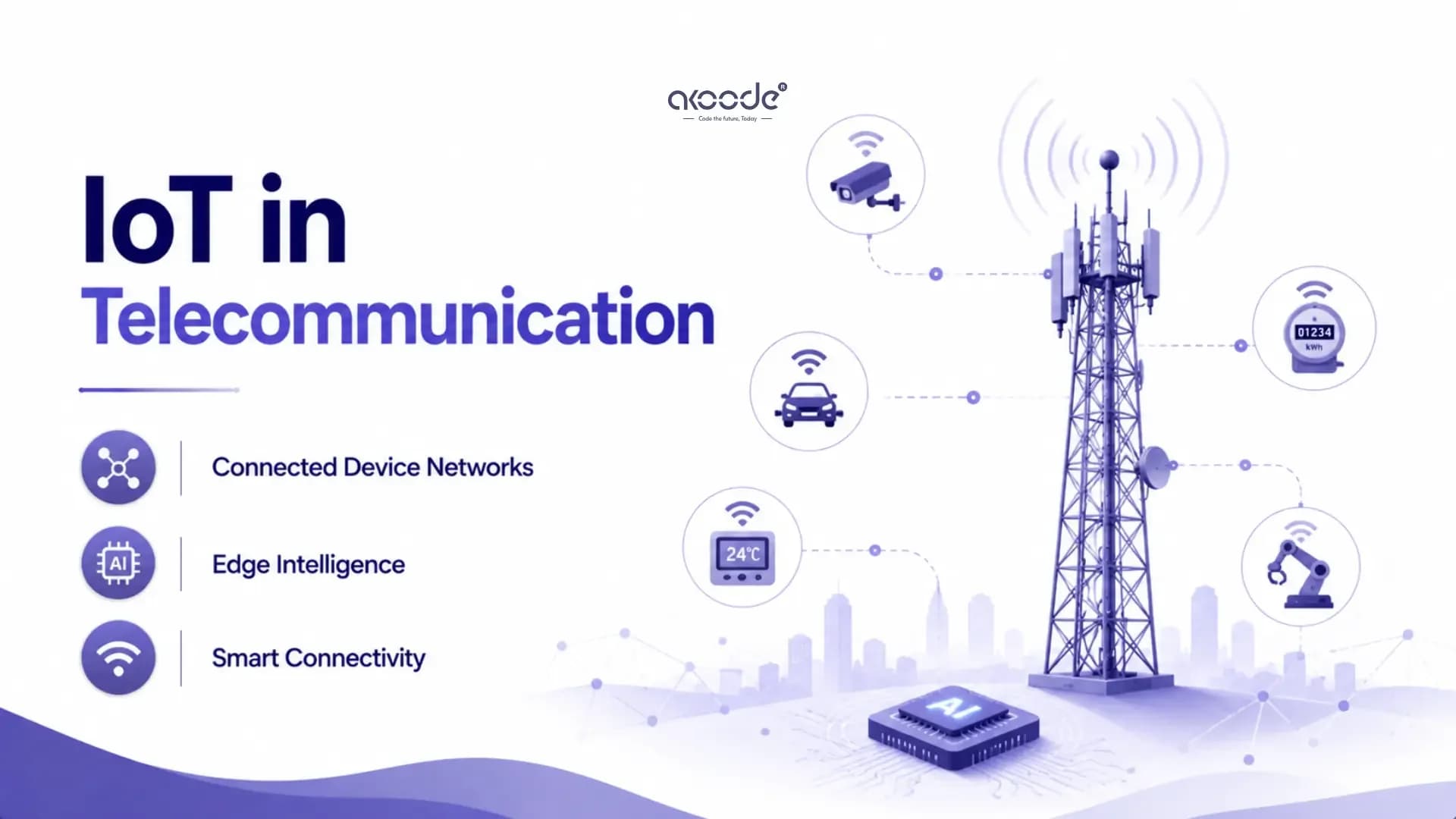
IoT billing introduces volume challenges that voice and SMS billing never had to handle. Mordor Intelligence's research notes that Asia Pacific's mobile subscriber base alone reached 1.8 billion in 2024. Operators are increasingly managing hybrid 2G-5G portfolios. IoT devices generate continuous, granular usage data within these portfolios. A connected sensor reporting every thirty seconds generates a transaction volume that traditional batch billing architectures were never designed to process in real time.
5G monetization more broadly has pushed operators toward what the industry calls network APIs. AT&T's Aduna platform is a documented example of this in practice. According to Mordor Intelligence's telecom data monetization research, Aduna generated $180 million in incremental revenue during its first year. It did this by exposing network capabilities, like location verification or quality-of-service guarantees, as billable API products. Other businesses can integrate these products into their own applications. This is a genuinely new revenue category. The billing infrastructure to support it did not exist in most legacy telecom billing platforms.
What Does Telecom Billing Software Development Cost?
Project Scope | Cost Range | What It Covers |
|---|---|---|
Billing module for an MVNO or small CSP | $80,000 to $200,000 | Core rating and charging, basic invoicing, single payment gateway |
Mid-scale convergent billing platform | $200,000 to $600,000 | Multi-service billing, partner settlement, self-service portal, CRM integration |
Enterprise carrier-grade BSS | $600,000 to $2,000,000+ | Full OSS/BSS integration, 5G network slicing support, real-time charging at scale, multi-region compliance |
These ranges reflect a genuine complexity difference. A billing system for a small regional ISP looks nothing like one built to handle carrier-grade transaction volumes with the regulatory and revenue assurance requirements a major operator faces.
Cost drivers worth understanding before scoping a project:
Legacy system migration is consistently the largest hidden cost. Moving billing data and active customer accounts from an old system to a new one without service disruption requires careful planning. In most real-world projects, this migration work costs more than building the new system's core features.
Real-time charging infrastructure for prepaid and IoT use cases requires specific architecture. This typically means in-memory data grids or specialised charging engines, not a standard relational database handling everything. This adds engineering cost. It is not optional for operators with meaningful prepaid or IoT customer bases.
Compliance and regulatory requirements vary significantly by region. Tax calculation rules, data residency requirements, and billing transparency regulations all add development scope. This is easy to underestimate if a development partner has not built for the specific regulatory environment before.
Team location affects cost as significantly here as in any other software category. An India-based development team with genuine telecom domain experience can deliver a mid-scale convergent billing platform at 35 to 50 percent of the cost of an equivalent US-based build. The underlying architecture does not need to be compromised to get there.
Should You Build Custom Billing Software or License a Platform?
Established BSS platforms from vendors like Oracle, Amdocs, Ericsson, and Huawei carry significant accumulated telecom domain knowledge. They have a long track record at carrier scale. For a large established operator, licensing and customising one of these platforms is often the lower-risk path. The platform has already solved problems a custom build would need to solve from scratch.
Custom development becomes the stronger choice in a few specific situations. A newer CSP, MVNO, or telecom-adjacent business with a business model that does not map cleanly onto a traditional vendor platform's assumptions often gets better results building something purpose-fit. An operator whose existing vendor platform cannot support a specific new monetization model, network API products being a good current example, may find custom development of that specific module faster than waiting for a vendor's roadmap to catch up. Businesses building billing infrastructure as their own product to sell to other telecom companies need custom development by definition.
The decision genuinely comes down to one question. Is the business model standard enough that an existing platform's assumptions fit? Or is it specific enough that those assumptions become a constraint worth paying to remove?
Conclusion
Telecom billing software is not a back-office utility. It is the system that determines whether 5G investment, IoT deployment, and new service launches actually translate into revenue. Without it, value quietly leaks through gaps between what the network delivers and what gets billed.
The market growth data backs up what is happening on the ground. Operators are replacing systems built for a voice-and-SMS world with platforms designed for real-time charging, network slicing, and the kind of API-driven monetization that did not exist as a billing category five years ago.
Akoode Technologies is a leading AI and software development company headquartered in Gurugram, India, with a US office in Oklahoma. From custom enterprise software and AI-powered platforms to cloud and DevOps solutions and full stack development, Akoode builds billing and revenue management systems for telecom operators, MVNOs, and enterprise clients across 15+ industries globally. If you are planning a telecom billing system build or modernisation and want a team that understands both the engineering and the regulatory complexity involved, that conversation starts here.
Frequently Asked Questions
1. What is telecom billing software?
Telecom billing software handles rating, charging, invoicing, and revenue assurance for telecom services. It sits within the broader BSS, Business Support System, which Ericsson describes as the business engine handling billing, charging, mediation, and order management so an operator can sell, deliver, and get paid for its services.
2. How much does telecom billing software development cost in 2026?
A billing module for an MVNO or small CSP costs $80,000 to $200,000. A mid-scale convergent billing platform with partner settlement and self-service features costs $200,000 to $600,000. Enterprise carrier-grade BSS with full 5G network slicing support and real-time charging at scale costs $600,000 to $2,000,000 or more.
3. How does telecom billing software integrate with OSS?
OSS handles network operations and service provisioning. BSS, including billing, handles the customer-facing and revenue side. The two systems must stay synchronised through API-driven integration. A gap between them can mean billing for services never delivered, or delivering services nobody gets charged for.
4. What does 5G change about telecom billing requirements?
5G introduces network slicing, where a single physical network is divided into multiple virtual networks each requiring different pricing models. It also introduces massive IoT transaction volumes and new monetization categories like network APIs. AT&T's Aduna platform used this approach to generate $180 million in incremental revenue during its first year by billing for network capabilities as API products.
5. What is the telecom billing software market size in 2026?
According to Mordor Intelligence, the global telecom billing and revenue management market is valued at $24.43 billion in 2026, growing from $22.15 billion in 2025. It is projected to reach $39.96 billion by 2031 at a 10.28 percent annual growth rate.
6. Should a telecom operator build custom billing software or license an existing platform?
Established platforms from vendors like Oracle, Amdocs, and Ericsson suit large operators with standard business models, since the platforms have already solved most carrier-scale problems. Custom development suits newer CSPs or MVNOs with non-standard business models, operators needing specific new monetization capabilities ahead of a vendor's roadmap, or businesses building billing infrastructure as their own product.