


 June 18, 2026
A telecom operator does not lose customers all at once. It loses them one bad network moment at a time.
A dropped call during an important conversation. A billing error that takes three calls to resolve. A network slowdown that happens every evening at the same time. None of these feel dramatic alone. Together, they explain why the global telecom churn rate sits around 21.5 percent. That is one of the highest rates of any major industry.
AI has become the lever operators are pulling to fix this. Not as some distant future capability. Deloitte's 2026 Technology, Media and Telecommunications Predictions found traditional operators facing margin compression of 2 to 4 percent per year. Saturated mobile penetration and aggressive 5G capex cycles are driving that squeeze. Margins are tight enough now that AI deployments reporting opex reductions of 15 to 30 percent are not optional experiments anymore.
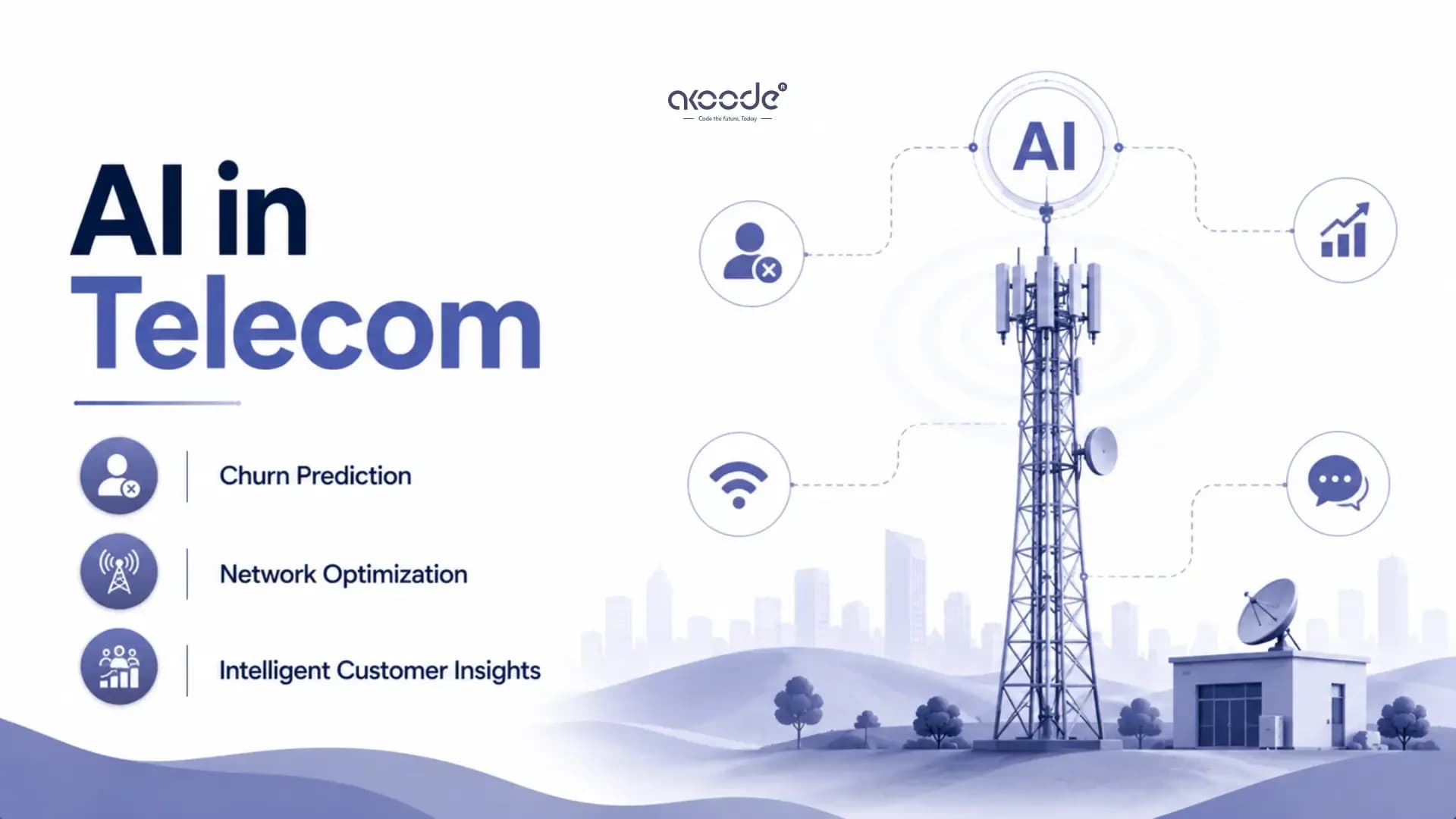
This guide covers what AI in telecom actually does. The focus is churn prediction and network optimization specifically. These two use cases are delivering the clearest measured returns in 2026.
What Is AI in Telecom and Why Does It Matter Now?
AI in telecom means applying machine learning and predictive analytics to problems the industry has faced for decades. Network management. Customer retention. Fraud detection. Billing accuracy. Customer service.
What separates 2026 from three years ago is maturity. The tool landscape has consolidated. Major network equipment vendors, Ericsson, Nokia, Huawei, have embedded AI throughout their core platforms. It is no longer a bolt-on feature. Hyperscalers are competing for the cloud AI layer above network infrastructure. A growing set of purpose-built telecom AI platforms now handle fraud detection, churn prediction, and billing optimization with industry-specific training data.
Here is why this matters financially, not just technically. McKinsey's telecom industry research found customers are up to five times more likely to churn after a poor network moment. That single statistic connects two things people usually treat separately. Network optimization and customer retention are not two competing initiatives. They are the same problem, seen from two angles.
How Does AI Churn Prediction Actually Work?
Telecom churn prediction has moved past simple rule-based flags. "Customer called support three times this month" is not how this works anymore.
Modern systems pull from customer transaction history, usage patterns, billing anomalies, and network experience metrics. Some even factor in competitive market signals. Gradient boosting models dominate production deployments. XGBoost, LightGBM, and CatBoost balance predictive accuracy with the explainability retention teams actually need.
That explainability point deserves attention. A 2026 study in Frontiers in Artificial Intelligence built a multi-model ensemble on the Telco Customer Churn dataset. Contract type, tenure, and technical support interactions were the strongest predictive features. SHAP analysis confirmed this. The same XGBoost model hit an AUC-ROC of 0.932. That means it could reliably tell churning customers apart from staying ones. Threshold optimization at 0.528 balanced precision at 0.90 and recall at 0.91, cutting false negatives by 15%.
Why does this technical detail matter if you are not a data scientist? A model with too many false positives wastes retention budget on customers who were never leaving. A model that misses too many true churners loses revenue silently. Getting the threshold right is not a minor tuning step. It is the difference between a programme that pays for itself and one that quietly burns money.
In production, the workflow is straightforward. The model flags at-risk customers 30 to 90 days before they likely churn. It triggers a personalised offer through the best channel. SMS, email, app notification, or a live agent call. Timed for maximum impact. Operators running these systems report voluntary churn reductions of 10 to 25%. Customer lifetime value rises 8 to 18 percent. ROI typically lands within 6 to 10 months of going live.
What Does AI-Driven Network Optimization Look Like in Practice?
Network optimization delivers some of the fastest, most measurable returns in telecom AI. The reason is simple. Every avoided outage eliminates its associated revenue loss directly.
Predictive maintenance is the clearest example. AI models trained on equipment sensor data and historical failure logs predict radio access network failures 24 to 72 hours in advance. Documented accuracy runs 80 to 92 percent. That lead time changes everything. Maintenance crews get prioritised by failure risk and customer impact, not a fixed schedule. This has cut truck rolls by 25 to 40 percent in deployed systems.
Ericsson's own published estimates put AI-driven network optimization's efficiency gain at 15 to 20 percent. Separately, AI-powered fault detection resolves network faults up to 50 percent faster than human-only processes. Predictive analytics deployments have cut unplanned downtime by up to 30 percent at operators running them live.
Why does a 30 percent downtime reduction matter this much? At a major mobile network operator, unplanned downtime can cost tens of millions of dollars per hour. That is not a marginal efficiency win. It is a material financial event every single time it happens. This is exactly why this use case attracts investment fastest.
The next stage beyond predictive maintenance is the self-organising network. Traditional 5G automation follows fixed rules. If a threshold is crossed, take a defined action. AI-native 5G learns optimal responses from data instead. It predicts congestion before thresholds are crossed. It reconfigures network slices automatically in response to real-time demand. NVIDIA's 2026 survey of telecom operators found autonomous networks delivering ROI faster than any other AI use case in the industry. The reason is straightforward. They reduce outages, energy consumption, and manual intervention all at once.
How Does AI Improve Telecom Customer Service?
Customer service eats 8 to 15% of total operating expenditure for telecom operators. That makes it a natural target for AI investment alongside churn and network use cases.
Conversational AI now handles a meaningful share of routine interactions. Vodafone's TOBi assistant is a widely cited example. It reportedly delivers €680 million in annual savings for the operator. Gartner projects conversational AI will cut contact centre labour costs industry-wide by $80 billion by 2026. McKinsey's 2025 contact centre analysis found AI agents cutting cost per call by 50 percent. Customer satisfaction improved at the same time. Those two outcomes rarely show up together in traditional service investments.
There is a specific mechanism worth understanding here. AI-driven speech analytics detect customer sentiment during live calls. Supervisors get alerted when frustration is rising. The system recommends intervention before the call escalates into a cancellation request. An agent fielding a complaint about repeated network issues can see the customer's full history instantly. The system can flag the account as at-risk in real time. This prompts a proactive discount or priority support before the customer even mentions leaving.
One thing worth noting clearly. Despite all this automation, 95 percent of customer service leaders surveyed plan to keep human agents as AI adoption grows. The pattern across deployed systems is consistent. AI handles routine volume. Billing questions, plan details, simple troubleshooting. Complex cases needing genuine empathy or judgment stay with people.
What Three Levels of AI Maturity Should Telecom Operators Understand?
Confusing where a capability sits on the maturity curve leads to bad investment decisions. It is worth being deliberate about this before committing budget.
Level one: mature, production-proven technologies: Network traffic optimization, predictive maintenance for radio access network equipment, churn prediction, automated customer service through large language models, fraud detection, and billing anomaly detection. All of these have at least five years of industrial track record. Costs are predictable. Specialised integrators exist in every major regional market. This is where a first AI investment should land.
Level two: rapidly scaling technologies: Self-organising networks using reinforcement learning, AI-driven energy optimization for cell sites, dynamic spectrum allocation, generative AI for marketing, and autonomous troubleshooting agents. These are maturing fast but carry less predictable cost and integration profiles than level one.
Level three sits at the genuinely experimental frontier. Most operators should not be putting production budget here yet, no matter how compelling the vendor pitch sounds.
The practical guidance from this framework is simple. Start with the use case where the data baseline is clearest and the cost of downtime or churn is easiest to measure honestly. That is where the ROI evidence to fund everything else actually gets generated.
What Tools and Vendors Dominate Telecom AI in 2026?
The vendor landscape has consolidated around a clear pattern. Network equipment vendors have built AI directly into their core platforms.
Ericsson's Explainable AI for network operations launched in 2024. AI had already been embedded throughout the company's 5G architecture since 2019. The system identifies root causes of network issues and suggests corrective actions through a modular structure. Nokia AVA, Cisco AI Network Analytics, IBM Maximo for telecom, and Huawei iMaster occupy similar positions for other operators.
For predictive maintenance specifically, average annual cost runs $0.5 to $5 million depending on network scale. Payback typically lands in 8 to 14 months for tier-1 and tier-2 operators.
For churn prediction, Salesforce Marketing Cloud Personalization, Adobe Customer Journey Analytics, and Pegasystems Customer Decision Hub sit alongside custom builds on Snowflake or Databricks. Average annual cost runs $0.3 to $3 million depending on customer base size.
How should a telecom operator decide between buying a vendor platform and building custom? It usually comes down to data uniqueness. An operator whose customer base and network topology closely match a vendor's training data will get strong results fast from that vendor's platform. An operator with unusual market dynamics, a distinct regulatory environment, or proprietary signals competitors lack often gets meaningfully better results from a custom-trained model. That model costs more and takes longer. The results justify it in those specific cases.
What Should a Telecom Operator Build First?
Start with the use case where the data baseline is clearest and the financial impact is easiest to measure honestly. For most operators, that means predictive maintenance or churn prediction. Both have five-plus years of industrial precedent. Both have well-understood cost structures.
Resist launching network optimization, churn prediction, fraud detection, and conversational AI all at once. Each needs different data infrastructure. Each needs different integration work with legacy billing and CRM systems. Each needs a different internal team to own the outcome. Spreading effort across all four simultaneously is a reliable way to under-deliver on every single one.
Legacy system integration, not the AI model itself, is consistently the longest part of any telecom AI deployment. Connecting to older billing and CRM platforms that were never built for real-time API exchange adds real complexity. An honest development partner scopes this accurately upfront. They do not promise a six-week delivery for what is actually a sixteen-week project.
The same principles covered in AI use cases across business functions apply directly here. Build the data foundation properly. Prove value on one use case before expanding. Let the ROI from the first deployment fund the next one.
Conclusion
AI in telecom in 2026 is not a research project. It is operational infrastructure delivering measured, repeatable returns. Churn prediction and network optimization lead that list specifically.
Churn models are catching at-risk customers 30 to 90 days before they leave. Voluntary churn reductions of 10 to 25 percent are documented. Network optimization systems are cutting unplanned downtime by up to 30 percent. Faults get resolved 50 percent faster than human-only processes. Both categories now have enough deployed history that the ROI case no longer requires faith. It requires honest scoping and the right starting use case.
The operators winning this transition are not deploying the most AI projects at once. They picked the clearest use case first. They built the supporting data infrastructure properly. They used proof from that first deployment to fund the next one.
Akoode Technologies is a leading AI and software development company headquartered in Gurugram, India, with a US office in Oklahoma. From AI-powered software development and predictive analytics to custom enterprise platforms and cloud and DevOps solutions, Akoode builds AI systems for telecom operators, technology vendors, and enterprise clients across 15+ industries globally. If you are evaluating an AI deployment for churn prediction or network optimization and want a team that understands both the models and the legacy integration challenge, that conversation starts here.
Frequently Asked Questions
1. What is AI in telecom?
AI in telecom means applying machine learning and predictive analytics to network management, customer retention, fraud detection, billing accuracy, and customer service. By 2026, major network vendors have embedded AI directly into their core platforms rather than offering it as an add-on.
2. How does AI churn prediction work in telecom?
Models built on gradient boosting algorithms like XGBoost analyse transaction history, usage patterns, billing anomalies, and network experience metrics. They identify customers likely to churn 30 to 90 days in advance. A 2026 study in Frontiers in Artificial Intelligence found contract type, tenure, and technical support interactions were the strongest predictive features, with top models hitting AUC-ROC scores above 0.93.
3. What results have telecom operators seen from AI churn prediction?
Documented deployments show voluntary churn reductions of 10 to 25 percent. Customer lifetime value increases 8 to 18 percent. ROI typically lands within 6 to 10 months of going live, according to industry analysis citing Deloitte's 2026 TMT predictions.
4. How does AI improve telecom network optimization?
AI models predict radio access network failures 24 to 72 hours in advance with 80 to 92 percent accuracy. This enables predictive maintenance that has cut unplanned downtime by up to 30 percent and reduced truck rolls by 25 to 40 percent. Ericsson estimates AI-driven network optimization improves operational efficiency by 15 to 20 percent.
5. What is the difference between traditional network automation and AI-native networks?
Traditional automation follows fixed rules. It takes a defined action when a threshold is crossed. AI-native 5G learns optimal responses from data. It predicts congestion before thresholds are crossed and reconfigures network slices in real time. NVIDIA's 2026 telecom survey found these autonomous networks delivering the fastest ROI of any AI use case in the industry.
6. What AI use case should a telecom operator deploy first?
Operators should start with churn prediction or predictive network maintenance. Both have over five years of industrial track record and predictable cost structures. Legacy billing and CRM integration, not the AI model itself, is typically the longest part of deployment. Accurate upfront scoping matters more than model selection.