


 June 22, 2026
There are now 4.7 billion cellular IoT connections running on the world's telecom networks. That number comes from IoT Analytics, an independent research firm tracking this market closely. It is also a number that keeps moving, and fast.
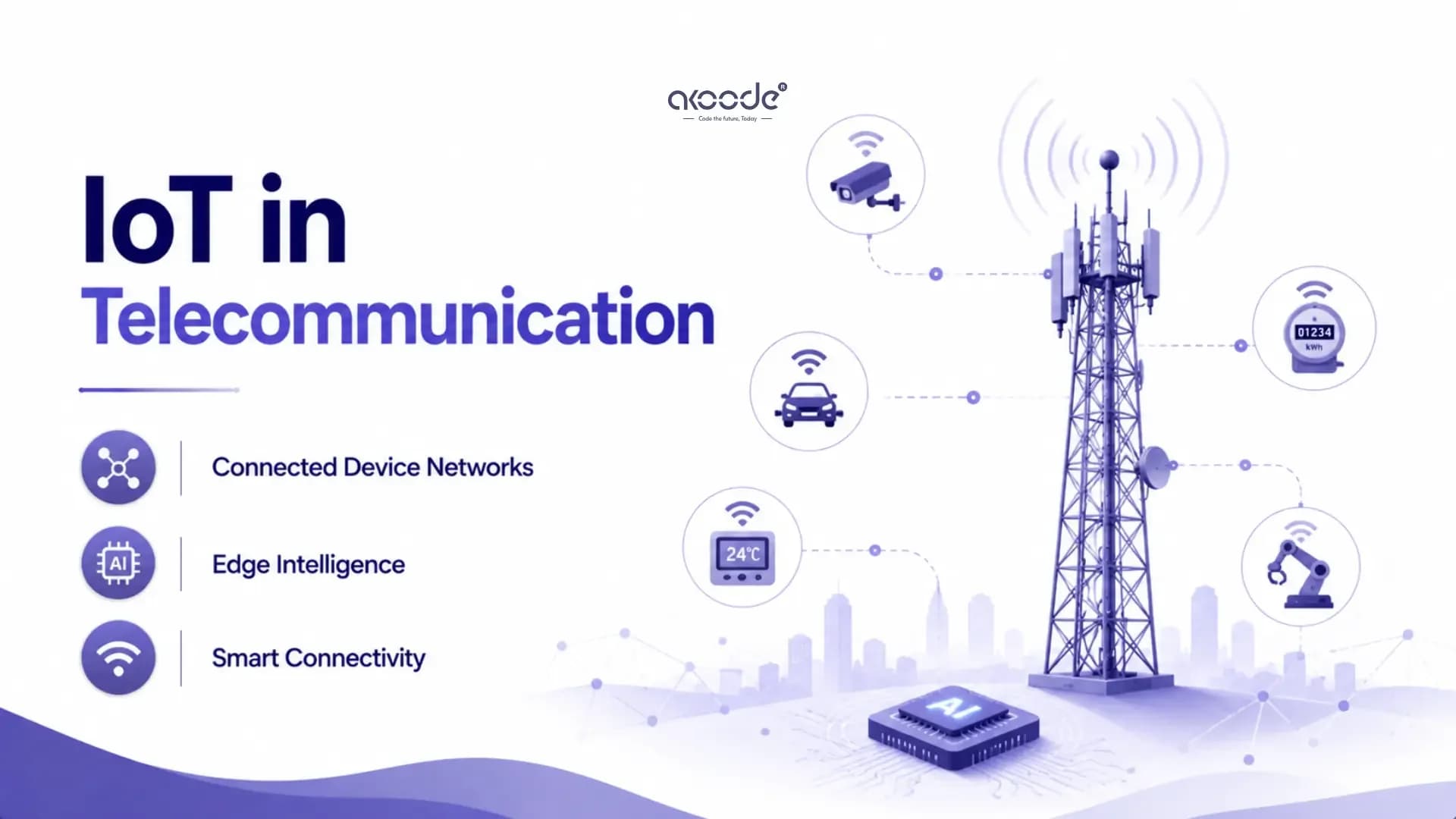
What makes this relationship between IoT and telecom interesting is that it runs both ways. Telecom networks are the infrastructure that makes IoT possible at scale. At the same time, IoT has become one of the biggest forces reshaping what telecom operators actually build and sell.
Five years ago, IoT in telecom was treated as a side project. A connectivity SIM here, a smart meter pilot there. That description does not hold anymore. According to Future Market Insights, the 5G IoT market alone is projected to grow from $8.1 billion in 2026 to $85 billion by 2036.
This guide covers how IoT and telecom actually connect, the communication technologies doing the heavy lifting, and where this is genuinely heading rather than where the marketing decks say it is heading.
What Is the Real Relationship Between IoT and Telecom?
IoT devices need a way to talk to the internet. Telecom networks are how most of them do it.
That sounds simple. The complexity sits in the variety. A smart water meter sitting in a basement sends a tiny burst of data once a day and needs to run on a battery for ten years. A connected delivery truck needs continuous location tracking while moving at highway speed across regions. A factory sensor array needs to upload data constantly with almost no tolerance for delay.
No single connectivity technology handles all of these well. This is the part most IoT explainers skip past quickly, and it is actually the most important thing to understand. Telecom operators have had to build out an entire portfolio of different network types specifically because IoT use cases are this varied.
Telecom companies are not just providing connectivity anymore either. AT&T's recent IoT Network Intelligence launch, unveiled at CES 2026, is a clear signal of where this is heading. The platform gives enterprises visibility into the performance of their entire connected device ecosystem, not just a connection. Operators are positioning themselves as the company that manages your IoT fleet's health, not just the company that bills you for data.
What Communication Technologies Actually Power IoT in Telecom?
This is where the real engineering happens, and it is worth being specific rather than vague about it.
NB-IoT, Narrowband IoT, is built for devices that send small amounts of data infrequently. According to a 2026 overview of IoT communication protocols, NB-IoT remains the standard choice for deep indoor penetration and ultra-low power consumption. Smart meters and environmental sensors are the classic use case. These devices are static. They send small data bursts. NB-IoT lets them run for years on a single battery.
LTE-M, also called Cat-M1, is the technology for anything that moves. It supports full handover between cell towers, which matters enormously for a tracked shipment crossing a country or a connected vehicle on a highway. It also carries enough bandwidth for firmware updates over the air, something NB-IoT struggles with.
5G RedCap is the newest addition, and it solves a specific gap that existed for years. Full 5G infrastructure was built for high-performance equipment. Lower-power devices, sensors, cameras, inspection tools, were stuck choosing between full 5G's cost and power demands or less reliable WiFi. RedCap extends real 5G benefits to these smaller devices without requiring the full bandwidth overhead. According to IoT Analytics' coverage of MWC 2026, RedCap and its successor eRedCap are now defining the actual 5G migration path for IoT, while a different protocol, Cat 1 bis, is winning near-term volume for simpler deployments.
Non-Terrestrial Networks, NTN, bring satellite connectivity directly into the cellular IoT story. Iridium presented its NTN Direct service at MWC 2026 as a standards-based commercial offering launching in the second half of the year. This matters for exactly the use cases cellular coverage cannot reach. Remote agricultural sensors, maritime tracking, and supply chain visibility across areas with no ground network coverage.
eSIM and the SGP.32 standard are quietly solving one of IoT's most persistent operational headaches. Provisioning and managing connectivity remotely, across borders, without physically swapping a SIM card. Tele2 IoT, IDEMIA, and Cisco launched the first commercial end-to-end SGP.32 solution in March 2026, combining managed connectivity, a certified secure SIM stack, and networking infrastructure into one deployment.
Why Is the Telecom Industry Retiring Older Networks Now?
This is a deadline most businesses running IoT devices have not fully registered yet.
According to Hologram's 2026 cellular IoT trends analysis, thirty-seven telecom operators will phase out 2G networks and thirty-nine will retire 3G networks throughout 2025 and 2026. That is not a distant future event. It is happening right now, across a meaningful share of global operators simultaneously.
Millions of legacy IoT devices built on 2G and 3G modules are being forced to migrate as a direct result. NB-IoT and LTE-M have become the default replacement path. Both protocols are now officially integrated into the 5G evolution roadmap, which means hardware investments made today carry support well into the 2030s rather than facing another forced migration in a few years.
For any business running a fleet of IoT devices on older cellular technology, this network sunset timeline is not a minor technical footnote. It is a forced hardware refresh cycle with a real deadline attached.
How Is Edge Intelligence Changing What IoT Devices Actually Do in Telecom Networks?
The next wave of growth in cellular IoT is not coming from connectivity volume alone. IoT Analytics' spring 2026 market update makes this point directly. More cellular IoT endpoints now require local processing, stronger security, and AI inference happening at the device level itself, rather than sending everything to the cloud for a decision.
This shift is happening for practical reasons, not just technical novelty. Running AI inference on the device reduces cloud dependency. It also improves response time, since a device that has to round-trip every decision to a distant server cannot react fast enough for time-sensitive use cases.
Nordic Semiconductor demonstrated this principle clearly at MWC 2026, linking on-device inference directly to lower power consumption and reduced data traffic. That detail matters because it shows edge AI is relevant beyond high-bandwidth 5G use cases. It is becoming relevant to low-power, narrowband connections too, which previously seemed like the wrong category for any kind of AI processing.
A separate but related approach comes from Semtech, which keeps intelligence on the end device or a partner microcontroller while using LoRa for connectivity and signal optimisation. This represents a genuinely different architectural choice. Rather than relying purely on cellular infrastructure, it extends edge AI capability to LoRa-connected sensor networks specifically.
For telecom operators and the businesses building on their networks, this points toward a shift in what value actually gets delivered. The connectivity itself is becoming closer to a commodity. The intelligence layer sitting at the edge of that connection is where the differentiation increasingly lives.
What Are Real Examples of IoT Reshaping Telecom Right Now?
Industrial automation and mining are one of the clearest current examples. Nokia's Cognitive Digital Mining platform, demonstrated at CES 2026, integrates multiple Telit Cinterion wireless modules with an NVIDIA GPU into a single mission-critical networking and computing device. The platform enables real-time edge intelligence with SLA-driven multi-access networking specifically built for heavy industrial environments like mining operations.
Network intelligence as a product is a newer category that did not exist as a distinct telecom offering a few years ago. AT&T's IoT Network Intelligence platform, also launched at CES 2026, gives enterprises direct visibility into how their entire connected device ecosystem is performing. This is the telecom operator selling operational insight, not just a data connection.
5G Standalone for industrial IoT is becoming the dominant architecture for serious deployments. According to Future Market Insights, 5G Standalone networks now represent roughly 55.3 percent of the 5G IoT market, specifically because this architecture enables network slicing, ultra-low latency, and the deterministic connectivity that industrial automation genuinely requires.
Cross-border IoT connectivity has historically been one of the most frustrating parts of running global IoT deployments. Unpredictable roaming charges and opaque contracts made multi-country IoT fleets expensive and difficult to manage. According to a recent overview of IoT communication protocols, software-led multi-region network backbones now let devices stay authenticated and stable even when crossing borders. This is a critical requirement for global supply chain trackers that previously had no reliable way to maintain connectivity across multiple countries.
What Should Telecom Businesses and IoT Developers Actually Build For?
Build for the network sunset timeline first, not last. If your IoT fleet, or a client's, is still running on 2G or 3G modules, the migration window is closing now, not in some distant future. Plan the hardware refresh before the network shuts off underneath you.
Match the connectivity technology to the actual use case rather than defaulting to the newest option available. A static smart meter does not need 5G RedCap. NB-IoT will run cheaper and last longer. A moving asset that needs firmware updates over the air genuinely needs LTE-M's bandwidth and handover support. Getting this match wrong is one of the most common and expensive mistakes in IoT deployment planning.
Design for edge intelligence from the start where the use case justifies it. The trend IoT Analytics is tracking, more processing happening on-device rather than purely in the cloud, is not a future consideration. It is shaping hardware and architecture decisions being made right now. A platform built assuming everything routes through the cloud will need rework sooner than most teams expect.
Plan for multi-region deployment differently than you would have two years ago. The software-led connectivity backbones and eSIM standards like SGP.32 that have matured through 2026 genuinely remove friction that made global IoT deployments painful before. Building around these newer provisioning standards from day one avoids inheriting the old roaming and contract complexity that legacy approaches still carry.
For businesses building IoT platforms that sit on top of telecom infrastructure, understanding how AI is separately transforming telecom operations through churn prediction and network optimization gives useful context. The two trends, IoT expansion and AI-driven network intelligence, are increasingly the same investment for many operators rather than two separate initiatives.
Conclusion
IoT in telecommunication has moved well past the pilot project phase. With 4.7 billion cellular IoT connections already live and a 5G IoT market heading toward $85 billion by 2036, this is core infrastructure now, not an experimental side line.
The real story in 2026 is not just more connected devices. It is the diversification of connectivity technology to match genuinely different use cases, the forced migration away from legacy 2G and 3G networks on a real deadline, and the shift toward intelligence happening at the edge rather than purely in a distant cloud.
Akoode Technologies is a leading AI and software development company headquartered in Gurugram, India, with a US office in Oklahoma. From IoT solutions and AI-powered platforms to custom enterprise software and cloud and DevOps solutions, Akoode builds connected device platforms and telecom-adjacent technology for startups, operators, and enterprise clients across 15+ industries globally. If you are building an IoT solution that depends on telecom infrastructure and want a team that understands both layers, that conversation starts here.
Frequently Asked Questions
1. What is IoT in telecommunication?
IoT in telecommunication refers to how telecom networks provide the connectivity that lets IoT devices communicate, and how telecom operators are increasingly building products and services specifically around managing and monetising connected device ecosystems rather than just selling data connections.
2. What are the main IoT communication technologies used in telecom networks?
NB-IoT serves low-power, infrequent-data devices like smart meters. LTE-M serves moving assets needing handover and firmware update support. 5G RedCap brings real 5G benefits to lower-power devices that cannot justify full 5G infrastructure. Non-terrestrial networks and eSIM standards like SGP.32 round out the current technology landscape.
3. Why are telecom operators retiring 2G and 3G networks now?
According to Hologram's 2026 analysis, 37 operators will phase out 2G and 39 will retire 3G networks through 2025 and 2026. This forces millions of legacy IoT devices onto newer networks like NB-IoT and LTE-M, which are now officially integrated into the 5G evolution roadmap for long-term support.
4. How big is the IoT in telecom market in 2026?
Future Market Insights projects the 5G IoT market growing from $8.1 billion in 2026 to $85 billion by 2036. IoT Analytics reports 4.7 billion cellular IoT connections existed at the end of 2025, with China Mobile as the top operator and Quectel as the top module maker.
5. What is edge intelligence in IoT and why does it matter for telecom?
Edge intelligence means running AI inference directly on an IoT device rather than sending all data to the cloud for processing. IoT Analytics identifies this as the next major growth driver in cellular IoT, since it reduces cloud dependency, improves response time, and lowers power consumption even for low-bandwidth narrowband connections.
6. What should businesses consider when choosing IoT connectivity for a telecom-dependent project?
Match the technology to the actual use case rather than defaulting to the newest option. Static, low-data devices fit NB-IoT. Moving assets need LTE-M's handover and bandwidth support. High-performance industrial use cases increasingly use 5G Standalone for network slicing and deterministic latency. Plan for the 2G and 3G network sunset timeline if any existing devices run on legacy cellular technology.