



 August 4, 2026
Two claims appear in almost every article about Manchester's tech sector: that it is the fastest-growing digital economy in Europe, and that inward investment into the city region's tech firms rose by more than 1,000 percent between 2017 and 2022.
The second is attributable — it comes from the Greater Manchester Combined Authority and is widely cited, including in academic commentary. The first is repeated constantly with no consistent source behind it. Notably, one Manchester development agency published a piece in 2026 explicitly retracting both claims from its own earlier article, on the grounds that neither survived scrutiny.
That is a useful place to start, because Manchester genuinely does not need the hyperbole. The defensible numbers are strong enough, and the interesting story in 2026 is not "Manchester is growing" — it is that Manchester's tech economy has split into two markets moving in opposite directions, and which one you are hiring into determines almost everything about your experience of building there.
This guide covers what the data actually supports, what it costs, where the talent is genuinely deep, where it is thinner than the marketing suggests, and how the Manchester-versus-London decision should actually be made.
The numbers that hold up
Stripped of the superlatives, here is what is reasonably well evidenced.
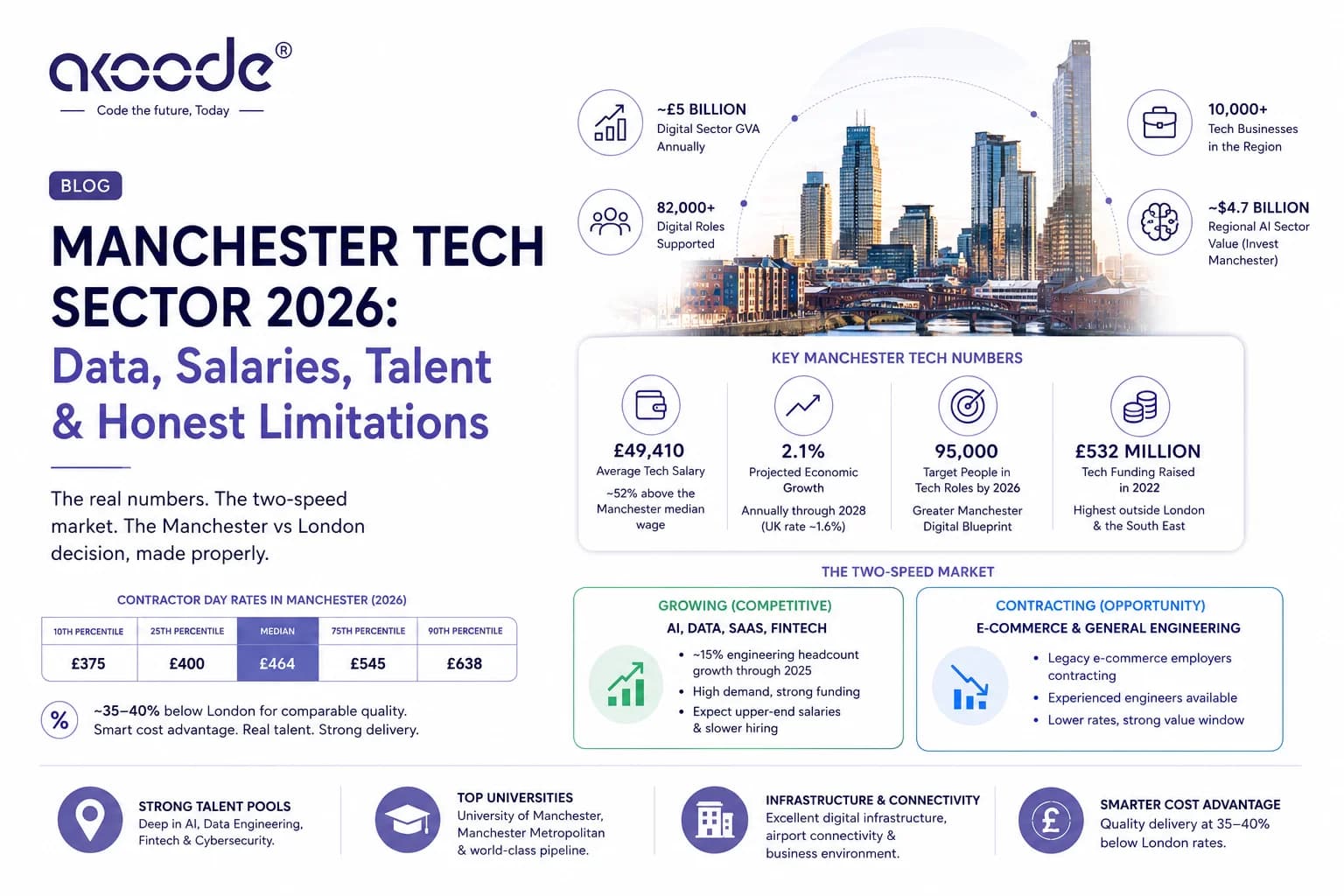
Metric | Figure |
|---|---|
Greater Manchester digital sector GVA | ~£5 billion annually |
Digital roles supported | 82,000+ |
Tech businesses in the region | 10,000+ |
Regional AI sector value | ~$4.7 billion (Invest Manchester) |
Average tech salary | £49,410 — around 52% above the Manchester median wage |
Projected economic growth | ~2.1% annually through 2028, against a UK rate near 1.6% |
Greater Manchester Digital Blueprint target | 95,000 people in tech roles by 2026 |
By most rankings Greater Manchester is the largest tech cluster in the UK outside London. It also hosts the largest artificial intelligence sector by headcount anywhere in the UK outside London and the south east, and has been named among the country's most AI-ready cities in 2026.
Those are substantial figures for a single city region, and they are the ones to use. The £5 billion GVA and 82,000 roles tell a buyer far more than a growth percentage with no denominator.
One more that matters commercially: Manchester tech firms raised £532 million in funding in 2022, the highest total outside London and the South East. Funding totals fluctuate year to year — treat any single year as a data point rather than a trend — but the ranking has been consistent.
The two-speed market
This is the part that changes decisions, and it is barely covered.
Manchester's digital economy has bifurcated. According to Manchester Digital's own sector data, AI, B2B SaaS and fintech teams grew engineering headcount by roughly 15 percent through 2025. Simultaneously, the legacy e-commerce employers that defined the city's tech reputation a few years ago have been contracting.
Both things are true at once, and the aggregate figures obscure them. "Manchester tech is growing" is accurate and, for a business planning a hire, close to useless.
What this means practically:
If you are hiring into AI, data, SaaS or fintech, you are competing in a tight market against well-funded teams. Expect to pay toward the upper end of local bands and expect a slower search at senior level.
If you are hiring general full-stack, front-end or e-commerce engineering, the market is considerably more favourable than it was two years ago. Redundancies at large e-commerce employers have released experienced people who know how to operate at volume, and many would prefer to stay in the region.
If you are the acquiring side of that second dynamic, this is a genuine and time-limited opportunity. Established engineers with real production experience, available in a softer market, at rates well below London. That window will not stay open indefinitely.
The strategic read: Manchester's cost advantage is largest exactly where general engineering demand is softest, and smallest where AI demand is hottest. Scope your team shape around that rather than assuming a uniform regional discount.
What it costs to build in Manchester
Contractor day rate data for Manchester developers:
Percentile | Day rate |
|---|---|
10th | £375 |
25th | £400 |
Median | £464 |
75th | £545 |
90th | £638 |
The North West regional median sits slightly above the city figure at around £475. For comparison, the UK national developer median is £500, and London runs 20 to 35 percent above national — with median software engineer rates in London tracked around £775.
That gap is the commercial argument for Manchester: roughly 35 to 40 percent below London for work that is, across most disciplines, of directly comparable quality.
The spread is also worth reading. Manchester's 90th percentile of £638 sits below the UK 90th of £875, which tells you something real about the top of the market — covered in the honest-limitations section below.
Permanent hiring runs around £49,410 average across tech roles, though that figure spans the whole sector including non-engineering positions. For a six-month build with a small team, the difference against equivalent London staffing typically runs to a substantial six-figure sum.
Full rate detail across roles, seniority and specialisms is in our UK developer day rate index.
Where Manchester is genuinely strong
Four areas where the depth is real rather than aspirational.
Applied AI and data engineering. The largest AI sector by headcount outside London and the south east, a regional AI sector valued around $4.7 billion, and — critically — an applied rather than purely research orientation. Manchester's AI strength is in deployment and data infrastructure rather than frontier research, which is exactly what most businesses actually need. Our AI and machine learning practice works with clients whose AI problem is a data pipeline problem, and Manchester's ecosystem is unusually well suited to that shape of work.
Cyber security. Greater Manchester has built genuine cyber capability, anchored by the Centre for Digital Innovation, which brings together four universities, the Greater Manchester Colleges Group and private sector partners across cyber, AI and immersive technologies.
E-commerce at scale. A legacy that is currently a hiring advantage. The city's large online retail employers built engineering teams that operated at genuine volume — peak trading, inventory synchronisation, payment reconciliation, warehouse integration. That experience is transferable and, given the contraction described above, available. If you are building eCommerce platforms, Manchester currently has the best value-to-experience ratio of any UK city.
Cross-sector convergence. Finance, health, advanced manufacturing and media all have real presence in the region, which creates deployment environments that a purely digital cluster does not. For industry-specific software this matters more than headcount does.
Where it is thinner than advertised
Three honest limitations. Nobody selling Manchester will tell you these, which is precisely why they are worth knowing.
Depth at principal level is limited. The 90th percentile rate of £638 against a UK figure of £875 reflects a real constraint. For genuinely rare specialisms — payments infrastructure, security architecture at scale, ML research rather than ML engineering — the Manchester pool exists but is small. Businesses discover this expensively, usually four months into a search. Plan for a national or remote search for those specific roles rather than assuming the region will supply them.
Narrow specialisms are hit and miss. General engineering depth is excellent. Specific niches — certain regulated-industry experience, particular legacy stacks, deep embedded work — can be genuinely difficult. Test the specific market for your specific need before committing, rather than relying on aggregate cluster figures.
The AI premium applies here too. The regional discount is smallest exactly where demand is hottest. Senior AI engineers in Manchester are not cheap by regional standards; they are cheaper than London, which is a different claim. Budget accordingly.
The talent pipeline
Stronger than most regional markets and worth understanding structurally.
Universities. The University of Manchester, Manchester Metropolitan University and Salford University collectively produce substantial volume across computer science, data science and related disciplines. The University of Manchester's computing heritage is not incidental — it sustains research relationships that feed into the applied AI capability described above.
The Centre for Digital Innovation. Four universities plus the Greater Manchester Colleges Group plus private sector partners. The practical value is access to specialist facilities and research, and a talent pipeline that is coordinated rather than incidental.
Alternative routes. Northcoders and similar providers train developers and data engineers through intensive bootcamp routes. Realistic expectation: bootcamp graduates address junior capacity, and junior capacity is not where the UK shortage sits. Useful for volume, not for the senior gap.
Infrastructure. Kao Data's £150 million data centre in Stockport provides regional compute for AI and machine learning work — relevant if data residency or latency matters to your architecture.
Density. Spinningfields, MediaCityUK and the Northern Quarter give the ecosystem physical concentration. The practical benefit is recruitment through networks rather than agencies, which is materially cheaper.
Manchester versus London: the real decision
Not a cost question, though it is usually framed as one.
Factor | Manchester | London |
|---|---|---|
Median developer day rate | £464 | ~£775 |
Senior/principal depth | Good, thin at the very top | Deepest in the UK |
AI capability | Strong, applied focus | Strongest, research-adjacent |
Fintech / regulated | Growing | Dominant — FCA, counsel, ecosystem |
Operating costs | Substantially lower | Highest in the UK |
Talent retention | Better — less churn to competitors | High churn, constant re-bidding |
Hybrid mandate pressure | Lower | High in financial services and professional services |
Choose London when your work is regulated financial services, when proximity to the FCA and to specialist counsel genuinely matters, when you need principal-level specialists in a narrow domain, or when your investors and customers are concentrated there. The detail is in our London fintech development guide.
Choose Manchester when you need sustained engineering capacity at a rate you can run for years, when your work is applied AI, data, SaaS or e-commerce, when retention matters more than access to the absolute top of the market, or when your runway makes a 35 to 40 percent cost difference determinative.
The retention point is underrated. London's depth is also London's churn — engineers there are being bid for constantly, and the cost of losing a senior person mid-build frequently exceeds the salary premium you saved by hiring regionally. Manchester teams tend to stay longer, and continuity in a codebase is worth real money.
How to actually build there
Four models, honestly assessed.
Hire permanently. Right if you are building something you will own for years. Expect eight to sixteen weeks to hire, and expect the search to be materially easier for general engineering than for AI or specialist roles. The current e-commerce contraction makes this unusually favourable for mid-level and senior general engineers.
Contract locally. Median £464, good availability at mid level. Fast to start. The same caveat applies as everywhere: contractors without internal architectural ownership produce a codebase nobody wants to inherit. For the IR35 implications of this model in 2026, see our IR35 guide.
Use a Manchester agency. Real regional agencies with genuine capability, typically at £700 to £1,100 blended — below London equivalents. Good for defined project delivery with risk transfer. Same evaluation questions apply as anywhere; our supplier evaluation guide covers them.
Blended delivery with regional ownership. Senior architectural judgement retained in Manchester, delivery capacity supplied at lower rates. Works when you have or will appoint real technical ownership; fails badly when you do not. This is the model we run with UK clients through our Manchester software development practice, across custom software and mobile applications — and we will tell you when a local permanent hire is the better answer, because it frequently is.
Frequently asked questions
How much cheaper is software development in Manchester than London?
Roughly 35 to 40 percent for comparable work. The Manchester median developer day rate is around £464 against London median software engineer rates tracked near £775. The gap is narrowest in AI and specialist roles and widest in general engineering.
Is Manchester the UK's second tech hub?
By most rankings Greater Manchester is the largest tech cluster in the UK outside London, with around £5 billion in annual digital sector GVA, more than 82,000 digital roles and over 10,000 tech businesses. It also hosts the largest AI sector by headcount outside London and the south east.
What is Manchester's tech sector actually strong at?
Applied AI and data engineering, cyber security, e-commerce at scale, and cross-sector deployment spanning finance, health, advanced manufacturing and media. The AI orientation is applied rather than research-focused, which suits most commercial requirements.
Is it hard to hire senior developers in Manchester?
It depends on the discipline. General senior engineering is currently more available than it was two years ago, partly because legacy e-commerce employers have contracted while AI, SaaS and fintech teams grew headcount around 15 percent through 2025. Genuinely rare specialisms — payments infrastructure, security architecture, ML research — are harder, and the local pool is smaller than aggregate figures suggest.
What is the average tech salary in Manchester?
Around £49,410 across tech roles, approximately 52 percent above the Manchester median wage. That figure spans the whole sector, so engineering-specific roles vary considerably around it.
Should I build in Manchester or London?
Choose London for regulated financial services, for proximity to the FCA and specialist counsel, and for principal-level specialists in narrow domains. Choose Manchester for sustained capacity at sustainable cost, for applied AI, data, SaaS and e-commerce work, and where team retention matters more than access to the very top of the market.
Is Manchester really the fastest-growing digital economy in Europe?
That claim circulates widely without a consistent source, and at least one Manchester agency has publicly retracted it from its own earlier content. The well-evidenced figures — around £5 billion GVA, 82,000+ digital roles, 10,000+ tech businesses, the largest AI headcount outside London and the south east — are strong enough without it. Treat unsourced growth percentages sceptically, including the frequently repeated 1,000 percent investment figure, which is attributable to GMCA but describes a specific 2017 to 2022 window rather than current conditions.
What is driving Manchester's AI sector?
A regional AI sector valued around $4.7 billion, university research relationships across the Centre for Digital Innovation, regional compute infrastructure including Kao Data's £150 million Stockport facility, and an applied orientation that suits commercial deployment. Manchester has been named among the UK's most AI-ready cities in 2026.
The short version
Manchester does not need the superlatives, and the businesses that use them are usually the ones with the least to say about the actual market.
What is true: the largest UK tech cluster outside London, roughly 35 to 40 percent cheaper, genuinely strong in applied AI, data and e-commerce, with better retention than London and a thinner pool at the very top.
What is currently unusual and worth acting on: the contraction among legacy e-commerce employers has released experienced engineers into a softer market at regional rates. If you need general engineering capacity, that window is open now and will not stay open.
The one thing to check before committing: whether the specific specialism you need exists locally in depth, rather than assuming the aggregate cluster figures apply to your particular role. They frequently do not.
About Akoode Technologies
Akoode Technologies is an AI and software development company headquartered in Gurugram, India, with a US office in Oklahoma, working with clients across the UK, USA and India. We build custom software, AI and machine learning systems, mobile applications and eCommerce platforms for startups, SMEs and enterprises across 15+ industries, with 180+ projects delivered globally and clients in Manchester, London and across the UK.
Verified ratings: 4.9 out of 5 on Google across 110 client reviews, and 5.0 out of 5 on GoodFirms.
If you are weighing a Manchester build against London or an offshore model, book a call and we will give you a straight read on which roles the local market will actually fill.
Get In Touch Now
View More Our Blog