



 August 3, 2026
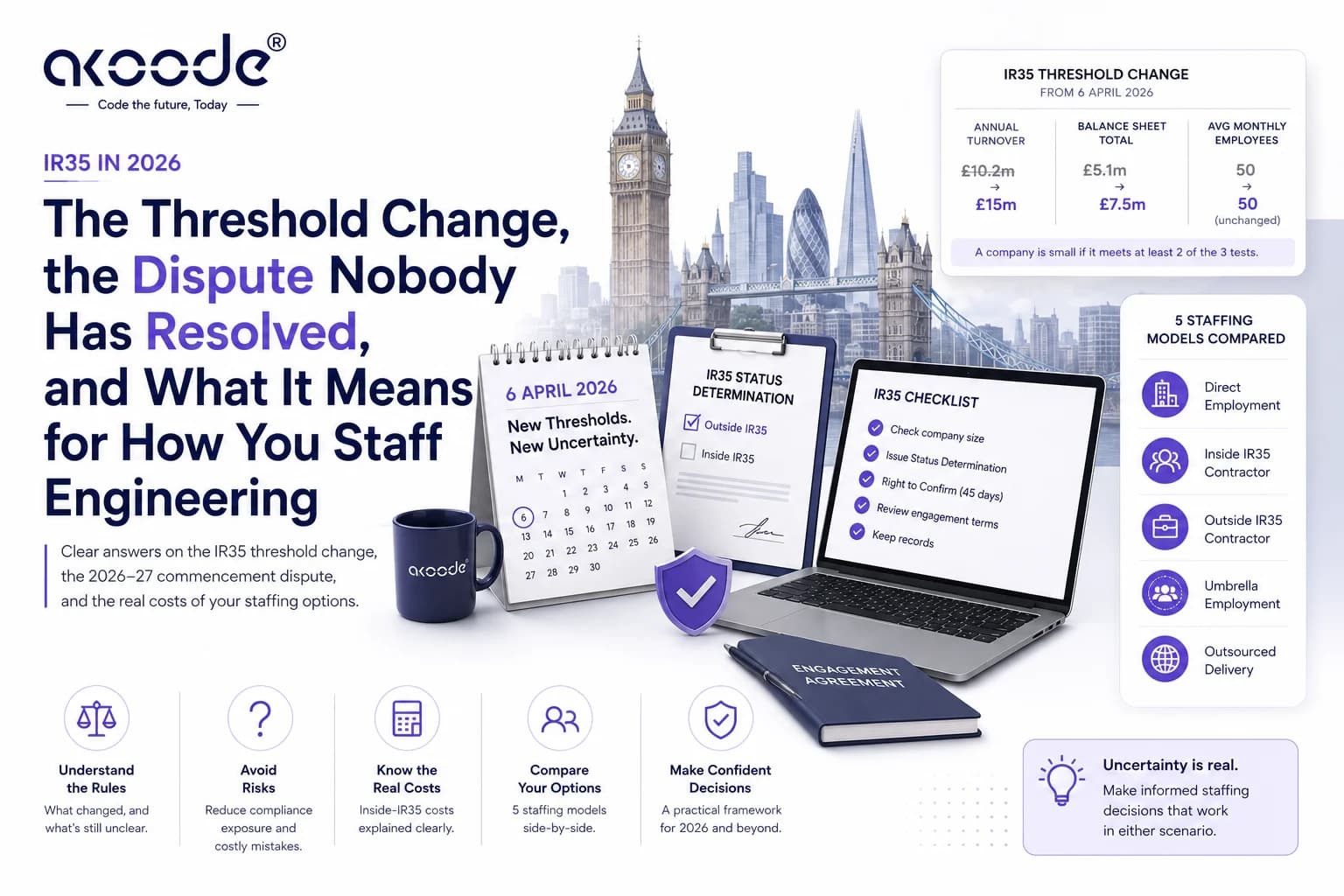
On 6 April 2026 the definition of a "small company" for off-payroll working purposes changed. HMRC estimates around 14,000 UK businesses are affected.
If your company is one of them, responsibility for determining contractor IR35 status has moved off your desk and back onto the contractor's. That is a meaningful reduction in administrative burden and compliance risk.
Except that a significant number of tax practitioners believe it has not happened yet, and will not happen until April 2027.
Both positions are defensible. Neither has been resolved. And UK businesses planning engineering capacity for the next eighteen months are making staffing decisions on top of a rule whose commencement date is genuinely contested.
This guide covers what changed, why the timing is disputed, how the four main engineering staffing models sit against the rules, and what each actually costs once employment taxes are accounted for.
This is not tax advice. Status determinations and company size classifications should be made with qualified professional input. What follows is a commercial guide to structuring engineering capacity, written for the people making budget and delivery decisions rather than the people filing the returns.
What changed on 6 April 2026
A short history, because the sequence matters.
The off-payroll working rules were extended to the public sector in April 2017 and to medium and large private sector clients in April 2021. Under those rules, the end client — not the contractor — determines whether an engagement is genuinely business-to-business or is, in substance, employment. Where the determination is "inside IR35," the client or the fee-payer in the chain deducts PAYE and National Insurance from the contractor's fee.
Small companies have always been exempt. Where the end client is small, the contractor's own personal service company makes the status determination under the older Chapter 8 rules, and the tax consequences sit with the contractor rather than the client.
What changed is the definition of small. A company qualifies if it meets at least two of three thresholds:
Threshold | Previously | From 6 April 2026 |
|---|---|---|
Annual turnover | £10.2m | £15m |
Balance sheet total | £5.1m | £7.5m |
Average monthly employees | 50 | 50 (unchanged) |
Two of the three rose substantially. The headcount test did not. The practical effect is that a business with, say, £14m turnover, a £4m balance sheet and 45 employees now meets two of three and falls outside the off-payroll regime — where previously it would have been squarely inside it.
The change flows from amendments to the Companies Act 2006 size thresholds introduced in April 2025, which the off-payroll rules then inherit.
The commencement dispute
Here is where it gets awkward, and where most published guidance quietly picks a side without telling you there is one.
The HMRC-aligned position: the new thresholds apply from 6 April 2026. Around 14,000 companies reclassify as small from that date, no longer need to issue Status Determination Statements, and contractors engaging them revert to determining their own status under Chapter 8 ITEPA 2003.
The counter-position, held by a number of tax practitioners: the legislation as drafted does not produce that outcome. Company size for off-payroll purposes is determined by reference to the prior financial year, and a company that is currently medium or large must meet the small thresholds for two consecutive financial years before its classification changes. Work that through against realistic accounting periods and filing deadlines and the earliest tax year in which a currently mid-sized end client could actually fall outside the rules is 6 April 2027.
That position has been argued in the tax press and by City law firms, not just by contractor forums. Greenberg Traurig's analysis concluded that while thousands of organisations may eventually move outside the regime, the practical effects may not be felt until April 2027. Analysis in Tax Journal reached a similar conclusion — that under the legislation as drafted, the earliest a medium-sized company can qualify as small for off-payroll purposes is the tax year beginning 6 April 2027.
What this means for you practically. If you are an end client near the thresholds, do not unilaterally stop issuing Status Determination Statements on the assumption you are now exempt. Getting that wrong means unpaid PAYE and NIC liabilities plus penalties, and the exposure sits with you. Take advice on your specific accounting periods before changing anything.
If you are engaging contractors, ask your client to confirm its size in writing and to state which tax year the confirmation covers. Do not infer it.
The uncertainty is itself an argument for structuring engineering capacity in ways that do not depend on the answer — which is most of what the rest of this guide is about.
Separately, and often missed: new PAYE rules covering labour supply chains involving umbrella companies also took effect from 6 April 2026. If you engage contractors through umbrellas, that is a second change to review, and it is not covered by the threshold discussion above.
How to check whether you are small
Four steps.
1. Identify the relevant financial year. Off-payroll size tests look backwards. Your status for a given tax year depends on prior financial year figures, not current ones.
2. Test against the three thresholds. Turnover, balance sheet total, average monthly employee headcount. You need two of three.
3. Check the consecutive-years requirement. A company that is currently medium or large does not become small the moment it dips below the thresholds once. Consistency across consecutive financial years matters, and this is precisely the mechanism at the centre of the commencement dispute.
4. Check group structures. If you are part of a group, the test is not applied to your entity in isolation. This catches out subsidiaries of larger organisations frequently.
Get steps 3 and 4 confirmed by your accountant. They are where the errors are.
The 45-day confirmation right
A provision worth knowing about on both sides of the relationship.
Contractors and staffing companies can formally request that an end client confirm its size for off-payroll purposes. The client must respond within whichever is later of: 45 days from receiving the request, or 45 days before the start of the tax year the request relates to.
If you are the client: expect these requests, and answer them accurately and in writing. Vague or delayed responses create friction with suppliers and do not reduce your exposure.
If you are engaging contractors: make the request in writing, state clearly that it is a size confirmation for off-payroll working purposes, and specify the tax year. Keep the response. In a dispute, the documented request and answer matter considerably more than a verbal assurance from a hiring manager.
What inside-IR35 actually costs
The headline point that budgets miss: an inside-IR35 day rate and an outside-IR35 day rate at the same number are not the same purchase.
Inside-IR35 engagements are taxed as employment. Where an umbrella company sits in the chain, employer National Insurance and the apprenticeship levy are typically passed through into the assignment rate rather than absorbed. The contractor's take-home from a £600 inside-IR35 rate is materially below their take-home from £600 outside, which is why contractors price inside roles higher — often 15 to 25 percent higher — to reach comparable net position.
Three consequences for buyers:
Benchmark like with like. Always ask which basis a quoted rate is on before comparing it to anything. A great deal of rate confusion in UK procurement comes from comparing inside and outside rates as if they were the same number.
Blanket determinations are expensive. Some clients classify every engagement as inside IR35 to eliminate administrative risk. It works, and it costs — in rates, and in losing access to the contractors who will not accept inside roles. The senior specialists you most want are frequently in that group.
The determination must be defensible. Status turns on the substance of the working relationship — control, the right of substitution, mutuality of obligation — not on what the contract says. HMRC's CEST tool produces a determination but does not remove your responsibility for taking reasonable care. Determinations made without genuinely assessing the working practices are the ones that fail on review.
Five staffing models compared
Model | IR35 exposure | Effective cost basis | Speed to start | Best for |
|---|---|---|---|---|
Permanent employees | None | Salary + ~25-30% employment cost | 8–16 weeks | Long-term product ownership |
PSC contractors (outside) | High — you determine, unless small | Day rate + admin | 1–3 weeks | Defined gaps, strong internal leadership |
Umbrella contractors | Moderate — new PAYE rules apply | Rate inclusive of employment taxes | 1–2 weeks | Short engagements, risk-averse clients |
UK agency / consultancy | Low — supplier's problem | £700–£1,400/day blended | 2–6 weeks | Risk transfer, regulated programmes |
Outsourced delivery partner | Low, if genuinely structured | £250–£550/day blended | 2–6 weeks | Sustained multi-year capacity |
Permanent employees
No IR35 exposure at all. The cost people underestimate is not salary — it is the roughly 25 to 30 percent on top in employer NIC, pension, holiday, sickness, equipment and recruitment amortisation, plus the eight-to-sixteen-week hiring cycle and the risk of a poor hire in a candidate-short senior market.
Right when you are building something you intend to own for years. Wrong when you need capacity for eleven months.
PSC contractors
Fast, flexible, and the model most directly affected by everything above. If you are medium or large, you carry the determination burden and the liability if you get it wrong. If you are genuinely small — or become small once the threshold question settles — that burden sits with the contractor.
The commercial risk is unrelated to tax: a room of contractors without internal architectural ownership produces a codebase nobody wants to inherit. That is the most common way UK engineering budgets are wasted, and it is a governance failure rather than a tax one.
Umbrella contractors
Simplifies status risk by treating the engagement as employment from the outset. Costs more per unit of engineering, and the new PAYE rules for umbrella labour supply chains introduced in April 2026 add compliance obligations that did not previously exist. Review your chain if you use this model.
UK agencies and consultancies
The supplier employs or engages the people; the status question is theirs. You buy an outcome, not a seat. That is genuine risk transfer, and it is priced accordingly — typically £700 to £1,400 per day blended.
Where the value breaks down is when the premium buys process rather than engineering, and when the seniors who won the pitch have moved to the next account by month two. Name individuals in the statement of work.
Outsourced delivery partners
Covered in its own section below, because the argument for it is more nuanced than the marketing usually admits.
Outsourced delivery and where the argument fails
The pitch you will hear from firms in this category, including from us: a genuine outsourced service arrangement — where a supplier is contracted to deliver a defined outcome, using its own team, carrying its own delivery risk — is a different legal animal to a contractor filling a seat in your organisation. The off-payroll rules address disguised employment. A supplier delivering a specified scope with its own people, its own management, and its own liability is not that.
That argument is broadly sound, and it is routinely overstated.
Where it fails: if you contract for "an outsourced service" but in practice direct the individuals daily, set their hours, integrate them into your teams, and substitute them at will, you have a staffing arrangement with an outsourcing label on it. Substance beats form. HMRC looks at how the relationship actually operates, and a services agreement does not immunise an arrangement that functions as employment.
Where it holds: defined deliverables, supplier-side technical management, supplier-side quality accountability, and a commercial structure where the supplier carries risk if the work is late or wrong. That is a real outsourced service and it is treated as one.
The honest framing: IR35 simplification is a genuine secondary benefit of properly structured outsourced delivery. It is not the reason to choose it, and any supplier leading with it as the headline is selling you a tax argument rather than an engineering capability. Choose the model on delivery merits — sustained capacity, cost structure, engineering standards — and treat the compliance simplification as a bonus.
And the constraint that applies regardless of model: if you have no internal technical ownership, no staffing arrangement will save you. That is true of contractors, agencies and outsourced partners equally.
At Akoode we work with UK clients on defined-scope delivery across custom software, AI and machine learning, mobile applications and eCommerce platforms, with clients in London, Manchester and across the UK. We will tell you plainly when a UK agency or a direct hire is the better answer, because engagements entered for the wrong reason end badly for both sides.
Choosing a model
Your situation | Model to consider |
|---|---|
Building a product you will own for five years | Permanent, with contractor surge capacity |
Specific 3–6 month capability gap, strong internal CTO | PSC contractors |
Regulated programme, seven-figure budget, audit exposure | UK consultancy |
Near the small-company threshold, want to avoid the question entirely | Outsourced delivery or permanent |
Sustained capacity over 12+ months, cost pressure, internal architect in place | Outsourced delivery partner |
No internal technical leadership | Fractional CTO first, then decide |
The last row is the one that saves the most money. If nobody on your side owns technical decisions, the highest-return first purchase is two days a month of senior technical judgement — not a delivery team.
For the underlying rate data behind these models, see our UK developer day rate index. For supplier evaluation, our guide to choosing a London development partner covers the nine questions that predict whether an engagement works.
Compliance checklist
For end clients engaging contractors:
Confirm your company size classification against the correct prior financial year, with your accountant
Check the consecutive-years requirement — do not assume a single year below threshold changes your status
Check group structure implications if you are part of a larger organisation
Do not stop issuing Status Determination Statements until advised the exemption applies to you specifically
Review determinations on working practices, not contract wording
Document reasonable care taken in each determination
Respond to size confirmation requests within the 45-day window, in writing
Review umbrella supply chains against the PAYE rules effective April 2026
For outsourced arrangements, confirm the substance matches the contract — defined deliverables, supplier-side management, genuine risk transfer
Diarise a review before the start of the 2027/28 tax year, when the commencement dispute should be settled
Frequently asked questions
What changed with IR35 in April 2026?
The small company thresholds for off-payroll working rose. Turnover increased from £10.2m to £15m and balance sheet total from £5.1m to £7.5m, with the 50-employee threshold unchanged. A company meeting two of three qualifies as small and is exempt from the off-payroll rules, meaning contractors determine their own status. HMRC estimates around 14,000 companies are affected.
Does the April 2026 change apply immediately?
This is disputed. HMRC's position points to 6 April 2026. A number of tax practitioners and law firms argue that because off-payroll size tests reference prior financial years and require consistency across consecutive years, the earliest a currently mid-sized company could actually fall outside the rules is 6 April 2027. Take specific advice before changing your compliance approach.
What are the small company thresholds for IR35 in 2026?
Turnover of £15m or less, balance sheet total of £7.5m or less, and 50 or fewer average monthly employees. A company must meet at least two of the three.
Who determines IR35 status if my client is a small company?
The contractor's own limited company, under the older Chapter 8 ITEPA 2003 rules. The client is not required to issue a Status Determination Statement, and the tax consequences of an incorrect determination sit with the contractor rather than the client.
How much more does an inside-IR35 contractor cost?
Contractors typically price inside-IR35 engagements 15 to 25 percent above equivalent outside rates to reach a comparable net position, because the engagement is taxed as employment and, where an umbrella is involved, employer National Insurance and the apprenticeship levy are commonly passed through into the assignment rate.
Does IR35 apply to outsourced software development?
A genuine outsourced service arrangement — defined deliverables, supplier-side technical management, supplier-side risk — is a different arrangement to individuals filling seats, and the off-payroll rules address the latter. However, substance beats form. If you direct the individuals daily and integrate them into your teams, a services label will not change how the arrangement is characterised.
Can I use HMRC's CEST tool to determine status?
CEST produces a determination, but using it does not discharge your obligation to take reasonable care. Determinations made without genuinely assessing working practices — control, substitution rights, mutuality of obligation — are the ones that fail on review, regardless of what the tool returned.
What is the 45-day rule?
Contractors and staffing companies can request that an end client confirm its size for off-payroll purposes. The client must respond within the later of 45 days from receiving the request, or 45 days before the start of the relevant tax year. Make and keep these requests in writing.
Should IR35 drive my engineering staffing decisions?
No. It should inform them. Choose a staffing model on delivery merits — capacity requirement, duration, internal technical ownership, cost structure — and treat compliance simplification as a secondary consideration. Arrangements entered primarily for tax reasons tend to be poorly structured for delivery, and delivery is what you are actually buying.
The short version
The threshold change is real and material, the commencement date is genuinely contested, and anyone telling you confidently which is correct is overstating the certainty available.
For most UK businesses the practical response is the same either way: confirm your size classification properly with your accountant, keep issuing Status Determination Statements until advised otherwise, document reasonable care on every determination, and structure engineering capacity around delivery requirements rather than around a rule whose commencement date is in dispute.
And if you take one thing from this: the compliance question is downstream of the ownership question. No staffing model works without someone on your side owning technical decisions.
About Akoode Technologies
Akoode Technologies is an AI and software development company headquartered in Gurugram, India, with a US office in Oklahoma, working with clients across the UK, USA and India. We deliver custom software, AI and machine learning systems, mobile applications and eCommerce platforms for startups, SMEs and enterprises across 15+ industries, with 180+ projects delivered globally.
Verified ratings: 4.9 out of 5 on Google across 110 client reviews, and 5.0 out of 5 on GoodFirms and Clutch
If you are working out how to structure engineering capacity for the next twelve to twenty-four months, book a call and we will give you a straight view — including when the answer is a UK agency or a direct hire rather than us.
Get In Touch Now
View More Our Blog