


 August 7, 2026
EIS limits doubled on 6 April 2026, and a surprising amount of founder-facing content still quotes the old numbers.
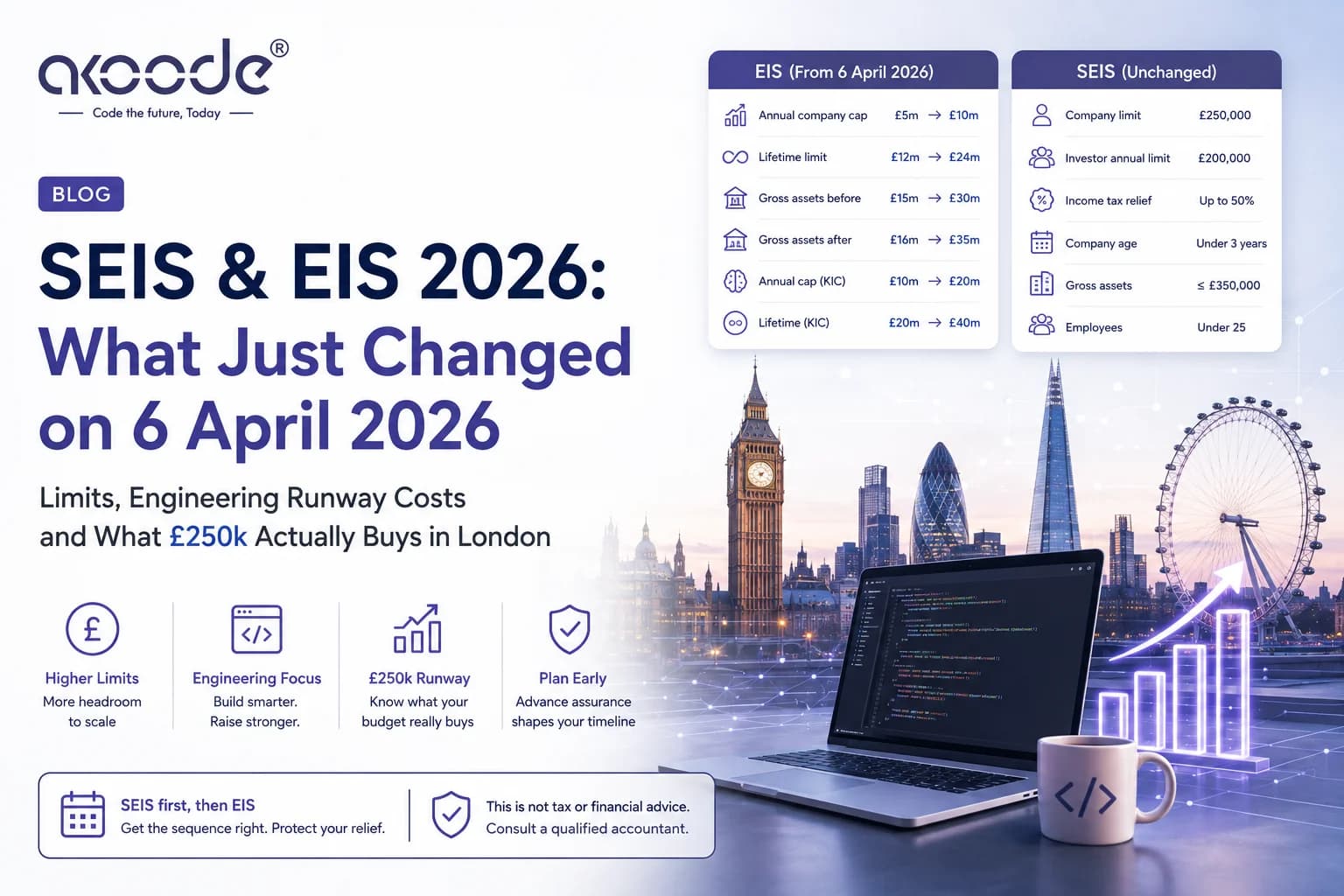
Announced in the Autumn Budget 2025 and delivered through the Finance Act 2026, the changes are substantial: the annual fundraising cap moved from £5 million to £10 million, the lifetime limit from £12 million to £24 million, and the gross assets test from £15 million to £30 million before the share issue. For knowledge-intensive companies the annual limit is now £20 million and the lifetime limit £40 million.
SEIS was left alone — £250,000 company limit, £200,000 per investor per tax year, unchanged.
What none of that tells you is the question founders actually ask us: what does this money buy in engineering terms, and how do I scope a build to it?
That is what this guide covers. The tax mechanics are handled better elsewhere by accountants. What follows is the engineering and delivery view — what £250,000 of SEIS buys in London, how to scope an MVP to a raise rather than to an ambition, the build decisions that can affect scheme eligibility, and how the advance assurance timeline should shape your delivery plan.
This is not tax, investment or financial advice, and we are not financial advisers. Scheme eligibility, advance assurance and compliance must be handled with a qualified accountant or tax adviser. Figures reflect published guidance as of August 2026 and are indicative.
What changed on 6 April 2026
Limit | Before April 2026 | From 6 April 2026 |
|---|---|---|
EIS annual company cap | £5m | £10m |
EIS annual cap (knowledge-intensive) | £10m | £20m |
EIS lifetime limit | £12m | £24m |
EIS lifetime (knowledge-intensive) | £20m | £40m |
Gross assets before share issue | £15m | £30m |
Gross assets immediately after | £16m | £35m |
Two things did not change, and both are commonly misreported:
Investor tax reliefs are unchanged. EIS remains up to 30 percent income tax relief with a £1 million annual investor limit, or £2 million where at least £1 million goes into knowledge-intensive companies. SEIS remains up to 50 percent relief with a £200,000 annual investor limit.
The wider qualifying conditions are unchanged. Higher financial thresholds do not relax the tests on trade, age, independence, use of funds or share structure. A company must still be within seven years of its first commercial sale for most EIS purposes, have fewer than 250 full-time employees, and carry on a qualifying trade outside HMRC's excluded activities list.
The headroom is bigger. The gate is the same width.
The two schemes at a glance
SEIS | EIS | |
|---|---|---|
Company raise limit | £250,000 total | £10m/year, £24m lifetime |
Investor annual limit | £200,000 | £1m (£2m with KIC allocation) |
Income tax relief | Up to 50% | Up to 30% |
Company age | Trading under 3 years | Within 7 years of first commercial sale |
Gross assets | ≤£350,000 | ≤£30m before, ≤£35m after |
Employees | Under 25 | Under 250 |
The sequencing point that costs founders money: if you are using both, SEIS shares must be issued before EIS shares. Get the order wrong and you can lose SEIS relief entirely. This is an administrative sequence, not a strategic one, and it is entirely avoidable with an accountant involved early.
Knowledge-intensive status is worth investigating if you are R&D-led. HMRC's tests include an operating cost condition — broadly, spending at least 15 percent on R&D or innovation in one of three relevant years, or at least 10 percent in each of them — alongside innovation or skilled-employee conditions. For deep tech and applied AI companies this is frequently achievable and materially changes your ceiling.
What £250k of SEIS actually buys in London
This is the part nobody writes down.
London runs 20 to 35 percent above UK national rates for equivalent engineering work, with median software engineer rates tracked around £775 per day against a UK excluding-London median closer to £475. Full detail is in our UK developer day rate index.
Run £250,000 against those numbers.
Scenario A — two London contractors, full time. Two mid-to-senior engineers at £600 per day, roughly 21 billable days per month: about £25,200 per month. Ten months of runway, before founder salaries, legal, accountancy, cloud costs or anything else. Realistically six to seven months of actual engineering once you account for the rest.
Scenario B — one senior London hire plus blended delivery. One senior engineer or technical lead in London at £110,000 all-in (salary plus employment costs), providing architectural ownership and stakeholder proximity, alongside three to four engineers of blended delivery capacity. Roughly fourteen to eighteen months of a five-person team.
Scenario C — a London agency. At £800 to £1,100 per day blended, £250,000 buys approximately 250 agency days. That is a small team for three to four months. It buys a well-built, well-managed thing — and it will not get you from nothing to product-market fit.
None of these is wrong. They answer different questions. But the numbers make one point unavoidable: £250,000 of SEIS does not buy a London-staffed engineering team for a year. Founders who model it as though it does run out of money at month seven with a half-built product, which is the worst possible position from which to raise a Series A.
The structure that works most often for London seed-stage companies is Scenario B — senior judgement local, delivery capacity elsewhere. That is what we build with early-stage clients through our London software development practice, and the honest caveat is the one we give everywhere: it fails if nobody on your side owns technical decisions.
Scoping an MVP to the raise
The discipline that separates companies that reach a Series A from companies that reach month eleven.
Work backwards from the raise, not forwards from the vision. Your SEIS round needs to fund a product that generates enough evidence to raise the next round. That evidence is usually retention, revenue or a validated wedge — not feature completeness. Every feature that does not produce that evidence is competing with your runway.
Define the one thing. An MVP is not a small version of the product. It is the smallest system that tests the riskiest assumption. If your assumption is that a specific user will pay for a specific outcome, build the thinnest path to that outcome and nothing else.
Write the deferral list explicitly. Not a backlog — a stated list of things you have decided not to build, with reasons. It is the single most useful artefact in early-stage scoping, because it makes scope creep visible as a decision to reverse rather than an accident.
Cost the things founders forget. Authentication, payments, admin tooling, error monitoring, deployment pipelines, and the boring compliance surface. These typically consume 25 to 35 percent of an MVP build and rarely appear in the founder's mental model. Note that UK data protection obligations changed in 2026, including a complaints procedure requirement live since 19 June — even a seed-stage product needs to handle this, and we cover the engineering implications in our UK data protection guide.
Reserve for the pivot. Roughly a quarter of your raise should be uncommitted at the point you start building. Most seed-stage companies learn something in month four that changes the product. Companies that have spent everything by then learn it and cannot act on it.
The runway calculation founders get wrong
Three systematic errors.
Day rates understate cost. An advertised day rate does not equal cost per productive engineering day. Once you account for ramp-up, absence, ceremonies, review and context switching, effective productive days per year land closer to 180 to 200 than 252. That understates true cost by 25 to 40 percent before overheads.
Advance assurance takes time and the clock is already running. Allow six to twelve weeks for EIS advance assurance. HMRC statistics show that as of March 2026, 76 percent of applications for 2025-26 had been approved, against 85 percent approval on 3,285 SEIS advance assurance applications in 2024-25. Most are approved — but "most" and "quickly" are different properties, and founders who model a raise closing in four weeks are frequently wrong.
Building is not the whole cost. Cloud, tooling, monitoring, security testing, legal, accountancy and the compliance surface. For a seed-stage product these commonly add 15 to 20 percent on top of engineering.
A workable model for a £250k SEIS round:
Line | Allocation |
|---|---|
Engineering | 55–65% |
Founder salaries | 10–15% |
Tooling, cloud, infrastructure | 5–8% |
Legal, accountancy, scheme compliance | 5% |
Go-to-market and validation | 5–10% |
Uncommitted reserve | 10–15% |
If engineering is above 70 percent, you are building a product with no capacity to learn whether anyone wants it.
Build decisions that touch eligibility
Genuinely worth knowing, and rarely discussed alongside engineering.
Excluded activities. HMRC maintains a list of trades that do not qualify. Most software businesses are fine, but the boundary matters for anything adjacent to financial services, property, or receiving royalties and licence fees. If your business model involves licensing IP you did not create, take advice before you build around it.
Funds must be deployed for the qualifying trade's growth and development. Keep detailed records of how investment is spent from the date of investment — this supports your EIS1 compliance submission. Practically: keep engineering spend traceable to the qualifying trade rather than buried in a general operating account.
Shares must be ordinary, full-risk shares. No preferential rights to assets, income or liquidation. This constrains your cap table structure, not your architecture — but founders occasionally agree investor terms during a build that turn out to disqualify the round.
Eligibility is not a one-time test. A later breach can cost investors their relief. If your company changes shape substantially — a pivot into an excluded activity, a group restructure — re-check.
Advance assurance is not a guarantee. It is based on the information supplied and covers only specified scheme conditions. Final relief depends on the actual share issue, the investor's circumstances and continued compliance afterwards.
Advance assurance and your delivery plan
The sequencing point that saves months.
Apply for advance assurance before approaching investors, and allow six to twelve weeks. That window is not dead time for your engineering plan — it is the right period for discovery, technical architecture, and building whatever prototype supports the raise itself.
A workable sequence:
Phase | Duration | Engineering activity |
|---|---|---|
Advance assurance applied for | Weeks 0–12 | Discovery, architecture, clickable prototype |
Round closing | Weeks 8–16 | Prototype supports the pitch |
Build starts | Week 16 | Scoped MVP, deferral list agreed |
MVP live | Weeks 16–40 | Depends on scope |
Evidence gathering | Weeks 30+ | Retention, revenue, validated wedge |
Next raise begins | Week 44+ | Before money runs out, not after |
The critical constraint: start the next raise conversation while you still have six months of runway. Founders who begin at three months negotiate from weakness, and it shows in the terms.
Team shape at seed stage
Role | Allocation | Note |
|---|---|---|
Technical founder or fractional CTO | Full time or 2 days/month | Non-negotiable. Someone must own technical decisions. |
Senior engineer / tech lead | 1.0 FTE | Architecture and standards |
Engineers | 2–3 FTE | Delivery capacity |
Design | 0.3–0.5 FTE | Usually fractional at this stage |
QA | Shared | Rarely a dedicated hire pre-Series A |
The first row is the one that determines outcomes. If you have no technical co-founder, the highest-return purchase at seed stage is a fractional CTO for two days a month — not an extra engineer. They will save you more in avoided architectural mistakes than they cost, and they make every other model on this page viable. Without that role, delivery capacity of any kind — contractors, agency, offshore — produces a codebase nobody wants to inherit.
For a fuller treatment of how to evaluate delivery partners, see our guide to choosing a London development partner.
On location: London is right if your customers, investors or regulatory environment are here — for fintech in particular, proximity to the FCA and specialist counsel is worth real money, as we cover in our London fintech guide. If none of those apply, Manchester runs 35 to 40 percent cheaper with comparable engineering quality, and at seed stage that difference is measured in months of runway.
Six expensive mistakes
1. Modelling London rates as though SEIS covers a year of them. It does not. Six to seven months of two contractors, realistically.
2. Building the vision instead of the test. Feature-complete products with no users. The most common seed-stage failure and the most avoidable.
3. Spending the whole raise on the build. No reserve, no capacity to act on what you learn in month four.
4. Starting the next raise too late. Three months of runway is a negotiating position, and not a good one.
5. Getting the SEIS-before-EIS sequence wrong. Entirely avoidable and potentially costs the relief.
6. Hiring delivery capacity before technical ownership. The recurring theme across everything we write, because it is the recurring cause. Contractors, agencies and offshore partners all fail the same way in the absence of someone who owns architectural decisions.
Frequently asked questions
What changed with EIS in April 2026? From 6 April 2026 the annual company fundraising cap doubled from £5 million to £10 million, the lifetime limit from £12 million to £24 million, and the gross assets test from £15 million to £30 million before the share issue and £16 million to £35 million immediately after. Knowledge-intensive companies can now raise £20 million annually and £40 million over their lifetime. Investor reliefs were unchanged.
Did SEIS limits change in 2026? No. SEIS retains a £250,000 company limit and a £200,000 annual investor limit, with up to 50 percent income tax relief. Qualifying conditions — trading under three years, gross assets under £350,000, fewer than 25 employees — also remain.
How much software can £250,000 of SEIS buy in London? Roughly six to seven months of two mid-to-senior London contractors once non-engineering costs are accounted for, or approximately 250 days from a London agency at blended rates. A structure combining one senior London hire with blended delivery capacity typically extends this to fourteen to eighteen months for a five-person team.
How long does EIS advance assurance take? Allow six to twelve weeks, and apply before approaching investors. HMRC statistics show approval rates are high — as of March 2026, 76 percent of 2025-26 applications had been approved, and 85 percent of 3,285 SEIS applications in 2024-25 — but processing time should be built into your funding timeline.
Can I use both SEIS and EIS? Yes, but sequence matters. SEIS shares must be issued before EIS shares. Getting the order wrong can cost the SEIS relief. Handle this with a qualified accountant before any share issue.
What is a knowledge-intensive company? A company carrying out innovation, research or development meeting HMRC's tests, which include an operating cost condition — broadly at least 15 percent of costs on R&D in one of three relevant years, or at least 10 percent in each — alongside innovation or skilled-employee conditions. KICs benefit from higher fundraising limits, a longer age allowance and a higher investor ceiling.
How much of a seed raise should go on engineering? Typically 55 to 65 percent. Above 70 percent generally means insufficient allocation to validation and reserve, leaving no capacity to act on what you learn. A 10 to 15 percent uncommitted reserve is worth protecting.
Should I build my MVP in London or elsewhere? London is justified where your customers, investors or regulatory environment require proximity — regulated financial services being the clearest case. Otherwise regional UK or blended delivery buys materially more runway. Manchester runs 35 to 40 percent below London for comparable engineering quality.
Does advance assurance guarantee my investors get relief? No. Advance assurance is based on the information supplied and covers only specified scheme conditions. Final relief depends on the actual share issue, the investor's circumstances and continued compliance after investment. Eligibility is not a one-time test.
The short version
The April 2026 changes give growth-stage companies meaningfully more headroom under EIS. They do not change the seed-stage arithmetic at all, and the seed-stage arithmetic is where most London startups get into trouble.
£250,000 does not buy a year of London engineering. Model it honestly, scope the MVP to the evidence you need rather than the product you want, keep a reserve you have not committed, and put someone in charge of technical decisions before you buy any delivery capacity.
And start the next raise while you still have six months of money. Everything else on this page is easier from that position.
About Akoode Technologies
Akoode Technologies is an AI and software development company headquartered in Gurugram, India, with a US office in Oklahoma, working with clients across the UK, USA and India. We build custom software, AI and machine learning systems, mobile applications and eCommerce platforms for startups, SMEs and enterprises across 15+ industries, with 180+ projects delivered globally and clients across the UK, including London and Manchester.
Verified ratings: 4.9 out of 5 on Google across 110 client reviews, and 5.0 out of 5 on GoodFirms.
If you are scoping an MVP against a raise and want an honest read on what it will actually cost, book a call. We will tell you if the scope does not fit the money — that conversation is more useful before the round than after it.
This article is a delivery and engineering guide. It is not tax, investment or financial advice, and we are not financial advisers. SEIS and EIS eligibility, advance assurance, share issue sequencing and ongoing compliance must be handled with a qualified accountant or tax adviser. Scheme figures reflect published HMRC and industry guidance as of August 2026 and are subject to change. Cost bands are indicative planning figures, not quotations.
Get In Touch Now
View More Our Blog