


 June 26, 2026
A smart thermostat in someone's living room and a pressure sensor on a chemical reactor are both, technically, IoT devices. Calling them the same thing is where most of the confusion about industrial IoT actually starts.
If the thermostat glitches, the room gets uncomfortable for an hour. If the pressure sensor fails silently, someone can get hurt. That difference in stakes is not a minor footnote. It is the entire reason industrial IoT needs its own architecture, its own protocols, and its own way of thinking about what "connected" actually means.
This guide covers what IIoT is, how the layers between a factory floor and the cloud actually fit together, and what makes this genuinely different from consumer IoT rather than just a bigger, more expensive version of the same thing.
What Is Industrial IoT, and How Is It Different from Regular IoT?
IIoT is not just IoT deployed at a factory. The reliability requirements, the safety implications, the protocol landscape, the legacy equipment it has to talk to, and the sheer data volume are fundamentally different from a smart home network.
Consumer IoT architecture optimises for user experience and convenience. A dropped connection on a smart speaker is annoying. Industrial IoT architecture optimises for safety, reliability, and uptime, because a dropped connection on a safety interlock system is a genuinely different category of problem.
The numbers behind this make the distinction concrete. Safety interlocks in industrial settings often require response times under 5 milliseconds. A round trip to the cloud and back typically takes somewhere between 30 and 150 milliseconds. That gap is not something better internet fixes. It is a physical limitation of distance and network hops, which is precisely why edge computing is not an optional optimisation in IIoT. It is structurally required.
Worth being precise about one more thing here: IIoT is the technology, not the goal. Industry 4.0 is the broader vision of fully connected, intelligent manufacturing. IIoT is what actually makes that vision technically possible. You cannot have one without the other, but they are not the same word for the same thing.
What Does the Five-Layer IIoT Architecture Actually Look Like?
There is broad convergence across serious technical sources on this point, even when the exact naming varies slightly. A production-proven IIoT architecture has five coordinated layers, each with a distinct job.
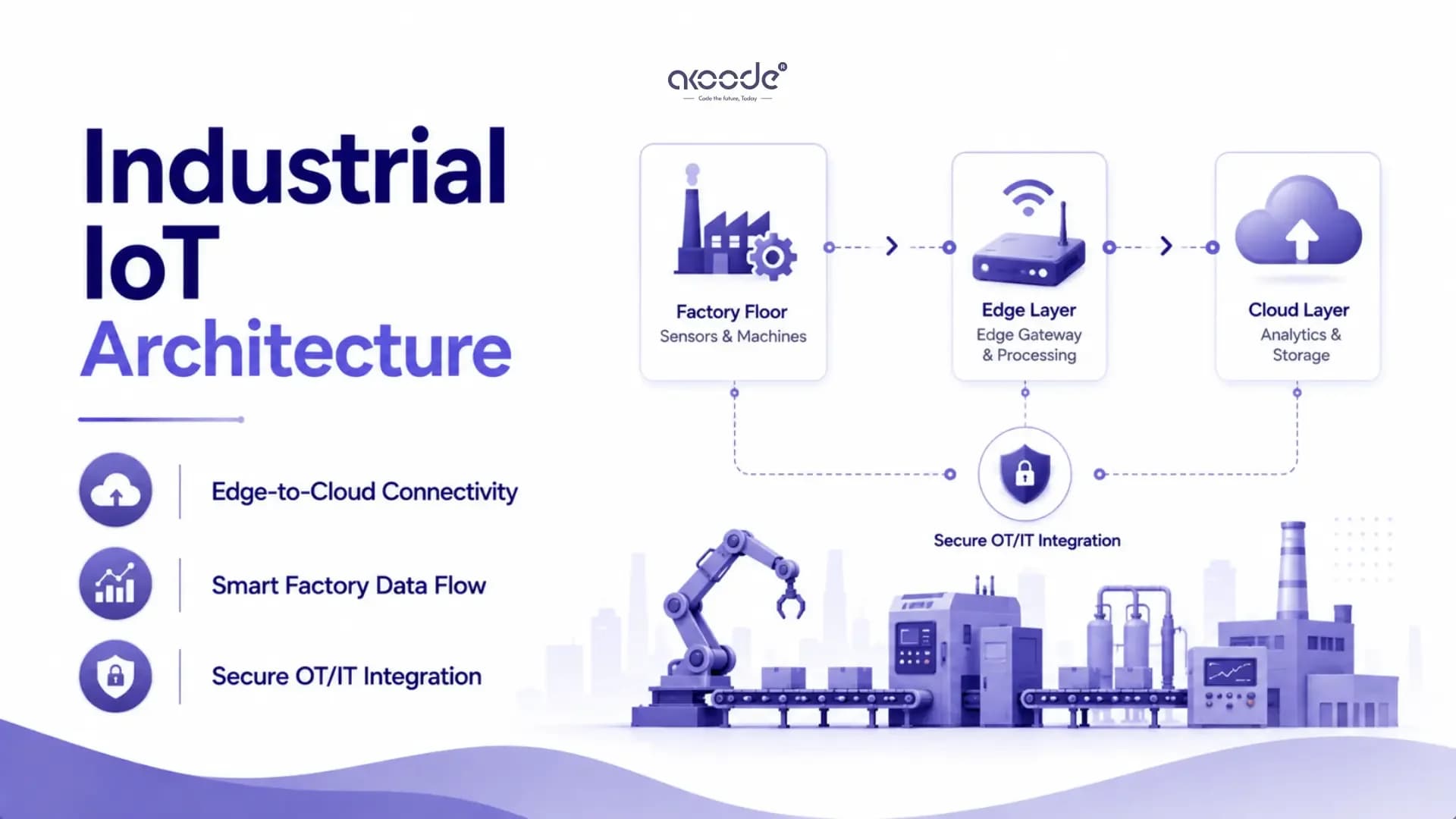
The field layer is where physical reality lives. Sensors, actuators, PLCs, and the machines themselves. This layer measures temperature, vibration, pressure, flow rate, whatever the physical process actually produces as raw signal.
The edge or fog layer sits physically close to the field layer and does the first round of processing before anything travels anywhere else. This is where local decisions happen fast. If a pressure threshold is breached, the edge layer can trigger an emergency stop instantly, without waiting for a round trip to a cloud server that physically cannot respond in time.
The connectivity layer moves data from the edge toward the cloud. This is where protocol choice matters enormously, and it is rarely a single protocol doing everything. Industrial settings frequently combine wired Ethernet for high-speed, fixed factory floor connections with wireless options like 5G or LoRaWAN for distributed or battery-powered sensors that cannot practically be wired.
The cloud and data layer is where information gets aggregated, stored, and made available for analysis at a scale no single factory's local systems could handle alone. This is also where data from multiple sites or facilities gets combined for the first time.
The application layer is what a human actually interacts with. Dashboards, alerts, predictive maintenance recommendations, production reports. This is the layer that turns raw sensor data into a decision someone on the floor or in the front office can actually act on.
The Industrial Internet Consortium's Reference Architecture, widely referenced across the industry as the IIRA, remains one of the most cited frameworks for organising exactly this kind of layered thinking, even as specific vendor implementations and protocols continue evolving underneath it.
Which Protocols Actually Matter, and Why?
Two protocols come up constantly in any serious IIoT architecture discussion, and they solve genuinely different problems.
OPC-UA provides semantic data modelling. It does not just move data from point A to point B. It describes what that data actually means, in a structured way that different systems and vendors can interpret consistently. This matters enormously in multi-vendor environments, which describes almost every real factory, where equipment from five different manufacturers somehow needs to speak a common language.
MQTT, specifically with the Sparkplug B specification, standardises how MQTT messaging works across multi-vendor IIoT deployments. MQTT itself is a lightweight messaging protocol built for unreliable networks and constrained devices, which made it a natural fit for industrial settings long before it became popular elsewhere. Sparkplug B adds the structure that keeps different vendors' implementations from quietly becoming incompatible with each other.
Time Sensitive Networking, or TSN, is a more recent standardisation effort specifically addressing a harder problem: how do you get the reliability, low latency, and precise time synchronisation that industrial automation genuinely requires, while still using standard Ethernet infrastructure rather than proprietary industrial buses? Academic research on wireless communications for smart manufacturing has identified TSN as one of the key developments harmonising what had previously been a fragmented landscape of incompatible industrial communication systems.
None of this is protocol trivia for its own sake. Getting protocol choice wrong early in an IIoT deployment creates integration debt that compounds with every additional device and system added afterward.
What Does OT/IT Convergence Actually Mean in Practice?
For decades, Operational Technology and Information Technology existed in genuinely parallel universes inside most industrial organisations. IT lived in temperature-controlled server rooms running enterprise systems. OT lived on the factory floor running isolated PLCs that were never designed to talk to anything outside their own control loop.
IIoT exists specifically to bridge that gap, and doing it securely is the harder half of the problem. A common and sound architectural pattern is outbound-only connectivity. The edge gateway on the factory floor initiates connections outward toward the cloud. No inbound ports get opened on the factory firewall. This significantly constrains an attacker's ability to reach back into operational systems from the IT or cloud side, though it is worth being honest that this pattern reduces risk rather than eliminating it entirely.
Security in IIoT architecture genuinely has to be layered rather than bolted on as an afterthought. Standards bodies have formalised much of this thinking. IEC 62443 addresses industrial automation and control systems security specifically. ISA-95, also published as IEC 62264, defines how enterprise and control systems should integrate. NIST SP 800-82 provides guidance specifically for industrial control systems security. These are not optional reading for anyone architecting a serious IIoT deployment. They represent decades of accumulated lessons about exactly where OT/IT convergence tends to go wrong.
There is a less obvious cost on the data side too. A recurring complaint among teams working with industrial data is that data scientists end up spending the overwhelming majority of their time simply cleaning raw machine noise into something usable, before any actual analysis or modelling can begin. That is not a software problem you fix later. It is a direct consequence of how the field and edge layers were architected in the first place.
Can You Retrofit Older Factory Equipment, or Do You Need New Machines?
You can retrofit, and in most real-world deployments, this is actually the norm rather than the exception.
The approach involves wrapping older, non-connected machines in a digital layer using external sensors and an edge gateway, without replacing the underlying equipment itself. The gateway sits between the legacy machine and the broader network, handling protocol conversion so a thirty-year-old PLC speaking an old proprietary protocol can still feed data into a modern cloud-based analytics platform.
This matters enormously for cost. Most factories are not going to replace their entire equipment base just to gain visibility into how that equipment performs. Retrofitting with the right edge gateway and sensor layer gets the same data benefit at a fraction of the capital cost, which is exactly why it has become the dominant pattern for organisations modernising existing facilities rather than building new ones from scratch.
What Are the Highest-ROI Use Cases for IIoT Right Now?
Three applications consistently show up with documented, measurable outcomes rather than speculative projections.
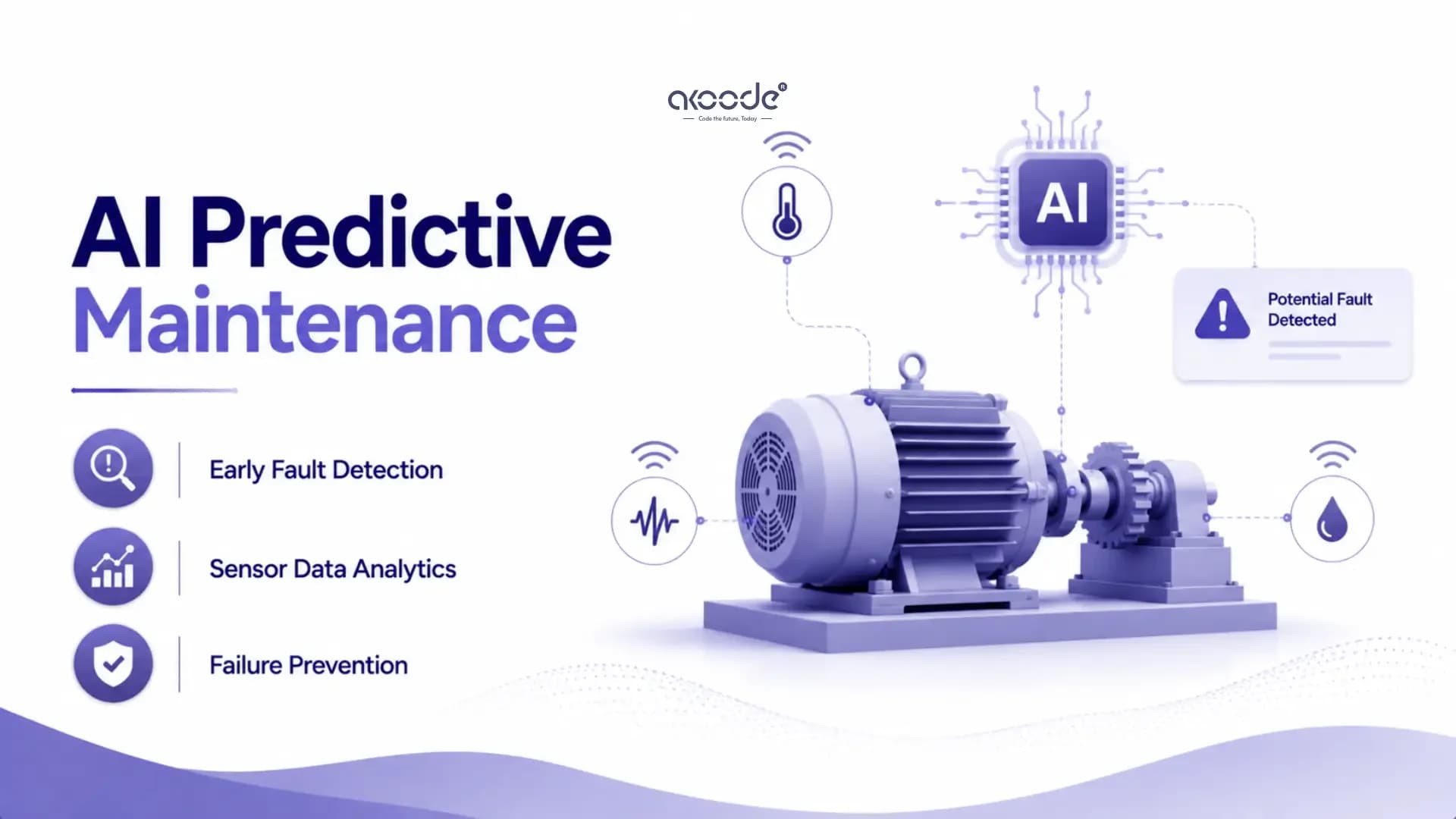
Predictive maintenance remains the clearest win, with documented downtime reductions in the 30 to 50 percent range across deployed systems. The architecture for building this properly depends entirely on getting the IIoT data pipeline right first, since the AI model is only as good as the sensor data and edge processing feeding it.
Cold chain logistics uses IIoT sensors to maintain and document temperature-controlled audit trails, which matters enormously for regulated industries like pharmaceuticals and food where compliance documentation is not optional. The sensor data itself becomes the compliance record.
Smart grid and precision agriculture applications push the connectivity layer in a different direction entirely, favouring long-range, low-power protocols like LoRaWAN over the high-speed Ethernet that dominates fixed factory floor connections. This is a useful reminder that there is no single right architecture for IIoT. The right connectivity choice depends entirely on whether you are connecting a fixed industrial line or a distributed network of battery-powered sensors spread across acres of farmland.
How Should a Business Actually Approach Building This?
Start with the connectivity layer decision, because getting it wrong creates problems that compound through every layer built on top of it afterward. Get connectivity wrong, and you build latency and integration debt into every decision that follows, regardless of how sophisticated the analytics or AI layer eventually becomes.
Be honest early about whether existing equipment needs replacing or can be retrofitted. Retrofitting with edge gateways is usually the more cost-effective path, and it lets you prove value on existing infrastructure before committing capital to anything new.
Treat security as architecture, not a feature added near the end. Outbound-only connectivity patterns, alignment with standards like IEC 62443, and a clear OT/IT boundary need to be designed in from the first conversation about the project, not retrofitted after a security review flags problems.
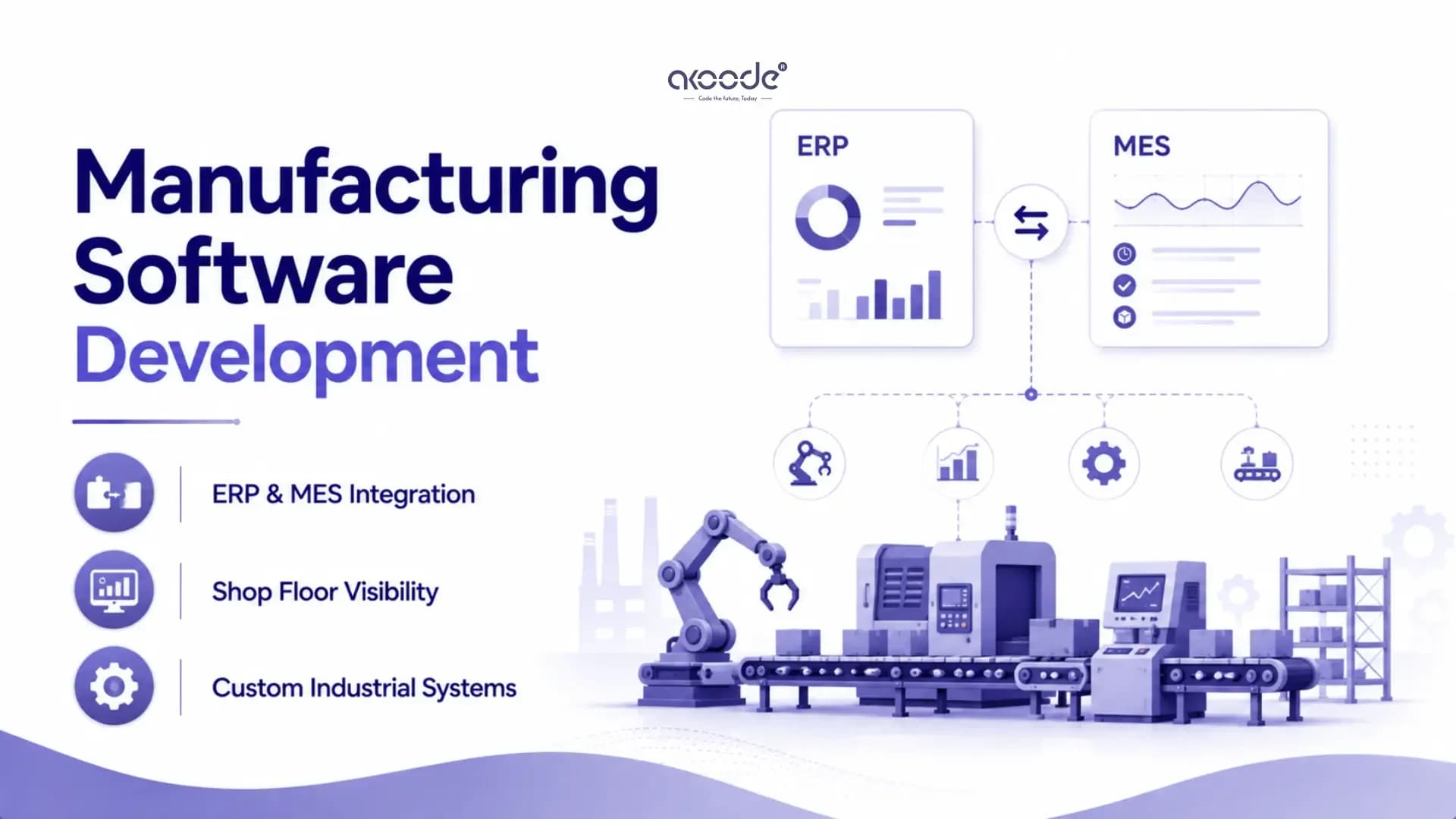
For manufacturing businesses thinking about how this connects to the broader software stack, understanding how ERP and MES systems integrate with real-time shop floor data is the natural next step, since IIoT is the data layer that makes accurate, real-time MES visibility possible in the first place.
Conclusion
Industrial IoT is not a bigger version of the smart home. It is a distinct engineering discipline with its own reliability requirements, its own protocols, and its own hard-won standards for security and integration, built specifically because the stakes of getting it wrong on a factory floor are categorically different from the stakes of a smart bulb losing connection.
The businesses getting real value from IIoT are the ones treating the architecture decisions, connectivity protocol, edge processing, OT/IT security boundary, as seriously as the analytics dashboards everyone eventually wants to look at. Get the foundation right, and the predictive maintenance, the smart grid application, the cold chain compliance record, all become genuinely achievable rather than a perpetual pilot project.
Akoode Technologies is a leading AI and software development company headquartered in Gurugram, India, with a US office in Oklahoma. From IoT solutions and AI-powered platforms to cloud and DevOps solutions and custom enterprise software, Akoode builds industrial IoT architecture for manufacturing, energy, and enterprise clients across 15+ industries globally. If you are planning an IIoT deployment and want a team that takes the OT/IT security boundary as seriously as the dashboard, that conversation starts here.
Frequently Asked Questions
1. What is IIoT and how is it different from regular IoT?
IIoT, industrial IoT, applies internet connectivity to industrial equipment and processes rather than consumer devices. The key differences are reliability requirements, safety implications, and data volume. Consumer IoT optimises for convenience, while IIoT optimises for safety and uptime, since a connectivity failure on industrial equipment can have far more serious consequences than a smart home glitch.
2. What does a typical IIoT architecture look like?
A production-proven IIoT architecture has five layers: the field layer with sensors and machines, the edge or fog layer for local real-time processing, the connectivity layer moving data toward the cloud, the cloud or data layer for aggregation and storage, and the application layer where dashboards and alerts reach actual users.
3. Why is edge computing necessary for industrial IoT rather than optional?
Safety interlocks in industrial settings often require response times under 5 milliseconds, while a round trip to the cloud typically takes 30 to 150 milliseconds. That latency gap is a physical limitation, not a software problem, which makes local edge processing structurally required for any safety-critical industrial application.
4. What protocols matter most in industrial IoT?
OPC-UA provides semantic data modelling so different vendors' systems can interpret data consistently. MQTT with the Sparkplug B specification standardises messaging across multi-vendor deployments. Time Sensitive Networking addresses the need for precise timing and reliability over standard Ethernet infrastructure in industrial automation settings.
5. Can older factory equipment be connected to IIoT systems, or does it need replacing?
Yes, through retrofitting. External sensors and an edge gateway can wrap a legacy machine in a digital layer without replacing the equipment itself. The gateway handles protocol conversion, allowing older PLCs running proprietary protocols to feed data into modern cloud-based analytics platforms at a fraction of the cost of full equipment replacement.
6. What are the highest-ROI use cases for industrial IoT in 2026?
Predictive maintenance shows documented downtime reductions of 30 to 50 percent and remains the clearest win. Cold chain logistics uses IIoT sensors to create compliance-grade temperature audit trails for regulated industries. Smart grid and precision agriculture applications favour long-range, low-power connectivity like LoRaWAN over the Ethernet used on fixed factory lines.
Get In Touch Now
View More Our Blog