 November 11, 2026
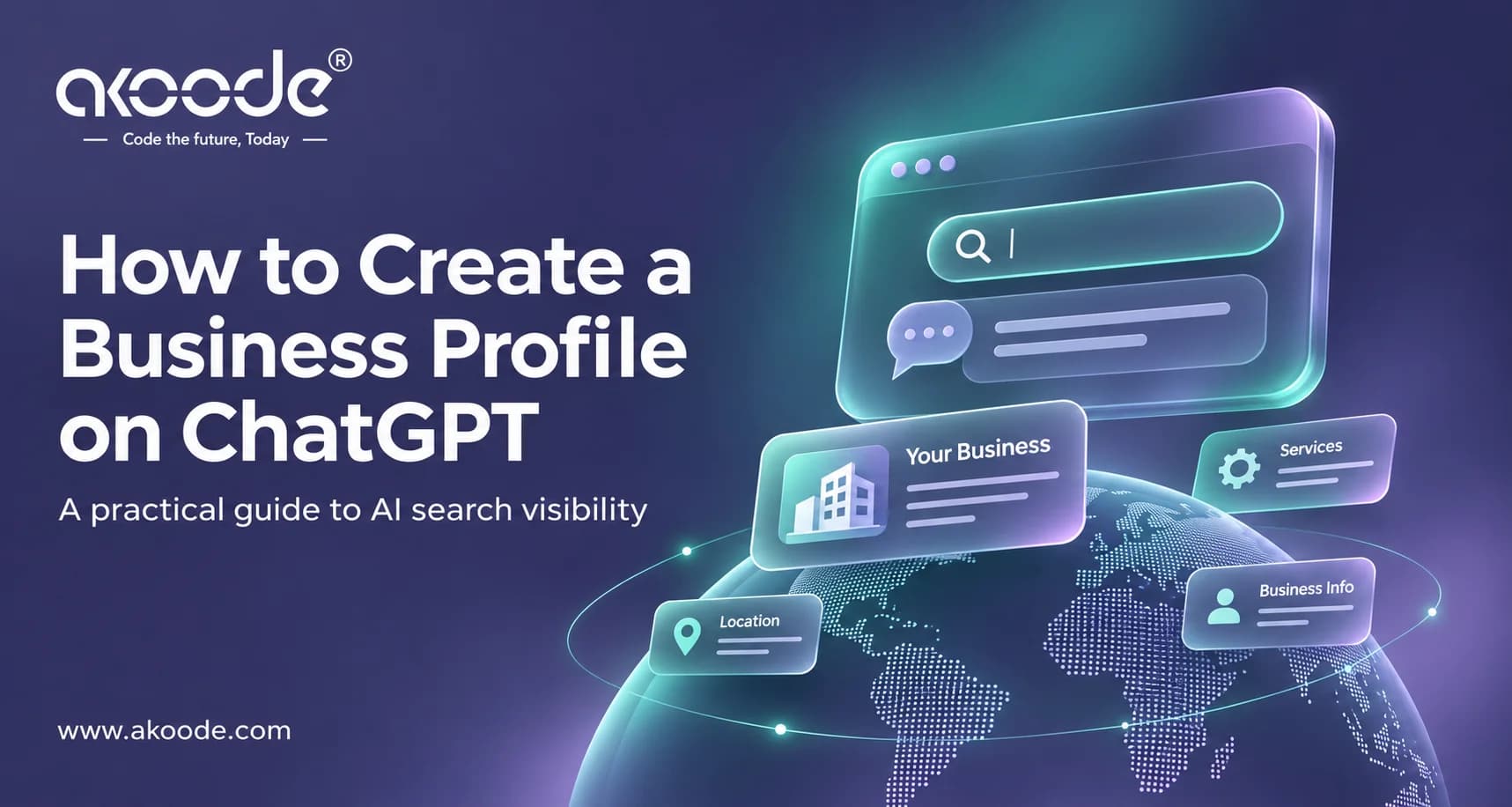
Potential customers can use ChatGPT to research companies, compare services, and build a shortlist of providers. For business owners, that raises an important question: How do you create a business profile on ChatGPT so customers can find your company?
The answer starts with a distinction. The official documentation reviewed for this guide does not describe a universal business listing that every company can register or claim. Building visibility means publishing accurate business information, making your website accessible to search, and creating useful content that helps people evaluate your services.
This guide explains the practical steps, the technical requirements worth checking, and how to measure progress without relying on promises of guaranteed recommendations.
Can You Create a Business Profile on ChatGPT?
If you are looking for an “Add Your Business” form that automatically places your company in ChatGPT answers, do not assume that such a universal registration process exists.
Several activities are sometimes confused with creating a public listing:
Activity | What it is used for | What you should not assume |
|---|---|---|
Providing company information in a conversation | Giving ChatGPT context for that conversation | That it registers your company for everyone |
Uploading a company brochure | Helping with tasks involving the uploaded information | That the brochure becomes publicly searchable |
Using a business workspace | Supporting your organisation’s use of ChatGPT | That subscribing purchases organic visibility |
Creating a branded AI assistant | Offering a particular assistant experience | That it guarantees recommendations in general search |
Publishing accessible website content | Making company information available on the public web | That accessibility guarantees inclusion |
For most service businesses, the useful starting point is a clear, credible website.
How Does ChatGPT Find Information About Businesses?
When ChatGPT uses web search, it can retrieve information from online sources to help answer a question. OpenAI documents OAI-SearchBot as a crawler used to surface websites in ChatGPT’s search features. developers.openai.com
That makes your public content important. A customer asking about your company needs reliable information about what you do, where you operate, and whether your experience matches their requirements.
However, there is no publicly documented formula that guarantees a particular business will be recommended. The following steps combine documented crawler guidance with practical website and content recommendations. They should be treated as improvements to discoverability and clarity, rather than confirmed ranking factors.
Step 1: Publish a Complete Business Profile on Your Website
Your website should provide an unambiguous answer to the question: What does this company do, and who does it help?
Create or improve your About page with:
Your business name and legal name, where relevant.
A concise description of your main services.
Your headquarters and genuine operating locations.
The markets and industries you serve.
Public contact information.
Relevant experience and credentials.
Links to service pages and project examples.
Avoid descriptions that could apply to almost any company, such as “We provide innovative solutions that transform businesses.”
A more useful description is:
Akoode Technologies is a software development company based in Gurugram, India, serving businesses internationally. Its services include custom software development, websites, mobile applications, AI assistants, and business automation.
The description identifies the business category, location, services, and market without exaggerated claims.
Distinguish Your Location From Your Service Area
A company can serve customers in a country without maintaining an office there.
State those facts separately. For example:
“Based in India, working with clients in the United States, Australia,Canada,UK and other international markets.”
Only describe a location as an office when that is accurate. Clear location information helps prospective customers assess working hours, communication, and delivery arrangements.
Step 2: Check Whether ChatGPT’s Search Crawler Can Access Your Website
OpenAI recommends allowing OAI-SearchBot in your website’s robots.txt configuration and permitting requests from its published IP ranges. developers.openai.com
Ask your developer to review both your website configuration and its security settings.
openai-search-crawler.jpg
Figure 1: OpenAI’s crawler documentation explains the purpose of OAI-SearchBot and the access settings website owners should review. Source: OpenAI Developers.
Review Your robots.txt File
A basic rule allowing this crawler looks like:
User-agent: OAI-SearchBot
Allow: /
This is an example, not a complete configuration for every website. A developer should check the existing rules before making changes.
Your review should also cover:
Whether important pages load without signing in.
Whether the server returns the intended page successfully.
Whether bot protection blocks legitimate requests.
Whether important information is available as readable text.
Whether internal links lead to your service and company pages.
Do not disable security controls broadly to accommodate a crawler. Use the provider’s documented configuration and verify legitimate traffic.
Understand OAI-SearchBot vs. GPTBot
These settings serve different purposes.
Crawler | Purpose described by OpenAI |
|---|---|
OAI-SearchBot | Surfacing websites in ChatGPT search |
GPTBot | Crawling content that may be used to train generative AI foundation models |
OpenAI states that these permissions can be managed independently. Allowing search access does not require allowing training access. developers.openai.com
Crawler access is a technical prerequisite worth checking, not a promise of visibility.
Step 3: Create Dedicated Pages for Your Main Services
A single paragraph listing everything your company offers gives customers little information to assess.
Create useful pages for your major services. For a software company, these might include:
Custom software development.
Mobile application development.
AI chatbot development.
Workflow automation.
Ecommerce development.
Website design and development.
Each page should answer a distinct set of buyer questions.
Buyer question | Content to include |
|---|---|
Is this service relevant to my business? | Typical customers and use cases |
What problems can it address? | Specific operational or commercial challenges |
What will I receive? | Deliverables and scope |
How does the engagement work? | Discovery, implementation, testing, and support |
What affects the cost? | Features, integrations, complexity, and support needs |
Why should I consider this company? | Relevant evidence and project examples |
Provide enough detail to help someone make a decision. Avoid creating many nearly identical pages with only the service name or city changed.
Step 4: Write Content Around Real Customer Questions
Customers often research the problem before they choose a provider.
A business considering automation might ask:
“Can an AI assistant answer questions from our company documents?”
Someone planning a product might ask:
“What should we prepare before hiring a mobile app development company?”
Create articles that answer those questions clearly.
Use an Answer-First Structure
A useful article structure is:
Answer the question directly.
Explain when the answer applies.
Describe the options and trade-offs.
Include a practical example.
Explain the next step.
For example, an article about AI assistants should discuss information sources, access permissions, answer quality, and ongoing maintenance—not simply repeat that AI saves time.
Explain technical terms the first time you use them. Readers in different countries and industries may have different levels of familiarity.
Where SEO, AEO, and GEO Fit
Search engine optimization (SEO) focuses on improving discovery through search engines.
Answer engine optimization (AEO) describes preparing content to answer questions clearly.
Generative engine optimization (GEO) describes efforts to improve how a business is represented in AI-generated responses.
These activities overlap. Accessible pages, clear explanations, reliable evidence, and accurate information are useful foundations across them. None provides a guaranteed placement in ChatGPT answers.
Step 5: Publish Case Studies That Demonstrate Your Expertise
A service page explains what you offer. A case study shows how you have applied it.
A strong case study includes:
The customer’s situation.
The challenge or requirement.
The scope of work.
The solution delivered.
Implementation considerations.
Verified results or delivery outcomes.
For example, a case study about an AI exercise application could explain the user journey, the role of AI guidance, the mobile experience, and how the product supports its users.
Use actual project details and approved screenshots. Do not invent revenue growth, accuracy figures, customer quotes, or performance improvements.
For businesses evaluating Akoode, the case studies page provides a natural place to explore relevant work.
Step 6: Make Your Business Information Consistent Across the Web
Review your website and legitimate external company profiles for conflicting information.
Common problems include:
An old address on a directory.
A previous company name on a social profile.
Broken website links.
Different descriptions of your main services.
Outdated contact details.
Unsupported claims about offices or certifications.
Correct inconsistencies at the source.
Choose directories, associations, and professional platforms that are relevant to your customers. A smaller number of useful, accurate profiles is easier to maintain than hundreds of low-quality submissions.
External profiles should support your broader online presence. They should not be sold as an automatic ChatGPT registration mechanism.
Step 7: Use Structured Data to Describe Your Business Accurately
Structured data provides machine-readable information about a webpage or organisation.
Ask your developer whether appropriate markup could clarify information already visible on your website, such as:
Organisation name.
Website URL.
Logo.
Relevant official profiles.
Business address, where appropriate.
Article author and publication information.
The markup should match the page. Do not add fictional locations, unsupported ratings, or services you do not provide.
Structured data is a general website practice. There is no established guarantee that adding a particular schema type will make ChatGPT recommend your business.
Step 8: Prepare Your Website for International Customers
A business seeking international visibility needs content that helps customers across markets assess its suitability.
Explain How You Work Across Borders
Answer practical questions such as:
Which time zones can your team support?
How do you communicate during a project?
How are scope changes handled?
What does post-launch support include?
Which currencies can you quote in?
How do you handle handover and ownership?
Publish only commitments your team can fulfil.
Localise Content When There Is a Real Need
If you serve customers in multiple languages, prioritise useful, professionally reviewed translations of your core pages.
Have a developer review language URLs, canonical tags, and hreflang implementation where relevant. These are international website considerations, not special ChatGPT ranking switches.
Avoid producing dozens of thin country pages simply to repeat location keywords.
Step 9: Measure Visibility With Repeatable Checks
Do not judge progress from one response.
Create a small set of questions that reflect your customers’ research journey.
Brand discovery prompt:
Search the web for [company name]. Explain its main services and locations, and cite the sources you use. Identify any conflicting information.
Service discovery prompt:
Find companies that provide [service] for [industry] in [market]. Explain why each company may be relevant and cite sources.
Buyer evaluation prompt:
What should a business check before hiring a company for [service]?
Use fresh conversations for cleaner comparisons. Record the date, exact question, whether search was used, the companies mentioned, and the cited pages.
A simple tracking table can help:
Measurement | What to record |
|---|---|
Brand accuracy | Whether services, locations, and contact details are correct |
Mentions | Whether your business appears in the sampled answers |
Citations | Which pages are referenced |
Referral visits | Visits attributed to ChatGPT where analytics identifies them |
Enquiries | Leads that report finding you through an AI assistant |
Conversions | Qualified opportunities or purchases associated with those visits |
Describe the results as observations from your sample, rather than a universal “ChatGPT ranking.”
Common Mistakes When Trying to Get a Business on ChatGPT
Treating a Conversation as a Public Registration Form
Telling ChatGPT about your business provides context for that interaction. It does not automatically create a business listing available to everyone.
Expecting a Subscription to Purchase Organic Recommendations
Evaluate subscriptions for their product capabilities. Do not treat them as a purchase of search visibility.
Publishing Large Volumes of Generic Content
Repetitive articles with little original information make it harder for readers to understand your expertise. Prioritise useful answers, genuine examples, and accurate details.
Confusing Crawler Access With Guaranteed Inclusion
Allowing a crawler resolves an access issue. It does not establish relevance for every question.
Promising a Fixed Ranking or Guaranteed Timeline
Be cautious of claims such as “number one on ChatGPT in seven days.” Ask what will actually be delivered and how progress will be measured.
A Practical 30-Day Business Visibility Plan
This is an implementation schedule, not a promise of results within 30 days.
Period | Main actions | Deliverable |
|---|---|---|
Week 1 | Review company information, crawler access, and major technical issues | Prioritised fixes |
Week 2 | Improve About, Contact, and core service pages | Clear business information |
Week 3 | Publish a detailed case study and useful customer-question content | Evidence and educational content |
Week 4 | Correct external profiles and establish measurement | Visibility baseline and reporting process |
Continue reviewing content as your services, team, locations, and customer needs change.
Frequently Asked Questions
How do I add my business to ChatGPT?
Start by making accurate company information publicly available, checking website accessibility, and publishing useful service pages and supporting evidence. Do not assume there is a universal business-registration form.
Can I create a ChatGPT business listing for free?
Many useful actions—such as improving your company description and correcting existing profiles—do not involve paying OpenAI. Website development, content production, and specialist support may involve their own costs.
Does my business need a website to appear in an answer?
A business may be discussed through third-party sources, but a website gives you an owned place to publish accurate information, explain services, and provide contact details.
Will uploading my company brochure make it publicly discoverable?
Uploading a brochure for a task should not be treated as publishing it or registering your company for other users.
Can a small business compete with larger brands?
A small business can provide detailed expertise for a particular service, customer group, or location. Focus on specific needs you can credibly address; there is no guarantee of inclusion based on company size.
How long does it take to appear in ChatGPT search?
There is no dependable universal timeline. Technical changes, content availability, the question asked, and the sources used can all affect what appears.
Should I allow GPTBot to improve search visibility?
OpenAI documents separate controls for GPTBot and OAI-SearchBot. Review search access and training preferences independently rather than treating them as the same decision.
Build a Business Presence Customers Can Understand and Trust
The most useful starting point is a website that clearly explains your company, provides evidence of your work, and answers the questions customers ask before contacting you.
For international businesses, that also means explaining where you operate, how you collaborate across time zones, and what clients can expect from delivery and support.
At Akoode Technologies, we help businesses improve their websites, build AI applications, and develop SEO, AEO, and GEO strategies grounded in practical technical and content work.
Explore Akoode Technologies, review our case studies, or schedule a conversation to discuss your business’s online visibility.
Get In Touch Now
View More Our Blog