


 June 26, 2026
If a SCADA integration fails at a utility, operators lose grid visibility immediately. If a compliance gap reaches production, the financial exposure is not abstract. NERC-CIP penalties can run up to $1 million per day per violation. And when ransomware hits an operational technology environment, the average recovery cost has reached roughly $3.12 million per incident, before regulators even get involved.
That is the actual risk profile behind energy software development, and it explains why this category of software gets built differently from almost anything else. A bug in a retail app is an inconvenience. A bug in a SCADA system is a safety and grid-stability event.
This guide covers what SCADA and EMS actually are and how they relate to each other, what custom utility platforms genuinely cost to build in 2026, and what separates a vendor who has actually worked in operational technology environments from one who has not.
What Is the Real Difference Between SCADA and EMS?
This distinction gets confused constantly, including by vendors who should know better, so it is worth being precise.
SCADA Is the Eyes and Hands on the Ground
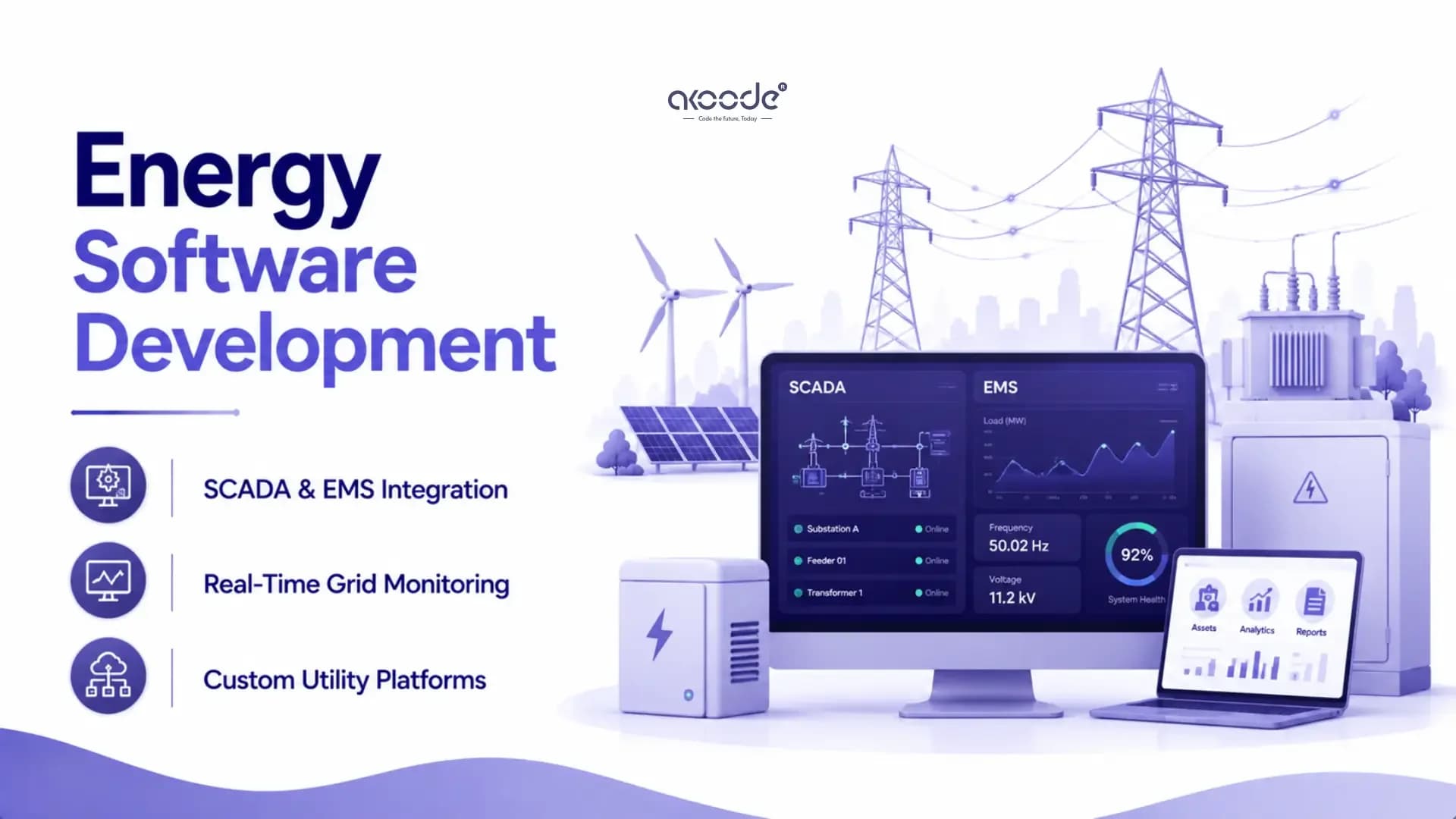
SCADA, Supervisory Control and Data Acquisition, provides the foundational, real-time data that everything above it depends on. It continuously monitors field devices like breakers, reclosers, and transformers, according to GE Vernova's documentation of its iPower SCADA platform. When a fault occurs, a line trip or a sudden voltage drop, SCADA flags the anomaly immediately, updates system status, and triggers alarms, giving operators the visibility they need to isolate the issue and coordinate field crews for restoration.
SCADA's role is fundamentally one of visibility and direct, local control. It tells you what is happening to a specific piece of equipment right now.
EMS Is the Brain Making Grid-Wide Decisions
Energy Management Systems sit a level above SCADA. Where SCADA provides the foundational data, breaker status, voltage levels, load measurements, EMS is responsible for grid-wide load balancing using that data, according to the same GE Vernova documentation. EMS takes the raw operational picture SCADA provides and makes the higher-level decisions about how power should flow across the entire system.
Why This Distinction Actually Matters for a Software Project
Confusing these two systems leads to scoping errors that show up expensively later. A 2026 industry analysis from Next Olive draws a sharper distinction worth understanding directly: traditional EMS, often tied closely to legacy SCADA, has historically acted as a historian, recording what happened for later analysis. Modern energy software, particularly anything managing renewable assets and battery storage, increasingly needs to function as a real-time control tower instead, orchestrating storage and responding to price signals within milliseconds rather than just logging history.
If your project brief says "EMS" but what the business actually needs is real-time, millisecond-level control of battery dispatch against fluctuating market prices, that is a fundamentally different engineering problem than a traditional load-balancing EMS, even though both get called by the same name.
What Does Custom Energy Software Actually Cost in 2026?
Cost estimates from multiple, separately sourced 2026 industry analyses converge on a fairly consistent picture, which is reassuring given how often these figures vary wildly by source.
Cost by Project Scope
A basic energy management system typically falls between $25,000 and $50,000. A mid-sized custom energy management platform in the US typically costs between $150,000 and $500,000, depending on AI complexity and the number of hardware integrations required. At the higher end, full energy software programs, covering EMS, SCADA extensions, analytics dashboards, or trading platforms, run from $150,000 for a focused pilot up to multi-million-dollar, multi-year programs for utility-scale deployments.
What Actually Drives Cost Within That Range
Integration depth is the single biggest cost variable, more than feature count. Connecting an EMS to existing SCADA systems, Modbus or BACnet protocols, inverter APIs, IoT sensors, ERP systems, and business intelligence tools is technically achievable, but the deeper the integration goes, the more development hours go into secure APIs and middleware. This is not optional complexity to be trimmed for budget reasons. Real-time data from meters, sensors, and grid systems is the entire point of the software, so integration depth tends to track directly with how genuinely useful the platform will be.
Security and compliance overhead adds real, non-negotiable cost on top of the base build. For organizations managing sensitive operational data, compliance with frameworks like ISO 50001 and sector-specific standards is not optional, and it imposes meaningful technical overhead beyond the feature development itself.
How Long Does This Actually Take to Build?
Typical EMS development timelines run 4 to 12 months, depending on integration scope, according to Techstack's 2026 analysis of energy software development. That range is wide because the variable is almost always integration complexity rather than the core EMS feature set itself.
What Should a Custom Platform Actually Do That Off-the-Shelf Tools Cannot?
Handle Real Tariff Structures, Not Generic Ones
A useful real-world example from a 2026 case study: for a client operating in the PJM Interconnection market, a custom system was built specifically to simulate the financial impact of load-shifting decisions against real-time locational marginal pricing. That is the kind of feature a generic, off-the-shelf monitoring tool simply does not offer, because LMP structures are specific to a given market and not worth building generically across every possible region.
Understand Operational Context, Not Just Raw Numbers
A plastic injection molding plant and a large bakery both consume significant energy, but their waste patterns are completely different. A generic dashboard might flag "high energy use at 10 AM" without further context. A custom system, built with operator input, can recognize that the spike corresponds to three extruders starting simultaneously, and recommend a staggered start sequence instead. This is the difference between a system that monitors and one that actually provides operational insight tied to how the facility runs day to day.
Bridge a "Frankenstein" Hardware Environment
Most real facilities run a genuinely mixed hardware environment, breakers from one manufacturer, HVAC systems from another, battery storage from a third. Custom development using API-first architecture is what bridges these silos into a single operational view, rather than forcing the business to monitor three or four separate vendor dashboards independently.
Participate in New Regulatory Markets as They Open
FERC Order 2222 is a concrete, dated example of why this matters for US-based utility and commercial energy software specifically. Its second set of tariff changes becomes effective in 2026, allowing small-scale distributed energy resources, like rooftop solar or EV chargers, to participate directly in wholesale markets. Off-the-shelf software generally lacks the sub-metering logic needed to aggregate these distributed assets for that purpose. Custom software is what allows a business to bundle its distributed energy resources and sell capacity back to the grid, turning what was previously a pure cost center into a genuine revenue stream.
What Does Compliance and Security Actually Require?
This is the part of energy software development that separates experienced vendors from inexperienced ones, and it deserves direct treatment rather than a passing mention.
The Regulatory Frameworks That Actually Apply
NERC-CIP compliance is mandatory for utilities operating in North America, and the financial exposure for a gap is severe, with penalties reaching up to $1 million per day per violation according to 2026 industry analysis of energy software vendor selection. IEC 62351 and NIST frameworks provide additional structure specifically around cybersecurity for industrial control systems. ISO 27001 and GDPR apply more broadly wherever sensitive operational or personal data is involved.
Why OT Security Is a Genuinely Different Discipline from IT Security
Operational technology environments, the actual control systems running breakers, substations, and grid equipment, are increasingly a direct target for ransomware specifically because disrupting them has real-world physical consequences, not just a data breach. Average recovery from a ransomware incident hitting OT systems has reached approximately $3.12 million, a figure that does not include whatever regulatory penalties follow once authorities get involved.
The practical implication for any business evaluating a development partner: a team that has only ever worked in conventional IT environments, web applications, internal business tools, and so on, does not automatically transfer that experience to OT-adjacent energy software. The risk of choosing a partner without genuine OT/IT convergence experience is not theoretical. It shows up as live outages and seven-figure recovery bills when a SCADA integration is handled by a team that does not understand the difference between IT and OT risk profiles.
How Should a Business Approach Choosing a Development Partner?
Ask directly what energy-specific systems a prospective partner has actually built, and push past vague answers. A vendor with genuine experience will name the system type without hesitation: an EMS platform, a SCADA integration, a trading platform, a customer-facing utility portal. Vague answers about "energy industry experience" without specifics are a warning sign worth taking seriously.
Ask specifically about real-time data handling and integration protocols. Energy software depends on live data from meters, sensors, and grid systems. A team that has actually done this work before will speak fluently and specifically about latency targets, data volumes, and which protocols, Modbus, BACnet, and so on, they have integrated with previously.
Confirm how compliance is embedded into the actual development process, not treated as a post-launch checklist. The strongest energy software vendors treat security and regulatory compliance as a design input from the very first architecture decision, not something added before go-live.
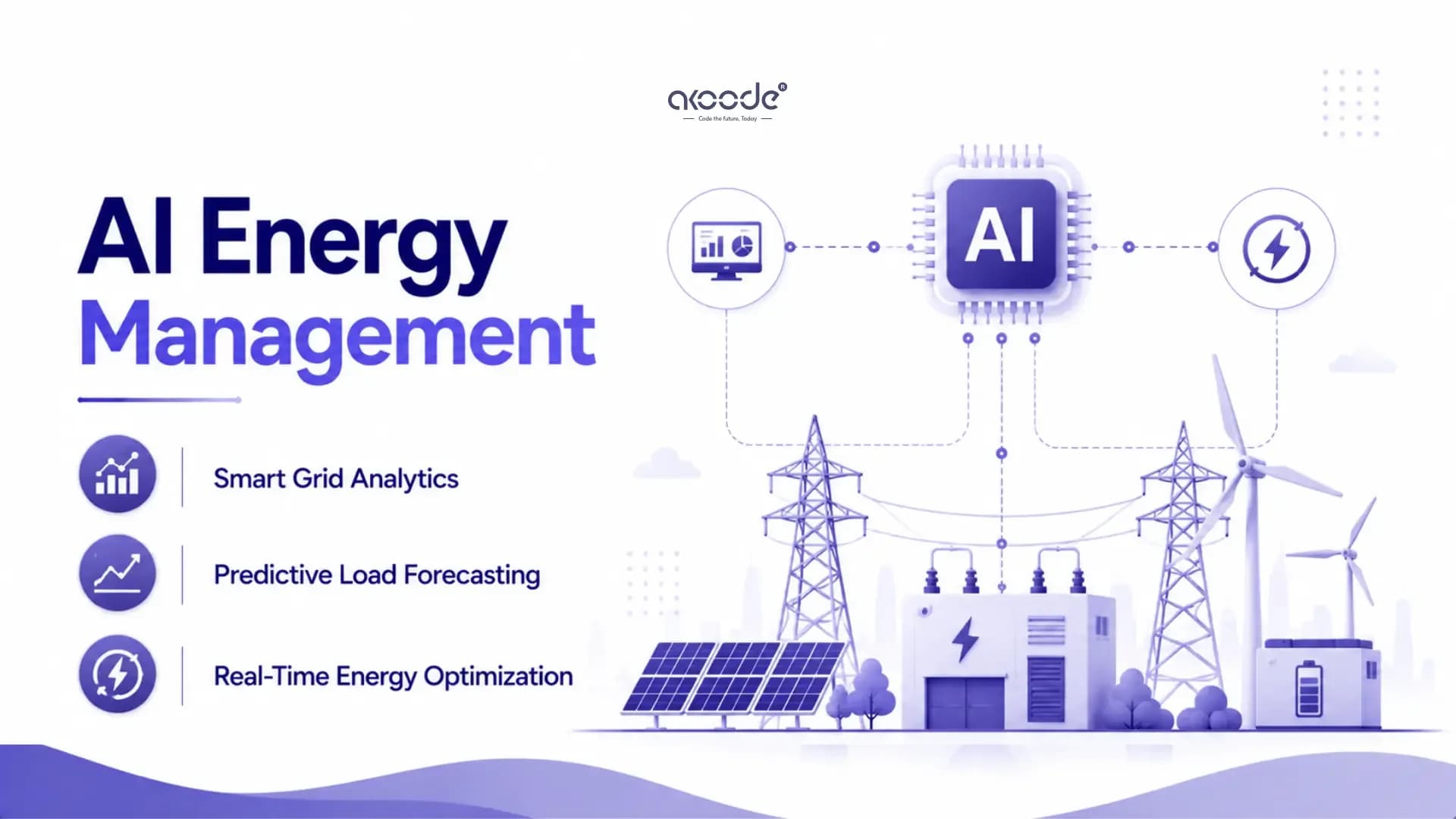
For organizations evaluating where AI fits into a broader energy platform strategy, Akoode's guide to AI energy management and smart grid analytics covers the forecasting and predictive maintenance layer that increasingly sits on top of the SCADA and EMS foundation described in this guide.
For organizations building these systems, Akoode's IoT solutions, cloud and DevOps solutions, and enterprise application development work covers exactly the discipline described above: real-time data integration, OT-aware security architecture, and compliance designed in from the first sprint rather than retrofitted before launch.
Conclusion
SCADA and EMS solve different layers of the same problem. SCADA gives you the ground-level visibility and control over individual equipment. EMS uses that data to make grid-wide or facility-wide decisions about how power should actually flow. Getting that distinction right at the scoping stage prevents a project from being built for the wrong problem entirely.
The cost ranges for custom energy software, from $25,000 for a basic EMS to multi-million-dollar utility-scale programs, are wide because integration depth and compliance requirements, not feature count, are what actually drive the budget. And in this specific category of software, the consequences of choosing a vendor without genuine OT experience are not abstract. They show up as real outages, real regulatory penalties, and seven-figure recovery costs when something goes wrong.
Akoode Technologies is a leading AI and software development company headquartered in Gurugram, India, with a US office in Oklahoma. From enterprise application development and IoT solutions to cloud and DevOps solutions and AI-powered platforms, Akoode builds custom energy management systems, SCADA integrations, and utility software for energy companies and enterprise clients across 15+ industries globally. If you are planning an energy software project and want a team that treats OT security as architecture rather than an afterthought, that conversation starts here.
Frequently Asked Questions
1. What is the difference between SCADA and EMS?
SCADA, Supervisory Control and Data Acquisition, monitors and controls field-level equipment like breakers and transformers, providing real-time visibility into specific assets. EMS, Energy Management System, uses that SCADA data to make higher-level, grid-wide or facility-wide decisions about load balancing and power flow. SCADA provides the data foundation that EMS relies on.
2. How much does custom energy management software cost to build in 2026?
A basic EMS typically costs $25,000 to $50,000. A mid-sized custom platform with AI forecasting and multiple hardware integrations runs $150,000 to $500,000. Full utility-scale programs covering EMS, SCADA extensions, and analytics platforms range from $150,000 for a focused pilot to multi-million-dollar, multi-year deployments.
3. Why does integration depth matter more than feature count for energy software cost?
Energy software depends entirely on live data from meters, sensors, SCADA systems, and existing business tools like ERP. The deeper the integration with these existing systems, the more development hours go into building secure APIs and middleware. This integration work, not the visible feature list, is usually what actually determines project cost and timeline.
4. What compliance frameworks apply to energy software development?
NERC-CIP is mandatory for North American utilities, with penalties reaching up to $1 million per day per violation. IEC 62351 and NIST frameworks address industrial control system cybersecurity specifically. ISO 27001 and GDPR apply wherever sensitive operational or personal data is processed.
5. Why is operational technology security different from standard IT security?
OT environments control physical infrastructure like breakers and substations, meaning a security failure can cause real-world physical and safety consequences, not just a data breach. Average ransomware recovery costs for OT systems have reached approximately $3.12 million per incident, separate from any regulatory penalties that follow.
6. How long does it typically take to build a custom EMS?
Typical EMS development timelines run 4 to 12 months, depending primarily on integration scope and the number of existing systems, SCADA, ERP, IoT sensors, that the new platform needs to connect with, rather than the core feature set itself.