


 June 26, 2026
A grid operator's forecasting model has decades of historical demand curves to learn from. Then a pandemic hits, employees stay home overnight, and industrial demand collapses. The model has no historic curve to match against. It simply has nothing to learn from.
That is a real example from Hydro-Québec, described by Sylvain Clermont, lead author of the UNECE Task Force on Digitalisation in Energy's case study on the utility's AI program, in 2026 reporting from Power Technology. It is a useful starting point for this guide because it captures something most marketing content about AI energy systems leaves out entirely: these platforms are genuinely good at pattern matching against history, and genuinely limited the moment something happens that has never happened before.
This guide covers what it actually takes to build an AI energy management system or smart grid analytics platform. The data architecture underneath it. The forecasting models that work in practice. And the real constraints that show up once a system moves from a pilot to production at grid scale.
Why Are Utilities Investing in AI Energy Management Systems Now?
The honest answer is that the grid itself has stopped behaving the way it used to, and legacy forecasting models were built for a grid that no longer exists.
"The increasing penetration of renewables introduces variability and uncertainty into grid operations, making traditional forecasting and control methods less effective," David Adkins, head of network architecture and innovation at National Grid, told Power Technology in 2026. Wind and solar generation fluctuate constantly. Demand patterns shift with extreme weather events that are becoming more frequent. The gap between what legacy models predict and what actually happens is widening, sometimes by hundreds of megawatts on a difficult day.
How Widely Deployed Is the Underlying Infrastructure Already?
The data foundation for AI energy management is already largely in place, which matters more than it sounds. Advanced metering infrastructure covers roughly 70 to 75 percent of US customers, according to GlobalData's tracking cited in Power Technology's 2026 reporting. China has reached approximately 80 percent smart meter adoption, and the EU market sits between 80 and 90 percent. The bottleneck for most utilities right now is not data collection. It is what happens to that data once it exists.
What Does the Data Architecture Actually Look Like?
This is where most AI energy management projects either succeed quietly or stall expensively, and it has very little to do with the forecasting model itself.
Why a Data Lake Architecture Works Better Than a Relational Database Alone
Power grids generate data in relational, semi-structured, and unstructured formats simultaneously, according to a 2025 MDPI study on AI-big data architecture for energy forecasting. Documentary records, log files, images, smart meter readings, and sensor streams all need to coexist. Historical operational databases that were originally built for transactional processes become progressively slower as both the live operational load and the ad hoc reporting load grow on the same infrastructure.
The architecture that addresses this directly separates data into layers, often called bronze, silver, and gold. The bronze layer stores raw, completely unmodified data exactly as it arrived. The silver layer holds cleaned, treated data that is ready for analysis. The gold layer holds the outputs: trained models, prediction results, and finished analysis. This separation matters because it keeps governance clean. You always know exactly what stage a given piece of data is at, and a mistake in processing does not corrupt the raw source record.
Where Real-Time Processing Fits on Top
For utilities working toward live, sub-second decision-making rather than batch reporting, an additional real-time layer using something like Apache Spark for in-memory stream processing sits above the core data lake, creating what is often called a lambda-style architecture, according to the same 2025 research. This is the layer that lets a platform react to a sudden frequency deviation or an unexpected demand spike within the timeframe that actually matters for grid stability, rather than discovering the problem in a report generated hours later.
Why On-Premises, Open-Source Infrastructure Is a Legitimate Starting Point
A reduced, customized stack of Hadoop and Spark is presented in the same study as a genuinely cost-effective, on-premises alternative to commercial big data platforms, particularly for utilities at an earlier stage of analytics maturity. The recommendation is not to avoid commercial tools forever. It is to start with something flexible and scalable, prove the value internally, and migrate to commercial or hybrid infrastructure once the organization has a clearer picture of what it actually needs at production scale.
What Forecasting and Prediction Capabilities Should the Platform Actually Deliver?
Load Forecasting
This remains the single most consequential AI capability in an energy management platform, because almost every other decision, generation dispatch, demand response, maintenance scheduling, depends on an accurate forecast underneath it. AI improves load forecasting by combining advanced metering infrastructure data with machine learning, producing more accurate predictions than traditional statistical approaches, according to SAP's analysis of AI in smart grid technologies.
Hydro-Québec's approach is a useful real-world example of how this actually gets built in practice. Clermont describes the method directly: "We look at patterns and try to find a model that gives a curve to match, then we adjust parameters depending on the day, and fit them to the mathematical model until it looks right." The utility is currently working through a multi-year rollout, continuing model improvement and renewable forecasting prototyping through 2026 and 2027, before moving to a bottom-up regional forecasting approach covering more than 350 substations starting in 2028. That timeline is worth sitting with. This is not a project that gets fully deployed in a single year, even at a well-resourced utility.
Outage Detection and Prediction
Sensors and meters across the grid can transmit a brief "last gasp" signal at the moment of a power loss, capturing the exact time and nature of the outage, according to SAP's smart grid analysis. Combined with predictive analytics, this lets operators distinguish between an individual customer outage, a street-level outage, and a broader zonal failure, and in some cases notify operators of a developing outage before it fully occurs.
Predictive Maintenance for Grid Assets
Sensor data on asset performance lets utilities forecast potential equipment failures well before an outage actually happens, according to GE Vernova's analysis of smart grid analytics. A specific example worth understanding: fault detection systems for solar arrays now combine a fast, lightweight spectral analysis front-end with a deep learning classifier that only activates on genuinely suspicious signal windows, according to a 2025 ScienceDirect review of AI-driven smart grid stability research. This two-stage approach keeps false alarms low while still catching weak or intermittent faults that a purely lightweight detector would miss, and it does so within the sub-cycle latency budget, roughly 8 to 16 milliseconds per frame, that real-time grid protection actually requires.
Distributed Energy Resource Optimization
Virtual power plants, which aggregate distributed energy resources like rooftop solar and battery storage across many individual sites, require optimized scheduling across multiple time horizons simultaneously: day-ahead on an hourly basis, then refined down to 15-minute and 5-minute intervals as real-time conditions become clearer, according to 2026 research published in MDPI's smart grid technologies special issue. The scheduling objective is typically dual: maximize net profit for the aggregated resource pool while minimizing emissions.
What Are the Real Constraints That Show Up at Production Scale?
Edge Computing and Latency Requirements
Deploying AI on edge devices like micro phasor measurement units demands a pipeline engineered specifically for sub-cycle inference, tight memory and compute budgets, and consistently high reliability, according to the ScienceDirect review of AI applications in grid stability. This is a genuinely different engineering discipline from training a model in the cloud on historical data. A model that performs beautifully in offline testing can be completely impractical if it cannot run within the latency budget that grid protection equipment actually demands.
The Interpretability Trade-Off
More sophisticated deep learning models, particularly three-dimensional convolutional networks, tend to deliver better detection accuracy on weak or intermittent faults but come with substantial compute cost and limited explainability for the human operator sitting in the control room, according to the same review. Lighter, more traditional signal processing methods are explainable and cheap to run but can become fragile during unusual conditions like sudden irradiance changes. The two-stage pipeline approach described earlier exists specifically to navigate this trade-off rather than picking one extreme.
Data Volume at Real Scale
"Having to deal with data from more than four million smart meters is another ball game," Hydro-Québec's spokesperson told Power Technology, describing the utility's own internal challenge as it scales its forecasting program. This is worth taking seriously as a planning input. The gap between a successful pilot covering a handful of substations and a production system covering an entire utility's customer base is not incremental. It is a different category of engineering problem.
Model Generalization to New Conditions
Transfer learning, semi-supervised learning, and domain adaptation are increasingly used specifically to help models generalize to new sites and operating conditions without requiring a complete retraining cycle on freshly labeled data every time, according to the ScienceDirect review. In DC microgrids specifically, transfer learning has enabled fault detection at a new site even without any prior labeled fault data from that exact location, which matters enormously for utilities trying to scale a working model across a diverse, geographically distributed asset base.
How Should a Utility or Energy Company Actually Approach This Build?
Start with the data architecture before the model, not the other way around. The layered data lake approach, separating raw, cleaned, and analysis-ready data, is what makes every subsequent forecasting or detection capability viable. Skipping this step and jumping straight to a forecasting model trained on whatever data happens to be easiest to access produces a system that works in a demo and degrades quickly once it meets real, messy operational data.
Be honest about the latency requirement for each specific use case before choosing a model architecture. A load forecasting model running on a daily or hourly cycle has very different constraints than a fault detection model that needs to make a decision within a single power cycle. Conflating these two categories of problem, and applying the same model complexity to both, is a common and expensive mistake.
Plan for a multi-year rollout rather than a single big-bang deployment, particularly for anything touching forecasting at scale. Hydro-Québec's own multi-year, phased approach, improving the model through 2027 before expanding to a full regional rollout in 2028, reflects how seriously well-resourced utilities are treating the scaling challenge rather than assuming a pilot's success automatically translates to grid-wide deployment.
For organizations building this kind of platform, Akoode's IoT solutions and AI-powered software development work covers the same foundational discipline that underpins smart grid analytics: getting the sensor data pipeline and the model architecture right together, rather than treating them as separate workstreams that get bolted together at the end.
Conclusion
Building an AI energy management system is fundamentally a data architecture problem with a forecasting and detection model sitting on top of it. The utilities seeing real results, National Grid improving its renewable integration forecasting, Hydro-Québec working through a genuinely multi-year scaling plan, are not succeeding because of a single breakthrough model. They are succeeding because they built the data layer correctly, were honest about latency requirements for different use cases, and planned for a phased rollout rather than expecting a pilot to translate directly into grid-wide deployment.
The constraints covered in this guide, edge latency budgets, the interpretability trade-off between model types, and the genuine difficulty of generalizing across millions of meters and diverse grid conditions, are not reasons to avoid this technology. They are the actual engineering work that separates a platform that works in production from one that only worked in the demo.
Akoode Technologies is a leading AI and software development company headquartered in Gurugram, India, with a US office in Oklahoma. From AI-powered software development and IoT solutions to big data engineering and cloud and DevOps solutions, Akoode builds smart grid analytics and energy management platforms for utilities and enterprise clients across 15+ industries globally. If you are planning an AI energy management system and want a team that takes the data architecture as seriously as the forecasting model, that conversation starts here.
Frequently Asked Questions
1. What is an AI energy management system?
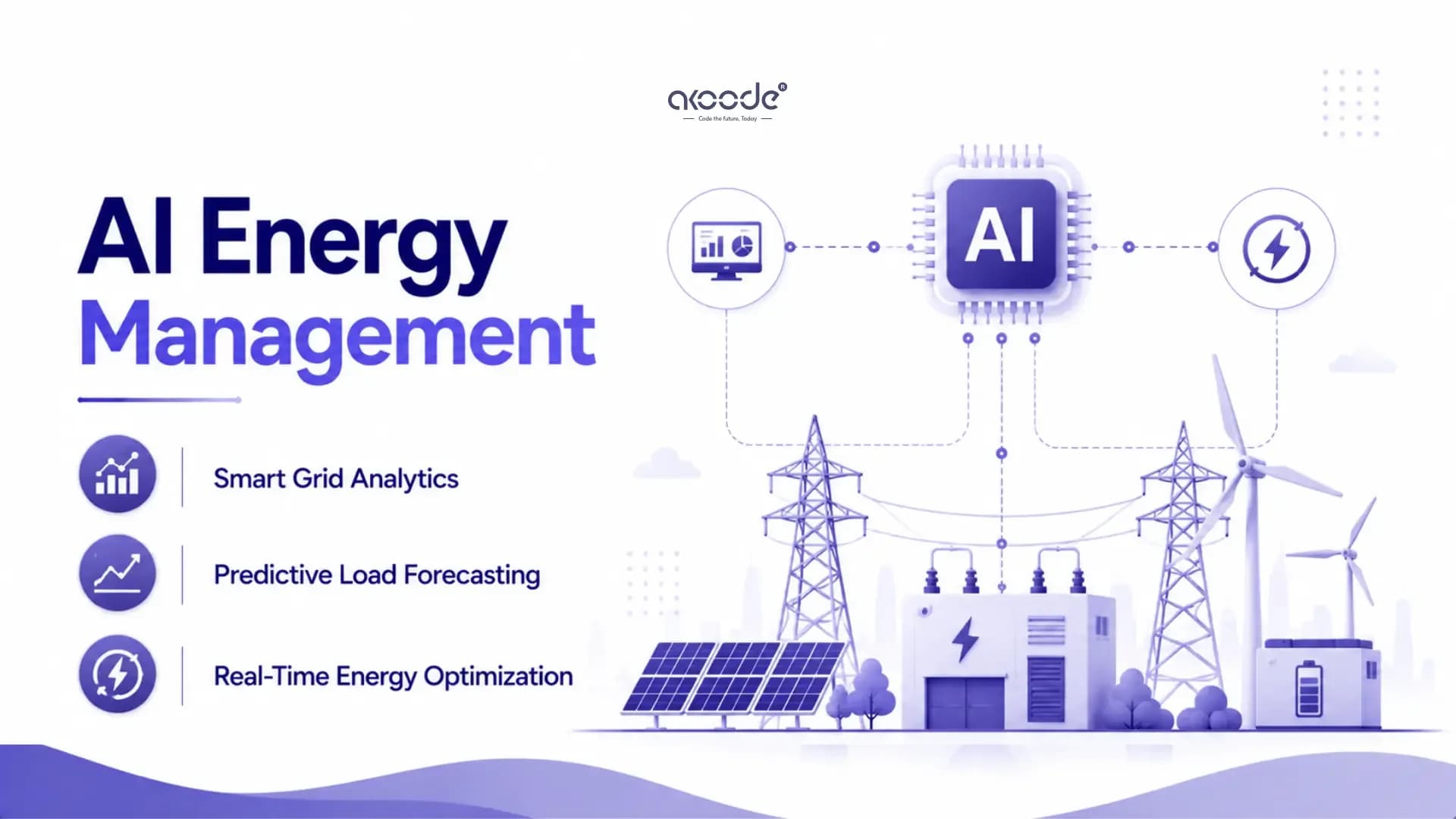
An AI energy management system uses machine learning and big data analytics to optimize how electricity is generated, distributed, and consumed across a grid. Core capabilities typically include load forecasting, outage detection and prediction, predictive maintenance for grid assets, and optimized scheduling for distributed energy resources like solar and battery storage.
2. What is the right data architecture for a smart grid analytics platform?
Most production systems use a layered data lake architecture, with a bronze layer for raw unmodified data, a silver layer for cleaned and processed data, and a gold layer for model outputs and predictions. A real-time processing layer using stream-processing tools like Apache Spark is often added on top for utilities that need sub-second decision-making rather than batch reporting.
3. Why do AI load forecasting models sometimes fail?
These models learn from historical demand patterns and adjust parameters until the predicted curve matches past behavior. They struggle specifically when something happens that has no precedent in the historical data, such as a sudden, unprecedented shift in demand. Hydro-Québec's own AI lead has described exactly this limitation when discussing the utility's forecasting program in 2026.
4. How does AI handle fault detection on solar and grid assets?
Many production systems use a two-stage approach: a lightweight, fast signal processing method first screens for suspicious activity, then a more computationally expensive deep learning classifier only activates on those flagged windows. This balances detection accuracy against the sub-cycle latency requirements that real-time grid protection demands, typically 8 to 16 milliseconds per frame.
5. How long does it take to scale an AI energy management system across an entire utility?
Multi-year timelines are common even at well-resourced utilities. Hydro-Québec's own public rollout plan runs from continued model improvement and renewable forecasting prototyping through 2026 and 2027, before expanding to a full regional forecasting approach covering more than 350 substations starting in 2028.
6. What is the biggest technical challenge in deploying AI at grid scale?
Two challenges stand out consistently in current research: meeting the strict latency requirements for edge-deployed models making real-time decisions, and generalizing a model trained on one site or region to new locations without requiring a full retraining cycle each time. Techniques like transfer learning are increasingly used to address the second challenge specifically.