 November 11, 2026
Short answer
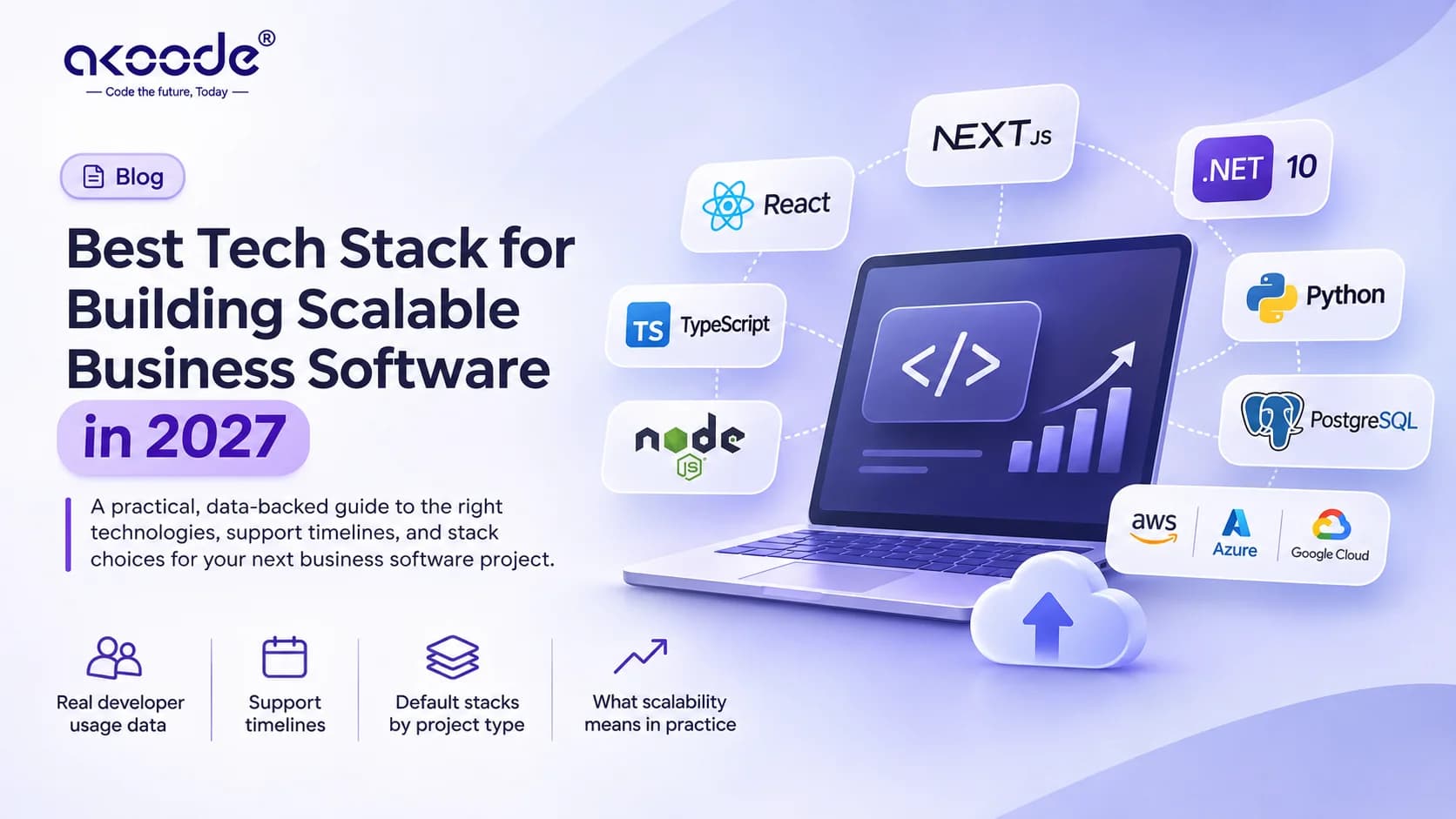
For most US business software in 2027, a boring stack wins. Use TypeScript with React or Next.js on the front end, a mainstream back end (Node.js, .NET 10 or Python), PostgreSQL for data, and one of AWS, Azure or Google Cloud. Start as a well-organized monolith and split it up only when you have a reason. Pick the language your team and your hiring market already know, because scale problems almost always come from design, not from the language.
Every few months a new framework gets crowned the future of software. Then a founder reads about it, and an engineer wants to try it, and suddenly a straightforward customer portal is being built on a stack nobody on the team has shipped before. Six months later the project is late and hiring is hard.
This guide is for the person who has to approve the stack: a founder, a CTO, a head of product. We look at what developers really use in 2026, five rules for choosing, a calendar of runtimes losing support right now, default stacks for different kinds of projects, and what scalability means in practice.
We build on several stacks and have no stake in one of them winning. Where a choice is a matter of taste, we say so.
What developers actually use in 2026
Languages and frameworks
Stack Overflow's 2026 Developer Survey (30,903 respondents in 169 countries, released October 6) has JavaScript at the top for the 12th year in a row, used by 62.0% of respondents. SQL (58.4%) edged past HTML/CSS (58.2%) for second place, Python sits at 58.0%, and TypeScript at 43.8%. Java (27.6%) and C# (27.1%) follow. Rust climbed to 12th.
On the web side, Node.js (46%) and React (42%) lead, with Next.js behind them. ASP.NET Core came fourth at 19.9%. GitHub's Octoverse 2025 report ranked TypeScript first by contributors, which fits the same story: the center of gravity is TypeScript and Python, with Java and C# a solid second tier.
Databases
PostgreSQL is the most used database in the survey, at about 58% of respondents, ahead of SQLite and MySQL, and it is also the most admired. If you have no strong reason to pick something else, PostgreSQL is the answer. It handles relational data, JSON documents and, with extensions, vector search for AI features.
Cloud
In Stack Overflow's cloud category, AWS was used by 41.8% of respondents, Azure by 25.1% and Google Cloud by 24.5%. Synergy Research's Q3 2026 data tells a similar story at the market level: cloud infrastructure spending rose 55% year on year to about $167.7 billion, with Amazon at 26% share, Microsoft at 19% and Google at 16%. About a third of the market is now AI-specific services.
AI changed the tools, not the stack
About 72% of respondents said they used a large language model, and Claude Code and GitHub Copilot were the most-used coding agents. Stack Overflow's own summary notes that AI changed how developers write code far more than which languages they write it in. It is plausible that AI tools do better on widely used stacks, but we know of no independent measurement, so treat that as a tiebreaker rather than a reason.
Five rules for choosing a stack
Rule 1: Choose what you can hire for
A stack is only as good as the people who can work on it. Mainstream choices have large hiring pools, and niche ones do not. Time to fill for software roles already runs from about 6 weeks to 3 months, and longer for specialists, as we cover in our guide to hiring software developers in the USA, and a rare stack makes that worse. Use the usage numbers above as a rough proxy for talent supply.
Rule 2: Treat boring as a feature
Mature tools have documented answers to the problems you will hit, long support windows and plenty of people who have already made the mistakes. New tools have exciting demos. A business system you will run for five years wants the first kind.
Rule 3: Check the support calendar
Every runtime has a date after which it stops getting security fixes. Building on a version near its end date means paying for an upgrade almost immediately. The next section gives the dates that matter this year and next.
Rule 4: Match the problem
Data and AI products lean toward Python. Microsoft-heavy enterprises lean toward .NET. Real-time and highly interactive products lean toward TypeScript end to end. The best stack for a customer portal is not the best stack for a machine learning pipeline, and a company can use more than one.
Rule 5: Optimize for change, not for scale
Most software never reaches the scale that stack debates assume. What it does reach, constantly, is change: new requirements, new integrations, new people. A clean, well-tested codebase in a mainstream language changes cheaply. We come back to this in the scalability section.
The support calendar: runtimes losing support in 2026 and 2027
Runtime | Support ends | What it means |
|---|---|---|
Node.js 20 | April 30, 2026 (passed) | Move to Node.js 22 or 24. |
Python 3.10 | October 2026 (passed) | Move to a current Python 3 release. |
.NET 8 and .NET 9 | November 10, 2026 | Microsoft recommends upgrading to .NET 10, an LTS release supported through November 2028. |
Node.js 22 | April 30, 2027 | Plan the move to Node.js 24 during 2027. |
Node.js 24 | April 30, 2028 | Current choice for new builds. |
.NET 10 | November 14, 2028 | Current choice for new .NET builds. |
Microsoft's own notice says that after November 10, 2026, .NET 8 and .NET 9 receive no further security updates or technical support. If you run either, today is the day to put an upgrade on the roadmap.
This is the real reason to budget for upkeep. Three major runtimes lost or are losing support within about seven months. In our custom software development cost guide, we use 15% to 25% of the build cost per year for upkeep as a planning convention, and platform upgrades are a big part of what that pays for.
Default stacks by project type
Project type | A sensible default | Why |
|---|---|---|
B2B SaaS or business web app | TypeScript, React or Next.js, Node.js or Python on the back end, PostgreSQL | Biggest hiring pool, fast to build, easy to change |
Microsoft-heavy enterprise | .NET 10, ASP.NET Core, SQL Server or PostgreSQL, Azure | Fits existing identity, tooling and skills |
Data or AI-heavy product | Python, PostgreSQL with vector support, a queue, a major cloud | The AI and data ecosystem lives in Python |
Mobile app | Flutter or React Native, shared backend | One team ships iOS and Android |
Online store | Shopify, or headless on top of it | Cheaper than custom for most stores |
Internal tool | A SaaS product or low-code tool first | Build only what you cannot buy |
B2B SaaS and business web apps
This is the largest category, and TypeScript across the stack is a common starting point because one language covers the front end and back end, which makes small teams faster. We have built on this pattern in projects such as our three-surface parking platform, which pairs a Flutter app with a Next.js web portal. If you are building a product to sell, see SaaS product development.
Enterprise and Microsoft-heavy shops
If your company already runs on Azure, Active Directory and Microsoft licensing, .NET 10 is a very reasonable choice, and ASP.NET Core was the fourth most-used web framework in the 2026 survey. Our enterprise application development work covers this kind of environment.
Data and AI-heavy products
Python is the default because the libraries, the model tooling and the people are there. Keep the AI service separate from the main application so you can change models without rewriting the product. If you are in Austin, our page on AI development in Austin is a good place to start, and our guide to AI agent development covers the build-or-buy math.
Mobile apps
Choose Flutter or React Native when you need both platforms and a normal feature set, and native Swift or Kotlin when you need the newest platform features or heavy hardware work. Our mobile app development cost guide shows what each choice does to the budget, and if you are building in Chicago, see mobile app development in Chicago.
Online stores and internal tools
For stores, a platform is usually cheaper than custom code, as our ecommerce cost guide shows. For internal tools, check whether SaaS covers the need before you write code. Our guide to custom software vs SaaS has the five-year math.
Scalability: what actually breaks first
The database, almost always
When business software slows down, the cause is usually a missing index, a query that fetches too much, or a table design that does not match how the data is used. Fixing those costs far less than changing languages. Learn to read a query plan before you consider a rewrite.
Work that should not happen while the user waits
Sending emails, generating reports and calling slow third-party services belong in a background queue. Caching frequently read data helps the same way. These two techniques carry most business applications a long way.
Monolith first
A well-organized monolith, split into clear modules, is easier to build, test and run than a set of microservices. You can carve out a service later when one part needs to scale or deploy on its own. Splitting early buys you network failures, deployment complexity and a bigger operations bill before you have the traffic to justify any of it.
Seeing what is happening
Logging, metrics and error tracking are part of the stack. Without them you will not know what is slow or broken until a customer tells you. Budget for them from the first release.
How stack choices change your bill
Hiring and rates
A mainstream stack widens the pool of people you can hire or contract, which keeps rates and time to fill down. A niche stack narrows it. The difference shows up in every quote.
Hosting and licensing
Open-source stacks avoid license fees. Managed cloud services trade your engineering time for a higher monthly bill, which is usually the right trade for a small team. Check licensing on databases and tools before you commit, and use the cloud your team already knows, because switching later costs more than any price difference.
Upgrade work
As the calendar above shows, runtimes age out every couple of years. Choose long-term-support versions, put upgrades on the yearly roadmap and avoid exotic dependencies that block them.
Compliance and security for US buyers
If you handle health data, payment cards or enterprise customer data, the stack has to support the rules. Use managed services your cloud provider covers in its compliance agreements, keep secrets out of code, encrypt data at rest and in transit, and log access. Larger customers will ask for evidence such as a SOC 2 report during security reviews. If you run on AWS or Azure and are in the Seattle area, our AI development in Seattle page is a good starting point for data-heavy work.
A one-page stack decision template
Score each candidate stack from 1 to 5 on the criteria below, multiply by the weight, and add up. The weights are our starting suggestion for a typical business application, and you should change them for your situation.
Criterion | Suggested weight | How to score |
|---|---|---|
Hiring and contracting availability | 25% | How many candidates can you find in your market? |
Fit with the problem | 20% | Does the ecosystem solve your hardest requirement? |
Ecosystem and libraries | 15% | Is there a maintained library for each integration you need? |
Support lifecycle | 15% | Is the version in long-term support for at least three more years? |
Speed to first release | 15% | How fast can your team ship version one? |
Fit with AI-assisted development | 10% | How well do your tools work with it? Treat as a tiebreaker. |
If the scores come out within about half a point of each other, pick the one your team already knows. A stack you can staff and run beats a stack that scores a hair higher on paper.
Mistakes to avoid
Choosing for a resume. The stack should serve the business, not a developer's career plans.
Microservices on day one. You pay the cost long before you get the benefit.
Building on a version near its end date. Check the support calendar before you start.
Rare tools in the critical path. A database or framework only two people understand is a risk to the company.
No owner. Every stack needs someone who decides when to upgrade and what to retire.
Ignoring the people who will run it. A stack your operations team cannot support will fail in production.
How Akoode approaches stack decisions
We start from your situation, not our preferences
We build web products on stacks such as Next.js, build mobile apps in Flutter, React Native, SwiftUI and Kotlin, and deploy on the major clouds. During discovery we look at your team, your existing systems, your compliance needs and your hiring plans, and then recommend a stack and say why. If your team already knows a stack, we will usually recommend staying with it.
How we scope and price
We do not publish a rate card. A quote starts with a one-to-two-week discovery that settles the architecture, the integrations, the risks and the way we will work with your team. It produces a roadmap and a scoped estimate tied to roles and hours. We work on a fixed-cost, dedicated-team or staff augmentation basis, depending on how settled your scope is. Our engineers are in-house, and you own the IP.
For the overview, see our custom software development company in the USA page and our software development services. For an early-stage product, MVP development for startups covers how we keep the first version small.
Proof from delivered projects
For M2 Method, a California pelvic health program, we took an AI proof of concept to a production iOS and Android platform with real-time feedback capped at 300 ms. Read the case study.
We built a three-surface parking platform: a Flutter app for drivers, a Next.js web portal for space owners and an admin console. Read the case study.
We built a subscription-based property and lead platform with a web dashboard for the office and a Flutter app for agents in the field. Read the case study.
Our Google rating is 4.9 from 126 reviews, and we have delivered 180+ projects across 15+ industries.
Frequently asked questions
What is the best tech stack for business software in 2027?
For most US business software, a mainstream, well-supported stack: TypeScript with React or Next.js on the front end, Node.js, .NET 10 or Python on the back end, PostgreSQL for data, and AWS, Azure or Google Cloud. Pick the option your team and hiring market already know, and start as a well-organized monolith.
Is TypeScript or Python better for a new web app?
Both are safe. TypeScript lets one language cover the front end and back end, which suits small product teams. Python is the stronger choice when the product leans on data or AI. In Stack Overflow's 2026 survey, 43.8% of developers used TypeScript and 58.0% used Python, so hiring is workable either way.
Should I use microservices or a monolith?
Start with a well-organized monolith split into clear modules. It is easier to build, test and operate, and most business software never needs more. Carve out a service later when one part needs to scale or deploy independently. Early microservices add network failures, deployment complexity and operations cost before you have the traffic to justify them.
Which database should I choose for business software?
PostgreSQL is the default. It was the most used database in Stack Overflow's 2026 survey, at about 58% of respondents, and the most admired. It handles relational data, JSON documents and, with extensions, vector search for AI features. Choose something else only when you have a specific requirement it cannot meet.
Which cloud should I use: AWS, Azure or Google Cloud?
Use the one your team already knows or your customers require. Synergy's Q3 2026 data puts Amazon at 26% of cloud infrastructure spending, Microsoft at 19% and Google at 16%, and all three are strong. Stack Overflow's survey shows AWS at 41.8%, Azure at 25.1% and Google Cloud at 24.5%. Switching later costs more than any price difference.
Does AI-assisted coding change which stack I should pick?
Not much. Stack Overflow's 2026 survey found that AI changed how developers write code far more than which languages they use, and about 72% of respondents used a large language model. It is plausible that AI tools work better on widely used stacks, but we know of no independent measurement, so treat it as a tiebreaker.
How often do I need to upgrade my tech stack?
Plan for yearly upgrades. Node.js 20 lost support on April 30, 2026, Python 3.10 in October 2026, and .NET 8 and .NET 9 on November 10, 2026. Choose long-term-support versions, put upgrades on the roadmap each year, and budget for them. We use 15% to 25% of build cost per year for upkeep as a planning convention.
Get a stack recommendation for your project
If you are choosing a stack and want a second opinion, book a technical consultation. Bring what you have: a requirements list, your current systems, the team you already have. We will tell you what we would ask in discovery, which stack we would pick and why, and where we think the risk sits, whether or not you end up working with us.
Get In Touch Now
View More Our Blog