


 August 16, 2026
Last verified against Ministry of Labour & Employment notifications: August 2026
Most HRMS projects in India start the same way. Someone in finance opens the payroll spreadsheet on the 27th, finds a mismatch between attendance and leave balances, and realises it is the third month running. Nobody planned to buy HR software that quarter. The spreadsheet made the decision.
What happens next usually goes one of two ways. The company buys a product, spends six months bending its policies to fit, and ends up running half its real workflows outside the tool anyway. Or it builds something custom, gets exactly what it needs, and pays more upfront to own it.
Neither is universally right. This guide is about working out which one applies to you, and — if it is the second — what custom HRMS development actually involves across different industries, what it costs, what breaks, and how to evaluate a development partner without taking their word for anything.
We have built enterprise HR platforms for organisations where attendance, payroll, leave governance and compliance all had to work together under real statutory pressure. Everything below comes from that work rather than from a product brochure.
What Custom HRMS Development Actually Means
The terminology is a mess, so it is worth being precise before anything else.
HRMS (Human Resource Management System) covers the operational core: attendance, leave, payroll, employee records, self-service. HRIS (Human Resource Information System) is often used for the record-keeping layer specifically. HCM (Human Capital Management) usually implies the broader suite including recruitment, learning, performance and succession. Vendors use all three interchangeably, and the distinction matters less than the question of which workflows the system actually governs.
Custom HRMS development means building the system around your organisation's real approval hierarchies, leave policies, attendance rules, shift patterns and payroll logic — rather than configuring a ready-made product and adjusting your processes to fit its assumptions.
Customised HRMS is a middle path that people conflate with the above, and shouldn't. It means taking an existing platform and extending it — custom modules, API integrations, workflow configuration, white-labelling — while the core product remains someone else's. It is faster and cheaper than building, and appropriate when the base product gets 70% right.
The three positions in plain terms:
Off-the-shelf product | Customised platform | Custom build | |
|---|---|---|---|
Time to live | Weeks | 2–4 months | 4–12 months |
Upfront cost | Lowest | Moderate | Highest |
Recurring cost | Per-user licence, forever | Licence plus maintenance | Maintenance only |
Workflow fit | Whatever the product assumes | Good, within product limits | Exact |
Who owns it | Vendor | Vendor owns the core | You |
Cost of policy change | Support ticket, maybe never | Change request | Sprint |
Risk | Low | Medium | Higher, front-loaded |
Nobody should build custom because building is better. You build because the arithmetic on your specific workflows makes buying more expensive over five years — and that arithmetic is genuinely different for a 12-plant manufacturer than for a 200-person software firm.
The 2026 Compliance Shift Every Indian Employer Is Now Handling
This is the part of the market that changed recently and the reason HRMS enquiries have risen sharply.
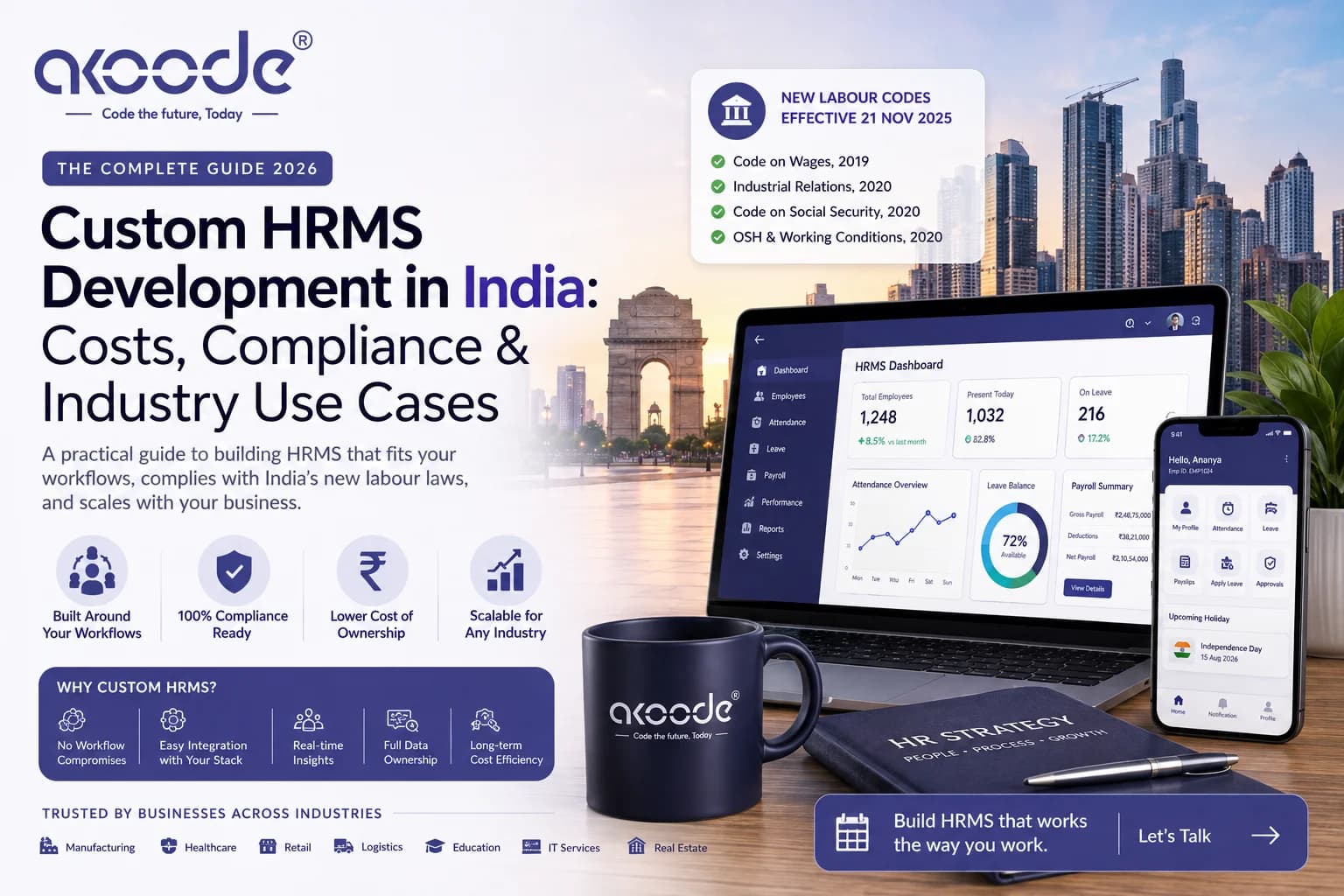
India's four labour codes — the Code on Wages 2019, the Industrial Relations Code 2020, the Code on Social Security 2020, and the Occupational Safety, Health and Working Conditions Code 2020 — became effective on 21 November 2025, replacing 29 central labour laws that now stand repealed. The Ministry of Labour and Employment then notified the central rules under all four codes on 8 to 9 May 2026.
The complication is jurisdictional. Labour sits on the Concurrent List, so every state and union territory must frame and notify its own rules separately, and most remain at draft stage. Until a state notifies fresh rules, employers there continue under the central rules together with legacy state rules and transitional notifications.
For anyone running payroll, three changes drive real system work.
The wage definition changes what you owe. The codes standardise the definition of wages, with a floor on basic pay as a share of total remuneration. The practical effect is an increase in statutory costs — PF, ESI and gratuity — with estimates in the range of 3 to 15% depending on how salaries are currently structured. If your payroll logic calculates contributions from a basic component that no longer qualifies, every payslip is wrong.
Fixed-term employment changed materially. Fixed-term employees must now receive the same wages, benefits and working conditions as permanent employees, and they qualify for gratuity after one year of service rather than five. Any system that models fixed-term staff as a lighter-weight employee type needs restructuring, not a configuration change.
Gig and platform workers are next. Gig worker contribution rules, expected as a percentage of aggregator turnover, and compulsory gratuity insurance are awaiting Central Government notification. Anyone running a platform, delivery, or aggregator model should be building for this rather than waiting for it.
What this means for your HRMS decision. A product vendor will update their platform for the codes on their roadmap, not yours, and you will take the update when it ships. That is fine if your structures are standard. If you run fixed-term contracts, multi-state operations with divergent rules, or a workforce mix that spans permanent, contract and gig, the transition period is exactly when owning your payroll logic pays for itself — because you can change it the week a state notifies, not the quarter your vendor gets to it.
This section describes statutory position, not legal advice. Verify against the Ministry of Labour & Employment gazette and your state labour department for the jurisdictions you operate in, and take professional counsel on your specific structures.
The Modules a Custom HRMS Is Built From
Scope discussions go badly when "HRMS" means different things to the two people in the room. This is the full landscape; almost nobody needs all of it in phase one.
Core operations
Attendance and time tracking — biometric, QR, geofenced, network-IP-validated, or app-based check-in; shift-aware logic; overtime calculation; WFH and hybrid handling
Leave management — policy engine, accrual rules, carry-forward, encashment, holiday calendars by location, approval hierarchies
Absence resolution — what happens automatically when someone is absent without approved leave; the deduction cascade through available balances before pay is affected
Payroll — compilation of attendance, leave, LOP, statutory deductions, bonuses and incentives; payslip generation; bank file output; statutory returns
Employee records — profiles, documents, contracts, org structure, reporting lines
Employee-facing
Self-service portal — balances, payslips, approval status, document downloads, without contacting HR
Mobile app — for workforces that are not at a desk, which in India is most workforces
Helpdesk and ticketing — routing HR queries that genuinely need a human
Talent lifecycle
Recruitment and ATS — requisitions, pipeline, interview scheduling, offer management
Onboarding — document collection, verification workflow, asset allocation, induction tracking
Performance management — goals, review cycles, appraisal workflows, ratings normalisation
Learning and training — course assignment, completion tracking, certification expiry
Exit and F&F — clearance workflow, full-and-final settlement, experience letters
Governance
Role-based access control — who sees what, who approves what, who executes financial actions
Audit ledger — an immutable record of every state change, which is the difference between defensible and merely accurate
Compliance reporting — PF, ESI, TDS, professional tax, labour returns by jurisdiction
Analytics — headcount, attrition, cost-per-head, absence patterns
The sequencing that works: attendance, leave, absence resolution and payroll first, because they are interdependent and because they are where the pain is. Self-service second, because it is what recovers HR bandwidth. Talent lifecycle third. Analytics last, because dashboards built on data you do not yet trust are theatre.
Buy, Customise, or Build: A Decision Framework
Run this before speaking to any vendor, including us.
Step 1: Write out your five most-used HR workflows in full
Not summaries. Every approval step, every exception path, every person who has to be consulted. Include what happens when it goes wrong.
Then evaluate any product against those five specifically. Four or five survive without modification — buy the product. It is cheaper, faster and lower risk, and any development company telling you otherwise is selling. Two or fewer survive — customisation cost will approach build cost and you will own nothing at the end.
Step 2: Identify your policy sequences
Write down exactly what happens when an employee is absent without approved leave. If the answer has more than two steps, it is company-specific policy, and company-specific policy is where products fit worst.
The same test applies to shift differentials, overtime eligibility, leave encashment, and probation confirmation. Multi-step, conditional, or exception-heavy policies are build signals.
Step 3: Count your approval tiers and their authority
Products generally model approval as a chain of yes/no gates. Real organisations often split advisory judgement from financial authority — a reporting manager recommends, HR approves and executes the balance deduction, a super-admin issues final payroll release. Those are three different kinds of authority, and flattening them into a chain is how shadow processes start.
Step 4: Price the five-year position
Per-user licensing scales with headcount. If you are growing, model the licence cost at your projected headcount in year five, add integration and customisation, and compare against a build plus maintenance. Growing companies frequently find the crossover point earlier than expected.
Step 5: Check your audit position
If a statutory authority asked today how a specific deduction on a specific payslip was calculated, could you demonstrate it? If the answer requires finding someone who remembers, you have an audit problem independent of which system you choose.
Step 6: Be honest about your internal capacity
Custom builds need a single empowered decision-maker on your side and someone who can answer policy questions definitively within a day. Organisations that cannot supply either should buy, regardless of what the workflow test says. This is the most common reason custom projects go badly, and it has nothing to do with the development partner.
Custom HRMS Requirements by Industry
The core modules look similar across sectors. What differs is which of them is hard — and the hard one is usually where the custom requirement lives.
Manufacturing
Shift-based workforces, often across multiple plants, with a mix of permanent workers, contract labour and apprentices under different statutory treatment.
What is hard: shift rostering with rotation patterns, overtime calculation under differing state rules, contractor workforce tracking with principal-employer compliance obligations, and biometric integration at plant gates where network connectivity is unreliable. Attendance has to work offline and reconcile later.
Build signals: more than two plants with different state rules; significant contract labour; shift differentials that vary by line or department; safety and training certification expiry that must block gate access.
IT, ITES and Software Services
Hybrid and remote work, project-based utilisation tracking, rapid headcount growth, high attrition requiring fast onboarding and exit cycles.
What is hard: attendance verification when people are not in the office, work-from-home approval workflows, project allocation and billable utilisation tied to timesheets, and onboarding at volume with document verification for Aadhaar, PAN, degree certificates and experience letters.
Build signals: utilisation data feeding client billing; multi-tier approval separating manager recommendation from HR financial authority; growth trajectory that makes per-user licensing expensive by year three.
Healthcare and Hospitals
Round-the-clock rostering across clinical and non-clinical staff, credential expiry that carries patient-safety consequences, and duty patterns that no generic scheduler models well.
What is hard: rostering that respects clinical competency, department coverage minimums and statutory rest periods simultaneously; licence and registration expiry tracking that must prevent scheduling; locum and visiting-consultant payment models; night differential and on-call compensation.
Build signals: multi-site hospital groups; nursing rosters built manually today; credential lapses that have already caused an incident.
Retail, QSR and Chain Operations
High store count, high attrition, part-time and hourly staff, and store managers who are not HR professionals doing HR work on a phone.
What is hard: store-level attendance with geofencing, rapid onboarding at volume, hourly wage calculation with shift and holiday differentials, and an interface simple enough that a store manager uses it correctly without training.
Build signals: more than 20 outlets; attrition above 50% annually; payroll that varies by store location due to state minimum wage differences.
Logistics, Transportation and Fleet
Drivers and field staff who are never at a fixed location, trip-based or distance-based compensation, and statutory driving-hour limits.
What is hard: mobile-first attendance without a fixed office IP or biometric device, trip-linked incentive calculation, driving-hour compliance tracking, and warehouse shift management running alongside a mobile workforce on entirely different rules.
Build signals: compensation tied to trips, distance or delivery counts rather than hours; workforce split between fixed-site and mobile.
BFSI, NBFC and Financial Services
Heavy regulatory oversight, mandatory leave policies, background verification requirements, and audit expectations far above other sectors.
What is hard: enforced block-leave policies for fraud control, role-based access that satisfies an auditor rather than merely working, background verification workflow with re-verification cycles, and an audit ledger that can reconstruct any decision years later.
Build signals: regulatory audit findings on HR process; branch networks with location-specific rules; access control requirements that off-the-shelf RBAC cannot express.
Construction and Infrastructure
Project-site workforces that appear and disappear, heavy contract labour, and compliance obligations under contract labour regulation.
What is hard: site-based attendance with no permanent infrastructure, contractor and sub-contractor workforce visibility, principal-employer compliance for labour engaged by others, and wage payment tracking to satisfy statutory obligations.
Build signals: multiple concurrent project sites; contract labour exceeding direct employment; compliance notices already received.
Education
Academic and non-academic staff on entirely different terms, workload measured in teaching hours, and vacation periods that break every standard leave accrual model.
What is hard: teaching workload allocation and tracking, academic calendars that make standard leave accrual meaningless, visiting-faculty payment models, and multi-campus institutions with different governing bodies.
Build signals: university or multi-campus groups; substantial visiting or guest faculty; accreditation reporting requiring staff qualification data.
Hospitality
Seasonal demand swings, tipped and service-charge compensation, and rostering that has to flex daily against occupancy.
What is hard: demand-linked rostering, service charge distribution rules, seasonal workforce onboarding and offboarding at volume, and multi-property groups sharing staff.
Build signals: property groups; service charge pooling; seasonal headcount that doubles.
Staffing, Recruitment and Managed Services
The workforce is the product. Deployed staff sit on client sites under client-specific terms while remaining your statutory responsibility.
What is hard: client-specific attendance and billing rules, margin calculation per placement, dual reporting into client managers and internal HR, and invoicing driven directly by attendance data.
Build signals: attendance data feeding client invoices; per-client policy variation; placement margin tracking done in spreadsheets today.
Telecom and Field Operations
Distributed field engineers, ticket-linked work, and network operations centres running continuous shifts.
What is hard: field attendance tied to work orders rather than locations, on-call and escalation rota management, NOC shift handover tracking, and technician certification mapped to permitted job types.
Build signals: field workforce compensation linked to tickets closed; 24×7 NOC operations; certification gating what an engineer may be dispatched to do.
The pattern across all of them
Every industry above has one module that is genuinely hard and nine that are ordinary. The right build strategy is to engineer the hard one properly — the rostering engine, the trip-based compensation logic, the contractor compliance layer — and keep the other nine conventional. Projects go wrong when teams treat all ten as equally novel, or when they treat the hard one as a configuration problem.
Architecture and Technology Choices
Four decisions shape everything downstream.
Role architecture before anything else. Map every HR operation across your role tiers and define permission boundaries, approval chains and data ownership before writing application code. In an HR system, roles are not a view filter — they are the business logic. Retrofitting access control onto finished modules produces systems where the frontend hides a button and the API still serves the data. In a platform holding Aadhaar numbers, PAN details and salary records, that is not cosmetic.
Atomicity on balance state. Leave balances, deductions and payroll variables are financial state. Every mutation must be atomic, and every reversal must be complete. The design instinct is to write an inverse function that undoes what was done. Inverse functions drift from their forward counterparts the moment either changes, and the drift surfaces months later in a payroll dispute. Re-running the original resolution logic against corrected inputs cannot drift, because there is only one implementation of the rule.
Scheduled jobs with per-record error isolation. Nightly absence resolution, accrual runs and expiry checks process the whole workforce. A failure on one employee must not halt the batch, and it must be flagged rather than silently skipped. A skipped employee is invisible until payroll lock. A flagged employee is a five-minute task on someone's morning queue. Same failure, entirely different consequence.
Real-time notification with role-aware routing. Four concurrent role tiers each needing different state updates makes polling wasteful and stale. Persistent connections with events routed by tier mean an employee gets a document rejection prompt immediately rather than at the next interval.
On stack: the specific choice matters less than most vendors imply. Node.js, Java, .NET and Python all build HR platforms competently. What matters is that the data model tolerates policy change, because HR policy changes more than most domains — leave types get added, deduction rules get amended, appraisal cycles get restructured. Choose for schema flexibility and atomic operations on balance fields, not for what the vendor's team already knows.
Mobile is not a phase two. In most Indian workforces the majority of interactions happen on a phone. Build mobile-first or accept that adoption will stall.
Integrations That Decide Whether the System Gets Used
An HRMS that does not talk to the systems around it becomes another silo, which is the problem you started with.
Biometric and access hardware — device SDK or API integration, with offline buffering for sites with unreliable connectivity.
Accounting and ERP — Tally, SAP, Oracle, Zoho and Microsoft Dynamics are the common endpoints. Decide early whether payroll output pushes to accounting or accounting pulls from payroll; retrofitting the direction is expensive.
Banking — salary disbursement files in each bank's format, plus reconciliation of failed transfers.
Statutory portals — EPFO ECR generation, ESIC returns, TDS via Form 24Q. These are format-sensitive and change; treat them as maintained integrations rather than one-time builds.
Identity and directory — SSO through Google Workspace, Microsoft Entra or Okta, so joiners and leavers propagate.
Communication — email, WhatsApp Business API and SMS for approvals and alerts, since notifications inside a portal nobody opens are not notifications.
Recruitment and background verification — job boards, assessment platforms, and BGV vendors where regulated sectors require it.
Scope discipline: every integration is a maintenance liability, not just a build cost. Integrate what people actually use daily. Defer the rest.
Employee Data Security and DPDP Obligations
HR platforms hold the most sensitive data most companies process — identity documents, bank details, salary, performance records, and in some sectors medical information.
India's Digital Personal Data Protection Act, 2023 applies to employee personal data. Rules and enforcement mechanics have been rolling out and should be verified against current notifications, but the direction is settled: purpose limitation, data minimisation, retention limits, breach notification, and defined obligations toward data principals.
What that means architecturally:
Retention policy in the data model, not in a document nobody follows. Ex-employee records should have a defined lifecycle with automated action at expiry.
Access logging as a first-class feature. Who viewed which employee's salary, and when. Auditors ask; systems that cannot answer fail.
Encryption at rest and in transit, with document storage separated from application data.
Consent and purpose tracking where data is used beyond the employment relationship.
Breach detection and notification workflow built rather than improvised.
Data residency decisions made deliberately, particularly for organisations with foreign parents.
Practical position: most breaches in HR systems are not sophisticated. They are an over-permissioned role, a document store left publicly readable, or a departed admin whose access was never revoked. Get role architecture and offboarding right before buying security tooling.
What Custom HRMS Development Costs in India
Anyone quoting a figure before reviewing your workflows is guessing. What is useful is knowing what moves it.
Cost drivers, roughly in order of impact:
Module count and which modules. Payroll and rostering are multiples harder than records and self-service.
Role tier count and permission distinctness. Four tiers with genuinely different approval authority costs substantially more than four tiers differing only in visibility.
Payroll complexity. How many variables compile into a salary, how many are statutory, how many are company policy, and how many jurisdictions apply.
Attendance verification method. Biometric hardware integration, geofencing, network validation and shift-aware logic are different budgets.
Multi-state or multi-entity operation. Divergent state rules multiply the policy engine's complexity, and this is the driver most often underestimated.
Integrations. Each one is scope plus ongoing maintenance.
Historical data migration. Moving attendance, leave balances and payroll records out of spreadsheets is almost always harder than the sample rows suggest.
Mobile app scope. Native, cross-platform or responsive web is a real fork in the budget.
What reduces cost: documented HR policies before kickoff, a single empowered decision-maker, willingness to phase so attendance and payroll ship before appraisals and recruitment, and accepting standard patterns for the nine ordinary modules so budget concentrates on the hard one.
Akoode's typical range for enterprise HRMS builds: Check with team by setting up meeting .
On engagement model: fixed cost suits scope that is genuinely well-defined at the outset. Scope still forming is usually better served by a dedicated team or staff augmentation, where you are not paying a risk premium for uncertainty on both sides.
Timeline and Phasing
4 to 20 Weeks
The sequence matters more than the total.
Phase 0 — Workflow architecture. Role matrix, approval chains, policy sequences, data ownership. Nothing shippable, everything load-bearing. Clients on fixed-cost engagements find this phase uncomfortable because there is no demo at the end of it. It is still the phase that determines whether the rest works.
Phase 1 — Attendance and absence resolution. Built together, not sequentially. Attendance and absence resolution are the same problem viewed from two ends; building them separately produces two models of the same truth.
Phase 2 — Leave governance and payroll. The approval tiers, the balance logic with atomic rollback, and the payroll synthesis engine compiling every variable into a locked, auditable monthly output.
Phase 3 — Document verification and self-service. Where HR bandwidth is actually recovered.
Phase 4 — Talent lifecycle. Recruitment, performance, learning, exit.
Phase 5 — Analytics. Last, deliberately. Dashboards built on data you do not yet trust are worse than no dashboards, because people act on them.
Parallel throughout: QA against the role-access matrix per module, then end-to-end workflow validation across all roles, covering concurrent approvals, scheduled-job failure handling, and rollback across historical records.
How to Evaluate an HRMS Development Company
Questions that separate teams who have built HR platforms from teams who have built software.
"Walk me through what happens when HR reverts an approved leave that payroll has already processed." This is the hardest problem in HR systems. A team that has solved it will describe re-running resolution logic and recomputing dependent state. A team that has not will say "we handle rollbacks."
"How does your nightly job behave when it fails on one employee out of 400?" Looking for per-record isolation and flagging. "It retries" is not an answer.
"How would you model our approval hierarchy?" Describe yours in detail and see whether they map it or flatten it.
"What are you planning for the labour codes as state rules get notified?" Anyone building HR software in India in 2026 should have a considered answer.
"Show me an audit ledger you have built." Not a log file. An immutable record with a readable interface.
"Who owns the IP, and when does it transfer?" Retained IP and perpetual licence-back clauses are common and materially change what you are buying. Get it in writing.
"What happens after go-live?" Statutory formats change, states notify rules, policies evolve. Maintenance terms matter more here than in most software categories.
Warning signs: a quote before a workflow review; feature lists as the response to a workflow question; no questions about your state footprint; a demo that avoids payroll; and any claim that custom is always better than buying.
What This Looks Like When It Is Built Properly
A fast-growing Indian IT organisation came to us at roughly 200 employees, running attendance in spreadsheets, leave approvals through WhatsApp threads, and manual payroll reconciliation every month.
We built a six-module platform: smart attendance verification with QR check-in validated against network IP and cross-checked against assigned shifts; dual-level leave governance separating manager recommendation from HR financial authority; a nightly absence resolution engine cascading through available balances before applying Loss of Pay; payroll synthesis generating locked PDF payslips automatically; document verification for Aadhaar, PAN, degree certificates and experience letters; and a full employee self-service portal — all governed by a four-tier role-based access matrix enforced across every frontend view and backend API route.
Outcomes: six connected HR modules operating as one pipeline, four role tiers with permissions enforced end to end, over 65% of workforce interactions handled through mobile self-service without HR involvement, and zero manual payroll reconciliation.
Full technical breakdown, including the atomic rollback design and what went wrong: Enterprise HR Automation Platform case study.
We have delivered 50+ workforce and HR platforms across sectors, as part of 180+ software projects in 15+ industries.
Akoode Technologies is an enterprise software development company headquartered at Spaze iTech Park, Sector 49, Gurugram, with a US office in Oklahoma. We serve clients across India, the UK and the USA. Rated 4.9 on Google from 110 reviews and 5.0 on GoodFirms, and recognised by GoodFirms among the Top Artificial Intelligence Companies in India 2026.
If you are working through a buy-versus-build decision, that conversation is worth having with someone who has done both. Book a technical consultation: calendly.com/akhil-akoode/ak — or send your requirement and someone responds within one business day. NDA signed before kickoff. IP is 100% yours from day one.
FAQs
What is custom HRMS development? Building a human resource management system around your organisation's actual approval hierarchies, leave policies, attendance rules and payroll logic, rather than configuring a ready-made product and adjusting your processes to fit it. It is appropriate when your workflows are specific enough that a product would require heavy customisation.
What is the difference between custom HRMS and customised HRMS? A custom HRMS is built from scratch and owned entirely by you. A customised HRMS is an existing platform extended with custom modules, integrations or configuration, where the core product remains the vendor's. Customisation is faster and cheaper when the base product already gets most of your workflows right.
Should we buy an HRMS product or build a custom one? Write out your five most-used HR workflows in complete detail and check how many survive contact with the product without modification. Four or five surviving means buy. Two or fewer means customisation cost will approach build cost and you will own nothing at the end.
How much does custom HRMS development cost in India? The main drivers are module count, payroll complexity, number of role tiers and how distinct their approval authority is, attendance verification method, multi-state operation, integrations and historical data migration. Any figure quoted before a workflow review is a guess.
How long does it take to build a custom HRMS? It depends primarily on module count and payroll complexity. Phasing so attendance and payroll ship before appraisals and recruitment is usually the fastest route to value, and lets the workflow architecture phase happen properly rather than being compressed.
How do the new labour codes affect our HR system? The four labour codes took effect on 21 November 2025 and central rules were notified in May 2026, with state rules still being notified unevenly. The standardised wage definition changes PF, ESI and gratuity liability, and fixed-term employees now qualify for gratuity after one year rather than five. Payroll logic calculating contributions on the old basis needs revision.
Which industries most often need a custom HRMS rather than a product? Manufacturing with multi-plant shift operations, healthcare with clinical rostering and credential gating, logistics with trip-based compensation, staffing firms whose attendance data drives client invoices, BFSI with audit-grade access requirements, and construction with contract labour compliance. The common factor is one module that is genuinely hard rather than merely present.
Can a custom HRMS integrate with Tally, SAP or our existing accounting system? Yes, and it is usually the right approach when the accounting system is working and trusted. Decide the direction of data flow early — whether payroll pushes to accounting or accounting pulls from payroll — because retrofitting that decision is expensive.
How do you handle attendance for field staff and remote workers? Through mobile-first check-in with the verification method matched to the workforce: geofencing for field staff, network IP validation for office staff, work-order linkage for technicians, and approved work-from-home requests gating remote access. A single verification method across a mixed workforce fails somewhere.
What is a Loss of Pay deduction cascade? The sequence in which an unexplained absence consumes available balances before pay is deducted — typically casual leave, then sick leave, then earned leave, then partial deduction, with Loss of Pay applied only when balances are exhausted. The specific sequence is company policy rather than an industry standard, which is why products handle it poorly.
Is our employee data safe in a custom HRMS? It depends on the build, not on whether it is custom. The requirements are encryption at rest and in transit, role-based access enforced at the API layer rather than only in the interface, access logging that records who viewed which employee's data, defined retention lifecycles, and an offboarding process that reliably revokes access. Most HR data incidents trace to over-permissioned roles or stale admin accounts.
Do you build HRMS platforms for companies in Gurgaon and Delhi NCR? Yes. Our India office is at Spaze iTech Park, Sector 49, Gurugram, and a substantial share of our enterprise software work is with organisations across Gurgaon, Delhi and Noida. On-site discovery sessions are straightforward for NCR-based clients, and we deliver nationally and internationally.
Who owns the code in a custom HRMS build? With Akoode, intellectual property transfers to the client from day one, with an NDA signed before kickoff. Confirm this explicitly with any development partner — retained IP and perpetual licence-back clauses are common and change what you are actually purchasing.
What size company needs a custom HRMS? The wall typically arrives between 100 and 300 employees, when manual reconciliation stops scaling and compliance exposure becomes material. Below that, a product usually suffices. Above it, workflow specificity decides rather than headcount — a 150-person hospital may need custom before a 500-person office does.
Can you migrate our existing HR data from spreadsheets or another system? Yes, and it should be scoped explicitly rather than assumed. Historical attendance, leave balances and payroll records are consistently messier than sample rows suggest. Sample broadly and early.
What happens after the system goes live? Statutory formats change, states notify rules, and policies evolve. Maintenance terms matter more in HR software than in most categories, and should be agreed before the build rather than negotiated after it.
Get In Touch Now
View More Our Blog