


 June 26, 2026
A municipal property registry in Asia digitized over 500,000 land records onto blockchain. Processing errors fell by 95 percent. Administrative delays dropped 60 percent.
That is not a projection. It is a documented 2025 deployment, cited in Congruence Market Insights' blockchain government market analysis. And it points to something important about where this technology has actually landed in 2026, separate from the speculation that dominated the conversation a few years ago.
Governments are not exploring blockchain anymore. In specific, well-bounded use cases, they are running it in production, at scale, with measurable results.
This guide covers what blockchain genuinely improves in government services, where the evidence is strongest, and where the technology is still working through real limitations rather than delivering on early promises.
Why Are Governments Adopting Blockchain Now Specifically?
A peer-reviewed systematic review published in March 2026, drawing on case studies from the UAE, Estonia, Georgia, Colombia, and multiple Gulf states, found that blockchain's benefits are most pronounced when the technology aligns with a real governance need and is supported by proper institutional structures. That distinction matters more than it sounds. It is the difference between blockchain solving an actual problem and blockchain being deployed because it sounded innovative.
The core properties driving adoption have not changed since the earliest research on this topic began around 2017. Decentralization, immutability, and transparency align naturally with public sector values like accountability and integrity in official records. What has changed is the maturity of the implementations and the willingness of governments to move past pilot projects into permanent infrastructure.
How Big Is This Market, Really?
The honest answer is that estimates vary significantly depending on what is being counted. One widely cited projection puts the global government blockchain market growing from $2.5 billion in 2022 to $218.6 billion by 2032. A separate analysis from Congruence Market Insights values the market at $571.47 million in 2025, growing at a compound annual rate above 66 percent through 2033. These numbers are not contradictory so much as they reflect different scoping decisions about what counts as "government blockchain" spending. What both agree on is the direction and the speed: this is one of the fastest-growing categories in government technology spending right now.
What Are the Real Benefits of Blockchain for Government Records?
1. Land Registries and Property Records
This remains the single most mature and evidence-backed use case in government blockchain. Traditional land registries, whether paper-based or centrally digitized, are vulnerable to manipulation, destruction, and the kind of opacity that enables fraudulent property transfers.
Blockchain-based land registries create ownership records that are cryptographically linked to the property itself, with a complete transaction history running from the original survey through to current ownership. This makes title tampering computationally impractical rather than merely difficult.
The implementation reality is more nuanced than the benefit summary suggests. Most working systems combine blockchain for the ownership record itself with traditional databases for property characteristics and spatial data, since not every piece of property information needs the same immutability guarantee. The harder challenges are digitizing decades of historical paper records and resolving existing title disputes before any migration can even begin.
2. Digital Identity and Reduced Identity Fraud
Self-sovereign identity systems let individuals control their own identity data and share verifiable credentials without relying on a centralized intermediary holding that data. The city of Zug in Switzerland introduced exactly this kind of blockchain-based digital ID for its residents, according to the 2026 systematic review of global blockchain adoption.
A more operational example comes from British Columbia, Canada, which implemented OrgBook, a blockchain-backed registry of business licenses and identities specifically designed to streamline verification between different government agencies. The practical benefit here is straightforward: it reduces identity fraud and avoids the repetitive KYC checks that currently force citizens and businesses to prove the same identity facts to multiple agencies separately.
Globally, identity management remains the dominant blockchain use case in government, according to SkyQuest's market analysis, precisely because growing breach and forgery exposure is pushing agencies toward tamper-evident ledgers with proper audit trails.
3. Public Procurement and Financial Transparency
Blockchain creates tamper-proof records of public spending, making it considerably easier to track how funds are used and to hold the relevant agency accountable. This is one of the clearer transparency wins, since procurement and budget execution are exactly the kind of process where a single, shared, unalterable ledger eliminates the disputes that arise from agencies keeping separate, inconsistent records of the same transaction.
Does Blockchain Voting Actually Work for Government Elections?
This is the use case generating the most attention and also the most legitimate caution, so it is worth treating carefully rather than overselling it.
Blockchain-based voting systems are the fastest-growing application segment in the entire government blockchain market, with adoption expected to grow above 55 percent annually according to Congruence Market Insights. The underlying argument is reasonable: votes recorded on an immutable ledger are harder to manipulate after the fact and can be independently audited.
There are real, documented pilots. West Virginia piloted a blockchain-enabled mobile voting application as early as 2018, specifically to improve absentee voting access for military service members deployed abroad, according to Brookings' research on government blockchain adoption. A separate 2024 national election pilot reportedly enabled over 2 million voters to cast digital ballots with a 99 percent verification rate.
Why This Use Case Still Needs Caution
Despite the growth numbers, blockchain voting at national scale remains far less mature than land registries or identity management. Brookings' analysis specifically flags that data privacy considerations need to be central to any government blockchain deployment, since the technology's transparency can cut against ballot secrecy if the implementation is not carefully designed. Smaller-scale pilots for specific populations, like deployed military voters, have a track record. Wholesale replacement of national election infrastructure does not yet have the same evidence base behind it.
How Is Blockchain Used in Welfare and Public Finance?
Smart contracts can be programmed to manage loan and grant applications, automatically dispense approved funds, and continuously track compliance with the terms attached to that disbursement, according to ConsenSys' documentation of real-world government use cases.
This matters specifically for welfare and subsidy programs, where eligibility verification and disbursement tracking are currently labor-intensive and prone to both error and fraud. Treasuries in several markets are now piloting tokenized welfare payments and tax refunds specifically to get instant settlement and a transparent, auditable disbursement trail, according to SkyQuest's market research. Central banks are running parallel pilots for wholesale settlement and cross-border payment corridors using the same underlying infrastructure.
What Does Blockchain Actually Improve in Smart City Infrastructure?
Combined with IoT and cloud computing, blockchain can provide a secure, interoperable infrastructure layer that lets smart city services and municipal functions coordinate without each department running an isolated, incompatible system, according to ConsenSys' analysis of public sector blockchain applications.
A practical example of this pattern: academic credential and vaccination records held on an encrypted identity wallet let an individual control exactly who can access that data, while still allowing schools, employers, or healthcare providers to validate the relevant attestation instantly rather than chasing paper verification.
Where Is Blockchain Genuinely Limited in Government, Right Now?
Honest coverage of this topic has to include where the technology has not lived up to early expectations, because several real constraints are still unresolved.
Integration Complexity
Integration complexity continues to limit the growth of the global blockchain government market, according to SkyQuest's analysis. Most agencies are not building blockchain systems on a blank slate. They are trying to connect new distributed ledger infrastructure to decades-old legacy databases, and that integration work is consistently underestimated in early project planning.
Data Privacy Tension
Blockchain's core strength, an immutable, fully transparent record, creates a genuine tension with personal data privacy. Brookings specifically warns that data privacy considerations need to be central to any government blockchain deployment, to avoid deepening inequality if the technology's benefits are not equally accessible, and to prevent personal information from being de-anonymized through clever analysis of supposedly anonymized blockchain data.
Legal Recognition Gaps
A blockchain-based land title or identity credential is only as useful as the legal system's willingness to recognize it. Implementation guides covering government blockchain land registries specifically flag ensuring legal recognition of blockchain-based ownership proofs in judicial proceedings as an unresolved challenge in several jurisdictions, separate from the technical implementation itself.
Equity and Access Concerns
Austin, Texas explored a blockchain program to help its homeless population securely store personal identification documents, with the goal of replacing paper records with encrypted electronic ones. City reports later urged departments to move slowly, specifically because of growing privacy and equity concerns around digital identity systems for vulnerable populations who may have inconsistent access to the devices or connectivity that a blockchain-based system assumes.
How Should a Government Agency or Vendor Approach a Blockchain Project?
Start with a single use case where blockchain's specific strengths, immutability, decentralization, and auditability, solve a problem that a traditional database genuinely cannot solve as well. Land registries and identity verification have the strongest evidence base for exactly this reason: they need a tamper-proof, cross-agency-verifiable record, which is precisely what blockchain is built for.
Plan for the integration work honestly from the outset rather than treating it as an afterthought once the blockchain component is built. This is the same lesson covered in Akoode's guide to government software compliance and procurement: legacy system integration is consistently where government technology projects lose time and budget, regardless of which underlying technology is being deployed.
Address data privacy architecture before deployment, not after a concern is raised publicly. Given how directly this connects to the broader governance question, the same discipline covered in Akoode's guide to AI in the public sector applies here too: human oversight, transparency, and privacy protection need to be designed in from the first planning stage of any public sector technology project, blockchain included.
For agencies and vendors building these systems, Akoode's blockchain development work focuses specifically on this discipline: identifying where blockchain's actual strengths solve a genuine governance problem, rather than applying the technology as a label without the architecture to back it up.
Conclusion
Blockchain for government services has moved past the hype cycle into a smaller set of use cases with genuinely strong evidence behind them. Land registries and digital identity management lead clearly, backed by documented deployments showing real reductions in fraud, processing errors, and administrative delay. Voting and welfare disbursement are growing fast but still carry real, unresolved questions around privacy and legal recognition that deserve honest treatment rather than dismissal.
The agencies and vendors getting genuine value from this technology share a pattern. They picked a use case where blockchain's specific properties solve a real problem, planned for the legacy integration work from day one, and treated privacy and legal recognition as design requirements rather than afterthoughts.
Akoode Technologies is a leading AI and software development company headquartered in Gurugram, India, with a US office in Oklahoma. From blockchain development and enterprise application development to AI-powered platforms and custom government software, Akoode builds secure, compliant public sector technology for government agencies and enterprise clients across 15+ industries globally. If you are evaluating blockchain for a government services project and want a team that knows where the technology genuinely fits, that conversation starts here.
Frequently Asked Questions
1. What are the main benefits of blockchain for government services?
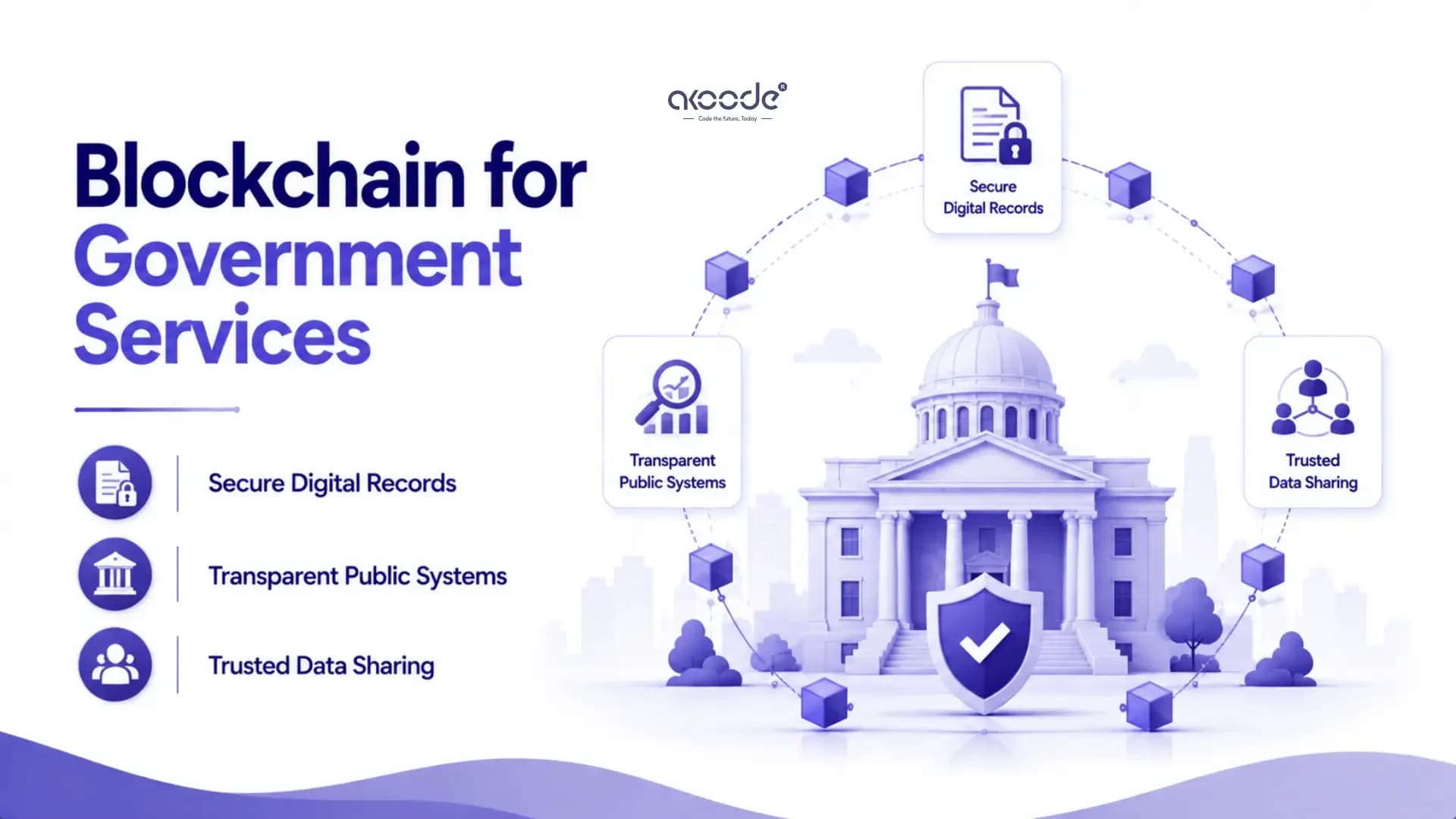
The strongest, best-evidenced benefits are tamper-proof land and property records, reduced identity fraud through self-sovereign digital identity systems, transparent and auditable public procurement and budget tracking, and faster, more verifiable disbursement of welfare payments and grants through smart contracts.
2. Does blockchain voting actually work for government elections?
It works well in specific, smaller-scale contexts with strong evidence, such as absentee voting pilots for deployed military personnel. A 2024 national pilot reportedly achieved a 99 percent verification rate across over 2 million digital ballots. However, wholesale replacement of national election infrastructure remains less mature, and privacy and ballot secrecy concerns still need careful handling.
3. How is blockchain used in government land registries?
Blockchain creates ownership records cryptographically linked to a property, with a complete, unalterable transaction history from the original survey to current ownership. A 2025 municipal deployment in Asia digitized over 500,000 property records with a 95 percent reduction in processing errors and a 60 percent decrease in administrative delays.
4. What is the biggest challenge facing government blockchain adoption?
Integration complexity with existing legacy systems is consistently cited as the primary constraint limiting market growth. Data privacy tension between blockchain's inherent transparency and citizens' right to personal data protection is the second major challenge, particularly for vulnerable populations.
5. How big is the government blockchain market in 2026?
Estimates vary by methodology. One widely cited projection puts the market growing from $2.5 billion in 2022 to $218.6 billion by 2032. Congruence Market Insights separately values the 2025 market at $571.47 million, growing at over 66 percent annually through 2033. Both sources agree the market is among the fastest-growing categories in government technology spending.
6. Which government use case has the strongest evidence behind it?
Identity management and land registry systems have the most mature, evidence-backed deployments. Both directly use blockchain's core strengths, immutability and cross-agency verifiability, to solve a problem that traditional centralized databases struggle with: preventing fraud and tampering in records multiple parties need to trust simultaneously.
Get In Touch Now
View More Our Blog