


 June 26, 2026
The UK government once had a backlog of 30,000 pension claims sitting unprocessed. Clearing it manually was estimated to take thousands of hours of staff time spread across many months.
Robotic process automation cleared the entire backlog in two weeks.
That single example, documented by the World Bank's GovTech Global Partnership, captures something important about AI in the public sector right now. The technology is not theoretical anymore. It is sitting inside tax authorities, benefits agencies, and pension systems, doing work that used to take human teams months to finish.
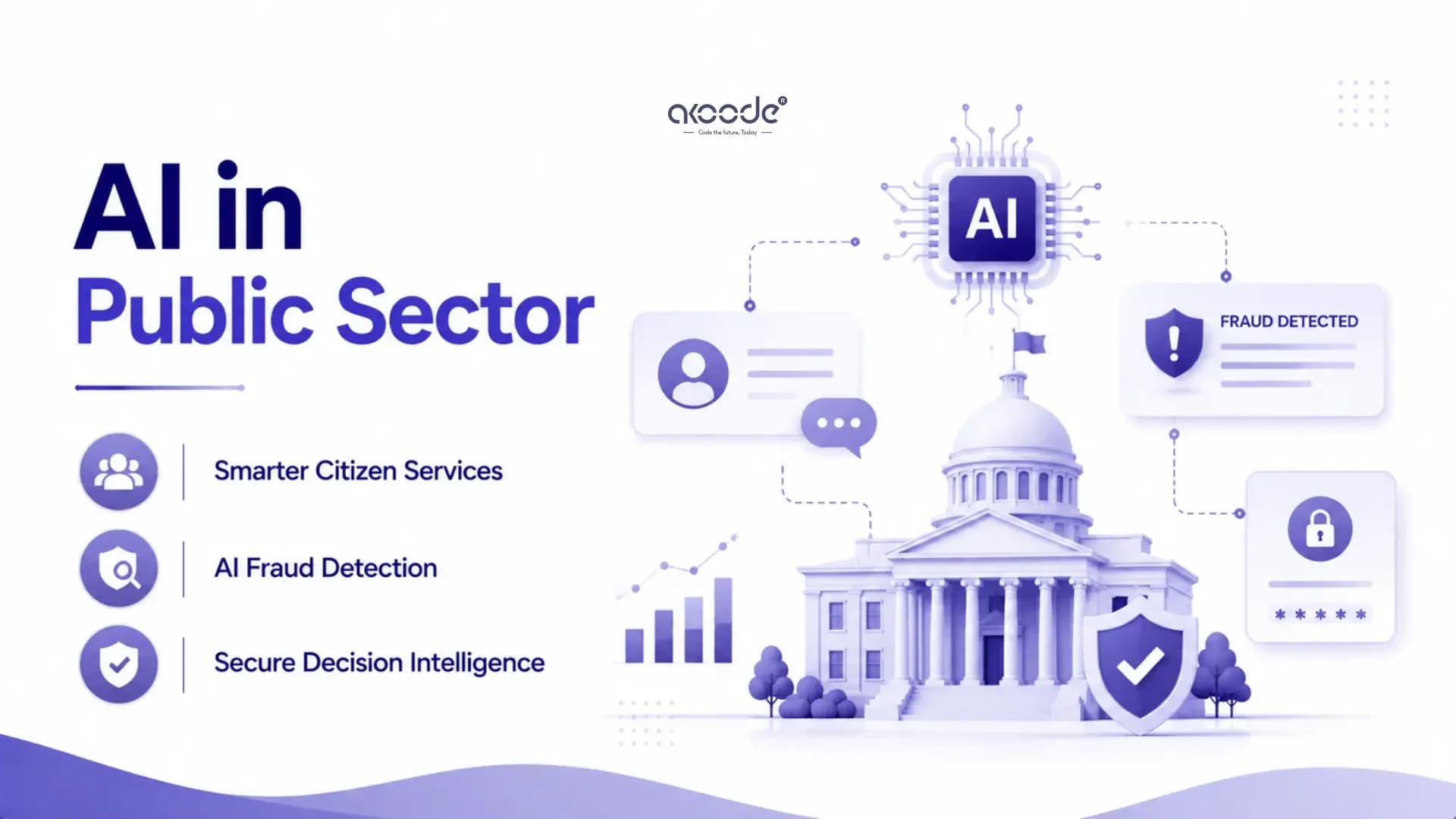
This guide covers where AI is genuinely delivering results in government today, specifically across citizen services and fraud detection, and what the actual risks and governance requirements look like once a pilot becomes a permanent system.
Why Is AI Adoption Accelerating in Government Right Now?
Two pressures are colliding at the same time, and together they explain why government AI adoption has moved from pilot projects into core operations.
The first is fiscal. Generative AI can automate an estimated 60 to 70 percent of routine administrative tasks, according to a widely cited 2023 McKinsey analysis, with the potential to add $2.6 to $4.4 trillion annually to global productivity. For agencies facing budget pressure and staffing shortages simultaneously, that is not an abstract number. It is the difference between hiring more reviewers and automating the review itself.
The second is fraud, and it is getting worse, not better. According to Databricks' 2026 analysis of public sector fraud trends, benefits-related fraud offenses have increased 242 percent since 2020. Criminals are now using synthetic identities and deepfake-enhanced documentation, which means the legacy rule-based fraud controls most agencies built years ago were never designed to catch this generation of attack.
How Big Is the Government AI Market Right Now?
Machine learning is the largest single technology segment within AI for government and public services, according to Grand View Research's 2025 industry analysis, because it enables the predictive analysis, anomaly detection, and decision automation that underpins most fraud and risk applications. The broader market is forecast to keep expanding through 2035 as more agencies move from pilot to production deployment.
How Is AI Actually Improving Citizen Services?
Citizen-facing AI has moved well past the experimental chatbot phase. It now sits at the center of how several governments handle high-volume, low-complexity interactions.
Citizen Engagement and AI Assistants
The IRS and the US Department of Veterans Affairs have both deployed AI-powered chatbots specifically to handle citizen inquiries, according to a 2025 federal AI use case analysis. The result has been a measurable drop in call center backlogs and faster response times for routine questions about benefits, filing status, and account details.
The UK has gone further on a different front. AI helped the government classify and streamline two million web pages into a more citizen-centric structure, according to the World Bank's public sector AI summary note. That is not a chatbot. It is AI doing the unglamorous work of organizing an entire government's digital footprint so citizens can actually find what they need.
Sentiment Analysis at Public Consultation Scale
When the US government opened its Net Neutrality policy for public comment, it received 21 million submissions. No human team could meaningfully read and categorize that volume. AI analyzed citizen sentiment across the entire dataset, turning an unreadable flood of comments into something policymakers could actually use.
Self-Service and Personalized Delivery
A growing pattern across advanced digital governments, including Estonia, Denmark, Singapore, and South Korea, is using AI to deliver personalized service nudges. A profile-based system can automatically alert a citizen when it is time to renew a driving license, schedule a health check-up, or register a child for school, according to the World Bank's documented use case typology. This shifts government services from something a citizen has to remember and chase, to something the system proactively manages on their behalf.
Contract Review and Internal Efficiency
Citizen-facing tools get most of the attention, but internal process automation is where a lot of quiet efficiency gain is happening. The US General Services Administration uses AI to assist with contract review, reducing the time needed to evaluate procurement documents according to 2025 federal use case reporting. This is the same logic as citizen chatbots, applied internally: take a high-volume, rules-based task and let AI handle the first pass.
How Is AI Being Used for Fraud Detection in Government?
This is where the financial case for government AI becomes the easiest to measure, because the savings show up directly in claims denied and money recovered.
What Real Fraud Detection Results Look Like
Between January and August 2025 alone, AI-powered fraud detection denied over 800,000 fraudulent claims and saved more than $141 million, according to Carahsoft's 2025 review of practical government AI applications. The IRS specifically uses a Risk-Based Collection Model to improve fraud detection and narrow the tax gap.
These are not pilot-stage numbers. They reflect systems already operating at production scale, processing real claims in real time.
Why Traditional Rule-Based Fraud Detection Is Failing
Legacy fraud controls were built around fixed rules: flag a transaction over a certain amount, flag an address that matches a known bad actor list. Modern fraud increasingly defeats this approach entirely. AI-powered fraud detection looks at the whole picture instead of individual transactions, according to NVIDIA's analysis of fraud detection across sectors, catching patterns that traditional rule-based methods overlook completely.
This matters specifically for government because of how fraud has evolved. Synthetic identities and deepfake-enhanced documentation, the same tools now showing up in benefits fraud according to Databricks, are specifically designed to pass the kind of single-point checks that older systems rely on. Pattern detection across a whole dataset catches what a single-transaction rule cannot.
International Fraud Detection Examples
Two examples from the World Bank's public sector AI documentation are worth knowing specifically, because they show this is not limited to large, wealthy economies with deep technical resources.
In Armenia, AI helped the national revenue agency increase tax revenue collection sixfold, with the World Bank supporting the underlying technology. In Brazil, an AI system detected 500 firms that were secretly owned by the same civil servants responsible for supervising those firms' government contracts, a conflict-of-interest pattern that would be extremely difficult to catch through manual audit alone.
A Better Side Effect: Fewer False Positives
One detail that gets less attention than it deserves. AI fraud detection does not just catch more fraud. It also reduces false positives by drawing on better contextual data about what a legitimate transaction actually looks like, according to NVIDIA's fraud analysis. For government staff, this means less time spent investigating non-issues and more capacity for the genuinely complex cases that actually need a human review.
What Does Robotic Process Automation Add on Top of AI?
RPA and AI are often discussed together, but they solve slightly different problems, and understanding the distinction helps explain why governments deploy both.
RPA tools can scan websites for live data like currency exchange rates, log into financial management systems to post invoices automatically against the correct purchase order, generate scheduled budget reports, and even scan multiple competing bids to extract costs, build a comparison matrix, and flag items priced suspiciously high against a market check, according to the World Bank's operational use case breakdown.
This is rules-based automation rather than predictive intelligence. It does not need to learn patterns. It needs to reliably execute a defined process, at scale, without a human repeating the same clicks every day. The UK pension backlog example earlier in this guide is RPA in its purest form: not smarter decision-making, just much faster execution of a known process.
What Governance and Risk Frameworks Actually Matter Here?
None of the results above are sustainable without a governance structure underneath them. This is the part of government AI adoption that gets skipped most often, and it is also where projects tend to fail publicly.
The Ethical Principles Multiple Governments Have Converged On
National governments and major international bodies, including the European Commission, IEEE, ISO, and the World Economic Forum, have converged around a similar set of core principles for AI governance, according to the World Bank's 2021 summary note that remains foundational to most current frameworks. These include privacy and data protection, accountability across the full AI lifecycle, safety and cybersecurity, transparency and explainability of automated decisions, fairness and bias mitigation, and meaningful human control over the technology.
Why Human Oversight Is Not Optional
It must be emphasized that humans play a critical role in AI adoption, and the appropriate role of humans needs to be considered in any use case, according to the World Bank's analysis. This is not a legal formality. Human oversight is the practical safeguard against machine-invoked bias, catching skewed results that come from problems like biased training data, data manipulation, or even deliberately programmed bias before those results affect a real citizen's benefits, tax status, or legal standing.
The Implementation Pattern That Actually Works
Governments adopting AI successfully tend to follow a staged, iterative pattern rather than a single big launch: ideate the problem clearly, conceptualize a solution with both technical and subject matter experts, propose a detailed plan with explicit legal and ethical risk checks, build a working prototype, test it thoroughly, then develop and deploy at full scale with continued monitoring. A feedback loop runs through every stage rather than only appearing at the end.
This mirrors the same lesson covered in Akoode's guide to government software compliance and procurement: the compliance and governance layer is not a final checklist before launch. It has to be designed in from the very first stage of the project.
What Should an Agency or a Vendor Actually Do Before Deploying AI?
Start by identifying a single, well-bounded problem rather than attempting a broad AI transformation across every department simultaneously. The World Bank's own implementation framework recommends proof-of-concept and pilot projects as the practical starting point, and several governments have specifically used hackathons in countries including Estonia, India, Poland, and the United States to surface promising ideas before committing significant budget.
Address the data foundation honestly before building the model on top of it. A whole-of-government, interoperable data architecture is repeatedly identified as a prerequisite for AI success, because most agencies are still managing standalone legacy systems with data that genuinely cannot be accessed or reused elsewhere in government. An AI fraud detection system fed by siloed, inconsistent data will underperform regardless of how sophisticated the model itself is.
Build the human review step into the workflow from day one, not as an afterthought once a system is already live. This is the single most consistent recommendation across every framework referenced in this guide, from the World Bank's governance principles to Databricks' operational fraud prevention guidance.
Conclusion
AI in the public sector in 2026 is no longer a pilot conversation. It is processing real claims, denying real fraud, and answering real citizen questions at a scale that genuinely was not possible through manual review even five years ago. The Armenia revenue example, the Brazil conflict-of-interest detection, the UK pension backlog cleared in two weeks: these are not hypothetical case studies from a vendor's sales deck. They are documented outcomes from organizations like the World Bank tracking actual government deployments.
What separates the agencies getting real value from this technology is not the sophistication of their models. It is whether they built the governance, the human oversight, and the data foundation in alongside the technology, rather than bolting compliance on after the system was already running.
Akoode Technologies is a leading AI and software development company headquartered in Gurugram, India, with a US office in Oklahoma. From AI-powered software development and enterprise application development to cloud and DevOps solutions and custom government platforms, Akoode builds compliant, secure AI systems for public sector agencies and enterprise clients across 15+ industries globally. If you are planning an AI deployment for citizen services or fraud detection and want a team that builds governance in from the start, that conversation starts here.
Frequently Asked Questions
1. What is AI in the public sector, and what does it actually do?
AI in the public sector refers to government agencies using technologies like machine learning, natural language processing, and robotic process automation to deliver citizen services, detect fraud, automate back-office processes, and support policy decisions. Real deployments include AI chatbots handling citizen inquiries, fraud detection systems flagging suspicious benefits claims, and automation tools clearing administrative backlogs.
2. How is AI being used for fraud detection in government?
AI fraud detection analyzes whole patterns across large datasets rather than checking individual transactions against fixed rules, which allows it to catch sophisticated fraud involving synthetic identities and forged documentation. Between January and August 2025 alone, AI-powered detection denied over 800,000 fraudulent claims and saved more than $141 million in US government programs, according to Carahsoft's 2025 review.
3. What are real examples of AI improving citizen services?
The IRS and US Department of Veterans Affairs both use AI chatbots to handle citizen inquiries and reduce call center backlogs. The UK used AI to classify and streamline two million government web pages for easier citizen access. AI also analyzed 21 million public comments on the US government's Net Neutrality policy, turning an unreadable volume of feedback into usable insight for policymakers.
4. What are the biggest risks of using AI in government?
The most significant risks are algorithmic bias affecting decisions like benefits eligibility or immigration cases, inadequate human oversight allowing skewed or incorrect automated decisions to go unchecked, weak data governance across siloed legacy systems, and insufficient transparency about when and how AI is influencing a decision that affects a citizen.
5. What governance frameworks should govern AI use in government?
Major governments and international bodies have converged on common principles including privacy and data protection, accountability throughout the AI lifecycle, safety and cybersecurity, transparency and explainability, fairness and bias mitigation, and meaningful human control over automated decisions. These principles work best when built into a project from the design stage rather than added before launch.
6. Can smaller governments or agencies realistically adopt AI, or is this only for well-resourced countries?
Yes, though the World Bank's research notes adoption is uneven and depends heavily on existing digital infrastructure and data quality. Examples like Armenia's sixfold increase in tax revenue through AI-supported systems show that meaningful results are achievable outside large, wealthy economies, particularly when projects start with a narrow, well-defined pilot rather than an ambitious whole-of-government rollout from day one.