


 June 2, 2026
Most OTT projects do not fail because of bad content. They fail because the infrastructure was wrong from day one.
Choosing the wrong CDN architecture. Skipping multi-DRM until subscribers complain about piracy. Building for one platform and discovering later that Smart TV integration requires rebuilding significant chunks of the backend. These are not edge cases. They are the patterns that repeat across failed streaming builds.
This guide covers what OTT platform development actually costs in 2026, which tech stack decisions matter most, the feature checklist every platform needs, and where the budget surprises live.
What Is an OTT Platform and How Does It Work?
OTT stands for Over-The-Top. It means video content delivered over the internet directly to users. No cable. No satellite. Just a stream, a device, and a content library.
Netflix, Hotstar, Amazon Prime Video, and Disney+ are the most visible examples. But the same technical architecture powers fitness streaming services, edtech platforms, sports networks, and corporate training products. The category is broader than most people realise.
The delivery mechanism works like this. A video file gets ingested, transcoded into multiple quality levels, stored behind a CDN, and delivered to the user's device via adaptive bitrate streaming. The player constantly checks network conditions and adjusts quality automatically. When the connection slows, the resolution drops. When it recovers, quality rises. Done correctly, the user never sees a buffer spinner.
Done incorrectly, they see one every few minutes and cancel their subscription.
What Monetisation Model Should You Choose First?
The monetisation model must be decided before architecture begins. It shapes billing infrastructure, entitlement systems, and content access logic at the database level.
SVOD charges a recurring subscription fee for unlimited access. Netflix and Hotstar run this model. It requires robust subscription management, payment gateway integration, and device-level entitlement checking. Most complex billing model to build correctly.
TVOD charges per title or per rental window. Simpler billing than SVOD. Requires per-title access control and rental expiry tracking at the content level.
AVOD makes content free and monetises through advertising. Requires ad server integration, ad insertion into the stream, and audience measurement tools.
Hybrid combines all three. A free tier on AVOD. Paid subscriptions for premium content. Pay-per-view for major live events. Most competitive platforms in 2026 operate hybrid models. Most technically demanding to build. Highest revenue ceiling.
Niche OTT platforms in fitness, education, sports, and faith-based content consistently show stronger subscriber retention than broad entertainment services. If you are not competing directly with Netflix's content budget, you probably should not be building for Netflix's scope either.
What Features Does Every OTT Platform Need?
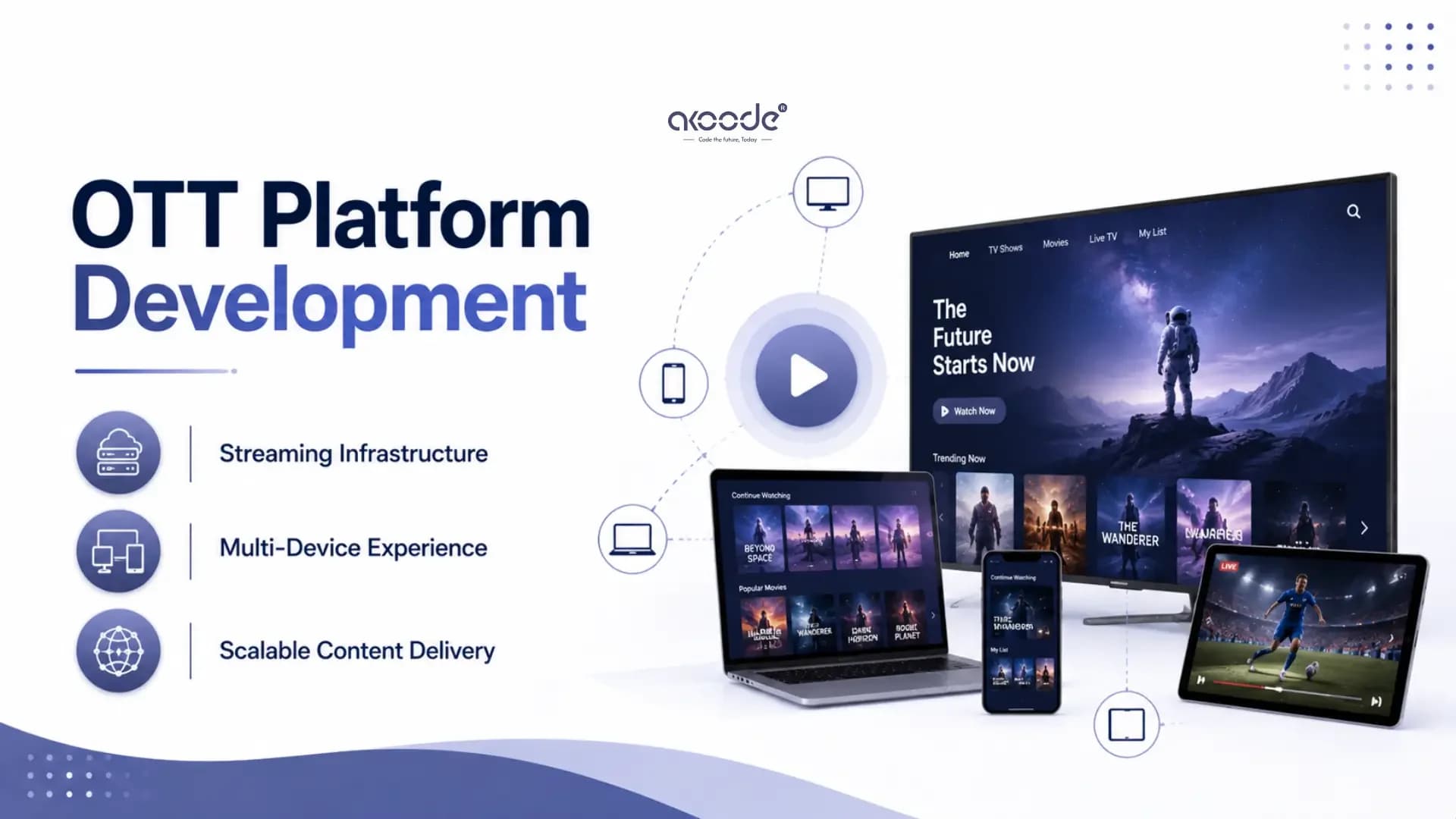
Core streaming: Adaptive bitrate player supporting HLS and DASH. Multi-resolution transcoding from 240p to 4K. Device support across iOS, Android, web, Smart TV, Roku, and Fire TV. Offline download capability. Chromecast and AirPlay support.
User management: Registration with social login. Multiple profiles per account. Parental controls tied to content ratings. Watchlist and continue-watching tracking. Viewing history.
Content management: Admin panel for uploads and metadata. Season and episode structure for series. Live event scheduling. Content tagging and category management.
Search and discovery: Full-text search across titles, cast, and genre. Genre browsing and editorial curation. AI-powered personalised recommendation rows. Trending and new release surfaces.
Monetisation: Payment gateway integration. Subscription tier management. Promotional codes. In-app purchase support. Ad server integration for AVOD.
Security: DRM across all three major schemes: Widevine, FairPlay, and PlayReady. CDN token authentication. Device registration. Concurrent stream limits per account.
Analytics: Real-time playback quality monitoring. Content performance dashboards. User behaviour tracking. A/B testing infrastructure. Push notification system.
The discovery layer deserves specific attention. A subscriber who consistently finds content they want to watch stays. One who scrolls through a generic catalogue for five minutes and finds nothing cancels. The architecture behind production recommendation engines is the infrastructure layer that directly drives subscriber retention on every serious OTT platform.
How Much Does OTT Platform Development Cost in 2026?
Two products with identical feature lists can sit in completely different budget tiers. The number of target platforms, whether live streaming is required, and which monetisation model is implemented are what actually move the cost.
Platform Tier | Cost Range | What It Covers |
|---|---|---|
MVP (web and mobile, VoD only) | $50,000 to $90,000 | Core streaming, user auth, basic CMS, one monetisation model |
Standard multi-platform, VoD | $90,000 to $150,000 | Four to five platforms, recommendations, full CMS, analytics |
Advanced with live streaming | $150,000 to $300,000 | Live streaming, hybrid monetisation, full DRM, personalisation |
Enterprise cloud-native | $300,000 to $800,000+ | Full multi-platform, ultra-low latency live, complete DRM stack |
Developer rates by region:
Region | Senior Rate | Mid-Level Rate |
|---|---|---|
United States | $150 to $250/hour | $100 to $150/hour |
United Kingdom | $80 to $140/hour | $55 to $85/hour |
India | $25 to $65/hour | $18 to $35/hour |
A standard OTT platform costing $200,000 with a US team costs $55,000 to $80,000 with a quality India-based team. India has produced some of the most technically demanding streaming infrastructure in the world. The media and entertainment technology teams based in Bengaluru, Pune, and Hyderabad have built at a scale that Western markets rarely match on equivalent budgets.
What Tech Stack Do You Actually Need?
Video processing: FFmpeg for transcoding. AWS Elemental MediaConvert for cloud-based pipelines. HLS and DASH as delivery protocols. AV1 codec where bandwidth efficiency matters most.
Storage and delivery: Amazon S3 or Google Cloud Storage for media files. AWS CloudFront or Akamai for CDN. A vendor-agnostic CDN strategy is architecturally sound. It lets you switch providers based on regional pricing and performance benchmarks rather than being locked into one vendor's rate card.
Backend: Node.js or Golang for high-concurrency API services. Both handle the burst traffic patterns that live events create. Python for ML pipeline work. GraphQL for flexible client-side data queries. Redis for session management.
Databases: PostgreSQL for user accounts, subscriptions, and structured content metadata. MongoDB for flexible catalogue management with complex metadata schemas. Elasticsearch for fast full-text search across large libraries.
Frontend and apps: React or Next.js for web. React Native for cross-platform mobile. Swift for native iOS. Kotlin for native Android. Platform-specific SDKs for each Smart TV target. Roku, Samsung Tizen, LG WebOS, Apple TV, and Amazon Fire TV each require their own SDK integration. This is one of the most consistently underestimated cost lines in any OTT budget.
DRM: Google Widevine covers Android and Chrome. Apple FairPlay covers iOS, macOS, and Safari. Microsoft PlayReady covers Windows and Xbox. Most production platforms use a multi-DRM service like EZDRM or BuyDRM rather than managing three separate integrations. The consolidation saves significant ongoing engineering time.
What Are the Hidden Costs?
CDN delivery fees. CDN is priced per gigabyte delivered. A platform with moderate traffic accumulates $5,000 to $30,000 per month in CDN costs. This number is invisible at MVP stage and grows directly with viewership. Build cost-per-minute-delivered tracking into your financial model before launch.
Smart TV certification. Each platform, Roku, Amazon Fire TV, Apple TV, Samsung, runs its own submission and certification process. Each takes weeks. Each has its own technical requirements. Each requires re-certification when the platform releases major SDK updates.
Transcoding compute. Encoding a large content library into multiple resolutions and formats costs cloud compute money upfront and continues as new content is added. Budget this separately from development cost.
Content licensing. If the catalogue is not original content, licensing fees are the largest ongoing cost. Regional rights for studio content range from thousands to millions annually depending on territory and catalogue depth.
Annual maintenance. Streaming platform maintenance runs 15 to 20 percent of the initial build cost every year. OS compatibility updates across all target devices, security patches, and SDK updates from Smart TV platforms drive most of this.
Should You Build Custom or Use a White-Label Platform?
White-label OTT platforms like Muvi, Uscreen, and Cleeng provide pre-built infrastructure that can be branded and launched quickly. Monthly costs run from $199 to $1,500 depending on the plan and revenue share terms.
For businesses launching with a defined content catalogue and straightforward subscription monetisation, white-label delivers genuine early-stage value.
Custom development becomes the right decision when the monetisation model is too complex for white-label platforms, when deep integration with existing systems is required, or when subscriber growth makes per-revenue fees economically unsound at scale.
One factor worth calculating before committing to white-label is the five-year total cost. Revenue-share agreements that look manageable at a thousand subscribers look very different at a hundred thousand.
How Does AI Change OTT Development in 2026?
AI is not optional infrastructure in a competitive OTT platform anymore.
Personalised recommendations directly affect retention. A user who finds relevant content stays subscribed. A user who scrolls and finds nothing cancels. How AI recommendation systems work for content platforms gives the conceptual foundation. The production implementation involves collaborative filtering, content-based models, and transformer architectures working together across every content surface the user sees.
Predictive churn models identify subscribers showing disengagement patterns before they cancel. Content performance models surface which formats and genres drive the most engagement for specific audience segments.
For teams building with AI-powered development approaches, the data infrastructure for recommendations is identical to the infrastructure that powers every other AI capability on the platform. Getting the data layer right early avoids rebuilding it when AI features are added later.
Conclusion
OTT platform development in 2026 is a real infrastructure investment. The market growth is genuine. The technical requirements are substantial. The businesses that build well make the right structural decisions early: monetisation model, platform scope, video infrastructure, and data architecture.
Smart TV certification timelines, CDN cost curves, and DRM complexity are all manageable when planned for. They cause budget overruns when discovered mid-build.
A well-architected OTT platform compounds in value. Every subscriber interaction improves the recommendation engine. Every playback event strengthens the quality model. The platform gets better with scale, but only if the foundation was built correctly.
Akoode Technologies is a leading AI and software development company headquartered in Gurugram, India, with a US office in Oklahoma. From OTT platform development and media and entertainment technology to AI-powered applications and full stack development, Akoode builds streaming and content platforms for startups, media brands, and enterprise clients across 15+ industries globally. If you are planning an OTT platform and want a team that understands infrastructure as well as product, that conversation starts here.
Frequently Asked Questions
1. How much does OTT platform development cost in 2026?
An MVP costs $50,000 to $90,000. A standard multi-platform VoD product costs $90,000 to $150,000. Advanced platforms with live streaming cost $150,000 to $300,000. Enterprise-grade builds run $300,000 to $800,000 or more.
2. What tech stack is used for OTT app development?
FFmpeg or AWS Elemental for transcoding. HLS and DASH for streaming protocols. AWS S3 and CloudFront for storage and CDN. Node.js or Golang for backend. React Native for mobile. Platform-specific SDKs for Smart TVs. Multi-DRM via Widevine, FairPlay, and PlayReady for content protection.
3. How long does OTT platform development take?
MVP builds take three to five months. Standard multi-platform products take six to ten months. Advanced platforms with live streaming take eight to fourteen months. Smart TV certifications extend timelines regardless of team capacity.
4. What are the must-have features for an OTT platform?
Adaptive bitrate streaming, multi-device support, user profiles, parental controls, full CMS, search, personalised recommendations, subscription management, DRM, and real-time playback analytics.
5. What are the hidden costs of OTT development?
CDN delivery fees scaling with viewership, Smart TV certification costs, content transcoding compute, DRM licensing, annual maintenance at 15 to 20 percent of build cost, and content licensing for non-original catalogues.
6. Should I build custom or use white-label?
White-label suits early-stage businesses with standard requirements at $199 to $1,500 per month. Custom is justified when monetisation complexity, integration depth, or subscriber scale makes white-label limitations or revenue-share fees economically unsound.