


 June 25, 2026
The global mobile app economy is projected to generate over $935 billion by 2026, and that number keeps climbing. Whether you are a startup looking to launch your first product or an enterprise seeking to modernize operations, finding the right mobile app development company is one of the most consequential decisions you will make as a business leader.
India has firmly established itself as the world's premier destination for mobile app development services, home to thousands of skilled developers, agile delivery teams, and proven app development companies that serve clients across North America, Europe, the Middle East, and beyond.
But with so many options available, how do you choose wisely? How do you separate genuine technology partners from low-cost vendors who overpromise and underdeliver?
This comprehensive guide answers every question you might have — from evaluating a mobile app development company's portfolio to understanding pricing, red flags, and future technology trends. By the end, you will have a clear, actionable framework for selecting a partner who will help your business grow for years to come.
What Is a Mobile App Development Company?
A App development company is an organization that designs, builds, tests, deploys, and maintains digital products — including mobile applications, SaaS solutions, and enterprise mobile app ecosystems — on behalf of client businesses.
Unlike hiring a single freelancer, working with a structured mobile app development company gives you access to an entire ecosystem of specialists: product managers, UI/UX designers, front-end and back-end developers, QA engineers, DevOps architects, and project managers — all operating under one roof or in a coordinated offshore model.
Core Services a Mobile App Development Company Offers
Custom mobile and web application development
Enterprise app development and system integration
SaaS product engineering
AI, machine learning, and automation solutions
Cloud infrastructure and DevOps
UI/UX design and prototyping
Ongoing maintenance, support, and scaling
IT staff augmentation and dedicated development teams
Types of Mobile App Projects They Handle
A mature app development company typically handles projects across several categories:
MVP (Minimum Viable Product): Rapid build of a core product to validate a market hypothesis
Enterprise Apps : Large-scale internal platforms, ERP systems, workflow automation
Consumer Mobile Apps: B2C products on iOS and Android
B2B SaaS Platforms: Multi-tenant cloud-hosted applications sold as subscriptions
Industry-Specific Solutions: Healthcare apps, real estate platforms, fintech, legal tech, retail, and hospitality software
Why Businesses Choose a Mobile App Development Company in India
India is not simply a cheap outsourcing destination — it is the world's largest talent pool for software engineering, and the numbers back this up.
India produces over 1.5 million engineering graduates per year, more than any other country
The Indian IT industry contributed approximately $283 billion to the country's GDP in 2024–25
India ranks #3 globally in startup ecosystems, behind only the US and China
Indian developers consistently rank among the top performers on global coding platforms like HackerRank and Codeforces
Here is why leading businesses across the US, UK, Australia, and Europe choose to partner with a mobile app company in India:
1. Significant Cost Advantages Without Quality Compromise
Hiring an in-house development team in the United States or Western Europe can cost $120–$250 per hour per developer. A comparable custom mobile app development company in India delivers the same or higher quality output at $25–$80 per hour — representing savings of 60–75% without sacrificing outcomes.
2. Deep Technical Expertise Across All Stacks
India's developer community has matured significantly. Today's Indian app development companies are proficient in the full modern stack: React, Node.js, Flutter, Swift, Kotlin, Python, AWS, Azure, GCP, TensorFlow, and more.
3. Scalability On Demand
Whether you need two developers for a quick MVP or a dedicated development team of 30 engineers for a long-term enterprise engagement, Indian companies can scale up or down rapidly — a flexibility that in-house teams simply cannot match.
4. Global Delivery Capabilities and Time Zone Overlap
Leading Indian app development companies operate in overlapping time zones with the US East Coast (10.5-hour difference), UK (4.5-hour difference), and Australia (5-hour difference), enabling real-time collaboration during business hours on both sides.
5. Proven Track Record in Offshore Delivery
Offshore app development from India has been proven over two decades. Companies like Infosys, Wipro, and HCL built the template; today, thousands of boutique agencies and mid-market firms have perfected it for startups and SMBs.
Key Services Offered by a Mobile App Development Company
Understanding the full service menu helps you identify which mobile app development services align with your specific project needs.
Android App Development
Android commands over 71% of the global smartphone market share. A professional mobile app development company builds Android applications using Kotlin (the modern preferred language) and Java, optimized for performance across thousands of device types and screen sizes.
iOS App Development
With iPhone users accounting for a disproportionately high share of consumer spending, iOS app development using Swift is a critical capability. Indian app development companies serving Western markets maintain strong iOS expertise, delivering apps that meet Apple's exacting App Store guidelines.
Flutter and React Native (Cross-Platform Development)
Flutter (by Google) and React Native (by Meta) allow developers to write a single codebase that compiles to both Android and iOS. This approach cuts development time by 30–40% and is ideal for startups and businesses that need to go to market quickly without the budget for two separate native apps.
Native Development
For performance-critical applications — gaming, AR/VR, financial platforms — native development using Swift (iOS) or Kotlin (Android) remains the gold standard. A seasoned app development company will recommend the right approach based on your product requirements, not just cost considerations.
SaaS Product Development
Building a SaaS platform requires deep expertise in multi-tenancy architecture, subscription billing, user role management, API design, and cloud scaling. Indian app development companies have delivered hundreds of successful SaaS products for global markets.
AI and Automation Solutions
From natural language processing to computer vision to predictive analytics, AI is transforming every industry. Leading mobile app development companies in India now have dedicated AI/ML teams that integrate intelligent features directly into mobile and web products.
Cloud Solutions and DevOps
A modern software development company does not just build applications — it builds them on resilient, scalable cloud infrastructure. AWS, Azure, and Google Cloud deployments, CI/CD pipelines, containerization (Docker, Kubernetes), and infrastructure-as-code are now table stakes.
Maintenance and Long-Term Support
The best offshore app development relationships don't end at launch. Ongoing maintenance — bug fixes, OS compatibility updates, feature additions, performance optimization — ensures your app stays competitive in a rapidly evolving market.
10 Factors to Consider Before Hiring a App Development Company
This is the framework that separates successful technology partnerships from expensive mistakes.
Factor 1: Proven Experience in Relevant Domains
How long has the company been operating, and in which industries? A app development company with healthcare or fintech experience brings regulatory knowledge and domain intuition that generic developers simply lack. Ask specifically for case studies in your vertical.
Factor 2: Portfolio Depth and Recency
A strong portfolio is the clearest evidence of capability. Review apps that are actually live in the App Store or Google Play. Check the quality of UI/UX design, read user reviews, and verify the claims made about their involvement.
Factor 3: Technical Expertise Aligned With Your Stack
If your product requires specific technologies — React Native, Flutter, Node.js, Python, AWS — verify that the company has genuine expertise, not just a checklist of buzzwords on their website. Ask technical questions during the discovery call.
Factor 4: Communication Standards and Responsiveness
Poor communication is the #1 cause of failed software projects. How quickly does the company respond to your initial inquiry? Do they ask smart questions about your business goals, or do they rush straight to pricing? A quality mobile app development company treats the discovery phase as seriously as the build phase.
Factor 5: Development Methodology
Agile, Scrum, Kanban — these are not just buzzwords. Ask how the team structures sprints, conducts stand-ups, handles scope changes, and involves you in the review process. You want to see and approve working software every 1–2 weeks, not wait six months for a big reveal.
Factor 6: Security Standards and Data Protection
Especially for healthcare, fintech, and legal applications, ask about OWASP compliance, data encryption practices, GDPR readiness, penetration testing, and secure code reviews. A professional enterprise app development company will have documented security protocols.
Factor 7: Pricing Transparency
Beware of companies that give you a firm quote without a detailed discovery process. Legitimate app development companies provide itemized estimates tied to specific deliverables, with clear hourly rates, milestone payment schedules, and change request processes.
Factor 8: Client References and Third-Party Reviews
Check Clutch.co, Google Reviews, and LinkedIn for independent client feedback. Ask the company for two or three references you can speak with directly. A confident mobile app company in India will readily facilitate these conversations.
Factor 9: Support Model Post-Launch
Who handles bugs after go-live? What are the SLAs for critical issues? Do they offer retainer-based ongoing support, or will you have to renegotiate a new contract for every change request? Understand the post-launch relationship before signing.
Factor 10: Scalability of the Team
Your needs will evolve. Can this software development company grow your team from 3 developers to 15 within 60 days if your product scales unexpectedly? Can they reduce the team during a strategic pause? Flexibility is a major advantage of working with a dedicated development team in India.
Red Flags to Avoid When Hiring a Software Development Company
Not every company that claims to be the best mobile app development company in India deserves that title. Watch for these warning signs.
Unrealistically Low Pricing: If a company quotes 50% below every other bidder, ask why. Suspiciously low pricing often signals offshore subcontracting, under-skilled developers, or a race-to-the-bottom on quality.
Inability to Provide References: No legitimate app development company with years of experience should struggle to name two or three satisfied clients willing to speak on their behalf. Reluctance here is a serious red flag.
Poor or Slow Communication in the Sales Process: If a company takes days to respond to a pre-sales inquiry, their responsiveness during a live project will only be worse. How they sell is how they deliver.
No Documented Development Process: "We're flexible" is not a development methodology. If a company cannot articulate how they plan, build, test, and deploy software, you are looking at a high-risk engagement.
Overpromising on Timelines: Custom software development is complex. A company that promises to build a fully-featured app in four weeks without a detailed requirements document is setting you up for disappointment. Realistic scoping is a sign of maturity.
No Ownership Clarity in Contracts: Always confirm in writing that you own 100% of the source code, IP, and all deliverables upon final payment. Vague language around IP ownership is a trap.
App Development Company vs Freelancers: A Comparison
Factor | App Development Company | Freelancer |
|---|---|---|
Team Size | Full team (dev, QA, PM, design) | Individual or small group |
Accountability | Company-level accountability | Individual accountability |
Availability | Business hours + escalation paths | Variable, often part-time |
Scalability | Can add resources quickly | Limited capacity |
Process & Documentation | Structured Agile processes | Rarely documented |
IP and Legal Security | Formal contracts, NDAs, IP assignment | Often informal |
Long-Term Support | Ongoing SLAs and retainers | Uncertain availability |
Cost | Higher, but includes full team | Lower hourly, but hidden overhead |
Risk | Lower | Higher |
Best For | Complex, long-term, enterprise projects | Simple tasks, limited budget |
The bottom line: For anything beyond a simple landing page or minor feature addition, a structured app development company delivers dramatically better risk-adjusted outcomes than freelancers. The overhead in project management, QA, and accountability more than pays for itself.
15 Questions to Ask Before Hiring a Mobile App Development Company
Before signing any contract, ask every potential mobile app development company these questions. Their answers will tell you more than any marketing brochure.
Can you walk me through two or three projects similar to mine in terms of industry and technical complexity?
Who will be my primary point of contact, and what is their role in the technical team?
Will our team be dedicated to my project or working across multiple clients simultaneously?
How do you handle scope changes mid-project? What is your change request process?
What project management tools do you use, and will I have real-time visibility into progress?
How do you conduct code reviews, and what are your quality assurance standards?
Do you follow any specific security standards (OWASP, ISO 27001, SOC 2)?
Who owns the source code, design assets, and all intellectual property upon project completion?
What does your NDA and confidentiality agreement look like?
How do you handle situations where a key developer leaves the project mid-engagement?
What is your testing methodology — do you practice TDD, and how do you manage regression testing?
Can you describe how you structure your Agile sprints and what our involvement in sprint reviews looks like?
What are your payment milestones, and how are they tied to deliverables?
What does your post-launch support model look like, and what are your SLAs for critical bugs?
Have you worked with clients in my country/time zone before, and how do you manage communication across time zones?
App Development Cost in India: What to Expect
One of the most common questions businesses ask when evaluating a mobile app company in India is: how much will this actually cost?
The honest answer is: it depends on complexity, features, platform, and team structure. Here is a realistic framework.
Factors That Affect Development Cost
Platform: iOS only, Android only, or cross-platform (Flutter/React Native)
Feature Complexity: User authentication, payment gateways, real-time chat, AI features, third-party API integrations
UI/UX Complexity: Simple templated design vs custom, animated, brand-forward interfaces
Backend Requirements: Simple CRUD vs complex microservices architecture
Team Composition: Junior developers vs senior specialists vs enterprise architects
Maintenance Scope: MVP only vs long-term post-launch support included
Typical Pricing Ranges from Indian App Development Companies
Project Type | Estimated Cost (USD) | Typical Timeline |
|---|---|---|
Basic app (1 platform, limited features) | $15,000 – $35,000 | 2–4 months |
Mid-complexity app (2 platforms + backend) | $35,000 – $80,000 | 4–7 months |
Enterprise-grade application | $80,000 – $250,000+ | 8–18 months |
SaaS platform (multi-tenant) | $50,000 – $200,000+ | 6–12 months |
MVP for startup validation | $10,000 – $30,000 | 6–12 weeks |
Note: These are illustrative ranges. Every project is unique. A proper estimate requires a detailed discovery session and requirements analysis.
MVP vs Enterprise Software: Choosing the Right Approach
An MVP (Minimum Viable Product) is the fastest path to validating your idea with real users. It includes only core features — nothing more. Cost is lower, time to market is faster, and learnings from real users shape the next iteration.
Enterprise app is built for scale, security, compliance, and integration with existing systems. It requires deeper architecture planning, rigorous testing, and often regulatory alignment. The investment is higher, but so are the stakes and the returns.
A good app development company will help you identify which approach is right for your stage, not push you toward a higher invoice.
Future Trends in Mobile App Development
The mobile app landscape is evolving rapidly. Here is what forward-thinking businesses and their technology partners are investing in right now.
1. Artificial Intelligence Built Into Every Layer
AI is no longer a standalone feature — it is being woven into the fabric of apps. From personalized recommendations to voice interfaces to predictive analytics, businesses that integrate AI into their mobile apps will outperform those that don't. Leading mobile app development companies in India are building AI capabilities as a core service offering, not an add-on.
2. Intelligent Automation and Workflow Optimization
Repetitive business processes — customer onboarding, document processing, inventory management, scheduling — are being automated through RPA (Robotic Process Automation) and AI-powered workflow engines. Mobile apps are increasingly the front end for these automation layers.
3. Cloud-Native Architecture
The shift to cloud-native development — microservices, serverless functions, containerized workloads — is accelerating. Applications built cloud-natively are more resilient, more scalable, and more cost-efficient to operate at scale. Any credible software development company in 2026 builds cloud-first by default.
4. Low-Code and No-Code for Non-Critical Workflows
While custom development remains essential for differentiating products, low-code and no-code platforms are gaining traction for internal tools and simple workflow apps. Smart businesses use both: custom development for their core product, low-code for internal operations.
5. Cybersecurity as a First-Class Concern
With data breaches costing companies an average of $4.45 million per incident (IBM Cost of a Data Breach Report 2023), security is no longer optional. Mobile apps that handle sensitive data must be built with security-first architecture from day one — including encrypted data storage, secure API design, biometric authentication, and regular penetration testing.
6. Progressive Web Apps (PWAs) and Super Apps
The line between web and native apps continues to blur. PWAs deliver near-native mobile experiences without requiring App Store downloads. Meanwhile, the "super app" model — a single app that handles multiple services like payments, chat, shopping, and services — is spreading from Asia to Western markets.
Conclusion: How to Choose Your Long-Term Technology Partner
Choosing a mobile app development company is not just a vendor selection decision — it is a strategic partnership that will shape your product's trajectory, your technical capabilities, and ultimately your competitive position in the market.
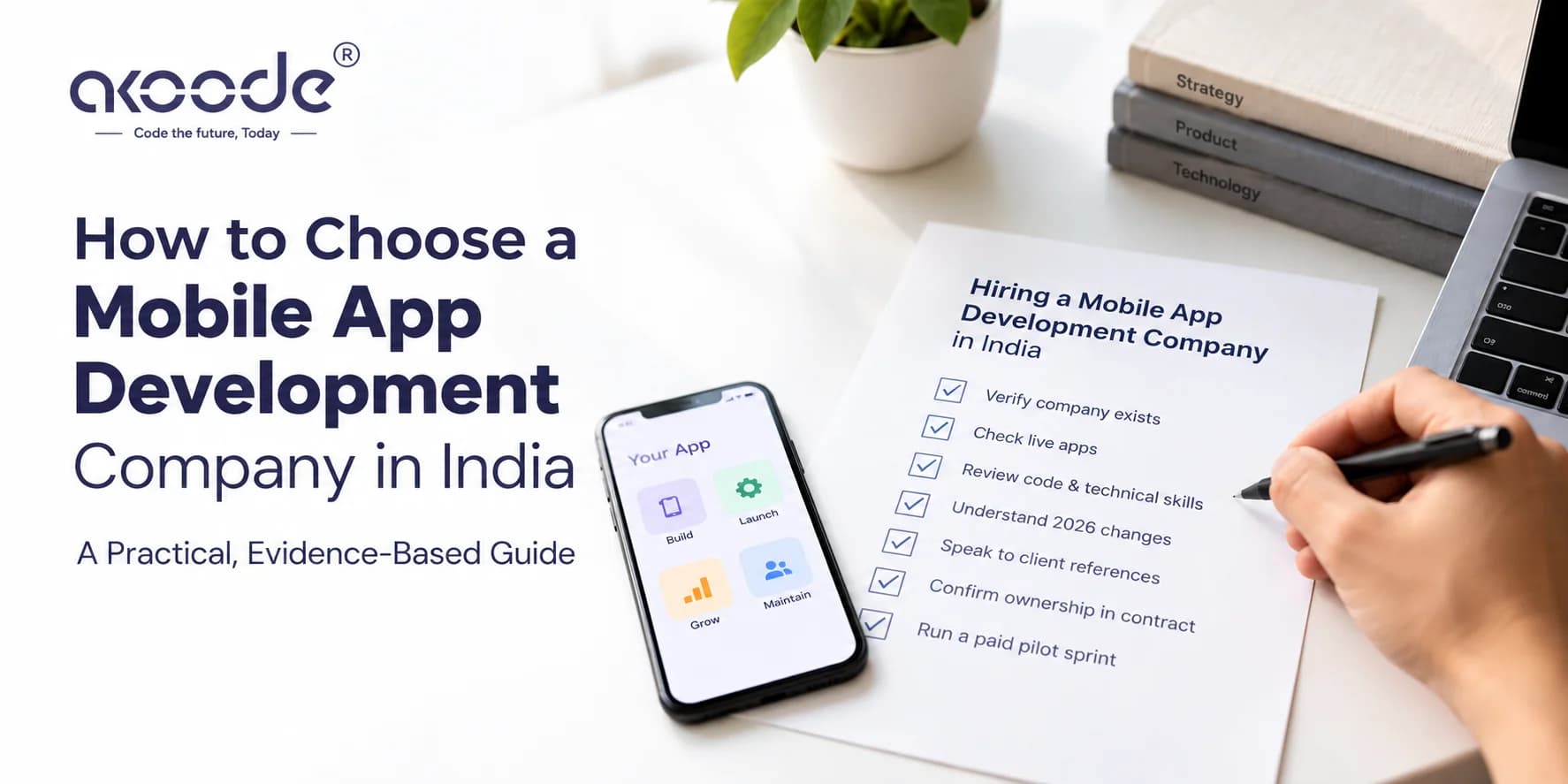
Here is a practical decision framework based on everything covered in this guide:
Step 1 — Define your requirements clearly. Before approaching any company, document your goals, target users, core features, timeline, and budget range. The clearer your brief, the better the proposals you receive.
Step 2 — Shortlist 3–5 companies. Use platforms like Clutch.co, LinkedIn, and direct referrals to identify mobile app development companies with verifiable portfolios, strong reviews, and relevant domain experience.
Step 3 — Conduct structured discovery calls. Use the 15 questions from this guide. Evaluate not just what they say, but how they think and whether they ask smart questions in return.
Step 4 — Evaluate proposals on value, not just price. The cheapest quote is rarely the best investment. Look for transparent scoping, clear milestones, and a team that demonstrates genuine understanding of your business.
Step 5 — Start with a small, paid discovery phase. Before committing to a full build, many top app development companies offer a paid discovery or prototyping engagement. This is the best way to evaluate the working relationship before the real stakes are on the table.
Step 6 — Protect yourself legally. Ensure your contract includes clear IP ownership clauses, NDA, milestone-based payment terms, and defined escalation procedures.
The right app development company will feel less like a contractor and more like an extension of your own team — invested in your success, proactive in their communication, and relentless in their delivery.
Why Choose Akoode Technologies as Your Mobile App Development Partner?
At Akoode Technologies, we have spent years building digital products that move businesses forward — from fast-growing startups to established enterprises across healthcare, real estate, retail, legal, and hospitality sectors.
We are a full-service software development company headquartered in Gurugram, India, with a US presence in Oklahoma, purpose-built to serve global clients with the same standards, communication discipline, and technical rigor you would expect from an in-house team — at the efficiency of an offshore model.
Here is what sets us apart:
Custom mobile app development for iOS, Android, Flutter, and React Native
Dedicated development teams that function as a true extension of your business
Proven expertise in AI/ML integration, cloud architecture, and enterprise software
Transparent pricing and Agile delivery with bi-weekly sprint reviews
US-India time zone overlap for real-time collaboration
End-to-end ownership from discovery and design through development, launch, and long-term support
Whether you are building your first MVP or scaling a complex enterprise app development initiative, we bring the experience, the team, and the commitment to make your vision a reality.
Ready to build something great?
Book a free 30-minute consultation with our senior technical team and let's map out your product roadmap together.
👉 Schedule Your Free Consultation — calendly.com/akhil-akoode/ak
Or explore our full range of services at www.akoode.com to learn how we have helped businesses like yours achieve their technology goals.
Frequently Asked Questions (FAQ)
1. What is the average cost to hire a mobile app development company in India?
The cost to hire a mobile app development company in India varies based on project complexity, platform (iOS, Android, or cross-platform), feature set, and team size. Basic apps typically range from $15,000 to $35,000, mid-complexity apps from $35,000 to $80,000, and enterprise-grade applications from $80,000 upward. Hourly rates for Indian developers range from $25 to $80 per hour depending on seniority and specialization.
2. How do I verify if a mobile app development company in India is legitimate?
Check independent review platforms like Clutch.co, Google Business, and LinkedIn. Request client references you can contact directly. Verify their portfolio by searching apps in the App Store or Google Play. Confirm company registration and look for a physical office address. A legitimate software development company will readily provide all of this information.
3. What is the difference between a dedicated development team and a project-based engagement?
A dedicated development team means a group of developers, designers, and QA engineers work exclusively on your project for an agreed period — typically billed on a monthly retainer. A project-based engagement has a fixed scope, timeline, and budget for a defined deliverable. Dedicated teams are better for long-term products; project-based works well for MVPs and defined features.
4. How long does it take to build a mobile app?
A simple mobile app can take 2–4 months. A mid-complexity app with both iOS and Android builds, custom backend, and third-party integrations typically takes 4–7 months. Enterprise applications with complex architecture can take 9–18 months. Timeline depends heavily on scope clarity, team size, and client responsiveness during review cycles.
5. What are the benefits of offshore app development compared to hiring locally?
Offshore app development in India offers 60–75% cost savings compared to US or UK developers, access to a much larger talent pool, the ability to scale teams quickly, and 24-hour development cycles (if needed) due to time zone differences. The tradeoff requires strong communication protocols, clear documentation, and a structured project management process.
6. Should I build a native app or choose Flutter/React Native?
If performance, device feature access, and premium user experience are critical, native development (Swift for iOS, Kotlin for Android) is the right choice. If you need to go to market quickly on both platforms with a limited budget, Flutter or React Native cross-platform development delivers 80–90% of the native experience at significantly lower cost. A qualified mobile app development company will recommend the right approach for your specific use case.
7. What questions should I ask a mobile app development company before hiring?
Key questions include: Can you share similar project case studies? Who will be our dedicated point of contact? How do you handle scope changes? What is your post-launch support model? Who owns the source code? How do you conduct QA and security testing? See the complete list of 15 questions in the guide above.
8. How do I protect my idea when sharing it with an app development company?
Before sharing any proprietary details, request and sign a Non-Disclosure Agreement (NDA). Reputable mobile app development companies will sign your NDA without hesitation. Additionally, ensure your development contract includes clear IP assignment clauses confirming you own all code, designs, and deliverables upon final payment.
9. Can a software development company in India handle enterprise-level projects?
Absolutely. India's top enterprise app development companies handle some of the world's most complex software projects. Companies like TCS, Infosys, and Wipro built global enterprises serving Fortune 500 clients. Meanwhile, specialized mid-market firms like Akoode Technologies deliver enterprise-grade solutions with the agility and personalized service that large corporations cannot match.
10. What is the best way to find a reliable mobile app development company in India?
Start with independent review platforms like Clutch.co to find companies with verified client reviews. Search LinkedIn for companies with relevant portfolio posts and case studies. Ask for referrals within your professional network. Once you have a shortlist of 3–5 companies, conduct structured discovery calls and evaluate them against the 10-factor framework outlined in this guide. Always request references and ask to see live apps before making a final decision.
This article was written by the team at Akoode Technologies — a leading app development company in India serving global clients across healthcare, real estate, retail, legal, and hospitality sectors. For custom mobile app development services, AI solutions, and enterprise software, visit www.akoode.com.
Get In Touch Now
View More Our Blog