


 June 4, 2026
Banks have always been trust intermediaries.
Every transaction runs through them because two parties need a third one to guarantee the settlement. That model worked for decades. It is also slow, expensive, and dependent on multiple institutions maintaining separate records that must be reconciled manually.
Blockchain changes the premise. A shared, tamper-proof ledger removes the need for institutional trust as the foundation. Two parties can settle directly because both are writing to the same record at the same time.
The numbers behind this shift are significant. The blockchain in banking market is forecast to exceed $16 billion in 2026 and reach $58 billion by 2029, according to research published by CoinLaw. That growth is being driven by active deployment, not pilots. Close to 80 percent of financial institutions are already running blockchain in some form across payments, settlements, or compliance infrastructure.
This guide covers what blockchain technology does in banking, where smart contracts create real value, and what implementation actually requires.
What Is Blockchain in Banking and Why Does It Matter?
Blockchain is a distributed ledger. Transactions are recorded across a network of nodes. Each record links cryptographically to the one before it. Changing a historical record requires altering every subsequent entry on every node simultaneously. In practice, that makes the ledger tamper-proof.
Three properties make this relevant to banking specifically:
Immutability: A posted transaction cannot be altered after the fact. This removes a class of fraud that relies on changing records after the fact and creates an audit trail that regulators can verify independently.
Shared access with controlled visibility: Permissioned blockchains let each participant see exactly the records they are authorised to access. Everyone with authorisation sees the same version simultaneously. No reconciliation step exists because there is no discrepancy to resolve.
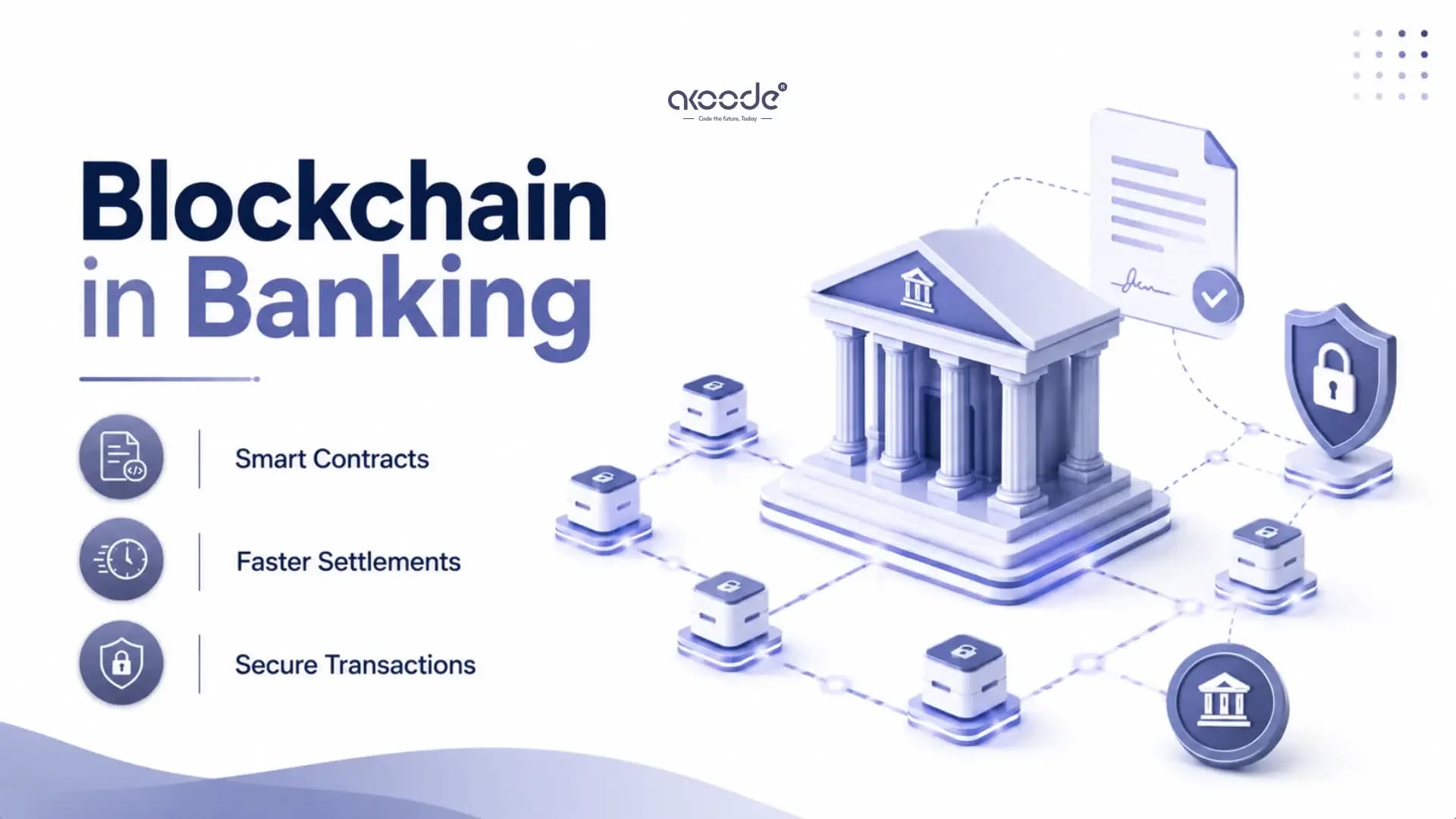
Smart contracts: Self-executing code stored on the blockchain. When pre-defined conditions are met, the contract runs automatically. No manual approval. No business-hours dependency. The terms are enforced by code, not by an institution's internal process.
Settlement delays, reconciliation costs, fraud from forged documents, and the overhead of multi-party financial agreements all trace back to the same problem. Different institutions maintain different records and spend time and money making them match. Blockchain solves this at the infrastructure level.
What Types of Blockchain Do Banks Actually Use?
Public blockchains like Bitcoin and Ethereum are not appropriate for most banking applications. The transaction volumes, privacy requirements, and regulatory obligations of financial institutions require a different architecture.
Permissioned blockchains are the standard. Access is controlled. Participants are identified before they join. Hyperledger Fabric is the dominant platform, handling around 3,500 transactions per second with customisable privacy controls that let banks keep specific transaction details visible only to authorised parties.
Consortium blockchains connect a defined group of institutions. R3 Corda is the most widely adopted in banking, linking hundreds of financial institutions across trade finance, capital markets, and payments. SWIFT has also run consortium blockchain pilots for cross-border settlements.
Hybrid models combine private and public chain elements. A bank might run internal operations on a private chain while anchoring certain compliance records to a public chain for external auditability.
Getting this architecture decision right before development begins is critical. The wrong choice at this stage is the most common reason blockchain projects fail to scale past their initial deployment.
How Is Blockchain Being Used in Cross-Border Payments?
Traditional cross-border payments move through a chain of correspondent banks. Each one adds processing time and fees. A business transfer from India to Germany can take three to five business days. A meaningful percentage of the transaction value disappears into exchange costs and handling fees along the way.
Blockchain-based payment networks settle in minutes. Both the sending and receiving institutions write to the same shared ledger simultaneously. There is no discrepancy to reconcile because there is no separate record to compare.
Ripple's payment network and JPMorgan's Onyx platform are the most widely deployed examples. Onyx has processed over a trillion dollars in daily transactions. Santander uses blockchain infrastructure to offer customers same-day international transfers through its One Pay FX product.
Smart contracts handle the execution layer. When funds reach the intermediary point, the contract verifies the conditions and releases payment to the recipient automatically. Settlement completes without waiting for a human to process the instruction.
How Do Smart Contracts Work in Trade Finance?
A standard letter of credit involves roughly twenty parties and twenty paper documents. Bills of lading, certificates of origin, inspection reports, and payment authorisations all move between buyer, seller, shipping company, buyer's bank, and seller's bank. Each party maintains a separate copy. Reconciliation is manual.
Smart contracts replace this sequence. A letter of credit coded as a smart contract releases payment when the shipping documents are verified on the blockchain. Every authorised party sees the same document status in real time. Fraud from forged documents drops because nothing written to the blockchain can be altered after submission.
The efficiency gains from this are measurable. According to research from CoinLaw citing 2025 institutional data, smart contracts in trade finance reduced processing times by more than 40 percent and delivered faster liquidity access for businesses.
HSBC processed millions of trade finance transactions through distributed ledger technology. The Contour platform, which runs on R3 Corda, handles live trade finance for major banks across Asia and Europe.
What Is the Blockchain Use Case for KYC in Banking?
Know Your Customer verification is one of the most expensive and repetitive processes in financial services. A business applying for multiple products at the same bank goes through KYC multiple times. A business banking with several institutions faces the same process at each one.
Blockchain-based shared KYC platforms change this. A customer verifies their identity once. The verified record lives on the blockchain. Any participating institution can access it with the customer's consent. The customer controls who sees their data. The bank accesses a pre-verified record rather than running the full process again.
This reduces cost on both sides. Banks eliminate duplicate verification work. Customers face less friction when opening new products. The audit trail of when and how verification occurred is carried within the blockchain record, which satisfies regulatory requirements.
How Does Blockchain Change Loan Syndication?
Syndicated loans involve multiple lenders sharing a single large facility. Tracking interest payments, drawdowns, and principal repayments across all lenders is highly manual. Each bank in the syndicate maintains its own record and reconciles against the others. Disputes are common.
Smart contracts automate the full lifecycle. When a borrower makes an interest payment, the contract calculates each lender's share and distributes automatically based on participation percentages. Drawdown requests trigger verification and execution without a manual approval chain.
Every participant sees the same payment record at the same time. Reconciliation costs disappear. The disputes that arise from record discrepancies disappear with them.
What Is Asset Tokenisation and Why Do Banks Care?
Tokenisation converts ownership rights in a physical or financial asset into digital tokens on a blockchain. Real estate, private equity funds, bonds, and commodities become tradable as fractions.
An illiquid asset that previously required a full purchase transaction can now be traded in smaller units. A portfolio accessible only to institutional investors becomes investable in fractional amounts. Settlement moves from days to seconds.
JPMorgan's tokenised collateral network lets institutional clients use tokenised assets as collateral without physically moving the underlying securities. Goldman Sachs has issued tokenised bonds. The European Investment Bank issued digital bonds on Ethereum and has continued expanding blockchain-based debt instruments.
The CoinLaw market research projecting blockchain in banking reaching $58 billion by 2029 identifies tokenisation as one of the primary growth drivers, creating new business models rather than simply making existing ones more efficient.
What Are CBDCs and Why Do They Matter to Banks?
More than 130 countries are actively developing central bank digital currencies. A CBDC is a digital currency issued and backed by a central bank, running on distributed ledger infrastructure.
For commercial banks, wholesale CBDCs could replace correspondent banking networks for interbank settlement. Retail CBDCs, available to the public, compete with commercial bank deposits and change the liability structure of the banking system.
India's Digital Rupee pilot, which has run since 2022 and expanded through 2025 and 2026, is one of the most significant CBDC implementations in any major economy. The Reserve Bank of India's wholesale CBDC pilot simplified interbank settlement for government securities transactions. The retail pilot has processed millions of transactions through SBI, HDFC, ICICI, and Kotak.
Smart contracts in CBDC systems enable programmable money. Conditional payments that release only when specified conditions are met. Subsidies restricted to designated spending categories. Time-bound currency that expires if unused. These capabilities do not exist in physical currency or in traditional digital payment systems.
What Does Blockchain Implementation Actually Require?
Understanding the use cases is straightforward. Building the system is where most projects encounter real complexity.
Define the problem first
Blockchain solves specific problems: multi-party trust, shared record-keeping, automated execution without intermediaries. If the problem does not involve multiple parties with separate, conflicting records, blockchain is probably the wrong tool. An internal bank system does not need a distributed ledger. An interbank settlement network does.
Choose the platform carefully
Hyperledger Fabric suits permissioned networks with complex privacy requirements. R3 Corda is optimised for financial agreements between known parties. Ethereum suits applications that benefit from public network composability. The platform shapes every technical decision that follows.
Treat smart contract security as critical
Smart contract vulnerabilities, logic flaws, access control errors, and oracle manipulation, are the primary security risk. Once deployed on a blockchain, fixing a bug is significantly more complex than patching conventional software. Formal verification before deployment is standard practice in production financial systems.
Design oracle integration carefully
Smart contracts execute on-chain data. Most financial contract conditions depend on off-chain data: interest rates, shipping confirmations, asset prices. An oracle brings external data onto the blockchain. A compromised oracle produces incorrectly executed contracts. Oracle design is as critical as the contract logic itself.
Plan integration costs honestly
Core banking systems, payment switches, and regulatory reporting platforms all need to connect to the blockchain layer. This integration work consistently consumes more time and budget than anticipated.
Engage regulators early
RBI, the FCA, and the OCC are all actively developing blockchain frameworks. Engaging during design rather than seeking approval after building reduces the risk of expensive architecture changes when regulatory requirements crystallise.
For finance and banking teams evaluating where to start, cross-border payments and trade finance offer the clearest ROI case. The cost of the existing manual process is well-documented. The blockchain alternative is proven in production.
For institutions thinking about blockchain as part of a broader digital transformation programme, treating it as an isolated pilot rather than a connected infrastructure component consistently limits how far it scales.
What Are the Real Challenges?
Interoperability: A consortium connecting five banks has limited utility. Scalable blockchain banking infrastructure requires networks that different institutional blockchains can communicate with. Cross-chain protocols are maturing but not yet fully standardised.
Regulatory uncertainty: The legal status of smart contracts, tokenised assets, and CBDCs varies across jurisdictions. A product compliant in one market may face ambiguity in another.
Legacy integration cost: Core banking systems in most institutions are decades old. Connecting them to blockchain networks requires significant engineering investment.
Talent scarcity: Engineers with both deep blockchain expertise and banking domain knowledge are genuinely rare. Projects that underestimate this face long hiring timelines or teams that understand the technology without understanding the financial requirements it operates within.
Conclusion
Blockchain in banking has passed the pilot phase. The use cases are proven in production. Settlement costs are lower. Trade finance processing is faster. KYC duplication is falling. The tokenisation market is creating financial products that were structurally impossible without distributed ledger infrastructure.
Smart contracts are the mechanism through which most of this value is delivered. They automate multi-party financial processes that previously required manual coordination across institutions. The efficiency gains compound over time. The banks building this infrastructure now are widening their operational advantage each year.
Akoode Technologies is a leading AI and software development company headquartered in Gurugram, India, with a US office in Oklahoma. From blockchain development and smart contract implementation to AI-powered financial platforms and full stack development, Akoode builds financial technology for banks, fintech startups, and enterprise institutions across 15+ industries globally. If you are planning a blockchain implementation and want a team that understands both the architecture and the financial domain it operates in, that conversation starts here.
Frequently Asked Questions
1. What is blockchain in banking?
Blockchain is a distributed ledger where transactions are recorded across multiple nodes simultaneously. In banking, it eliminates the reconciliation step between institutions, enables smart contracts that execute financial agreements automatically, and provides an immutable audit trail that regulators can verify independently.
2. What types of blockchain are used in banking?
Permissioned blockchains like Hyperledger Fabric are standard for enterprise banking. Consortium blockchains like R3 Corda connect multiple institutions on a shared network. Public blockchains are used for specific applications like tokenised bonds. Most banking implementations use permissioned or consortium architectures for privacy and compliance.
3. How do smart contracts work in banking?
Smart contracts are self-executing code stored on a blockchain. A letter of credit that releases payment when shipping documents are verified. A syndicated loan that distributes interest payments to lenders based on participation percentages. The execution is automatic and the result is recorded on the shared ledger for all parties simultaneously.
4. What are the main blockchain use cases in banking?
Cross-border payments, trade finance, KYC and digital identity, syndicated loan administration, asset tokenisation, and central bank digital currencies. Each use case eliminates manual process overhead, reduces settlement time, or removes reconciliation cost.
5. What are the biggest implementation challenges?
Interoperability between different blockchain networks, regulatory uncertainty across jurisdictions, legacy system integration cost, scarcity of engineers with banking and blockchain expertise, and scalability under peak transaction volumes.
6. What is the blockchain in banking market size in 2026?
According to CoinLaw research, the blockchain in banking and financial services market is projected to exceed $16 billion in 2026 and reach $58 billion by 2029, growing at a compound annual rate of approximately 52.9 percent from 2024. Banking holds the largest share of enterprise blockchain adoption at 29 to 30 percent of total deployments.