


 July 8, 2026
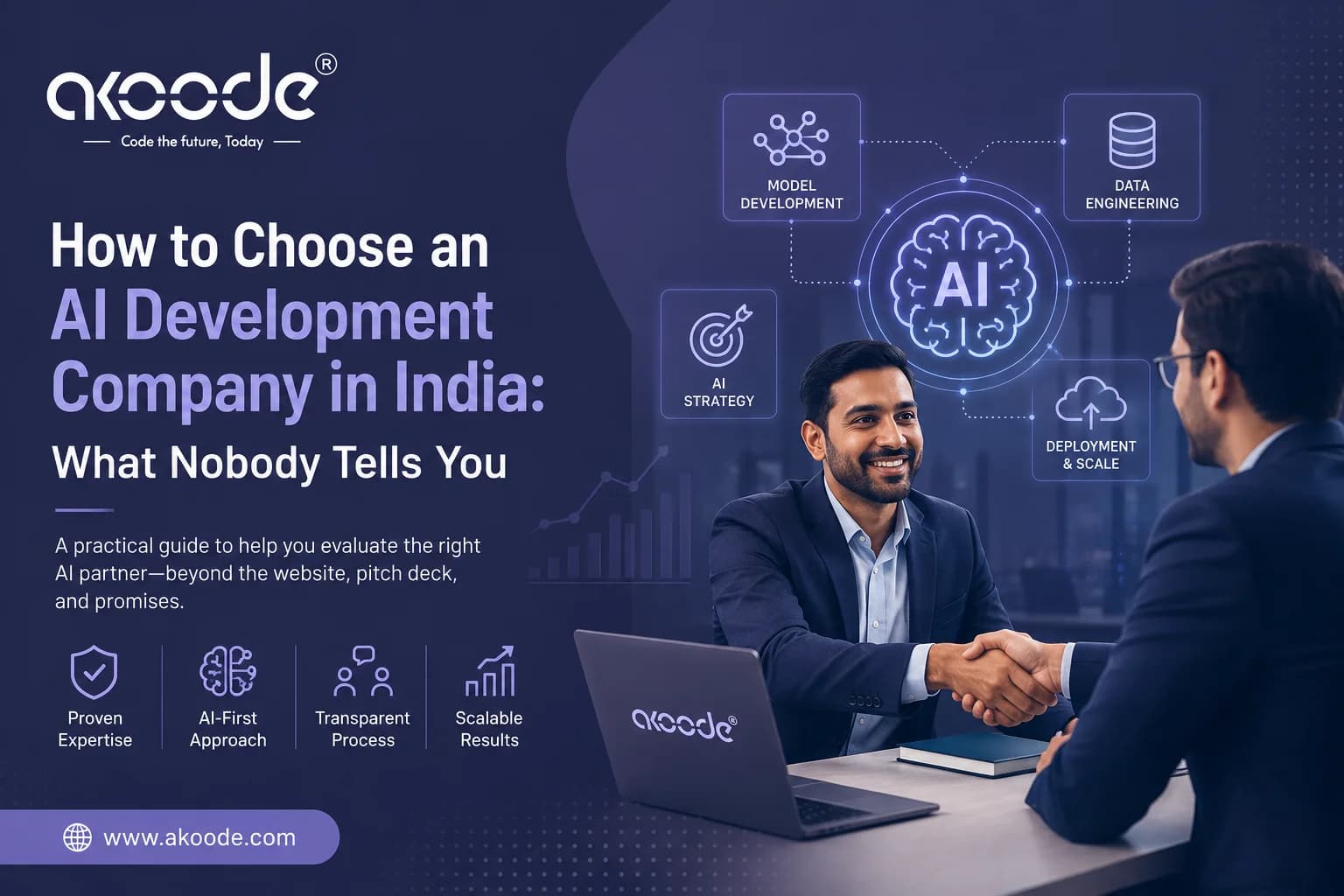
How to Choose an AI Development Company in India: What Nobody Tells You
Most companies that get AI development wrong don't fail because they picked bad technology.
They fail because they picked the wrong partner — usually based on a slick website, a competitive quote, and a demo that looked better than the eventual product.
India has become one of the world's most active markets for AI development services. The talent pool is genuinely deep. The cost advantage over US or UK-based teams is real. And the quality ceiling — when you find the right team — is as high as anywhere in the world.
But the market is also crowded with vendors who are better at selling AI projects than building them. Understanding the difference before you sign anything is the most valuable thing this article can offer you.
Why Businesses Are Turning to India for AI Development
The honest answer isn't just cost, though cost matters.
An AI development team in India — engineers with genuine machine learning expertise, experience deploying LLM-based systems, and a track record in production environments — typically costs 50–70% less than an equivalent team in the US or Western Europe. For a project that might run $300,000 with a US-based firm, you are looking at $80,000–$120,000 with a quality Indian partner.
That gap is significant. It changes what is financially viable for mid-market companies and startups alike.
But beyond cost, India has built genuine depth in AI and software engineering. IITs, IIITs, and NITs produce tens of thousands of engineers annually. A meaningful percentage of that talent stays in India and builds careers in product and service companies there. Cities like Bengaluru, Hyderabad, Pune, and Gurugram have mature tech ecosystems — not just outsourcing hubs, but places where actual AI product thinking happens.
When you work with Akoode Technologies, you are working with a team headquartered in Gurugram with project delivery experience across India, the UK, and the USA. That cross-market exposure matters — it means the team understands both the technical requirements and the business context of what you are trying to build.
That said, the market is not uniform. Quality varies enormously. Knowing how to evaluate an AI development company in India properly is the difference between a transformative project and an expensive lesson.
What "AI Development" Actually Means in 2026
Before evaluating any vendor, get clear on what you actually need. The phrase "AI development" covers a wide range of work, and vendors mean different things when they use it.
Machine learning development involves building models trained on your data — classification systems, recommendation engines, predictive analytics, demand forecasting. This requires data science expertise, feature engineering, model selection, and production deployment experience.
LLM integration and fine-tuning means working with existing large language models (GPT-4o, Claude, Gemini) and adapting them for your specific use case. This could be a customer support agent, a document analysis system, a code assistant, or a content generation workflow. Most AI projects in 2026 fall somewhere in this category.
Generative AI application development is building user-facing products powered by AI — AI writing tools, image generation platforms, conversational interfaces, AI-assisted workflows. This combines LLM work with traditional software engineering.
AI automation means connecting AI models to your existing business processes — using AI to handle tasks that previously required human judgment, like routing support tickets, extracting data from documents, or monitoring operational anomalies.
Computer vision involves training models to interpret visual data — quality control in manufacturing, medical image analysis, retail shelf monitoring, security systems.
Each of these requires different skills. A team that is excellent at computer vision may have limited experience with LLM-based conversational systems. A team that builds generative AI applications may lack the data science depth for custom machine learning model development.
Know which category your project falls into before you start talking to vendors. It will save you weeks of misdirected conversations.
The Indian AI Development Market: What You Are Actually Choosing Between
When you search for an AI development company in India, you encounter a few distinct types of organisations. Understanding the differences helps you shortlist faster.
Large IT services firms (Infosys, Wipro, TCS, HCL) have AI practices, but their model is built around large enterprise contracts and billable hours. They are capable. They are also slow, expensive at scale, and often better at AI consulting than AI product delivery. If you are a Fortune 500 buying AI strategy and implementation across a global organisation, they make sense. For a startup or mid-market company building a specific AI product, they are typically the wrong fit.
Mid-size specialist AI companies are the sweet spot for most projects. These firms have 50–500 engineers, dedicated AI and ML teams, real product delivery experience, and pricing that is competitive without being suspiciously cheap. They have enough structure to manage complex projects and enough agility to adapt when requirements change — which they always do.
Freelancers and small agencies can work well for narrow, well-defined tasks — building a specific API integration, training a model on a labelled dataset, building a proof of concept. They are higher risk for full product development because AI projects require continuity, iteration, and multi-disciplinary collaboration that small teams struggle to sustain.
Offshore arms of Western firms are mid-size agencies or product studios that operate India delivery centres under a Western brand. Quality varies widely. Some are genuinely good. Others are thin layers over freelancer networks with a polished website in front.
Akoode Technologies sits in the mid-size specialist category — focused on AI, software, and digital transformation, with delivery experience across multiple industries and markets. That focus matters. A generalist software company that added an "AI division" in 2023 is a different proposition from a team that has been building intelligent systems as a core practice.
Eight Things to Evaluate Before You Hire Anyone
This is the framework we would use if we were in your position.
1. Ask for Production Examples, Not Demo Videos
Anyone can build a compelling demo. The relevant question is: has this team shipped AI systems that actually run in production, at real usage volumes, over extended periods of time?
Ask specifically: "Can you show me an AI system you built that has been in production for more than 12 months?" Ask about the infrastructure, the failure modes they encountered, how they monitored model performance, and what they had to fix after launch.
The answers will tell you more than any sales presentation.
2. Evaluate Data Handling Expertise
AI projects live or die on data. A development company that cannot discuss data pipelines, data quality assessment, labelling workflows, and training/validation splits with fluency is not ready for serious ML work.
For LLM-based projects, ask about their RAG implementation experience — how they structure knowledge bases, how they handle chunking and embedding, how they evaluate retrieval quality. These are now standard skills for AI development teams in 2026. If the answers are vague, that is a signal.
3. Understand How They Handle Uncertainty
AI projects have inherent uncertainty. Model accuracy cannot always be guaranteed upfront. Data quality issues emerge during development. Scope changes as you learn what is actually possible.
A good AI development partner is honest about this. They set realistic expectations, propose milestone-based projects with defined evaluation criteria, and have frameworks for managing the experimental nature of AI work.
Be cautious of vendors who promise specific accuracy numbers before seeing your data, or who quote fixed-price contracts for ML projects without appropriate discovery phases. They are either naive about AI development or optimistic in ways that will cause problems later.
4. Assess Integration Experience
Building a model is one thing. Connecting it to your actual business systems — your CRM, your order management platform, your ERP, your data warehouse — is where projects often stall.
Ask specifically about the integrations they have built. REST APIs, GraphQL, webhooks, message queues, authentication systems, legacy system connectors. A team that only knows how to train models but struggles with production integration is going to create handoff problems.
Akoode's custom software development practice runs alongside our AI work precisely because these capabilities need to sit together. An AI model that cannot connect reliably to your production systems is not a finished product.
5. Check Their Understanding of Your Industry
Generic AI development skills need to be applied in specific business contexts. A healthcare AI project has compliance requirements (HIPAA, ABDM in India) that a retail project does not. A financial services AI project has explainability requirements that a content platform does not.
If a vendor has no experience in your sector, they will learn on your budget. That is not necessarily a dealbreaker — every firm has worked in a sector for the first time at some point — but it does mean you need deeper discovery and more rigorous review processes.
Ask directly: "Have you built AI systems in our industry? What were the specific challenges you encountered?"
6. Evaluate the Team You Are Actually Getting
Sales conversations are typically conducted by business development professionals. The team that will work on your project is different.
Before signing anything, ask to meet the technical lead and at least one engineer who will work on your project. Ask them about a past technical challenge they faced and how they solved it. Understand their experience with the specific AI stack your project requires.
Staff augmentation and bench allocation are realities in consulting. Some vendors win projects and then staff them with whoever is available. Know who you are buying before you commit.
7. Understand Their Approach to Ongoing Maintenance
AI systems are not static. Models drift as data distributions change. New data requires retraining. Performance needs monitoring. Integration points break when upstream systems change.
Ask: "What does your post-launch support look like for AI systems? How do you handle model monitoring and retraining? What is your SLA for production issues?"
A vendor that treats deployment as the finish line will leave you with a system that degrades quietly over time.
8. Verify Financial and Operational Stability
You are potentially entering a 6–18 month engagement. A development company that has been operating for 18 months with 12 employees is a different risk profile from one with a 5-year track record and 200+ staff.
Check: How long have they been operating? Do they have references from clients they have worked with for multiple years? Can they show you Glassdoor reviews or equivalent signals of employee stability? High staff turnover in a development team is a major risk to project continuity.
What AI Projects in India Actually Cost
Pricing is where a lot of buyers get confused — either by suspiciously low quotes or by enterprise-tier fees that do not reflect the actual work involved.
Here is a realistic picture of what different types of AI projects cost when working with a quality mid-size Indian AI development company in 2026.
Project Type | Typical Scope | Cost Range (USD) | Timeline |
|---|---|---|---|
AI proof of concept / MVP | Single use case, limited data | $8,000 – $25,000 | 4–8 weeks |
LLM-based application | RAG system, knowledge base, chat interface | $20,000 – $60,000 | 8–14 weeks |
Custom ML model development | Data pipeline + model training + API | $30,000 – $80,000 | 10–18 weeks |
AI customer support agent | Omnichannel, CRM-integrated | $15,000 – $60,000 | 6–12 weeks |
Computer vision system | Image/video analysis, production deployment | $40,000 – $120,000 | 12–24 weeks |
Enterprise AI platform | Multi-model, multi-integration, full ops | $100,000 – $400,000+ | 6–18 months |
A few important notes on these numbers.
Discovery phases add cost but save money overall. A proper discovery and scoping phase typically costs $3,000–$8,000 and can prevent scope errors that cost ten times more during development. Vendors who skip discovery to offer lower headline quotes are deferring that cost, not eliminating it.
Data preparation is frequently underestimated. If your data requires significant cleaning, labelling, or structuring, that work adds to project cost and timeline. A thorough discovery phase will surface these issues early.
Ongoing costs are separate from build costs. Hosting, LLM API fees, monitoring tools, and maintenance engagement are recurring costs that start after deployment. Plan for $500–$5,000/month depending on usage volume.
Common Mistakes Companies Make When Hiring AI Development Partners in India
These come up repeatedly, and they are expensive.
Choosing based on the lowest quote. AI development is not a commodity service. A quote that is 40% lower than competitors is either missing scope, planning to cut corners, or will recover the margin through change orders. Price is a signal, not just a number.
Skipping the discovery phase. The number one cause of AI project overruns is insufficient upfront scoping. Requirements that seemed clear at the start reveal hidden complexity as development progresses. A structured discovery phase — where the team analyses your data, maps your workflows, and defines success criteria — is not optional overhead. It is the foundation everything else rests on.
Treating AI like traditional software development. Software requirements can be defined upfront with high confidence. AI project outcomes depend on data quality, model behaviour, and iterative testing that cannot be fully specified before you start. Companies that impose waterfall project management on AI development consistently end up with brittle, over-engineered systems that do not perform as expected.
Not defining success metrics before the project starts. "We want AI to improve our customer support" is not a success metric. "We want to reduce tier-1 ticket volume by 40% with a CSAT score above 4.2/5" is a success metric. Without concrete, measurable targets, you cannot evaluate whether the project has succeeded — and neither can your vendor.
Underestimating change management. AI systems change how people work. An AI agent that handles customer queries changes what your support team does all day. A predictive analytics system changes how your operations team makes decisions. These changes require training, process redesign, and leadership buy-in. Companies that treat AI as a purely technical project consistently struggle with adoption.
AI Development Services You Should Expect From a Serious Partner
A credible AI development company in India should be able to offer the following as standard capabilities, not as add-ons.
AI strategy and discovery — helping you identify where AI creates genuine value in your business before committing to development. This requires understanding your business model, your data, and your operational constraints.
Machine learning development — custom model training, evaluation, and deployment. Not just wrapping an API around an existing model, but building systems that learn from your specific data.
LLM integration and RAG systems — connecting large language models to your knowledge base, CRM, and backend systems to build accurate, grounded AI applications.
Digital transformation consulting — AI rarely succeeds as an isolated technology project. It needs to fit within a broader digital transformation strategy, connected to your data infrastructure, your operational workflows, and your organisational capabilities.
Mobile app development with AI features — building AI-powered mobile applications that bring intelligent features directly to end users on iOS and Android platforms.
Web development with AI integration — embedding AI capabilities into web platforms, from personalisation engines to intelligent search to automated content systems.
MLOps and production deployment — the infrastructure, monitoring, and operational practices that keep AI systems performing reliably after launch.
Post-launch support and model maintenance — ongoing engagement that monitors model performance, retrains on new data, and manages system updates.
If a vendor cannot speak fluently about all of these areas, ask why. Gaps in this list often indicate limitations that will surface during your project.
India's AI Development Landscape: Cities and Capabilities
Not all Indian AI development talent is concentrated in the same places, and geography matters less than it used to — but it still matters for factors like time zone alignment, in-person collaboration options, and regulatory compliance.
Bengaluru remains the largest tech ecosystem in India. It hosts engineering teams from every major global tech company, a dense startup ecosystem, and deep AI and data science talent. Competition for engineers drives salaries up, which affects vendor pricing.
Gurugram and Delhi NCR is the primary enterprise technology hub of North India. Akoode Technologies operates from Gurugram — a location that gives access to a strong talent pool while maintaining close proximity to enterprise clients across North India and easy connections to international markets.
Hyderabad is strong in data science and analytics, with a significant presence of US technology companies that have built India delivery centres there.
Pune has a mature software engineering culture and growing AI capability, particularly in the automotive, manufacturing, and financial services sectors.
Chennai is strong in engineering and has particular depth in embedded systems and IoT work that increasingly intersects with AI.
For most international clients, geography within India matters less than the vendor's ability to work effectively across time zones, communicate clearly in English, and deliver to international quality standards.
A Decision Framework: When to Build Custom vs. Buy a Platform
One of the most important decisions before engaging an AI development company is whether you actually need custom development or whether an existing platform solves your problem well enough.
Use an existing platform when:
Your use case is standard (customer support chatbot, document summarisation, basic recommendation engine)
Time to market is more important than customisation
Your data volume is low and your workflows are simple
Budget is tight and a proof of concept is the primary goal
Build custom when:
Your use case requires deep integration with proprietary systems
You need the AI to take actions, not just generate responses
Compliance requirements (HIPAA, GDPR, RBI regulations) require specific infrastructure architecture
You are building a product where AI is a core differentiator, not a feature
Your data is unique and provides genuine competitive advantage
Long-term economics favour ownership over SaaS licensing fees
Most businesses that start with a platform eventually need custom development as they scale. The question is when to make that transition. The answer is usually earlier than most organisations expect.
Questions to Ask Any AI Development Company in India Before Signing
Use these during your evaluation process. The quality of the answers will tell you a great deal.
Can you walk me through a recent AI project from discovery to post-launch? What went wrong and how did you handle it?
What is your data assessment process before starting an ML project?
How do you handle model performance monitoring after deployment?
What does your team structure look like for a project of this size?
Who specifically will be the technical lead on our project, and can we meet them before we sign?
What compliance frameworks have you worked with? (HIPAA, GDPR, SOC 2, ISO 27001)
How do you price for scope changes during development?
What does your handoff process look like if we want to bring the system in-house eventually?
Do you have experience in our industry specifically? Can you share relevant case examples?
What AI/ML projects have you built that are still running in production today?
Real Signals That a Vendor Is Ready for Serious AI Work
Beyond what vendors say, watch for what they do.
A credible AI development company will ask hard questions about your data before quoting. They will push back if your project scope is unclear. They will propose a discovery phase before a full engagement. They will be honest about what AI can and cannot realistically achieve with your data and timeline.
They will also be able to discuss failure. Every AI development team that has shipped real projects has projects that did not go to plan. Ask about one. A team that claims a perfect record either has not shipped much or is not being straight with you.
Akoode's case studies reflect real projects across healthcare, e-commerce, real estate, and SaaS — with specific metrics and honest descriptions of what was built. That kind of specificity is what separates genuine experience from marketing narrative.
The Maintenance Problem Nobody Mentions Upfront
Here is something worth understanding before you hire anyone.
AI systems require more ongoing attention than traditional software. A well-built web application can run for years with minimal intervention. An AI system — particularly one that involves machine learning models — needs active monitoring, periodic retraining, and adaptation as the business environment changes.
This has budget implications. Plan for 15–20% of your initial build cost annually in ongoing maintenance and optimisation. If a vendor is not discussing this with you upfront, either they have not thought about it or they are choosing not to mention it.
The staff augmentation model works well here for some organisations — retaining access to AI engineering expertise on an ongoing basis rather than relying on a fixed-price maintenance contract. It gives you flexibility as needs evolve.
Frequently Asked Questions
What is the typical cost of hiring an AI development company in India?
For a custom AI project — something beyond basic chatbot integration — expect to invest $20,000–$80,000 for a well-scoped initial build with a mid-size specialist firm. Enterprise-scale systems run significantly higher. Discovery phases typically cost $3,000–$8,000 and are worth every rupee.
How long does an AI development project take in India?
A focused LLM-based application takes 8–14 weeks from discovery to production. A custom machine learning system with data pipeline work takes 12–20 weeks. Enterprise AI platforms with multiple integrations run 6–18 months. These timelines assume adequate data availability and stable requirements — which is rarely fully the case in practice.
Is it safe to share business data with an AI development company in India?
Yes, with appropriate contracts. Any credible vendor will sign an NDA before discovery and a formal data processing agreement for projects involving customer or sensitive business data. Ask specifically about their data security certifications (ISO 27001, SOC 2) and their data handling protocols for AI training data.
What is the difference between an AI company and a software company that offers AI services?
A specialist AI company has AI and machine learning as its core capability — the majority of their engineers work in AI, they have dedicated data science expertise, and their project delivery frameworks are designed around the experimental nature of AI work. A software company that offers AI services has added AI to a broader menu. Neither is inherently better, but the specialist is usually the stronger choice for complex or high-stakes AI projects.
Can an Indian AI development company work in our time zone?
Most mid-size Indian AI firms are experienced at working across time zones. India Standard Time (IST, UTC+5:30) overlaps with European mornings and US East Coast evenings. Teams typically set up a daily overlap window of 3–4 hours for collaboration and handle asynchronous work for the remainder.
What industries do AI development companies in India serve?
The strongest verticals by experience in India are: healthcare, fintech, e-commerce and retail, SaaS product development, manufacturing, logistics, and real estate. Industry depth matters — an AI firm with healthcare deployment experience understands compliance requirements that a generalist firm will discover during your project.
How do I verify the credentials of an AI development company in India?
Check Clutch, GoodFirms, and G2 for verified client reviews. Ask for client references you can speak with directly. Review their published case studies for specificity — vague claims without metrics are a yellow flag. Look at their team on LinkedIn — the seniority and continuity of their technical staff is a reliable signal of organisational quality.
Should I hire a local AI development company or one in India?
The decision comes down to what you are optimising for. Local teams offer easier in-person collaboration and may have stronger regulatory familiarity for highly regulated industries. Indian teams offer cost advantages of 50–70%, deep technical talent, and — for most AI development work — equivalent quality outcomes. Many companies run hybrid models: strategic oversight with a local consultant, execution with an Indian development partner.
What happens if the AI system does not perform as expected after launch?
This is a reality of AI development, not an exception. A responsible vendor will have defined evaluation criteria before the project starts, a testing phase before launch, and a support engagement after launch that addresses performance issues. Contracts should specify what "acceptable performance" means and what the vendor's obligations are if it is not achieved.
What is the difference between AI consulting and AI development?
AI consulting focuses on strategy, feasibility assessment, technology selection, and roadmap planning — without necessarily building anything. AI development is the hands-on engineering work of building, training, and deploying AI systems. The best AI development companies do both — you need strategic thinking to know what to build and engineering depth to build it well.
What to Actually Do With This Information
Here is where most articles end with a motivational summary. This one won't.
If you are evaluating AI development companies in India, the most useful thing you can do right now is define your project clearly enough to have a specific conversation. Not "we want to use AI" — but "we want to build a system that does X with our Y data, and we need it integrated with our Z platform."
That specificity will immediately separate vendors who can actually help you from those who will agree to anything during the sales process and figure it out later.
The Indian AI development market offers genuine quality at competitive prices. The variance is high. Evaluation discipline — the kind outlined in this article — is what determines whether your project ends up in the success stories or the cautionary tales.
If you want to understand what a well-scoped AI project looks like for your specific situation, the team at Akoode Technologies offers an initial consultation to assess feasibility, define scope, and give you an honest picture of what it would take to build what you have in mind.
No obligation. Just a straight conversation.
Get In Touch Now
View More Our Blog