


 August 22, 2026
"AI agent" gets used loosely enough now that the term covers everything from a slightly smarter chatbot to a system that autonomously processes documents, makes decisions, and takes action without a human in the loop. That range is exactly why pricing questions about AI agents are hard to answer with a single number — a scripted assistant that answers FAQ questions and an autonomous system that reads engineering drawings and produces cost estimates are both "AI agents," and they cost very different amounts to build.
This guide breaks down what actually drives AI agent pricing in 2026, gives realistic cost ranges by agent complexity, and walks through a real build — an autonomous document-processing agent — to show where the budget actually goes.
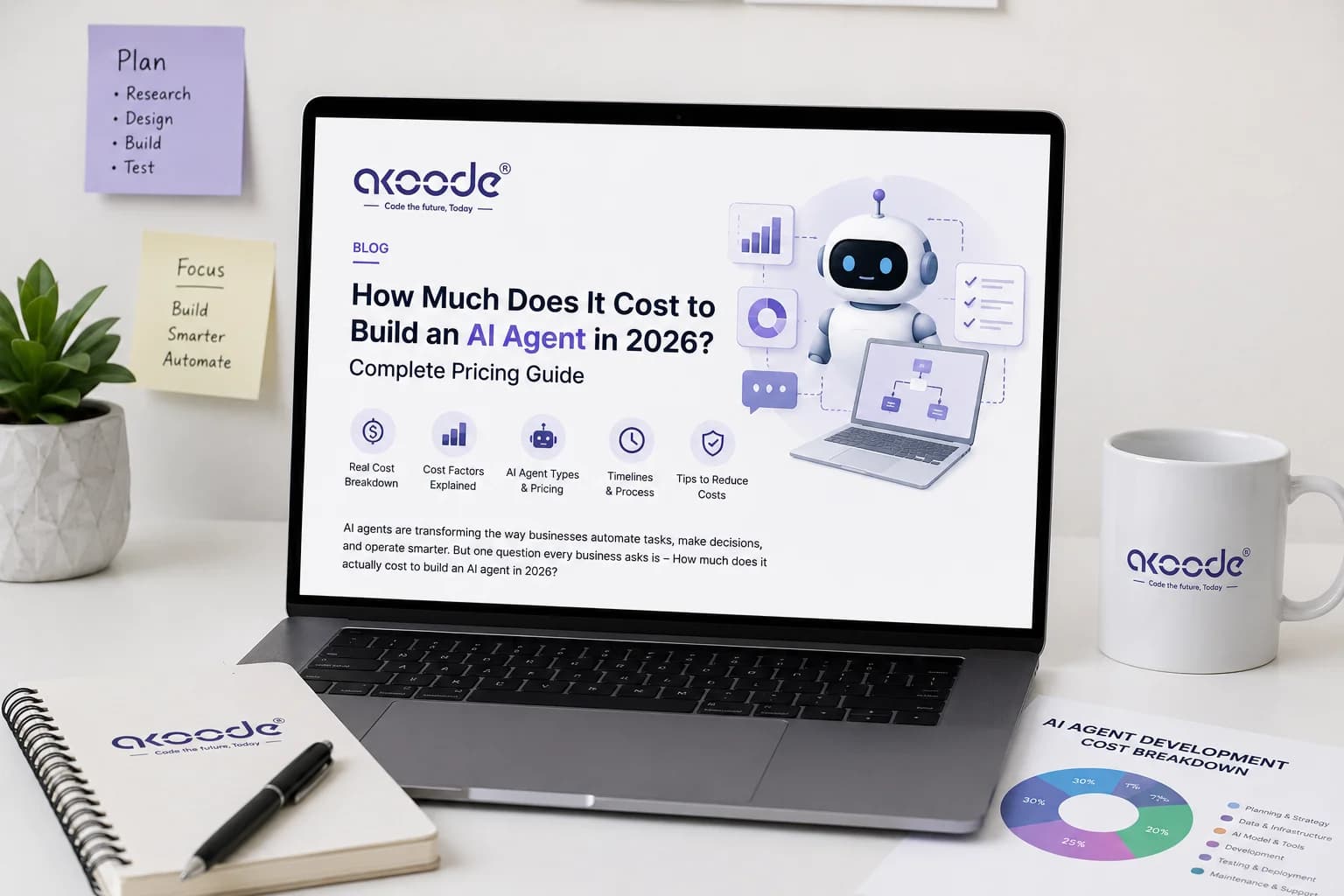
Quick answer: AI agent development typically costs between $15,000 for a simple single-task agent and $150,000+ for a complex multi-step autonomous system with custom integrations. The biggest cost drivers are the number of tools the agent needs to use, how much reasoning and decision-making it has to do without human oversight, and how much custom infrastructure (data pipelines, offline processing, security) sits around it.
What Is an AI Agent, Exactly?
An AI agent is a system that can take a goal, break it into steps, use tools or data sources to complete those steps, and act — largely without a human directing each individual action. That's the line that separates an agent from a standard AI feature: a chatbot answers a question; an agent decides what to do to accomplish an outcome, then does it.
In practice, agents built for businesses in 2026 tend to fall into a few categories:
Task automation agents — completing a defined workflow (processing a form, updating a record, routing a request)
Research and retrieval agents — pulling information from multiple sources and synthesizing an answer
Document-processing agents — extracting, classifying, and structuring information from files, drawings, or scans
Customer-facing agents — handling support or sales conversations with the ability to take actions (refunds, bookings, escalations)
Operational agents — monitoring systems, flagging anomalies, and triggering downstream workflows
Multi-agent systems — several specialized agents coordinating on a larger task
The complexity — and cost — scales with how much autonomy the agent has, how many systems it needs to talk to, and how much damage a wrong decision could cause if nobody catches it.
How AI Agents Get Built
1. Define the Task and the Boundaries of Autonomy
Before any engineering starts, the real question is: what is this agent allowed to decide on its own, and where does it need to hand off to a human? This isn't a technical decision — it's a risk and workflow decision, and it has a direct effect on cost. An agent that only drafts something for a human to approve is far cheaper to build than one trusted to act unsupervised.
2. Choose the Agent Architecture
Most agents in production today are built around an LLM as the reasoning engine, connected to tools it can call — a database query, a document parser, an API, a search function. Some use a single-agent loop (plan, act, observe, repeat); more complex systems use multiple specialized agents that hand off tasks to each other. Frameworks like LangGraph and similar orchestration layers are common here, though the framework matters far less than how well the tool integrations and guardrails are designed.
3. Build the Tool and Data Layer
This is usually the largest chunk of engineering effort, and it's the part that's easy to underestimate. An agent is only as capable as the tools it can call — if it needs to read PDFs, query a database, call a CRM API, or process images, each of those integrations has to be built, tested, and made reliable. A "simple" agent idea often turns out to need five or six solid tool integrations before it's actually useful.
4. Add Guardrails and Human-in-the-Loop Controls
Because agents take multi-step actions, testing a single input/output pair isn't enough — you need guardrails that stop the agent from taking a harmful or incorrect action, confidence thresholds that route uncertain cases to a human, and audit logging so every decision the agent makes can be reviewed after the fact. This layer is often where security and compliance requirements add the most cost, particularly in regulated industries.
5. Test for Reliability, Not Just Accuracy
Agent testing has to account for the fact that a single bad decision early in a multi-step task can compound into a completely wrong outcome by the end. Testing means running the agent against edge cases, adversarial inputs, and ambiguous instructions — not just checking whether it gets the "happy path" right.
6. Deploy, Monitor, and Tune
Once live, agents need ongoing monitoring of decision quality, not just uptime. Teams that skip this step tend to find out about agent failure modes from a frustrated customer or an internal team member, rather than from their own logs.
What Drives AI Agent Development Cost
Number of tools/integrations the agent needs to use — each one is its own build, test, and maintenance surface
Degree of autonomy — an agent that drafts for human approval costs less than one that acts independently
Reasoning complexity — a single-step task vs. a multi-step plan with conditional logic
Data requirements — clean, structured data is cheap to work with; messy source documents (scanned PDFs, inconsistent formats) add real engineering time
Offline vs. cloud processing — agents that must run without sending data to the cloud (common in construction, healthcare, and legal work) require more infrastructure engineering
Guardrails and human-in-the-loop review — confidence scoring, approval workflows, and audit logging all add scope
Multi-agent coordination — systems with several specialized agents cost more than a single agent handling everything
Security and compliance — regulated industries or sensitive data (financial, medical, proprietary drawings) increase scope significantly
Platform — a desktop app, web app, and mobile app each carry their own development cost on top of the agent itself
Ongoing model/inference costs — agents that make many LLM calls per task (multi-step reasoning loops) cost more to run than a single-prompt feature
AI Agent Development Cost by Type (2026)
Agent Type | Estimated Cost | Typical Timeline |
|---|---|---|
Simple single-task agent (one tool, human-approved output) | $15,000–$35,000 | 4–6 weeks |
Multi-tool workflow agent (several integrations, moderate autonomy) | $35,000–$75,000 | 8–14 weeks |
Document-processing / domain-specific agent (custom detection, offline or high-security) | $75,000–$130,000 | 3–5 months |
Multi-agent enterprise system | $130,000+ | 5+ months |
These are indicative ranges based on the factors above — actual cost depends on your specific tools, data, and autonomy requirements.
As with any AI build, development cost and ongoing cost are separate. Agents that reason through multiple steps typically make several LLM calls per task rather than one, so inference costs scale faster with usage than a simple chatbot does. It's worth modeling expected task volume before launch, especially for agents running continuously rather than on-demand.
How Long Does It Take to Build an AI Agent?
Scoping and autonomy definition: 1–2 weeks
Architecture and tool-layer planning: 1–2 weeks
Core agent + first tool integrations: 4–8 weeks
Additional tool integrations, guardrails, testing: 3–6 weeks
Deployment and monitoring setup: 1–2 weeks
A narrow single-task agent can realistically ship in 4–6 weeks. A domain-specific agent that has to process unusual data formats (technical drawings, scanned documents, specialized file types) and run in a high-security or offline environment takes considerably longer — most of that added time goes into the tool and data layer, not the "AI" part itself.
Case Study: An AI Agent That Processes Engineering Drawings, Offline
One of the clearer examples of where AI agent budget actually goes is a project we built for Qualis Construction Ltd., a Canadian estimator. Their quantity takeoff process — manually counting and measuring materials from architectural and engineering drawings — had become a bottleneck. Every large drawing set meant hours of manual counting, and manual counting under deadline pressure meant costly errors slipping into bids.
The brief had three requirements that shaped almost every cost decision: it had to run as a desktop application across Windows, macOS, and Linux; it had to process large, high-resolution drawing files without losing detail; and — critically — it had to run entirely offline, with zero cloud dependency, because the drawings contained sensitive, proprietary project data the client couldn't send to a third-party API.
That offline requirement is a good illustration of why "just call an LLM API" pricing doesn't apply to every agent. We built a local AI engine that detects materials and fixtures directly from the drawings, runs interactive review controls so an estimator can adjust detections before anything is finalized, and generates exportable cost-estimate reports — all without the data ever leaving the client's machine. Detection accuracy on large-format drawings and running a capable model efficiently on standard hardware, without cloud compute to fall back on, were the two hardest engineering problems in the build.
The result is an agent in the fuller sense of the term: it doesn't just answer a question, it works through the drawings, makes detection decisions, and produces a structured output — with a human reviewing and adjusting before the numbers go into a bid. That review step was a deliberate scope decision, not a limitation: for a task where a missed count affects real project margins, human-in-the-loop review was worth the added design work.
Common Mistakes When Budgeting for an AI Agent
Pricing the agent like a chatbot — a chatbot answers; an agent acts, and each action it can take is its own scope item
Underestimating the tool layer — the LLM reasoning is often the smallest part of the build; the integrations around it usually aren't
Skipping guardrails to save budget early — this almost always costs more later, once the agent is trusted with real decisions and something goes wrong
Not deciding on autonomy boundaries upfront — "figure it out as we go" on what the agent can decide independently leads to expensive rework
Assuming cloud-first pricing applies everywhere — offline, high-security, or regulated builds have a different cost profile than a standard SaaS agent
Ignoring per-task inference cost — multi-step agents call the model more than once per task; usage costs can scale faster than expected
How to Choose an AI Agent Development Partner
Evidence of production agents, not just prototypes — a working demo and a reliable production system are very different things
Comfort with the tool-integration work, not just prompt design — this is where most agent projects succeed or fail
Experience with your specific constraints — offline processing, regulated data, or industry-specific file formats all require real prior experience, not general AI familiarity
A clear point of view on autonomy and guardrails — a partner who pushes back on giving an agent too much unsupervised authority too early is usually the safer choice
Post-launch monitoring support — agent behavior needs tuning after real usage starts, not just at handoff
Akoode Technologies builds AI agents for both cloud and offline/high-security environments, including document-processing and computer vision agents for teams working with sensitive or proprietary data.
Frequently Asked Questions
How much does it cost to build an AI agent?
Costs typically range from $15,000 for a simple single-task agent to $130,000+ for a domain-specific agent with custom data processing, and $150,000+ for multi-agent enterprise systems.
What's the difference in cost between an AI chatbot and an AI agent?
A chatbot generally costs less because it responds to input; an agent costs more because it plans, uses tools, and takes multi-step actions — each tool integration and autonomy decision adds engineering scope.
Does an offline AI agent cost more than a cloud-based one?
Usually yes. Running without cloud infrastructure means the local AI engine has to be optimized to run efficiently on standard hardware, which adds engineering time compared to calling a hosted API.
How much does it cost to run an AI agent after launch?
Ongoing cost depends on task volume and how many model calls each task requires — multi-step agents typically make several calls per task, so usage costs can scale faster than a single-prompt AI feature.
Can an AI agent be built without giving up cloud costs?
Yes — most agents use cloud-hosted LLM APIs, which is usually cheaper to build initially. Offline processing is worth the added cost specifically when data privacy or connectivity requirements demand it.
How long does it take to build an AI agent?
A simple single-task agent can take 4–6 weeks. Domain-specific agents with custom data processing or offline requirements typically take 3–5 months.
Do I need a multi-agent system, or is a single agent enough?
A single agent is usually sufficient unless the task genuinely splits into distinct specialized roles (e.g., one agent researching, another verifying, another drafting). Multi-agent systems add coordination complexity and cost — worth it only when a single agent's scope becomes unwieldy.
What's the biggest hidden cost in AI agent projects?
The tool and integration layer. Teams often budget for "the AI part" and underestimate how much work goes into connecting the agent reliably to the systems and data it needs to act on.
Final Thoughts
AI agent pricing in 2026 isn't really about the model — it's about how much the agent has to do on its own, how many systems it has to connect to, and how much can go wrong if it gets something wrong unsupervised. A narrow, well-scoped agent with clear guardrails is often both cheaper and more reliable than an ambitious one trying to handle an entire workflow end to end.
If you're scoping an AI agent — whatever the constraints, cloud or offline, simple or complex — it's worth talking through the specific task and data before pricing anything. Book a time to talk it through.
Get In Touch Now
View More Our Blog